
Post-Epic Theatre and Ostermeier’s An Enemy of the People
Antonia Tsamouris*
An Enemy of the People, by Henrik Ibsen. Adapted by Florian Borchmeyer and Thomas Ostermeier. Dramaturg: Florian Borchmeyer. Translated to Greek: Antonis Galeos. Direction by Thomas Ostermeier. A Schaubühne Berlin production in collaboration with the Theatre of Neos Kosmos. Costumes: Nina Wetzel. Stage Design: Jan Pappelbaum. Sound Design: Malte Beckenbach, Daniel Freitag. Lighting Design: Erich Schneider. Participating: Konstantinos Bibis, Michalis Oikonomou, Lena Papaligoura, Ieronymos Kaletsanos, Stelios Dimopoulos, Alcestis Ziraux, Jason Aly. Staged at Theatre Knossos, Athens, Greece, 28 November 2025 to 5 April 2026.
Henrik Ibsen’s An Enemy of the People was written in 1882. Although it is not one of Ibsen’s most often staged plays, nonetheless, it has been adapted twice. The first time, it was adapted by Arthur Miller in the fifties, and the second by Florian Borchmeyer and Thomas Ostermeier in 2012. Both adaptations emerged in disquieting times. Nonetheless, the two adaptations, emerging in different time periods, denote the play’s timely value. An Enemy of the People has been among Ibsen’s so-called social plays, but the writer argued that all his plays discuss people and their relationships.
In Ibsen’s play, Dr Thomas Stockmann works as the Doctor in a small city, where the Mayor is his brother, Peter Stockmann, who also helped him in acquiring the place at the town’s Municipal Baths. Dr Stockmann lives there with his wife and his three children. When his suspicions that the water at the Municipal Baths is contaminated prove to be real, he is ready to take action to protect both the citizens and those visiting the town. However, to his great surprise, his brother is opposed to this decision, because he believes that it would be disastrous both for the town and its people, since these are the town’s only financial resources. Gradually, Dr Stockmann realizes that, although in the beginning many people supported him, at the end he is left alone, as no one wishes to lose money, even if that results in the death of hundreds of people.
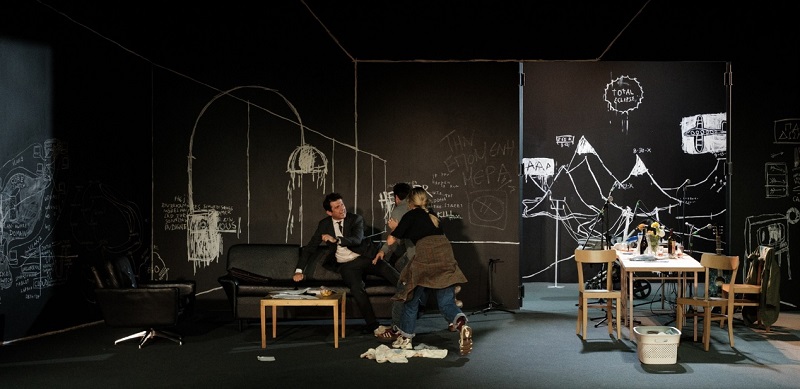
Borchmeyer and Ostermeier brought quite a few changes to the original text. Among others, they omitted some characters, merged others (for example, the character of Mrs Stockmann has been merged with the family’s oldest daughter, in order to modernize the character of Katharina) and placed a live band on stage. Also, they included an interactive part. In particular, towards the end of the fourth act, and after Thomas has gone to the Town Hall and addressed the citizens of the town, the speech is given to the audience to express their thoughts on the play and on society overall. The additions brought to the play (for example, the live band and the interaction with the audience causing a disruption in the play’s flow) underline Ostermeier’s influence from Brecht’s epic theatre of alienation, depicting the director’s perspective. In particular, it highlights his political and social point of view, rejecting realism’s illusion.
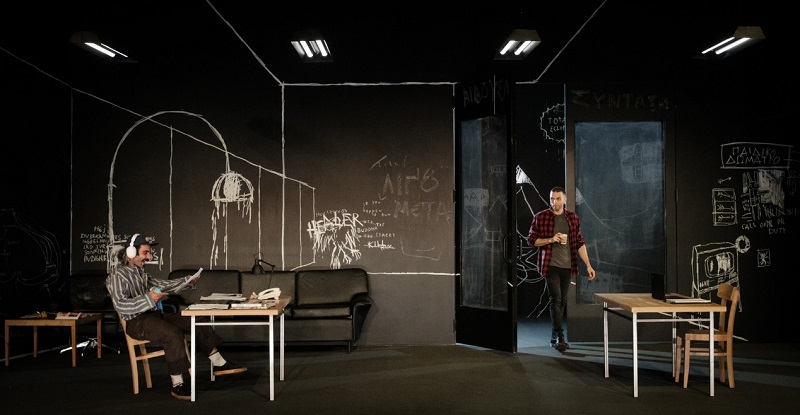
The German director had originally produced his performance in Athens, at the Hellenic Festival, in 2013, when Greece was still in a very turbulent political and social situation, with huge protests taking place, almost on a daily basis, in the Greek capital. Despite Ostermeier’s conviction that the performance would create huge protests and even demonstrations, there was neither turmoil nor rage expressed during the interactive part with the audience. According to the director, there was “absolutely nothing. They [Greeks] were in no way whatsoever keen to engage in the discussion scene. We really screwed up badly” (Boenisch 106). One of the basic problems in that first production had been the on-stage translation, from German to Greek and vice-versa, disrupting the pace of the performance and impeding the audience’s participation.
In 2025-2026, Ostermeier staged the performance in Athens again. This time, however, he collaborated with a Greek company and used a Greek translation. Furthermore, he made additions and changes to the text, so that he could bring it closer to Greek society and the problems it has been enduring for the past ten-fifteen years. The Greek translation helped the audience to better relate to what was happening on stage. As a result, the spectators participated seriously in the interactive part of the performance. There were people siding either with Thomas or, rarely, with the Mayor, where others were even sharing their thoughts and beliefs on society and today’s politics, in relation to Greece but to the rest of the world as well.
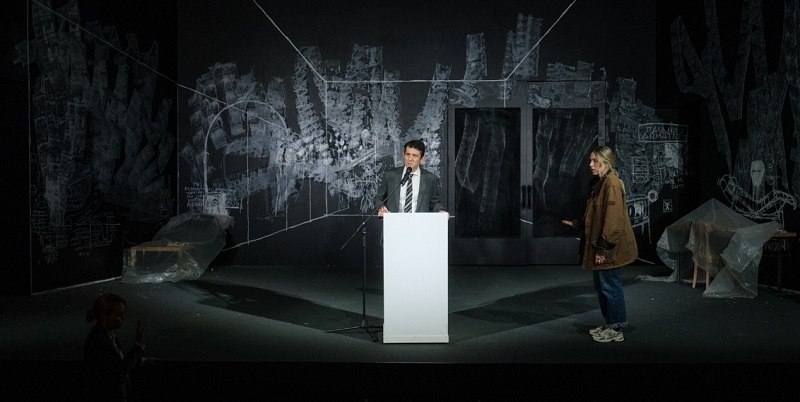
The performance thus related to the audience, since it addressed them, while also getting into dialogue with them. This amounted to building a communal perception, on and off stage, underlining that having a dialogue in contemporary society, whatever people’s subjective viewpoint, is immensely important and necessary.
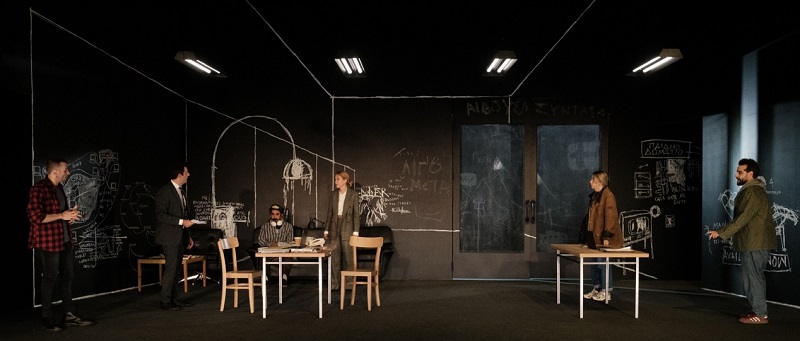
Lena Papaligoura, as Nina Aslaksen, the Editor in Chief of the town’s Newspaper, greatly enabled and contributed to the interaction between the actors and the spectators, while maintaining the theatrical illusion. Michalis Oikonomou as Peter and Konstantinos Bibis as Thomas were also straightforward, especially in their address to the spectators, while remaining within the theatrical framework.
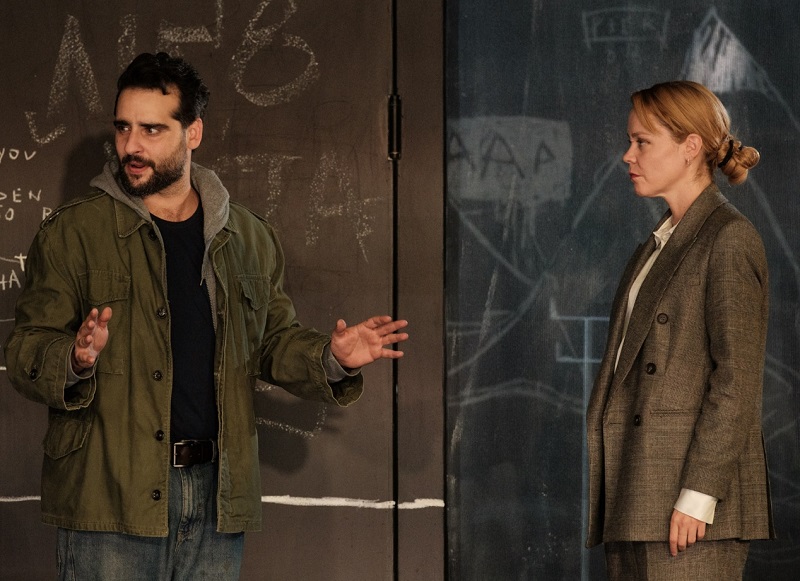
The stage design seemed realistic, though minimal, at the beginning, but during the performance it became evident that it had a multiple role, as well as various connotations. It originally depicted the Stockmann household but was later transformed into the town’s Newspaper Offices, and after that, into the Town Hall. Painted in black, the actors and actresses were able to draw and write on it, demolishing the theatrical illusion and signifying the deconstruction of the well-made play and its scenery. Lighting greatly contributed to this by hiding or bringing to light, well-hidden secrets and people’s inner thoughts. The lighting also underlined, during Peter’s and then, Thomas’ speech, the disruption of the theatrical illusion, turning them on both on and off stage and thus following the Aristotelian definition that theatre is mirroring reality. The role of the costumes was also significant. First, it placed the play today, proving that Ibsen’s plot still remains contemporary. Also, the costumes were indicative of the characters’ social status, denoting how clothing in the present day plays a decisive part in people’s life. For example, Billing the free-lance journalist was dressed in a casual way, but when he started working with the Mayor he was dressed in a suit and carrying a briefcase. Thus, the directionargued that clothing in contemporary societies is indicative of social ranking.
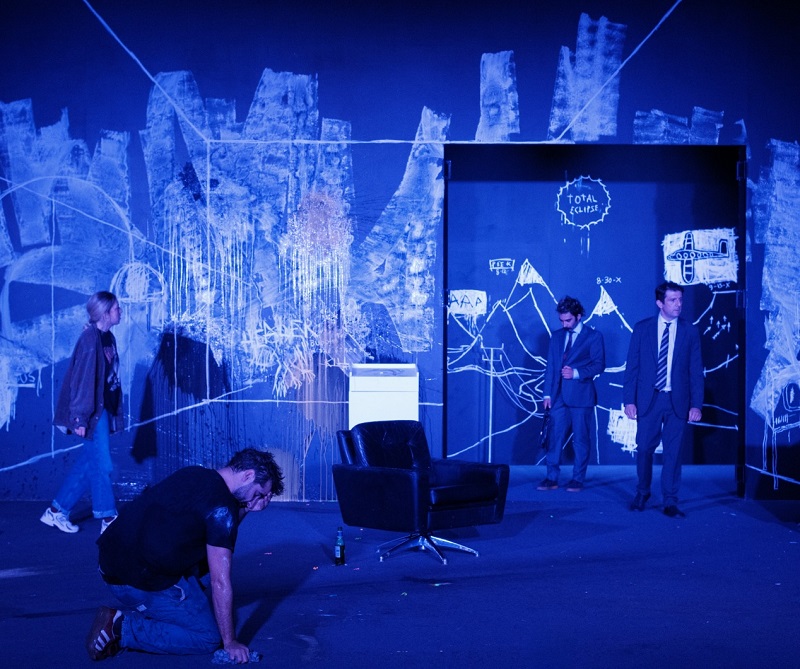
According to Ostermeier, An Enemy of the People deals with “how people live in a society that privileges economic relations above personal ones” (Boenisch x). In his Athens production, this was obvious from the performance’s overall phenomenology, signifying the problems that contemporary societies are facing. Employing elements based on the Brechtian epic theatre, Ostermeier discussed contemporary politics by adapting a classical theatre of the nineteenth century, proving that humanity does not change; it simply modifies its communicative tools.

Note: Critical Stages reviewed the German version, here.
Bibliography
Boenisch, Peter M., and Thomas Ostermeier. The Theatre of Thomas Ostermeier. Routledge, 2016.

*Antonia Tsamouris holds a PhD and a Post-doctoral thesis from the School of English (Aristotle University). Secretary of Eastern Europe of the Board of Directors’ for the Edward Albee Society, she is also member of the Greek section of IATC, the Harold Pinter Society and the Eugene O’Neill Society. She has contributed with articles and reviews in magazines, books and selected volumes, both in Greece and abroad. Her book on Harold Pinter’s phenomenological analysis of his theatre plays and screenplays was published in Greek in 2024.
Copyright © 2026 Antonia Tsamouris
Critical Stages/Scènes critiques, #33, June 2026
e-ISSN: 2409-7411

This work is licensed under the
Creative Commons Attribution International License CC BY-NC-ND 4.0.
