Your Shakespeare Is No Longer Your Shakespeare
Marta Brkljačić*
International Shakespeare Festival in Craiova, Romania. HAMLET|TOILET, written and directed by Yu Murai. May 22, 2026. Cast:Takuro Takasaki | G.K.Masayuki | Atsuyuki Tanaka. Author of the play: Yu Murai. Translation: Japan Society. Set design: Natsuko Takebe. Costume design: Akane Sato. Lighting design: Ryuichi Okino. Video design: Takashi Kawasaki. Sound / Music design: Tsutchie. Choreography: Shinnosuke Motoyama. Production Manager: Marie Fujiwara.
Titus Andronicus: Reborn, directed by Ryunosuke Kimura. May 21, 2026. Cast: Titus Andronicus – Tsunao Yamai (Noh performer). Lavinia – Fūka Haruna. Tamora – Miki Takii. Saturninus – Go Kijima. Bassianus – Mark Yudai Iwasaki. Lucius – Rion Yanagimoto. Martius – Ryo Morimoto. Quintus – Natsuyama Tatsumoto. Mutius – Makoto Hikage. Marcus – Seiji Miyagawa. Aaron / God of Revenge – Hirokazu Tategata. Translation: Kazuko Matsuoka. Adaptation and Direction: Ryunosuke Kimura. Set design: Izumi Matsuoka. Costume design: Maya. Lighting design: Naoyoshi Negoro. Noh Mask Design: Hisato Iwasaki. Music and sound design: Koji Ozono. Music / Composition: Takashi Yoshida. Choreography: Ami Rokuhara. Stage Manager: Koki Ura. Assistant Director: Kosuke Hioki.
Two Japanese productions approached Shakespeare through ritualistic repetition, translating famous words into new concepts at the International Shakespeare Festival in Craiova.
Words, Words, Words
Shit or chocolate? In HAMLET|TOILET, The Question boils down to the point of (in)digestion. Among Japanese takes on the Bard’s legacy, Yu Murai’s HAMLET|TOILET, created by KPR/Kaimaku Pennant Race, cultivates an interesting blend of intellectual legacies. It lands Hamlet in a toilet setting, as unexpected as it is brilliant, because defecation is one of the most elementary, existentially important functions of the human body.
The show is described as a contemporary reinterpretation that explores human existence through the uniquely Japanese notion of ‘aesthetics of excretion.’ Yet the logocentric constipation of the Western literary tradition is perhaps the most obvious undercurrent of HAMLET|TOILET. Here, in so many words, relief opposes no relief, and this particular bowel movement becomes an existential crisis, as the substantial load of Shakespeare’s Hamlet provokes constipation.
Relieving oneself of a burden—or rather, the inability to do so—is a big deal for Hamlet. His father’s “shit” is in many ways generational. This is what is presented as the “thesis of the faeces,“ accompanied by an exhausting bellyache of a constipated child, the burdened descendant. At the same time, Yu Murai’s distinctly Japanese deconstruction of one of the ultimate authorities of the Western literary canon has an unmistakable way of saying: your Hamlet is no longer your Hamlet.
Yu Murai’s is a deceptively simple and comical premise, which makes bold critical and philosophical assumptions about reception, tradition and authority. So much so that the only real downside may be coming across as too intellectual. Like a person enclosed in their own cubicle, in my heart of hearts, I felt almost completely detached from the performance. It wasn’t controversial enough to shake me, not ridiculous enough to keep me entertained, and definitely not sentimental enough to be moving. Instead, I was becoming progressively irritated by the entire thing. What a relief when it ended.
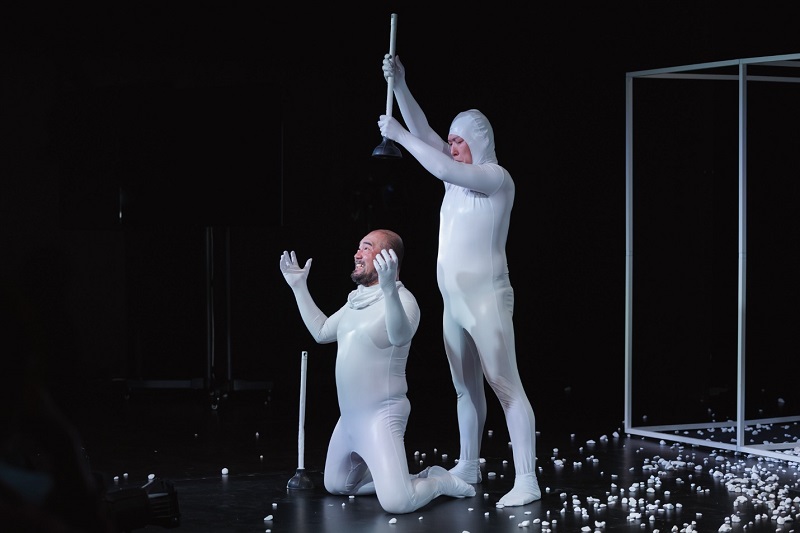
Ironically, ever since, this performance has been haunting me like no other. Call it catharsis by annoyance. Despite some questionable staging choices, like ice hailing down on the actor’s head while his mouth ejects a verbal hail of its own, HAMLET|TOILET does the job of displacing Shakespeare to the point of word-induced frustration very well. In the set designed by Natsuko Takebe, lighting by Ryuichi Okino and video by Takashi Kawasaki, minimalist solutions marry lighting and image projections to a simple construction reminiscent of bathroom stalls.
This creates a symbolic existential limbo, which is also, incidentally, a toilet. The overall campy quality coexists with simple solutions built from elements with little embellishment. It is as aggravating as it is brilliant to watch. The three male actors—Takuro Takasaki, G.K. Masayuki and Atsuyuki Tanaka—deliver multiple Hamlet roles in a deliberately cartoonish way. Costume designer Akane Sato devised bodysuits to visually emphasise their bodies, while framing the actors’ faces like expressive plates wrapped in white spandex. This is as ridiculous as it is profound, because humanity’s troubles exist on the face as much as they exist in our guts. The clever defamiliarisation also allows the actors to exist as somewhat ready-made objects: elements trapped in an eternal loop within this symbolic space.
Looping is both a hallmark and a prominent dramaturgical device in Yu Murai’s production. It is an obvious sign of a troubled, indecisive, potentially deranged mind. In addition, the repetitive overlapping of words, actions and sequences points to an obsessive devotion to tradition. It manifests through an overwhelming word-hail: a particularly long monologue mesh of the predominantly Western literary and philosophical canon, deliberating on Christian morality, compressing Thomas à Kempis and Seneca with Herodotus, Dante Alighieri and Zeami Motokiyo, while the great dream of Christian freedom blends Martin Luther with Martin Luther King. Their projected names appear and disappear on the imaginary wall. It is a dense, heavy pile, especially, perhaps, from a Japanese cultural perspective.
Undoubtedly, the toilet is a secluded birthplace of philosophical ruminations. Facing yourself and your (failed) efforts is a prominent issue in Shakespeare’s Hamlet.
In a way, HAMLET|TOILET challenges us to face our own generational constipations. Much like poor Hamlet, we are in a constant cultural dialogue with the past. Be it shit or chocolate, famous words pile up and haunt us. And what do we owe to the words that shaped what is, clearly, no longer our own? That is the question.

Things We Would Rather Not See
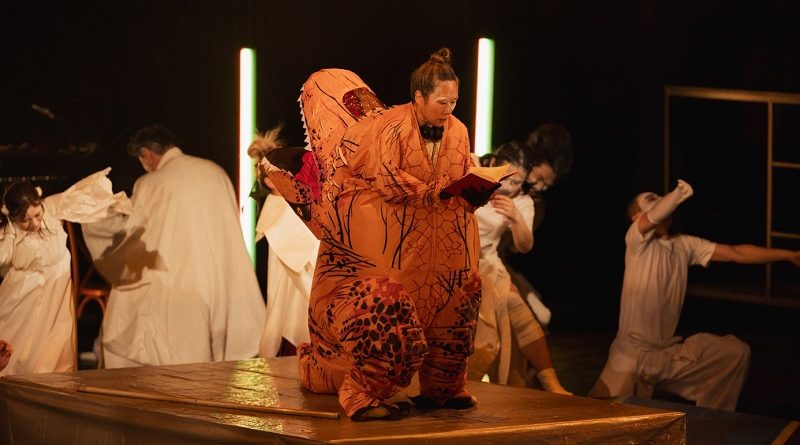
A student, a raven in drag and a T. rex enter a stage. Sounds like a joke, but in theatre, imagination is reality. Ryunosuke Kimura’s Titus Andronicus: Reborn, created with Theatre Company KAKUSHINHAN, introduces things out of context only to clarify Shakespeare’s bloodiest play. The result is stylised, musical, ironic, sometimes melodramatic, dazzling, and a little too eager to explain itself.
The scenes change under the same unsettling chorus: lose what you love, then retaliate with hate. In Titus, everyone has a chance to show mercy, and everyone refuses. Kimura treats this pattern as an echo of civilisation, amplified by the mythical weight of both Shakespeare and Rome—the modern Westʼs foundations.
The strongest point is turning storytelling into spectacle and building ironic distance through three narrative layers. Kimura framed Shakespeare’s story with Ovid as the occasional „MC“ addressing the audience, and then further, with the student discussing Titus with the Raven-bard. The Raven, who doubles as Aaron, played with magnetic force by Hirokazu Tategata, is alluring and deadly in black lace and velvet: a harbinger, vengeful god, bard, burlesque performer and guide. He represents the appeal of evil, the glamour of destruction, and the power-trip of being an apex predator.

Visually, Izumi Matsuoka’s set suggests a platform, ring, arena and gym: a place where bodies meet, and contact turns into conflict. Maya’s “civilised” costumes combine martial arts, traditional Japanese attire, pop culture and the Roman toga, making civilisation a matter of dress and viewpoint. The Goths appear beastly, but the Romans are hardly more civilised. The perpetually gloved right arm points out this relativity. It is a civilised weapon trapped in metamorphosis, always ready to strike.
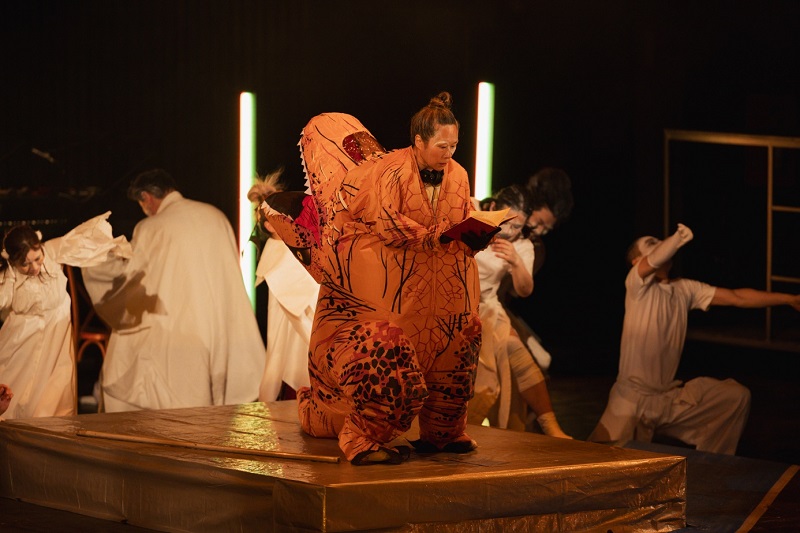
The showʼs self-indulgence comes from images that seem to belong to different genres: manhwa-style asides, cartoonish villainy, kawaii-coded Lavinia, drag culture, a sexually and ritualistically loaded golf metaphor, interpretive dance, rape and mutilation. An outrage, yet the production turns it into a strange, bearable chain of associations. The T. rex cameo, the most campy dad-joke of all, captures the logic: by rejecting the title of Rex, Titus loses his apex privileges. Though consistent with Shakespeare, the show is constantly on the verge of collapsing into its own wit.
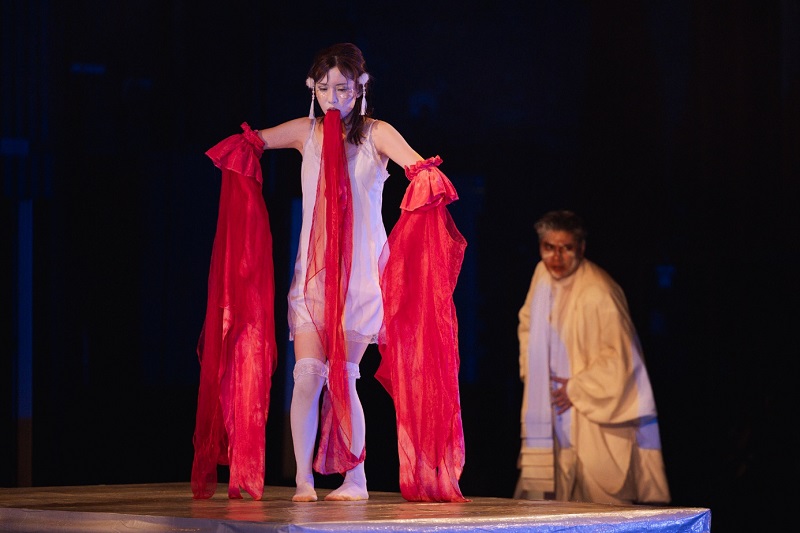
The violence we would rather not see is not realistic, but stylised—lyrical movement, red fabric and a Noh-inflected river of cloth over the disarmed and defiled body, in a nod to Yukio Ninagawa. Koji Ozono’s music, performed live by the incredible Takashi Yoshida, sustains the argument. Aaron’s jazzy dissonant clusters render violence seductive and addictive, while Ravel’s Bolero musically sums up the obsessive repetition of the same pattern.
The theatrical shift to Noh is not a decorative Japanese overlay, but one of the production’s strongest acts of translation. Tsunao Yamai, a professional Noh performer, plays Titus as a man rearranged by grief and vengeance into a ritual figure. In an adaptation obsessed with transformations, mutilating images into new meaning, the final metamorphosis feels earned: a human being transformed into a spectacle of revenge.
However, the production weakens when reaching too plainly for contemporary relevance. We already understand the world is violent; the images, music, transformations and repetitions have made the point more persuasively than any direct reference. Perhaps this is Kimuraʼs way of keeping a child’s perspective, where real conflict is what we would rather not imagine too clearly. What remains compelling is precisely that the production knows how much horror can be held at a distance only by turning it into form. Titus Andronicus: Reborn refuses the “realism” of being an apex predator in a violent world in favour of the collective, mythical imagination. It speaks of a reality beyond blood, but immediately implies it’s impossible, because war, revenge and the “reversible coat” of love and hate are the terrifying markers of the human condition. The paradox is staged with enough beauty and wit to keep the audience’s jaded gaze.
In any case, rebirth is not much of a consolation, unless it happens in the theatre. Titus Andronicus: Reborn is not merely an adaptation of Shakespeareʼs bloodiest tragedy. It is a weapon of reimagination, an extension of man, striking again and again to keep humanity alive.

*Marta Brkljačić is a Zagreb-based independent theatre critic and researcher, and a Croatian Critics and Theatre Scholars (HDKKT) member writing reviews, essays and commentary online/in print. She holds MAs in Comparative Literature and English Language and Literature from the University of Zagreb. Her work brings together online and print criticism, academic research, and public theatre mediation, with a special focus on drama, ballet and adaptation.
Copyright © 2026 Marta Brkljačić
Critical Stages/Scènes critiques, #33, June 2026
e-ISSN: 2409-7411

This work is licensed under the
Creative Commons Attribution International License CC BY-NC-ND 4.0.
