
Wicked Versailles in Helsinki
Henna Raatikainen*
Versailles. Direction and dramaturgy: Jussi Sorjanen and Sinna Virtanen; scenography and lighting design: Jenni Pystynen; costume design: Janette Laakso; sound design: Tatu Nenonen; masking and wigs: Ari Haapaniemi, Riikka Virtanen. Premiere at Viirus Theatre, Helsinki, 21 October 2022; revival premiere at Viirus Theatre, 20 March 2026. Reviewed performance: 27 April 2026.
An absent-minded group of tourists wanders onstage, led by a manically talkative guide. We are in the Hall of Mirrors at Versailles. The guide is played by Oskar Pöysti, with an enthusiasm bordering on threat. Facts about Louis XIV’s seventeenth-century court—ballets, wars and the spectacle of the palace itself—spill from his clenched jaws in a mechanical, distancing stream. “This is the body of Europe,” he insists, glancing at the audience.
The tourists, played by Viirus Theatre’s excellent ensemble (Maria Ahlroth, Martin Bahne, Iida Kuningas and Jessica Raita) receive it all with yawns. Their body language signals polite attention: this must be important, because it is history and because of the sheer size of the hall. Versailles is presented as the throbbing heart of culture whose influence still shapes cuisine, thought and art, the guide goes on. Life at the court of Louis XIV, who reigned over France from 1643 until his death in 1715, becomes a cultural origin story.
For the first part of the performance, Versailles unfolds in a way that might have pleased the Sun King himself. Versailles was a vast PR project built around a single body and its image: a stage on which Louis XIV represented himself as Apollo, the god of the sun. In the Hall of Mirrors, his image was endlessly multiplied. He dined and danced as the centre of the world—while famine unfolded outside the palace.
Slowly, the guide’s stories begin to absorb the king’s physical reality: rotting teeth, an anal fistula, diapers. The king loved food, but his intestines leaked. The guide claims that diapers became fashionable because of the king, as did anal surgery. Information contained in familiar narratives is turned into a sticky pulp that foreshadows the bodily emphasis that will follow on stage. As much as the court was a site of order and spectacle, it was also a site of leakage, bad hygiene and smell.
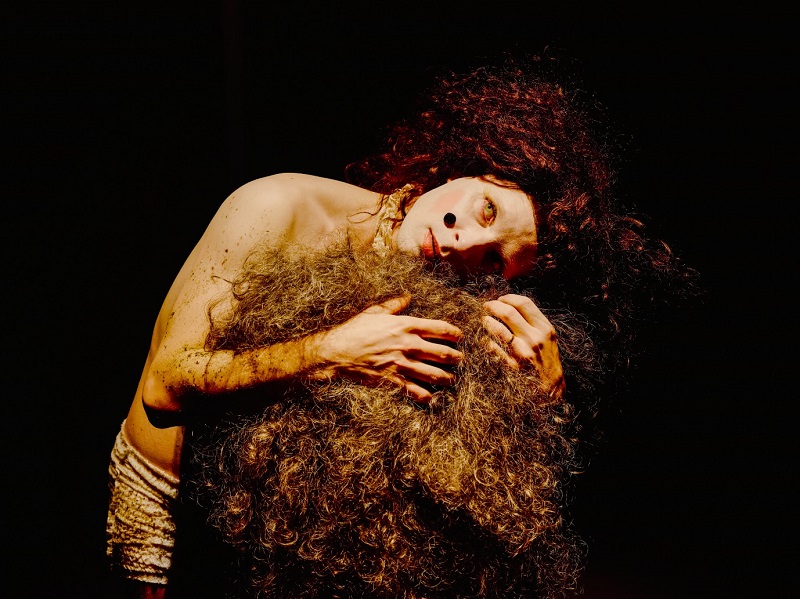
In a striking scene, the ensemble sheds its layers of pastel jeans and T-shirts one by one and reappears—catwalk-style—in heavy baroque gowns, embodying an absurd version of courtly life under the Sun King’s rule. Louis himself growls his commands from among the audience, where he has taken the shape of a golden, phallic speaker partially concealed underneath a wig.

For the rest of the performance, grotesque humour, excessive power and the audience’s own gaze become tightly intertwined. Versailles does not simply depict power but implicates its witnesses in its logic. Mirrors at the back of the stage reflect a warped image of the audience. Spectators and spectacle collapse into one another.
The Choreography of Chocolate Jelly
Jussi Sorjanen and Sinna Virtanen’s Versailles originally premiered at Viirus Theatre in Helsinki in 2022, performed in Swedish at the time. The performance was revived in spring 2026, this time in English. Created collectively with the working group, the piece continues to stand out as one of the funniest and, in many ways, most memorable Finnish performances of the decade.
As a dance critic, I am drawn in particular to its treatment of the body and more specifically its movement—from body to body, from era to era. The body of the court, of France, of Europe is, in this performance, literally a body. History here is not neutral or fixed. It is performed, staged and consumed by bodies affecting and affected by other bodies. Versailles reminds us that domination is lived not only by those who exercise it, but also, and especially, by those subjected to it.
The humour unfolds through pushing the materiality of history and hierarchy to its limits. In an unforgettable scene, Louis XIV asks his hesitant courtiers to consume “chocolate jelly” (gelée in French), a ritual in which power passes from one body to another. Eat me, live me, dance me, the king seems to insist. The small size of the Viirus auditorium is an advantage here, as the actors’ micro-expressions and reluctant hands reaching for the gelée are central to the work. In their faces and fingers, obedience and dissent are precisely crystallised. The meticulous lighting design by Jenni Pystynen renders the smallest details visible.
Orders issued by the king send the courtiers into other repetitive and competitive sequences of compliance. They perform through games and dance—danse triste, then a faster version, danse compétitive. The one who can dance longest and please the king best might, for a while, receive his approval. Moments of bodily collapse and failure hilariously expose the fragility of the performance of control.
Just as important is how authority is enacted through choreography that relies on internalised discipline rather than spoken command. The court was a theatre where individuals defined themselves for one another as much as for the king. The system at Versailles could only function through the participation of the entire court, where self-presentation became as important as obedience.

In Versailles, patterns are repeated to the extent that coordination becomes compulsion. Discipline and self-discipline emphasise the impossibility of stopping. There is something hypnotic in this repetition. Given classical ballet’s historical ties to Louis XIV’s court, the effect is pointedly unsettling. What was then is still here now.
Audience as King
Focusing on history in the body and history as present, and defying the boundaries of historical drama, Versailles has a peculiar, punky charm. Its sharp, rough-around-the-edges approach is steeped in laughter that tips into unease.
The staging remains simple, with few elements used masterfully. Sound designer Tatu Nenonen warps familiar baroque harpsichord textures, making them feel unsettling and unstable. Janette Laakso’s costume and wig design function not only as period markers but as instruments of control, shaping the way bodies move. A wig becomes weight: crown, symbol and constraint.
Throughout, there is a wildness that feels as if it could all go wrong; a sense that the performance could tip too far at any moment. Aesthetically and dramaturgically, this feeling of risk and collapse is key.
Rather than illustrating Louis XIV’s court, the performance exposes the act of performing power itself—and enacting it for oneself and one’s peers. Versailles both expands across time and slices the present into micro-performances. What it embodies is not only a past structure of governance, but an apparatus that still operates today.
When the speaker-king asks for danse émancipative and the ensemble begins its final dance of “freedom,” the performers appear to step outside the king’s authority. They undress, break the rhythm, abandon synchrony. Yet nothing fully disappears. The diapers, the wigs, even the gestures persist, only in altered form. What looks like emancipation is difficult to separate from performance.
The audience remains seated. We watch what we have come to watch, wanting more, expecting some sort of release. A door to the outside world is opened, but does it free us? After an hour and a half in the world of Versailles, it only reveals another layer of performance.
The question turns back on us. We, the “free” individuals of the present, are trained to manage ourselves correctly and to perform this management to ourselves and others: what we eat, how we train and whom we speak to. In our contemporary Hall of Mirrors, performance multiplies until watching and being watched become the same gesture.

*Henna Raatikainen is a dance critic, journalist and author. Her background is rooted in classical ballet and social sciences. She is currently completing a Master’s degree in Theoretical Research of Choreography at the University of the Arts Helsinki, Finland. Her research focuses on the relationship between contemporary performance practices and the codified traditions of ballet, which she examines through choreographic and linguistic perspectives.
Copyright © 2026 Henna Raatikainen
Critical Stages/Scènes critiques, #33, June 2026
e-ISSN: 2409-7411

This work is licensed under the
Creative Commons Attribution International License CC BY-NC-ND 4.0.
