When the Stage Becomes Solace for Exile: 40 Minutes Exile and the Concept of Reactive Theatre
Józef Legierski*
Abstract
What happens when theatre no longer waits for distance or reflection, but emerges directly from the urgency of the present? This article reflects on reactive theatre as a practice grounded in immediacy a form that arises in response to unfolding social and political crises and operates between impulse and action. Rather than representing reality from a distance, it engages it in real time, transforming lived experience into shared, affective events. The performance 40 Minutes Exile,created by Ukrainian artists under the direction of Søs Banke at the Nordic Theatre Laboratory, serves as a central case study. Developed rapidly through improvisation, the work demonstrates how minimal means, embodied presence, and the use of language and song can activate memory as a lived and collective process. Drawing on memory studies, the article suggests that reactive theatre does not preserve the past but responds to its unresolved presence, particularly in the context of war and migration. At the same time, it raises questions about the ethics of speed, representation, and the responsibilities of art created in moments of crisis.
Keywords: reactive theatre, memory studies, war and migration, performativity, political theatre
Introduction: The Urgency of Response
Imagine a theatre that doesn’t wait. A theatre that emerges from crisis like a reflex, immediate and visceral. This is reactive theatre, a form of contemporary performance whose essential characteristic is its rapid, emotionally charged yet reflexive response to current social, political, or cultural upheaval. It grows from the traditions of political and interventionist theatre but transforms them into something more temporary, more affective, more deeply rooted in process. Reactive theatre doesn’t plan its intervention; it reacts immediately, directly, often in the mode of performative commentary. Its action is embedded in real time, and its essence remains a reaction: to social change, to acts of symbolic violence, to political tension, to collective affect. Unlike one-off interventionist gestures, reactive theatre can enter the repertory space, becoming part of an institutional discourse about the present moment.
Reactive theatre is an authorial conceptual category that describes performative practices emerging from the pressure of the present moment and responding to crisis while it is still unfolding. It does not refer simply to theatre that retrospectively interprets events, nor to a form preoccupied with aesthetic autonomy, but rather to action undertaken often “in the heat of the moment” within a short interval between a social impulse and its artistic response. Temporality becomes here a crucial organizing principle of the creative process: the speed of reaction shapes dramaturgy, the economy of means, and the relational structure of the event. Reactivity thus signifies more than a thematic engagement with crisis; it denotes the capacity to initiate a collective process of responding within a space of co-presence, where the audience ceases to function as a passive recipient and becomes a co-participant and co-creator of the situation. Aesthetics operates not as an end in itself but as a mechanism of mobilization and affective activation, while the performative act acquires a cognitive dimension producing knowledge about crisis through embodied experience. Reactive theatre does not promise resolution; rather, it opens a space for response, for the negotiation of meaning, and for the formation of provisional communities under conditions of uncertainty, acceleration, and limited agency.
Memory as Crisis
A crucial avenue of analysis for reactive theatre is its examination in the context of research on memory cultures. The links of reactive theatre are especially strong in the context of war memory. In such theatre, memory is not just presented, it is activated. Memories become part of the process, can be co-created by participants, can be renegotiated. It also reveals the mediating role of theatre, which meanders between past and present, taking into account the contexts of trauma, migration, conflict, and social change.
Reactive theatre is affective theatre reacting with emotion, mood, body, communal agitation. In this sense, it can also be read through the lens of memory studies as a practice of responding to forgetting, preserving traces of social affects and political tensions. Reactive theatre is not only a response to the world but also an emotional archive of the community that records its fears, resistances, and hopes.
In this context, I want to reflect on how contemporary Danish theatre relates to the concept of reactive theatre. Which trends and examples does it follow? To demonstrate these assumptions, I will analyze the performance 40 Minutes Exile, created by a group of Ukrainian artists and director Søs Banke at the Nordic Theatre Laboratory in Holstebro.
40 Minutes Exile: A Case Study in Reactive Performance
In her long-standing creative practice, Søs Banke as director, playwright, and co-creator has been involved in social, educational, and multicultural projects, as evidenced by her work at Nordisk Teaterlaboratorium. Her work, including the performance BABEL, BABEL, BABEL, which deals with themes of war, exile, and freedom, and her participation in the SOCIACT (Social Acting) project, geared towards social theatre and work with groups at risk of exclusion, is clearly part of the paradigm of engaged theatre.
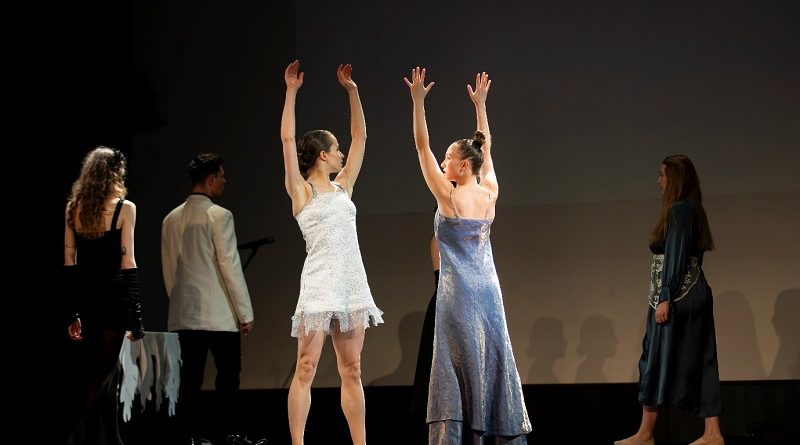
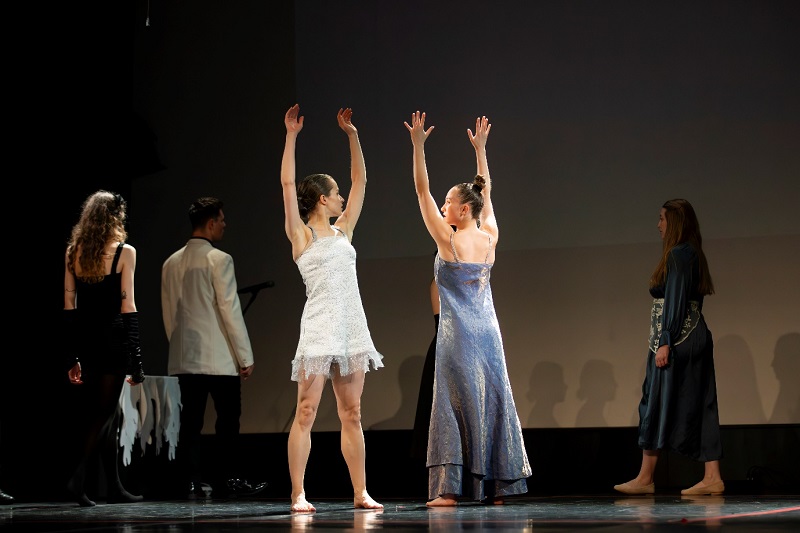
The performance 40 Minutes Exile, created by eight Ukrainian artists at Nordisk Teaterlaboratorium (NTL) under the directorship of Søs Banke, is a unique example of reactive theatre an artistic form which, instead of merely interpreting reality, reacts to it. The forty-minute performance focuses on a story of exit, escape, and the search for a path. The group of performers worked in just ten days, largely basing their process on stage improvisation. In this way, the performance fits into the logic of an immediate reaction to a social situation both the time of its creation and the performance formula emphasize the high speed of artistic response and the flexibility of form.
Aesthetic Elements: Building Reactivity Through Form
From an aesthetic perspective, the performance constructs its reactive power through several carefully orchestrated key elements, each contributing to the overall impact and immediacy of the theatrical experience. These elements work in concert to create a performance environment that is responsive, dynamic, and deeply engaged with the present moment.
The first crucial element is the minimalist stage form, characterized by a deliberate reduction of decoration, limited spatial configuration, and concentrated focus on maximizing the communicative message. This stage minimalism in reactive theatre creates a fascinating paradox: as the visual elements are stripped away, there is a corresponding maximization of the aesthetic-choreographic message, punctuated and enriched by carefully placed verbal insertions. As Jane Collins and Andrew Nisbet articulate in their seminal work Theatre and Performance Design: A Reader in Scenography, post-dramatic theatrehas opened up an entirely new vocabulary of terms, not only for understanding theatre itself but also for comprehending the fundamental elements that constitute theatrical experience. This theoretical framework helps us understand how the reduction of traditional theatrical means serves a specific purpose: it shifts the audience’s attention away from conventional plot structures and elaborate set designs toward the act itself, toward the precise moment of gesture, movement, and reaction. The performers’ bodies and actions become the primary focus, unmediated by decorative distraction. Such minimalism actively supports both pace and temporal responsiveness, creating conditions where the spectator experiences the stage as a living place of decision and response unfolding in real time. The stripped-down aesthetic environment makes every gesture significant, every movement meaningful, and every moment charged with potential.
The second essential element is choreographic improvisation, through which movement, dance, pantomime, and body language become catalysts for non-literal communication. This physical vocabulary allows the performance to express what cannot be adequately conveyed in words, or what speaks more powerfully and authentically through the body than through verbal language. The body becomes an instrument of meaning-making that transcends linguistic limitations. Through improvisational practice, the group of performers creates the possibility to react “here and now,” responding to the immediate conditions of each performance moment. The fact that the performance was created in just ten days and has not been stabilized through extended rehearsal periods over a long duration means that its structure remains fundamentally open-ended. This openness makes the performance susceptible to change and reaction both during the creation process and during each live performance. The improvised choreography thus embodies the principle of reactivity at its most fundamental level the willingness and ability to respond spontaneously to emerging conditions, emotions, and energies within the performance space.
The third significant element involves set design created in real time, a practice that fundamentally transforms the relationship between visual environment and performance action. The visual artist actively reacts to the movement of the performers and to the evolving stage situation as it unfolds, which means that the stage space becomes genuinely dynamic, continuously changeable, and co-created by all participants in the performance. Rather than providing a static backdrop against which action occurs, the visual design becomes a responsive participant in the theatrical event. This approach fits perfectly with the core idea of reactivity the readiness of form to receive impulse, embrace change, and provide immediate response. The audience witnesses not a completed design but a design in the process of becoming, shaped by the same forces and energies that shape the performers’ actions. This simultaneity of creation and performance collapses the traditional separation between preparation and presentation, making visible the responsive and collaborative nature of theatrical meaning-making.
The fourth vital element is the presence of native voice and language, specifically the Ukrainian language, songs, and singing traditions that function as powerful vehicles of cultural and social memory within the community. These linguistic and musical elements actively involve the viewer in an act of identification, creating bridges between individual experience and collective cultural heritage. Through the deliberate presence of Ukrainian language and traditional singing, the performance connects the individual experiences of the traveling artists and refugees to their broader cultural embeddedness. The performance speaks of journey, escape, and search, but it does so in a language that simultaneously creates connection and activates memory. The use of the mother tongue is not merely representational but performative it does not simply describe cultural identity but actively constitutes and reinforces it in the moment of utterance. In this sense, cultural and social memory enter the performance not only as retrospective reference to a distant past but as active reaction to the present moment. The songs and language become sites where past and present converge, where cultural continuity is both remembered and enacted, where the pain of displacement meets the resilience of cultural survival.
The fifth and final element is the transience and impermanence of the stage image, a quality that fundamentally distinguishes this reactive performance from more traditional theatrical forms. The performance deliberately refuses to attach itself to permanent forms of decoration or classical dramaturgical structures. Instead, it remains in a constant state of “hot” reaction alive, responsive, and unrepeatable. The ephemerality of the gesture, the fleeting nature of each image, and the uniqueness of each moment emphasize that reactive art does not seek to archive or preserve but rather acts in and through real time. Each moment of action becomes simultaneously a moment of meaning-making and a moment of disappearance. This temporal quality creates a sense of urgency and presence that demands the audience’s full attention and participation. The performance exists only in its happening, in the lived experience of performers and spectators sharing the same temporal and spatial frame. This impermanence is not a limitation but a defining feature it ensures that the performance remains responsive to the specific conditions of each presentation, that it cannot calcify into fixed form, and that it retains its capacity to surprise, challenge, and move both performers and audiences in unpredictable ways. The transient nature of the stage image thus becomes a powerful metaphor for the experiences of displacement and migration that the performance explores experiences characterized by instability, uncertainty, and the constant need to adapt to changing circumstances.

Political Representation: Who Speaks? Who is Seen?
It is worth noting the aspect of reactive theatre as political response, which becomes a particularly touching component of this work. In the case of the analyzed performance, the motif of migration caused by armed conflict becomes a representation of a political agenda. An interesting analysis of the word “representation” in a political context is made by Theron Schmidt in his article “Is This What Democracy Looks Like?” The researcher dwells on the notion of representation and draws two paths that can be helpful in understanding stage representation in reactive theatre. Representation for him refers, in the first instance, to choices and decisions; in the second, to presence and visuality. He proposes a shift in the emphasis of representation from choices and decisions to visibility and gesture. This shift contributes to the formal questions of representation: Who is represented? Who represents? What forms of action are considered political?
Reactive theatre, therefore, draws on the interventionist and rapid action of interventionist theatre to act quickly and respond hotly to situations. Its subject matter is primarily focused on specific current political events, polycrises, and changing political affects. Its aim is to respond to a specific situation, but it can also draw on committed theatre to draw attention to the motivational or spectatorial element. The formal aspects of reactive theatre oscillate around the temporality of a strong journalistic charge and fast-paced temporality is at the heart of reactivity. Its place of action is both public space and institutional theatre space. It is frequently of a temporary, ad hoc nature, yet not devoid of aesthetic immersion unlike interventionist theatre, reactive theatre practices often enter the repertory space of the theatre. The simplest and most blatant examples are reactive aesthetics created as a reaction to the introduction of controversial laws or responses to instantaneous political crises.
This shift can be helpful in analyzing the political reactivity of the forty-minute performance. One of the key questions emerges: What forms of aesthetic reactivity can be regarded as a political tool?
The Temporality of Witness: Experiencing Now
From the perspective of reactive theatre, the performance of 40 Minutes Exile presents itself as an immediate action, expansive in stage form, combining multiple stage languages movement, voice, image. It is not interventionist theatre in the classical sense the performance does not position itself solely as an explicit social intervention, nor as a profound philosophical existential metaphor. Its strength lies in its reactivity, in its temporal responsiveness, in the intensity of its message while maintaining aesthetic minimalism and richness of performance. The moment of reaction becomes simultaneously a moment of drama and a social moment form becomes reaction and reaction becomes form. The spectator not only observes the event but experiences the time of the performance as part of the message: the pace of production (10 days), the duration (40 minutes), and the dynamics of improvisation create the impression that the performance operates in the moment of “now” and invites participation in that time.
Memory in Three registers: Cultural, Collective, Somatic
The performance demonstrates how theatre functions as a powerful tool of memory, weaving together individual memories of the artists with the collective memory of journeys, escapes, and exits. This interweaving creates a reactive form that opens up possibilities for redefining the past, reflecting deeply on history, and responding to the urgent needs of contemporary social debate. The performance operates across three distinct yet interconnected registers of memory, each contributing to the overall impact and meaning of the theatrical experience.
The first register is cultural memory, manifested through the use of native language, traditional songs, and communal gestures. A particularly significant moment within this register is a micro-collective scene: the performers gather on stage and, almost unanimously, execute a choral piece together. This scene plays a key dramaturgical role within the structure of the performance, intensifying mnemonic and imaginative tensions. The collective act of singing does not merely illustrate cultural belonging but enacts memory as an embodied, shared experience. The performance deliberately draws on elements deeply rooted in the history and culture of the Ukrainian community, transforming them into integral components of the stage message. These elements are not merely decorative references but carriers of identity and historical continuity, linking past and present through a shared symbolic language. In the choral convergence of voices, memory acquires an affective and communal dimension, creating an intense atmosphere in which the imagined homeland, experiences of loss, and resilience condense into a single performative gesture.
The second register operates through social and collective memory. Here, the performance skillfully combines the individual experiences of the performers their personal stories of travel, refuge, and escape with broader group experiences. This combination creates a shared narrative that transcends individual testimony to become a powerful record of the collective memory of migration and exodus. This is particularly evident in the scene where the performers move around the square carrying a suitcase, sharing it as if they were custodians of a migratory memory experience. The performance thus becomes a site where personal and communal histories converge, intersect, and resonate with one another.
The third register operates through somatic and emotional memory, activated through improvisation of movement, gesture, and pantomime. Physical expression and embodied action form a central element of the performance, encompassing not only the actors’ improvisations that form its foundation but also functioning as a tool for emotional testimony. Individual scenes take the form of improvised monologues, bearing witness to the experiences of the characters. Of particular importance is the visual dimension of the stage design minimalist and strongly aligned with the reactive aesthetic of the performance, created in real time by the artist through graphics, projections, and displayed memory spaces that interact with the actors’ improvisational work. In the context of reactive memory, the performance provides an exemplary illustration of how the memory of war deeply embedded in both individual and collective memory systems can be interwoven and expressed through theatre, incorporating bodily and emotional dimensions into the process of remembering.
Mapping Reactive Theatre
The category of reactive theatre I’m proposing is situated within a broad field of terms describing the relationship of theatre to social and political reality, but it isn’t a simple equivalent or another name for already recognized trends. To understand the essence of reactive theatre, we must examine the word “reactivity” itself. Its source is the Latin verb reagere, meaning “to respond,” “to react,” “to act reflexively.” In this sense, reactivus “reactive” refers to the ability to respond to stimuli. Anthropologically speaking, the term implies the co-presence of subject and world, their constant dialogue and interaction. Reactivity in theatre can thus be understood as a readiness to respond not only intellectually, but bodily, emotionally, and communally. Its essential function is to reinterpret and reformulate existing terms by shifting the focus from a declared artistic stance or theme to the mechanism of theatre as a practice responding to specific crisis stimuli. Reactive theatre is defined primarily as a process starting from a social impulse conflict, tension, trauma, political or identity crisis that is transformed into an aesthetic and performative stage response strongly rooted in the current historical and cultural context.
In this sense, reactive theatre has a close relationship with, but doesn’t fully overlap with, the notions of engaged theatre and political theatre. Political theatre is sometimes defined primarily by its subject matter or ideological references, while engaged theatre is defined by the ethical statement of its creators and their relationship to the community or public debate. Reactive theatre doesn’t negate these traditions but proposes a different criterion of recognition: it isn’t so much “what” the theatre is talking about or “whose side” it is on, but how and in response to what it is created. What becomes crucial here is the temporality of the response and its direct reference to the current state of the polycrisis of 2015-2025, which forms the essential backdrop of the analysis. In this view, every reactive theatre is political because it operates in a field of real social conflicts and hegemonic tensions, but not every political theatre fulfills the condition of reactivity understood as a direct response to a specific crisis stimulus.
Artivism, understood as a practice that combines art with direct social activism, is also an important point of reference. Unlike many artivist activities, reactive theatre doesn’t relinquish aesthetic autonomy or complexity of form in favor of an explicit political message. While it may have an interventionist and mobilizing function, its goal is not solely effectiveness understood in terms of immediate social change. Rather, reactivity is about building an affective community of spectators and performers, about working with emotions, memory, and the body as areas of resistance to hegemonic narratives.
Reactive theatre can also be contrasted with the notion of theatre as intervention, but here too there is a relationship of partial coverage. Intervention often implies a punctual, short-lived action that violates an established symbolic or institutional order. Meanwhile, reactive theatre encompasses not only the stage gesture itself but also the extended creative process. New models of work, based on collectivity, egalitarianism, psychological care, contracting relationships, and attentiveness to representations of marginalized groups, are integral to the theatre’s reactive response to social crises. Intervention thus becomes one possible mode of reactive theatre, but it does not exhaust its specificity.
There is a close, though not identical, relationship with the concept of theatre as situation, derived from performativity theory and emphasizing the co-presence, processuality, and emergence of meaning in the stage event. Reactive theatre draws on this ontology of theatre as event but explicitly politicizes and historicizes it. Here, the theatrical situation isn’t an autonomous field of affect play but is set in motion by an external social impulse and inscribed in specific conflicts of memory, identity, and power. In this sense, we can speak of reactive theatre as situational theatre with a high degree of entanglement in current social and historical processes.
The category of reactive theatre brings above all a tool for ordering contemporary, dispersed theatrical practices that escape the classical definitions of political, documentary, or post-dramatic theatre. Reactivity doesn’t function here as a theme or as an aesthetic, but as a relational and processual mechanism of action that simultaneously encompasses the thematic, formal, and productive spheres. It is this triple perspective social stimulus, aesthetic response, and model of creative work that allows us to grasp the specificity of contemporary theatre responding to feminist, queer, and decolonial crises and to tensions related to historical memory. As a result, reactive theatre does not so much compete with existing categories as it transcends and integrates them, offering an analytical framework adequate to describe theatre emerging under conditions of permanent crisis.
Theoretical Frameworks: Assmann, Halbwachs, and the Memory Boom
To understand the role of reactive theatre as a tool for analyzing memory-related issues within theatrical aesthetics, it is essential to examine how theatre activates various tensions and traumas centered on the processing of the past through memory. Memory emerges as an important reactive tool because it responds to the ability to quickly redefine the past, critically reflect on historical events, and seek answers to the current needs of historical debate. The memory boom of the 1960s and 1970s produced the first significant attempts at memory debates, providing crucial context for understanding contemporary memory work in theatre.
Understanding the interrelationships between memory-related issues in theatre requires examining the influence of reactive theatre on cultural, collective, and individual memory. cultural memory, as theorized by Aleida and Jan Assmann, draws upon the symbolic and cultural capital embedded within cultural works. In reactive theatre, engaging with cultural memory involves the preservation and reinterpretation of locally significant symbols, creating bridges between historical traditions and contemporary meanings.
Social memory functions as a reservoir responsible for building community identity and facilitating social group integration. This integrative aspect of memory production is fundamental to how communities understand themselves and their place in history. Closely related is collective memory, one of the most extensively explored forms of memory in Polish theatre, where Maurice Halbwachs and his concept of the social framework of memory play a paramount role. Collective memory involves the storage and transmission of historical experiences, social trauma, and historical education. It operates through a three-phase process: the storage, transmission, and communication of historical experiences, social traumas, and systems of memory awareness among citizens.
The scholarly literature on theatre and memory emphasizes that theatre not only uses memory to create narratives but itself becomes a “site of memory” a performative act that functions as a vehicle for cultural and social memory. The performance of 40 Minutes Exile can be understood as such a space of memory, one that simultaneously stores experiences and reinterprets and activates them. Within this framework, stage action, movement, gesture, dance, and voice become manifestations of somatic and emotional memory, in which the bodies of both performers and spectators are inscribed in the ongoing process of remembering and transmission.
Throughout Søs Banke’s performance, the theme of movement and migration remains constant and central. The dragged suitcase that actors exchange with one another, the continuously shifting positions on the stage, the changing scenery on the stage set that is being painted throughout the performance all these elements introduce reflection not only on the memory of war but also on the memory of migration. In the context of memory research, an important aspect of war memory relates to individual memories of experiences and tensions that shape self-remembrance. These memories are highly subjective and influence, for example, the evocation of components of national identity through the act of singing songs in the mother tongue, as witnessed in the final minutes of the performance. The performance thus creates a complex layering of memory registers, where cultural symbols, collective experiences, and somatic expressions converge to create a multidimensional exploration of memory, displacement, and identity.
Memory as Process, not Archive
In addition to issues related to the memory of war, the performance engages with other dimensions of memory studies, such as the temporal dimension of memory. The performance uses the speed of reaction and temporal reactivity as an aesthetic and memory mechanism: because it was created quickly and functions as an immediate reaction, the spectator experiences not only the content but also the time of production and action itself as part of the message.
Finally, the process of remembering and ephemerality: the performance emphasizes the impermanence of the image analogous to the mechanisms of memory storage, where remembering and forgetting are inseparable. The performance-reaction operates in a moment that is transitory, a reminder that memory is not just an archive but a process.
If reactive theatre refers to memory, it doesn’t remember the past in a factual sense but responds to crises of memory to what remains unaccounted for, repressed, or contested in community narratives. In performances like 40 Minutes Exile, it is not only specific historical events that are remembered but, above all, the mechanisms of their absence: the lack of justice, the deficit of responsibility, structural violence, and the continuity of historical effects in the present. Both specific historical events and the mechanisms of their erasure are remembered.
Reactive theatre doesn’t so much “tell a story” as it initiates a memory situation a performative event in which memory becomes an experience of the here and now. In this sense, its aim is not to impart knowledge but to activate testimony. However, it is not about the classical understanding of testimony as an eyewitness account of historical events. Rather, reactive theatre produces second-order witnesses: spectators who are drawn into the process of confronting the absence, gap, and conflict of memory. These witnesses don’t “find out how things were” but experience their own position in the face of violence, denial, and responsibility.
In performances like 40 Minutes Exile, testimony is not biographical in the classical sense, although biographies individual and collective are often a starting point. What is more important is that biography functions as a tool for destabilizing hegemonic narratives rather than as a story of individual fate. This applies to the documentary projects analyzed in the broader research corpus: the biographies of witnesses, victims, or performers do not serve to empathize but to reveal the systemic framework of violence and memory.
In analyzing such performances, tools developed within the field of memory studies become crucial, in particular the concept of agonistic memory (Chantal Mouffe, Anna Cento Bull), which allows us to think of memory as a field of irremovable conflict rather than consensus; post-memory theory (Marianne Hirsch), helpful in analyzing relations between generations and the inheritance of trauma; and performative approaches to memory (Diana Taylor), which treat theatre as a repertoire of memory actions rather than merely a medium of representation. These theories allow us to analyze reactive theatre as a practice that does not stabilize the past but activates and problematizes it.
Reactive theatre doesn’t so much “commemorate” as it refuses to encapsulate memory. Its aim isn’t reconciliation or a consensual community narrative but to create the conditions for the experience of memory conflict as something that concerns the present. Memory in reactive theatre is thus not a record of the past but a form of response to its effects in the here and now and it is here that its political and performative potential is most fully revealed.

War Memory in Migration: Victoria Sereda’s Framework
The use of Ukrainian language through songs provides links to Ukrainian pre-war memory as a chance to critique the contemporary conflict. However, it is still worth noting the connection in the spectrum of the memory of war and its reactivity to the theme of displacement and migration. Victoria Sereda, among others, writes about this in her book War, Migration, Memory. This connection appears very strongly in the context of the performance with regard to the phenomenon of the transfer of the memory of war in migration. In the simplest terms, this phenomenon is a situation in which those who have experienced the memory of war migrate with it and need to integrate it into a new social, political, or cultural context. This means that the memory of war migrates with the person who experienced it, and the memories themselves become part of migrant memory.
Possibilities and Limitations: The Ethics of Speed
Reflecting on the possibilities and limitations of such a model, the following conclusions can be drawn: The model of reactive theatre represented by 40 Minutes Exile opens an important field of artistic and social activity, it offers the possibility of immediate artistic response, community action, entering the space of emotion and experience in a direct and sensual way. Minimalist aesthetics and improvisation allow for an intensification of the message and an invitation to the viewer to participate.
At the same time, however, there are challenges: the pace of response while an asset can mean limited time for reflection and can encourage simplification or understatement. Moreover, when a performance refers to the experience of migration, flight, possibly war, the question of artistic responsibility arises whether the experience is exploited without sufficient sensitivity, whether the creators maintain an ethical consciousness towards the participants and the audience. Another problem is sustainability: the performance as a “hot” action may have limited possibility of impact beyond the moment of performance, and its form may be less accessible or comprehensible to a wider audience. Finally, the ethics of memory: how do we avoid simplification, the cosmetization of trauma, and how do we balance the impulse of reaction with the depth of reflection?
Document vs. Drama: The Body as Archive
Reactive theatre may be based on documents, but it isn’t defined by them. This distinction is crucial, especially in relation to documentary theatre. In this conception, the documentary is not a starting point in the genre sense but a tool for responding to the crisis of memory, which may or may not be activated. This means that reactive theatre does not primarily ask “how do we faithfully reconstruct the past?” but “why does this past return now and how does it demand a response?”
In classical documentary theatre, the document functions as a source of authentication of the truth: archival material, minutes, testimonies, or recordings are supposed to confirm the factuality of events and legitimize the stage narrative. Reactive theatre, on the other hand, shifts the emphasis from the document to the memory situation, in which the document is one of the elements of the play sometimes even its object of criticism.
In the case of 40 Minutes Exile, the performance operates without traditional documentary materials in the archival sense. Instead, it uses the lived experiences of Ukrainian performers their bodies, voices, gestures, and native language as living documents of displacement and war trauma. The documentary functions here not as evidence of specific historical facts but as embodied testimony to ongoing crisis.
This approach demonstrates that reactive theatre does not need conventional documents to work with memory it is enough to recognize the body, voice, and cultural practice as vehicles for displaced history. Documentary in reactive theatre does not stabilize meaning but problematizes it; it does not close down the past but opens it up as an unresolved present. The autobiographical and observational materials in 40 Minutes Exile function as traces of experience rather than evidence, activating affective and situational memory. Reactivity is about responding to the crisis of visibility of peripheral experiences and non-hegemonic narratives.
In sum, reactive theatre as a practice of memory may use documents, but it is not loyal to them in a representational sense. The document becomes subordinated to the logic of the reactive: it serves to reveal the deficiencies, tensions, and conflicts of memory rather than to reconstruct the past. In this sense, reactive theatre is not a variant of documentary theatre but a broader category that allows us to analyze both archive-based works and those that work with memory through body, voice, landscape, and affect. This shift from the documentary as a source of truth to the documentary as a problem is one of the most important contributions of this concept to contemporary reflection on theatre and memory.
Conclusion: Theatre in the Time of Polycrisis
As a result, a performance such as 40 Minutes Exile opens up a space to think of theatre not as a stable structure but as a field of investigation a form that is flexible, responsive, co-creative, and inviting engagement. At the same time, it reminds us that the power of such a form goes hand in hand with responsibility: for the form, for the context, and for the experiences of participants and spectators. In conditions of rapid social change, such a reactive form may be necessary, but it is equally important that it remains informed, reflective, and ethically grounded.
Reactive theatre as a responsive creative model subsumes both the interventionist and critical roles of theatre. Based on the practice of rapid reaction embedded in the creative process, it closely observes social changes and their dynamics, paying particular attention to emerging stage aesthetics. Where the pace of reaction plays a decisive role, opportunities arise to formulate new definitions and expand theoretical horizons. 40 Minutes Exile exemplifies a project in which the minimalism of scenic form and the intensity of bodily expression intersect with an immediate temporal response to war and the consequent necessity of migration.
While this performance primarily responds to the crisis of war-induced migration and memory displacement, it shares with other reactive practices a fundamental mechanism: a social impulse transformed into an aesthetic response through a specific working model. The performance shows how reactive theatre transcends traditional categories of political, documentary, or post-dramatic theatre by prioritizing the process of reaction itself the temporality of response, the activation of memory as crisis rather than archive, and the formation of affective communities of witnesses.
The category of reactive theatre brings coherence to fragmented practices, offering an analytical framework adequate for describing theatre emerging under conditions of permanent crisis. It enables us to think of theatre not merely as a medium of representation or critique but as a dynamic practice of reacting, negotiating meaning, and producing community in unstable socio-political realities. The case of 40 Minutes Exile confirms that reactive theatre is defined not by what it represents but by how and in response to what it is created, making visible the mechanisms through which contemporary theatre actively participates in working through collective trauma, displacement, and the ongoing effects of historical violence. At the same time, research on reactive theatre encourages further analytical exploration, which will be continued through sustained engagement with feminist, queer, and decolonial frameworks as key interpretative horizons for future studies.
Bibliography
Assmann, Aleida. Cultural Memory and Western Civilization: Functions, Media, Archives. Cambridge UP, 2011.
Barnes, Hazel, and Marié-Heleen Coetzee, editors. Applied Drama/Theatre as Social Intervention in Conflict and Post-Conflict Contexts. Cambridge Scholars Publishing, 2014.
Bull, Anna Cento, and Hans Lauge Hansen. “On Agonistic Memory.” Memory Studies, vol. 9, no. 4, 2016, pp. 390–404.
Collins, Jane, and Andrew Nisbet, editors. Theatre and Performance Design: A Reader in Scenography. Routledge, 2010.
Halbwachs, Maurice. On Collective Memory. Edited and translated by Lewis A. Coser, U of Chicago P, 1992.
Hirsch, Marianne. The Generation of Postmemory: Writing and Visual Culture After the Holocaust. Columbia UP, 2012.
Kostaszuk-Romanowska, Monika. “Teatr bieżącej interwencji w praktyce.” Białostockie Studia Literaturoznawcze, no. 6, 2015, pp. 121–42.
Mouffe, Chantal. Agonistics: Thinking the World Politically. Verso, 2013.
Schmidt, Thomas. “Is This What Democracy Looks Like? The Politics of Representation and the Representation of Politics.” Performing Antagonism: Theatre, Performance & Radical Democracy, edited by Toni Fisher and Eve Katsouraki, Palgrave Macmillan, 2017, pp. 101–30.
Sereda, Viktoriya. War, Migration, Memory: Perspectives on Russia’s War Against Ukraine. transcript Verlag, 2025.
Taylor, Diana. The Archive and the Repertoire: Performing Cultural Memory in the Americas. Duke UP, 2003.

*Józef Legierski is a PhD student at the Doctoral School in the Humanities at Jagiellonian University in Kraków and at Alma Mater Studiorum – University of Bologna. He holds a degree in theatre studies. His research focuses on reactive theatre, a performative model that responds to social, political, and cultural crises and intervenes in the erosion of democratic institutions. He engages gender and queer perspectives to explore how reactive theatre destabilizes normative binaries, and draws on memory and decolonial studies to examine collective remembrance and marginalized voices. His interdisciplinary approach frames theatre as both critique and a generative space for imagining more plural futures.
Copyright © 2026 Józef Legierski
Critical Stages/Scènes critiques, #33, June 2026
e-ISSN: 2409-7411

This work is licensed under the
Creative Commons Attribution International License CC BY-NC-ND 4.0.
