What Brecht Can Teach Artists in Exile
Azadeh Sharifi*
Four Walls and a Roof. Text & Performance: Lina Majdalanie and Rabih Mroué, Songs: Hanns Eisler and text by Bertolt Brecht, additional composition and music: Henrik Kairies. Dramaturgy: Sandra Noeth, technical direction: Thomas Köppel. Co-produced by Residenz Schauspiel Leipzig, Festival D’Automne Paris, HAU Hebbel am Ufer Berlin, Performing Exiles/Berliner Festspiele, Künstler*innenhaus Mousonturm Frankfurt a. M. and Kampnagel Hamburg, 2024.
In October 1947, Bertolt Brecht was ordered to appear before the House Un-American Activities Committee (HUAC). At that time, he had been living for almost six years in US exile as an “enemy alien” under constant surveillance by the US government. Knowing that the only exit from this situation would be moving back to Germany, he had prepared a theatrical spectacle for his hearing. A spectacle that exposed the inability of the HUAC Committee to deal with a theatre trickster like Bertolt Brecht, who presented himself in a very Brechtian manner as a protagonist similar to many of his plays: a persecuted individual who is outwitting the authorities. During the cross-examination, he chose to speak himself, albeit in broken English, while his designated translator became his prompter, jumping in when Brecht needed him. In the recording, Brecht neither lies nor reveals his political views; he directs the session to demonstrate the absurdity of the committee’s activities and its ignorance of artistic freedom.
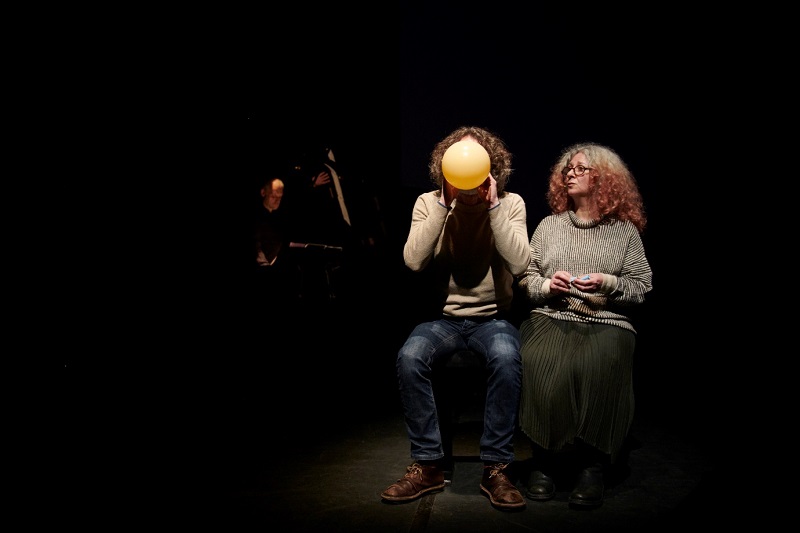
The artist duo Lina Majdalanie and Rabih Mroué use Bertolt Brecht as a blueprint to address the experiences of artists in exile and the current global political climate, which, in so many ways, bears resemblance to Brecht’s experience before the HUAC Committee. The performance Four Walls and a Roof, already premiered in 2024, has now been awarded the 2026 Berlin Theatre Prize “for their internationally groundbreaking artistic work.” In the performance, Lina Majdalanie and Rabih Mroué, accompanied by Henrik Kairies, who performs Brecht-Eisler songs on the piano, use humour and creative digressions to expose ongoing injustice, epistemic violence and authoritarian conduct.
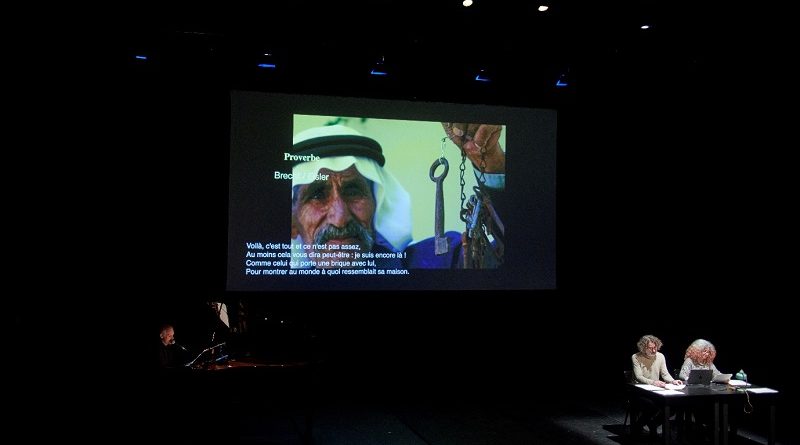
In the centre of the stage is a table with a wooden chair, where Rabih Mroué will sit down or sometimes move around, facing the audience. On the table are a desk lamp and a stack of papers. On the right side of the stage, at the back, is another table facing the centre of the stage. This is where Lina Majdalanie will spend most of the performance. On the left, likewise in the back part of the stage, Henrik Kairies sits at the piano. Overall, the stage is dark, and light is directed sparingly toward each of the three performers on stage. In the background, on a screen, both subtitles and additional material such as videos and photographs are displayed. The performance is structured through sequences or scenes that are not necessarily chronological, but, similar to Epic theatre, can be restructured. The Eisler-Brecht songs, however, serve as the common thread or transition between the scenes.
At the beginning, Rabih Mroué re-enacts the character of the Chief Investigator during the interrogation of Bertolt Brecht in front of the HUAC Committee—the stack of papers on the table is the original script from the cross-examination, but in Four Walls and a Roof, Brecht’s answers are left out. In the artist talk I moderated after the performance, Mroué explained their decision to present the cross-examination only through questions, since Brecht had initially prepared a statement he wasn’t allowed to read. Instead, they chose to present Brecht’s statement as a stand-alone text, giving him the stage he was denied. In the statement, in which he not only tells his personal story of how he, as a German artist, was exiled by the German government (like many other dissidents), but also clearly draws parallels between Nazi Germany and the HUAC committee’s rationale. The chairman of the committee dismissed the statement because he found no connection in it to the committee’s questionnaire.
Brecht’s statement about his artistic freedom being restricted is particularly fitting because the current German government is attempting to control and limit artistic freedom and expression, and is even enforcing restrictions with the help of the German secret service. The German government justifies these repressions, that is, cutting funding for artists and art institutions, as a measure against the so-called “left-liberal bubble” that does not represent the “silent centre.” What these politically highly inaccurate claims lead to, we can only guess. However, Brecht’s life circumstances under these conditions can give us a pretty good idea.
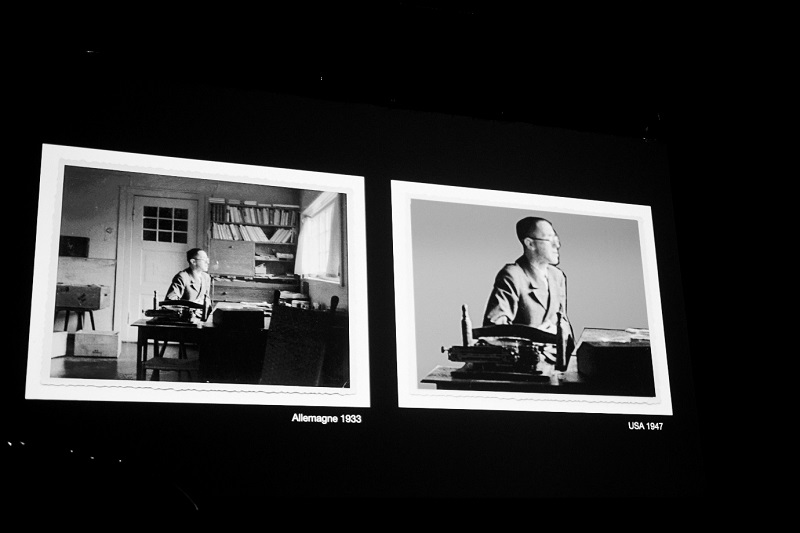
Brecht’s circumstances as an exiled artist and an “enemy alien” to several governments serve as a framework that runs through the performance like a threat. Majdalanie and Mroué make use of a photograph that was taken of Brecht the day before he had to flee Berlin, and compare it with a photograph of him the day before he had to leave the US. While stripping the image down to its core through a detailed analysis, they explore not only the intention behind the snapshot, but also the conditions under which Brecht had to live, organise himself, and hold close to his political and artistic integrity during exile. These critical examinations and their suppositions about Brecht’s situation enable them to draw a parallel, for example, to a photograph of an ID card of a Palestinian artist, on which German authorities had signed “XXX” as the nationality since he is “stateless.”
The Palestinian artist, who was initially confused about the designation, afterwards found out that the three Xs would also be used to mark porn movies. When he informed the German citizens’ office, they replaced Xs with blank spaces, which was even more dehumanising to him. It also corresponds to the artists on stage, Lina Majdalanie and Rabih Mroué, who use examples and the power of engaging with different artefacts on stage in order to say so many things without having to voice them and thereby “discredit” themselves in the art world of German state policy—that is, without having to fear actual political and, in particular, cultural-political repression which would mean not getting funded or their art being not presented on a German stages.
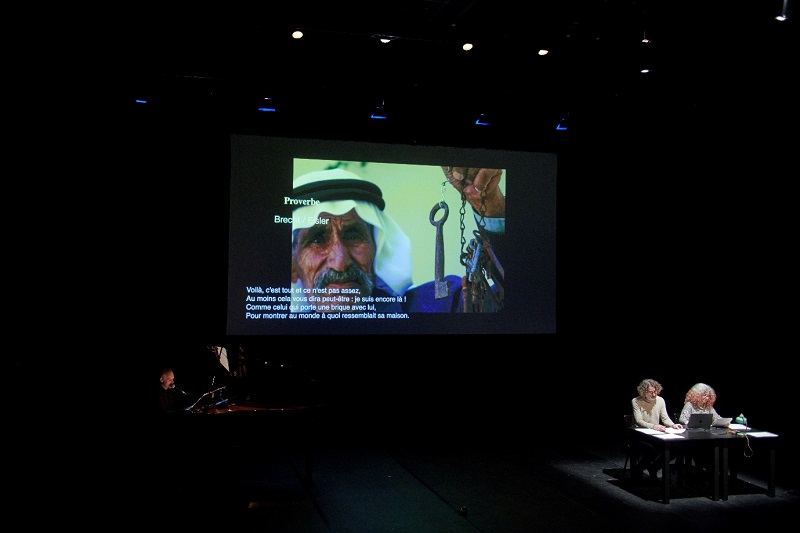
The unique capacity of this performance is not only how it engages with the political and artistic circumstances of exile, but also the emotional side: the burdens of exile, that is, the ways one has to leave not only material but also emotional things behind. But what is needed for survival? Here again, Majdalanie and Mroué make use of Brecht’s artistic trickery to navigate what is difficult to express in words. A video is screened without being contextualised, showing elderly people holding heavy iron house keys in front of the camera. These keys are characteristic of the Palestinians who had to leave their houses during the Nakba. A historical event that is part of a controversial discussion in Germany, and whose remembrance has become highly politicised and divisive. But no words or contextualisation are needed, since the faces of the elderly people shown in the video and their gestures convey their own powerful expressiveness, telling their stories.
And then there is the music of Brecht-Eisler, sung by Henrik Kairies, accompanied on the piano between the scenes and underpinning the performance as another artistic layer. Songs like “Lob des Lernens” (Praise of Learning), which is part of the play The Mother (1932), “Solidaritätslied” (Solidarity song) (1931) or “Kinderhymne”(Children’s hymn) (1950) weave together an ongoing history of political theatre from Brecht to current theatre practitioners, as well as linking historical events from Brecht’s time with current developments.
Four Walls and a Roof is a masterpiece of artistic trickery in times of an authoritarian political climate. Lina Majdalanie and Rabih Mroué take Brecht’s lead and combine it with their own brilliant ingenuity to offer a rendition of political theatre that offers critical analysis and commentary. While many artistic voices have fallen silent in recent years—sometimes due to self-censorship, sometimes due to political repression—this performance navigates the tension between social responsibility and the aesthetic survival strategies that unite all artists in exile and their existence as “enemy aliens” in hostile environments.

*Azadeh Sharifi is a theatre and performance scholar based in Berlin. She is currently a Fellow at the Käte Hamburger Research Centre global dis:connect, LMU Munich. Previously, she was a visiting professor at Free University Berlin, the University of Toronto, and the Berlin University of the Arts. Her research focuses on (post)colonial and (post)migrant theatre history, contemporary performance and decolonial and activist art. She is currently working on her monograph Theatre in Post-migrant Germany. Performing Race, Migration and Coloniality since 1945 (Palgrave Macmillan/2027).
Copyright © 2026 Azadeh Sharifi
Critical Stages/Scènes critiques, #33, June 2026
e-ISSN: 2409-7411

This work is licensed under the
Creative Commons Attribution International License CC BY-NC-ND 4.0.
