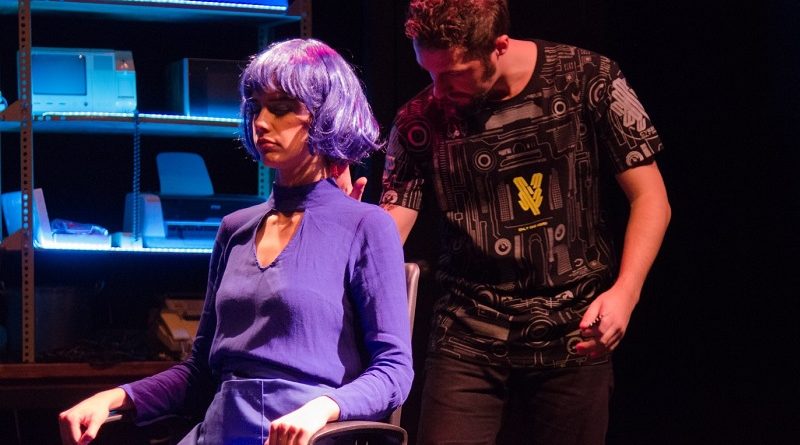
Towards a Meta-technological Ecocritical Dramaturgy: Entangling Digital Environments with Human “Lived” Bodies in Automata
Graça P. Corrêa*
Abstract
Following a line of inquiry that approaches the relation of humans with their home or oikos—whilst drawing upon ecofeminist criticism and ecophilosopher Félix Guattari’s proposal of three interrelated ecologies—this article explores how the dystopian technological landscapes of a theatre performance (Automata, Lisbon 2017) are enacted through some of the digital devices they propose to criticize, giving rise to a meta-technological dramaturgy that contrasts and combines mechanistic apparatuses with human ‘lived’ bodies.
Keywords: theatre and technology; ecofeminism; ecophilosophy; performance
Introduction
In Staging Place (1995) Una Chaudhuri remarks how geopathology—the notion of ill-placement or of place as problem—shapes most late twentieth-century theatre. Accordingly, she notes that if Anton Chekhov was already writing at the brink of a shift in human beings’ attitude towards nature, in the theatre of Sarah Kane, Harold Pinter, Samuel Beckett, Sam Shepard and Caryll Churchill, there is no possible recuperation of home because it is “hermetically sealed off from nature” (119).
The linkage between ecology and home—or of a branch of study associated to the earthly environment on a vast scale with the intimate dwelling-space of living beings—may provide important insights towards an ecocentric ethics. It suggests that a sustainable, diverse, and well-balanced earthly environment must be sought not only at the macro level but also at the microcosmic scale of individual wellbeing and interpersonal relations within a household. Indeed, as ecophilosopher Félix Guattari argues, we urgently need to interconnect three interrelated ecologies: a mental ecology, involving individual ethical practices at a micropolitical level; a social ecology, demanding collective change at a macropolitical scale; and an environmental ecology, respectful of the agency and inherent value of more-than-human species (119-20).
In ever-increasing fashion, both our home-space and our home-life are dependent on digital gadgets and integrated artificial intelligence technologies, with adoption highest in the United States, China, South Korea, Norway, Denmark, Netherlands, Ireland, UK and the UAE. The evolution of smart home technology is creating hyper-personalized, AI-driven environments tailored to residents’ habits and preset comfort preferences, and that prioritize artificial well-being over ecological interaction. Within an illusory sense of human independence from nature, humans have become increasingly disembodied, disembedded and discontinuous from more-than-human nature, as well as deeply dependent on these technologies. As philosopher Achille Mbembe claims, today “the technosphere has become a structuring dimension of the biosphere” (28). Instead of being seen as a life-giving and breathing entity, the Earth is presumed to be fundamentally a neutral realm that can be conquered and appropriated; it has become the market of “techno-molecular colonialism”:
Today is all about acceleration, about the sprawling of networks of connections that encircle the entire globe, about the inexorable mechanics of speed and dematerialization. It is assumed that the future of human groupings, material production, and the living now reside in the computational. (. . .) Technology, especially in its digital form, has not only become permanently integrated into all aspects of our lives. It has become our condition. (30/49)
Ecofeminist theorists have mentioned how a technological control and manipulation of nature (rather than a symbiotic collaboration with nature), as well as an “analytical breakdown and reduction of systems to their simplest parts (as opposed to recognition of holistic effects and emergent levels of systems), have gender bias behind them” (Dusek 150-51). Whether attributing it to male and female biological natures, or to the hierarchical gendered power structure of societies, feminist ecologies have revealed the interconnectedness of environmental and social injustices. Accordingly, ecofeminism equates our civilization’s technological advancement and unprecedented exploitation of the natural world, most markedly since the industrial revolution, with the patriarchal structures of domination and exploitation of the “other”: women, the poor, the colonized, the nonhuman, among others (Stevens et al 2).
Built on a dual fracture between humanity and nature, the technosphere now structures our living spaces. In “The Flood Project: Thinking through an Applied Dramaturgy Framework for Community Regeneration,” authors Linda Hassall, Natalie Lazaroo, and Tanja Beer propose a ecosceno-dramaturgy framework (confluence of ecodramaturgy, climate dramaturgy and ecoscenography) across both conventional and expanded contexts of theatre-making, where place itself is the dramatic provocation, a layered site of trauma, resistance, response, recovery and renewal.
Following a line of ecosceno-dramaturgical inquiry that focuses upon the relation of human beings with place, and especially with their home or oikos—a term which is actually at the etymological root of ecology—, I composed and directed Automata, consisting of a multimedia theatre performance with ecofeminist resonances that was presented from 29 November to 10 December 2017 at Espaço Hangar-Inimpetus in Lisbon, Portugal.
Home as a Hyper-technological Uncanny Place
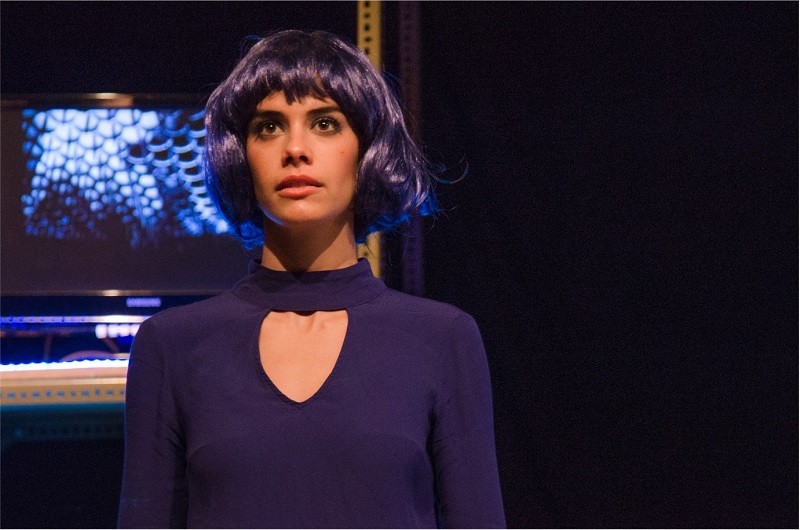
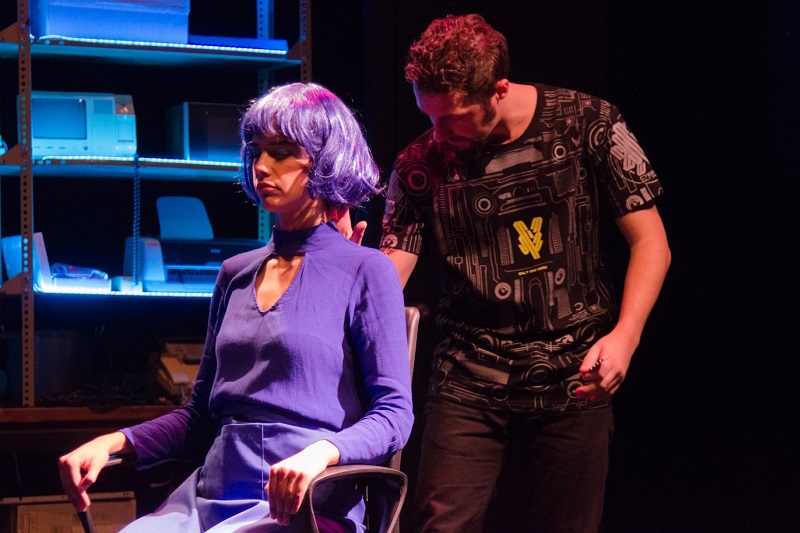
In Automata, the human characters are immersed in a hyper-biotechnological environment packed with enhanced virtual reality gadgets. Loosely inspired by Alan Ayckbourn’s Henceforward (1987),[1] this similarly dark comedy takes place in the near future, inside the windowless working studio of a residential apartment located on the derelict outskirts of a huge unnamed city. This room is filled with digital and electrical devices, a paraphernalia of screens, wires, keyboards, headphones, smart phones, digital boards, amid old computers, discarded crates and cardboard boxes. Ricky, a technological nerd, owns the place; he lives alone with Náná, a beautiful-looking automaton he bought sometime ago, back when he was married to Corina, to work as babysitter to their daughter, but which he reprogrammed after their divorce to serve as his housemaid and sexual slave.
Home in Automata is a superspace, a space that opens onto many virtual others, intersecting and fusing with them to the point where there is no personal intimacy left. It connects to screen views from the building to the run-down street outside, to surveillance city cameras, to state administration offices, to escort and call-girl facilities, to diagnostic and pharmacology services, to social media networks, and to a search engine that is always ready to activate and project images of the words or ideas being spoken in the room. There are invisible smart phones and supercomputers that can be operated through “ultrahaptics” (i.e., manipulated through vibrations from soundwaves alone) by simply moving one’s hands across the air. The overabundance of information in this environment has the effect of disassociating its dweller from his actual lived space, of confining him to a world of incessant communication that not only overheats his brain but also generates affective distance towards the real “other.”
Home in Automata is a hyper-technological uncanny place that reflects the moral values of a society centered on technological development, and thereby on a ceaseless investment on human “enhancement”. It has become a prison of convenience where there is no ecological diversity, and where everything is tailored to the preset habits and preferences of its lone dweller. Home in Automata is effectively un-homely: it is an uncanny place in the Gothic sense. As I mentioned elsewhere, when referring to the Gothic mode, the uncanny is not simply an experience of strangeness or alienation, but rather a conflating of the familiar with the unfamiliar (“The Gothic Uncanny”). If on the one hand we recognize the common actions of family drama in Automata, on the other hand that same image is surreally distorted, revealing the interactions between progenitors and their offspring as essentially destructive. The ethics of this future world is one of speed and eternal youth. Not only are there no aged people, due to the intake of hormones, replacement of organs, plastic surgery, implants and artificial joints, but children also take pills so as to quickly become autonomous and spare their families both time and money. Accordingly, Ricky’s daughter is a five-year old child in the mature body of a young woman: intellectually and emotionally underdeveloped, deeply damaged and unhappy, but technologically shrewd.
Patriarchal Technoscapes
Remarkably, in spite of being set in the future, the dwelling’s dynamics remains patriarchal: it is a utilitarian serviceable world where women, plants, animals and more-than-human matter are manipulated and put to use as commodities. Concerning the development of digital technology and of artificial intelligence, I suggest that we often neglect gender issues, thus overlooking the patriarchal structures of power and oppression inherent in them. As of the last quarter of the twentieth century, worldwide political administrations and tech corporations have regularly claimed that the advance of automation would enable humans in so-called developed countries to survive reasonably well on part-time jobs, with more time to pursue their personal interests and enjoy their leisure. The incredibly fast technological transformation of labor since then, however, brought with it not only more exploitation through excess working hours and low wages, but also rising numbers of unemployment and of human slave trade networks. This makes Lupus—Ricky’s only friend who never appears onstage, but always onscreen—remark earlier in the play:
I have nothing against synthetics, androids and humanoids but this is becoming chaotic. As you know, I no longer can find a job as a nurse, not even at the Euthanasia Clinic. And there’s so much work to do there! Thousands of people are admitted in the clinic every day, people who no longer have points-hours [Automata’s currency] to live on, and therefore are eager to receive the subsidy the State provides to their family in exchange for their voluntary self-extinction. It’s a million-point-hour business, Ricky. But they always prefer synthetic workers because they are safer and cleaner, they don’t drink, they don’t eat, they don’t defecate, they don’t breathe, they don’t feel, they don’t sleep!
Home in Automata is no longer a private haven, and even sexual caresses are recorded for future use in musical remixes. Considering himself a talented musical composer, Ricky considerably fancies smooth, passive and beautiful sexual robots rather than complex actual flesh and blood women. Sexual humanoid robots with womanlike attributes help maintain the patriarchal perception that a woman is a kind of object and that, as such, she can be easily substituted by a machine. Not only do humanoid robots serving as “intimate companion robots” (ICRs) reinforce solipsistic desires and lifestyles by enabling a form of empty contact, but they also erode human capacity for the emotional, social, and reciprocal complexities of human relationships (Harvey 89). Further, humanoid robots are able to withstand all sorts of abuse, allowing users to act out violent sexual behaviors. By allowing and encouraging such abusive treatment, robots designed with female features can obviously normalize aggression against women and reinforce sexist attitudes. In Automata, such an abusive relation becomes apparent in the way Ricky deals with Náná, e.g., using and discarding her at whim, as well as in his awkward avoidance of relationships with real women.
At the time I composed Automata, I was invited to integrate a workshop on Philosophy of Technology at CFCUL-Center for the Philosophy of Sciences of the University of Lisbon.[2] My communication revolved around humanoid robots, partly impelled by having heard the news of a humanoid robot named Sofia making her debut at the Future Investment Initiative (FII) summit in Riyadh, Saudi Arabia, where she was granted citizenship (“legal personhood”), and played to the expectations of the audience: “I’m glad to be among such rich and influential people.”[3] I was especially interested in investigating why robotics companies have been so intensely focused on making humanoid robots indistinguishable from humans, with a human-like body and a human-like face. Evidently, robots are quite useful in performing a multiplicity of dangerous, dull and dirty tasks, including in automotive and heavy machinery industries. But as of the late 2010s, robotics companies have invested a massive amount of money and research resources to achieve a hyper-realistic human-likeness in robots, aiming to endow them with a synthetic skin (or even a biohybrid skin grown from real human cells)[4] that mimics human body temperature, with realistic-looking hair, and with expressive facial mechanics that simulate human emotions.
This shift towards making robots appear “real humans,” much beyond industrial efficiency demands, is termed “emotional AI” and is allegedly aimed at fostering trust and social acceptance for caregiving service and customer-facing roles. Such declared aims obscure the fact that the manufacturing of sexual humanoid robots is rapidly evolving and constitutes a potential multi-billion euros industry.[5] Instead of encouraging and developing technologies that help mitigate and eventually eliminate power inequalities between women and men, an enormous amount of talent, knowledge, time and energy is spent in manufacturing sexual android robots to perfection. Most of these humanoid robots are stereotypical stand-ins for female humans (as well as for child-humans), confirming how our sexual economy is so deeply rooted in a monosexual culture in which the masculine is the norm, as feminist philosopher Luce Irigaray argues (Irigaray 171).
Automata’s world has apparently fulfilled to perfection the mechanistic model of nature held by seventeenth century scientists and philosophers, among them René Descartes who notably proposed the mind/body substance dualism, separating “high” reason from “lowly” body emotions. Viewed as mindless and inert, nature may be explained in strictly physical-chemical terms, and thereby quantified, predicted, exploited, manipulated. Associated to erratic emotions and bodily functions, both women and animals are relegated to an inferior status. Opposed to this patriarchal worldview, a constant menace threatens the hyper-tech rationalistic environment throughout the play, exerted by the so-called Luddite Foxes, a gang of women disguised as animals that are opposed to technological progress and ultimately manage to produce havoc in the end. Historically framed as anti-progress fundamentalists who destroyed industrial machinery, early nineteenth-century Luddites were skilled artisans who resisted against technologies that prioritized speedy efficiency and thereby turned human workers into mere parts of a larger mechanical process. In Automata’s final episode, the Luddite Foxes invade Ricky’s home following a widespread general blackout that affects the whole surrounding region, due to surging electricity demand and extreme weather.
Apparently aimed at reducing household energy consumption, the increasing use of digital technologies and AI automation in all fields of our lives, including in our “smart” homes, actually consume huge amounts of water and energy, to say nothing about the computers, tablets, smart phones and other gadgets used to operate these programs, which are made of plastic derived from fossil fuels and include as components heavy and precious metals, thus requiring energy-intensive mining. In that sense, and as I suggested elsewhere, theatre is a most significant medium to foster an eco-empathic environmental culture, by raising a much-needed awareness of how present-day ecological degradation is ascribable to an ideology of unceasing techno-economic growth, and to particular social practices, adopted collectively and at the micropolitical individual scale (Climate Theatre and Ecodramaturgies in the Anthropocene 36). In effect, as Val Plumwood remarks, when faced with an economic system that systematically destroys the earth’s protective shield and natural ecosystems, the solution to the problem is not about developing more technology, but rather about nurturing an environmental culture that situates humans as ecological and embodied beings (111).
An open letter against the uncritical adoption of artificial intelligence (AI), co-authored by a team primarily composed of women researchers from Dutch universities and signed by over 1,800 academics as of June 2025, argues that “under the banner of progress and efficiency” the AI technology industry aims to obtain market penetration and increase technological dependency, by “creeping into society through data colonialism” to steal data, thus manipulating results, reinforcing discriminatory practices and normalizing dominating hierarchies, “leaving the door open to pseudoscience, exclusion, and surveillance.” Although tech firms suggest AI technology can be used to mitigate the climate crises, it
directly causes environmental and social harms: water, energy, and occupation of land are all needed for data centres (…). Hence, we cannot remain complicit with the greenwashing rhetoric and actions of the technology industry. Resisting AI technologies means refusing to take a role in the continuing devastation of the environment and the exploitation of labour. (Guest et al.)
Although Automata does not directly address climate change, it becomes evident throughout the performance how the air outside is toxic, plants are scarce, and the city is practically deserted. As the following exchange between Ricky and a trans woman model, Ella, reveals:
ELLA – But where exactly is this? Where are we? The Miss Anonymous agency car had to drop me off a long way from here, near the 15th perimeter wall, and I still had to walk a long way because there’s no transport. Then I cut across a huge open field of ashy land packed with ruins and uninhabited buildings, without a single person in sight. Actually, it seems like nobody lives in your building either…
RICKY – Everyone fled. During the Great Fear. Apart from me, only a forty-year-old woman remains; I haven’t seen her in a year.
ELLA – During the Great Fear? I don’t remember. It’s not from my time.
RICKY – Of course it is. Don’t you remember when the nuclear reactors melted down?
ELLA – That was just now, a few days ago.
RICKY – Not those, some others. Closer to here.
ELLA – I don’t remember. (. . .)
RICKY – Want something to eat?
ELLA – Maybe.
RICKY returns from the kitchen with four tin packets of liquid.
RICKY – What flavor do you want? Goose Breast with Croutons on a Bed of Lettuce or Gourmet Chicken with Peanuts and Wildflower Sauce? There’s also one with Cow flavor.
ELLA – What does that taste like?
RICKY – Cow.
ELLA – What is that? (An image of a huge Swiss cow appears on the wall.) Oh no, please!
(Corrêa Automata)
As Automata progresses its dystopian narrative of hypertechnological place and space, it utilizes evocative images of the Climate Gothic mode that Linda Hassall proposes in her article on ecoscenographic theatrical atmospheres and climate-scapes (“Prophecy or Cautionary Tales?”), inducing geographic imaginings about the climate-affected planet, through damaged and uncanny landscapes, as provocation for spectating anxieties over imminent environmental collapse.
Conclusion
In several ways, Automata performs a critical reflection on contemporary mainstream technology and science, criticizing the patriarchal structures of dominance, marginalization, and oppression inherent in them. Indeed, it follows a powerful traditional critical view of technology that started at least since the Gothic-Romanticism of the late 1700s, which counters dominant beliefs about “progress” and the absolute benefits of science and technology, as if both were ethically and politically neutral.[6] Indeed, as I argue in Gothic Theory and Aesthetics:
it is interesting to note how the Gothic mode cyclically recurs in historical periods of social, economic and ethical crises, as a way of negotiating alterities (subjective, sexual, racial, political and social class), as well as to remind us that technoscience cannot ultimately dominate non-human Nature. (23)
In her “Manifesto for Cyborgs,” Donna Haraway has proposed that the natural and the technological are inextricably intertwined (65). My suggestion at the end of the Automata performance is likewise that humans, more-than-humans and machines are all actants, that we all make up an ecology of interconnected parts or of many “small agencies,” resulting in not so fully predictable encounters, but rather in open, non-linear, and complex ways. As Mbembe notes, “All critical reflection on technology must start from the relations between the living and matter” (41). The history of entanglement of humans with objects, especially with those that are the source and instruments of various forms of empowerment, requires that the reality of objects be rethought beyond human meanings and uses, in their own thingness or animate materiality.
In terms of dramaturgical and performance practice, in Automata I opted for an ecophilosophical approach or a comprehensive view that encompasses many ecological aspects other than the strictly “environmental.” In parallel with environmental concerns, an ecophilosophical approach relates to the psychic and political ecology of individual human beings as immanently environmental, and brings back to our current critical discourse the notion of subjective or micropolitical agency: of its impact on the microcosm of one’s home, on the larger structure of society, and on the macrocosm of the biosphere.
Giovanna Di Chiro argues that environmentalism’ s primary concern for “wild and natural” places helps perpetuate a “separation between humans and the ‘natural’ world.” She therefore proposes that ecocritical research include the places “where we live, where we work, and where we play” (300-301). Accordingly, an ecophilosophical approach calls for an awareness of how technology is shaping our homes, working practices and personal lives; and for an investigation of what are the actual agendas for so-called universal human progress. We should interrogate through theatre performance and criticism the ways virtual reality is being implemented through new technologies in domestic spaces, flattening every place into a homogeneous sameness accessed through a superspace, aiding in the control and surveillance of every individual’s most intimate aspects of life, and indeed turning home into an unwelcome site. Ideologically, such technological developments celebrate a “new enhanced humanity” but in fact aspire to a transhuman reality where we will have finally exceeded the limits of our biological nature.
Returning to Chaudhuri’s notion of geopathology at the beginning of this article, we urgently need to make our earth-home a space of psychic-physical flourishing and well-being – starting from the small scale of our dwelling to the macro-scale of the biosphere. Not only is environmental destruction connected to sexist oppression, but home should be an intimate and generative place of belonging for its individual dwellers. It should be, as ecofeminist Carol Bigwood proposes, a cultivating and constructing place where we touch and are touched, with touch being understood as “empathetic, tender, and questioning,” just as the flesh of our Earth is naturally empathetic (110).
To conclude, I want to cite playwright Edward Bond (1934-2024) when he cautions:
We evolved in a biosphere but we live in what is more and more becoming a technosphere. We do not fit into it very well and so it activates our biological defences, one of which is aggression (…). But a species living in an unfavourable environment dies out. For us the end will probably be quicker because the aggression we generate will be massively expressed through our technology. (53)
Remarkably, the dystopian technological landscapes of Automata are enacted in performance through some of the digital devices they propose to criticize, thus giving rise to a self-referential, meta-technological dramaturgy that contrasts and combines mechanistic apparatuses with human ‘lived’ bodies. Through this performance, the artistic team strove to make evident how the culture of everyday life has been subjected to utilitarian and technological criteria, to the point that people no longer feel at home both in their own lives and in the world they live in, so as to produce an awareness that we have to free ourselves of these roles as cogs in a seemingly boundless production-consumption system.
Note: A distinct and shorter version of this paper was presented at the IFTR-International Federation for Theatre Research World Congress on Theatre Ecologies: Environments, Sustainability, and Politics, National University of Ireland, Galway, online (during the covid pandemic), in July 12, 2021.
Endnotes
[1] Alan Ayckbourn’s Henceforward (1987) is a comedy centered on the dealings of a lonely composer (Jerome), living in a futuristic crime-ridden North London neighborhood, who attempts to regain custody of his daughter from his ex-wife by using a robot nanny (NAN 300F) to simulate a perfect and loving family. What interested me in Ayckbourn’s play was its comic tale of dysfunctional family and love interactions set in the far future. For Automata, I retained his refashioning of an android robot as a servant escort, as well as the play’s prescient warnings about how machines can replace human connection.
[2] Face – Mask – Avatar – Embodiment consisted in a three-day conference and Think Tank meeting co-organized by the Philosophy of Human Technology Research Line of the CFCUL at University of Lisboa (Portugal) and the Institute for Critical Theory and Institute for Performing Arts and Film at the University of the Arts, Zurich. It was held at Lisbon’s Fábrica Braço de Prata in October 25-27, 2017. See here.
[3] See Andrew Ross Sorkin, “Interview with Lifelike Hot Robot Named Sophia,” CNBC, YouTube video, 25 Oct. 2017 (accessed 26 Apr. 2026).
[4] Developed in 2022 by the Max Planck Institute for Intelligent Systems in Germany, through research merging bioengineering with robotics. Biohybrid skin equipped with sweat glands, hair follicles, and nerve-mimicking sensors has also been developed by researchers at the University of Tokyo in 2024 (see Ahmad Rafsanjani et al.).
[5] The global sextech market—which includes AI sex robot dolls—is projected to grow significantly, with some forecasts suggesting the industry may reach over $88 billion by 2030. See here. It is estimated that by 2050 we will see “relationship-free” human-on-robot sex overtaking human-with-human. See here.
[6] As Val Dusek explains in the introduction to Philosophy of Technology, both logical positivist and logical empiricist sciences reinforce the notion of science as neutral, and of technology as applied science. On the other hand, feminist, ecological, multiculturalist critics, and activists in indigenous cultures have exposed the pervasive bias in the methods and results of mainstream Western science and technology (24).
Bibliography
Bigwood, Carol. “Logos of Our Eco in the Feminine: Approach Through Heidegger, Irigaray, and Merleau-Ponty.” Merleau-Ponty and Environmental Philosophy: Dwelling on the Landscapes of Thought, edited by Suzanne L. Cataldi and William S. Hamrick, SUNY Press, 2007, pp. 93–116.
Bond, Edward. “Author’s Preface.” Lear, A&C Black, 2013, pp. 48–54.
Chaudhuri, Una. Staging Place: The Geography of Modern Drama. U of Michigan P, 1995.
Corrêa, Graça. “The Gothic Uncanny: Selected Mind-Images in Literature and Film.” Kairos: Journal of Philosophy & Science, vol. 22, 2019, pp. 179–204. DOI: 10.2478/kjps-2019-0014.
———. Gothic Theory and Aesthetics: Transdisciplinary Landscapes in Film, Theatre, Architecture and Literature. Caleidoscópio, 2020. DOI: 10.30618/9789896586508.
———. and Alexander Gerner, editors. Climate Theatre and Ecodramaturgies in the Anthropocene. Caleidoscópio, 2025. DOI: 10.30618/978-989-658-909-7.
———. “Automata.” Anthology of Plays II, Edições Húmus, 2026, in press.
Di Chiro, Giovanna. “Nature as Community: The Convergence of Environmental and Social Justice.” Uncommon Ground: Rethinking the Human Place in Nature, edited by William Cronon, W. W. Norton & Company, 1995, pp. 298–320.
Dusek, Val. Philosophy of Technology: An Introduction. Blackwell, 2006.
Guattari, Félix. Chaosmosis: An Ethico-Aesthetic Paradigm. Translated by Paul Bains and Julian Pefanis, Indiana UP, 1995.
Guest, Olivia, Iris van Rooij, et al. “Against the Uncritical Adoption of ‘AI’ Technologies in Academia.” 2025. DOI: 10.5281/zenodo.17065098.
Haraway, Donna. “A Manifesto for Cyborgs: Science, Technology, and Socialist Feminism.” Socialist Review, no. 80, 1985.
Harvey, Charles. “Sex Robots and Solipsism: Towards a Culture of Empty Contact.” Philosophy in the Contemporary World, vol. 22, 2015, pp. 80–93. DOI: 10.5840/pcw201522216.
Hassall, Linda. “Prophecy or Cautionary Tales? Australian Climate Gothic Drama and Mutating Climate-Scapes.” Critical Stages, no. 25, 2022.
Hassall, Linda, Tanja Beer, Saffron Benner, and Natalie Lazaroo. “The Flood Project: Thinking through an Applied Dramaturgy Framework for Community Regeneration.” Critical Stages, no. 28, 2023.
Irigaray, Luce. This Sex Which Is Not One. Translated by Catherine Porter and Carolyn Burke, Cornell UP, 1985.
Mbembe, Achille. The Earthly Community. Translated by Steven Corcoran, V2 Publishers, 2022.
Plumwood, Val. “Ecofeminist Analysis and the Culture of Ecological Denial.” Feminist Ecologies: Changing Environments in the Anthropocene, edited by Lara Stevens et al., Palgrave Macmillan, 2018, pp. 97–112.
Rafsanjani, Ahmad, et al. “Giving Life to Robotic Skins.” Matter, vol. 5, no. 7, 2022. DOI: 10.1016/j.matt.2022.06.006.
Sorkin, Andrew Ross. “Interview with Lifelike Hot Robot Named Sophia.” CNBC, 25 Oct. 2017. Accessed 26 Apr. 2026
Stevens, Lara, Peta Tait, and Denise Varney, editors. Feminist Ecologies: Changing Environments in the Anthropocene. Palgrave Macmillan, 2018.

*Graça P. Corrêa works as a theatre researcher, director, dramaturg, educator, and playwright. Affiliated with CET – University of Lisbon, she leads projects on eco-empathy through the arts (performance, theatre, and film). She holds a PhD in Theatre from the Graduate Center of the City University of New York, and a Master of Arts in Directing from Emerson College, Boston, as a Fulbright scholar. She also holds licentiate degrees in Architecture (University of Lisbon) and Theatre (ESTC). She has taught in both master’s and bachelor’s programmes at ESTC, as well as in PhD programmes at the University of Lisbon. Recent publications include “Theatre as Science: Performing Empathy,” in The Routledge Companion to Performance and Science (2025); “Empathy in Art and Science,” Global Philosophy Journal, vol. 35, no. 7 (2025); and the book Climate Theatre and Ecodramaturgy in the Anthropocene (2025).
Copyright © 2026 Graça P. Corrêa
Critical Stages/Scènes critiques, #33, June 2026
e-ISSN: 2409-7411

This work is licensed under the
Creative Commons Attribution International License CC BY-NC-ND 4.0.
