Thus Spake Wilson
Vēsma Lēvalde*
7 Solitudes. World premiere on March 20, 2026, at the National Kaunas Drama Theatre (Lithuania). Seen on March 29, 2026. Director, set and lighting designer Robert Wilson (1941–2025). Co-director and adapter Charles Chemin. Based on the poetry of Oscar Milosz.
As the audience take their seats, an elderly man in white make-up, dressed in a sacramental white robe, is revealed on the white stage. Sitting on a white chair, he reads from a small black book with a childlike, open mouth. Upbeat music plays in the background and, to its rhythm, the old man rocks his head and drums his feet in red slippers.
The silent figure played by Vladimir Sherstaboyev appears wholly absorbed in his own world. This wordless prologue introduces a production which, at first glance, appears to contain more spoken text than any other of Robert Wilson’s works. At the same time, Oscar Milosz’s poetry serves mainly as a symbol of immortal, supreme art, rather than being a driving force behind the plot. In 7 Solitudes, the artist is akin to Nietzsche’s Übermensch, whereas the actors must embody Gordon Craig’s Übermarionette—a paradoxical embodiment of autonomous self-creation realised through rigorous artifice.

Wilson chose to set his swan song to the oeuvre of Oscar Vladislas de Lubicz‑Milosz (or Oskaras Milašius, 1877-1939), the Lithuanian‑Jewish poet who wrote in French. Although Milosz and Wilson belong to different eras, their creative life stories share a certain genetic affinity: both are solitary, singular artists whose creative uniqueness and polyphonic vision compress time and space into metaphysical poetry; both are shaped by the condition of deliberate exile.
The production draws on texts from Milosz’s Les Sept Solitudes (1906), his poems written between 1895 and 1927, Les Éléments (1911), the plays Miguel Mañara (1913) and La Confession de Lemuel (1922), the philosophical poem “Ars Magna” (1924), and the Lithuanian folktales and legends Milosz collected (1930–1933). In this way the script spans Milosz’s entire oeuvre, fused with Wilson’s stage magic. For the production, the French‑born dramaturg, director and long‑time member of Wilson’s creative team, Charles Chemin, selected and arranged fragments of Milosz’s poetry, prose and fables. Chemin also served as co‑director, inevitably leaving his mark on the production, as he completed the staging after Wilson’s passing.
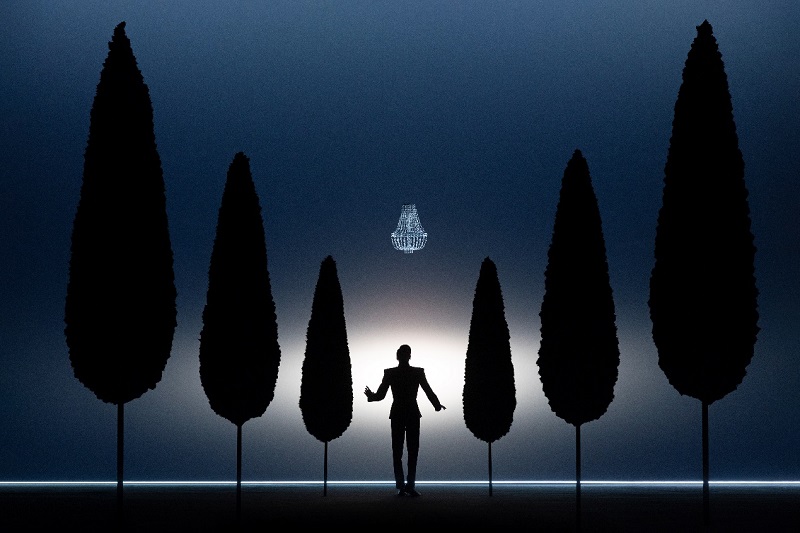
The first scene poses a sharp contrast to the prologue. In total darkness, the face of the protagonist, the Poet, emerges and recites verses about the autumn wind, falling leaves, the alienation of people, as well as the mystery of time and its restless passage. As the rhythm and vocal intonation shift, the pale, made‑up face appears in different parts of darkness, like Lewis Carroll’s Cheshire cat in Wonderland. This character, who clearly speaks on Wilson’s behalf through Milosz’s voice, is played by Dainius Svobonas, whose stage personae, even before his encounter with Wilson in Dorian (2023), belongs to a theatrical mode where appearance, gesture, mimicry, inner tempo and vocal modulation carry equal weight. Svobonas’ presence appears to be sketched—or rather, animated—within the scenographic space created by Wilson and Stephanie Engeln, and the lighting design of Wilson and Marcello Lumaka. Every gesture and facial shift resonates with the original score by Hans Jörg Brandenburg and with other sonic rhythms whose range is as startling as anything in Wilson’s oeuvre. Alongside Brandenburg’s music we hear lyrical clarinet lines from Syrian‑born Kinan Azmeh, where Eastern intonation meets Western classical and jazz phrasing; the sharp, energetic sounds of violinist Jennifer Koh; sacred music by J. S. Bach; Dickie Landry’s saxophone in blues inflections; and the rough, propulsive rhythms of Lou Reed.

Don Juan, rendered here by Gytis Laskovas, has become an iconic presence in world literature. In this production the creators define him as the Poet’s traveling companion, the embodiment of insatiable earthly desire. Yet it is perhaps more accurate to read Don Juan as the Poet’s alter ego—his inner antagonist in the liminal space between temporal longing and the metaphysical realm of eternity—if we accept the staging as Wilson’s self‑revelation and testament.
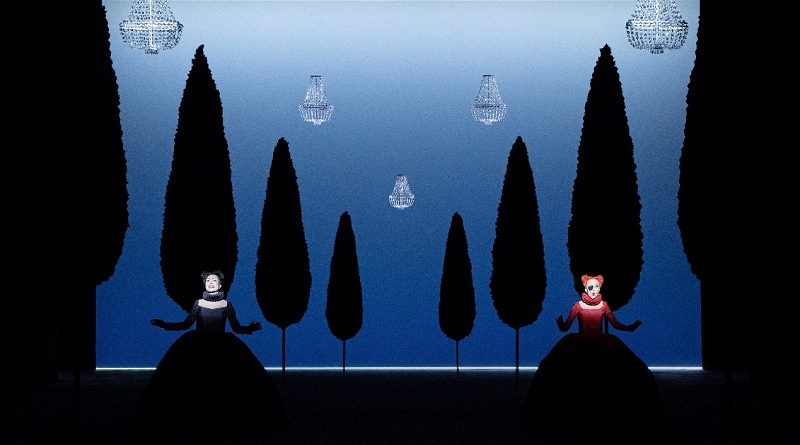
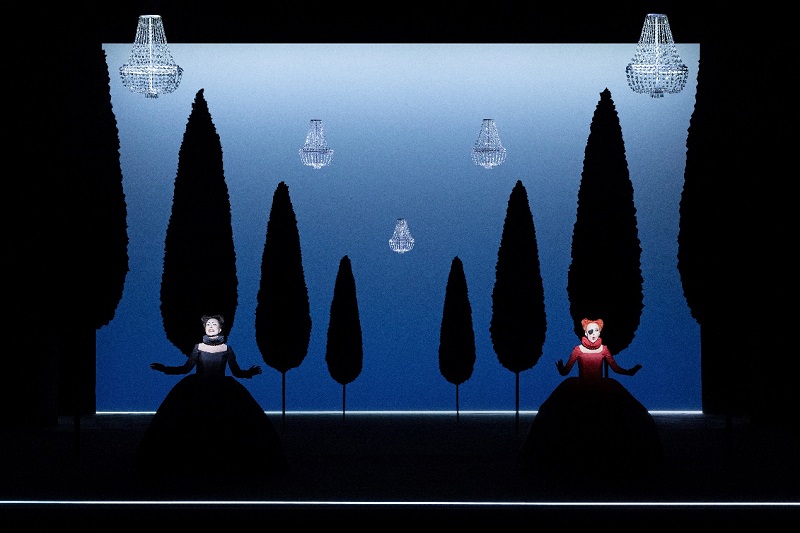
Essentially, the production functions as a journey through memory. Though it rests on new dramaturgical material, it strings together visual quotations from Wilson’s earlier projects—pale painted faces, avenues of trees, Baroque costume motifs—gestures that evoke a long artistic trajectory. One can only regret having seen but a few of those prior works; the riddle of intertextual reference therefore remains only partly solved.

Scenes unfold as kaleidoscopic compositions of clear colours arranged in precise geometric patterns. Costumes, make‑up, gesture and mise‑en‑scène assemble figures that seem at once familiar and wholly new, generating an original, previously untold narrative. On one level the staging literalises the Poet’s inner quest: the disembodied, shifting face and the puppet‑like old man stage disconnection between voice, body and identity, suggesting fragmentation, the theatricality of selfhood and the primacy of language as a site of being.
On another level the motley tableaux—Baroque‑striped costumes in black and red, painterly stage pictures and the Poet’s encounters with Don Juan and other characters—read as a ritualised journey from solipsism toward encounter and transformation. Every element seems calculated to merge into a perceived perfection, allowing the audience to inhabit an uninterrupted melodic flow—an aspiration reminiscent of Wagner’s Gesamtkunstwerk. In Wilson’s hands this ideal fuses with Gropius’s synthesis of the arts and with Steven Berkoff’s emphasis on physical expressivity.
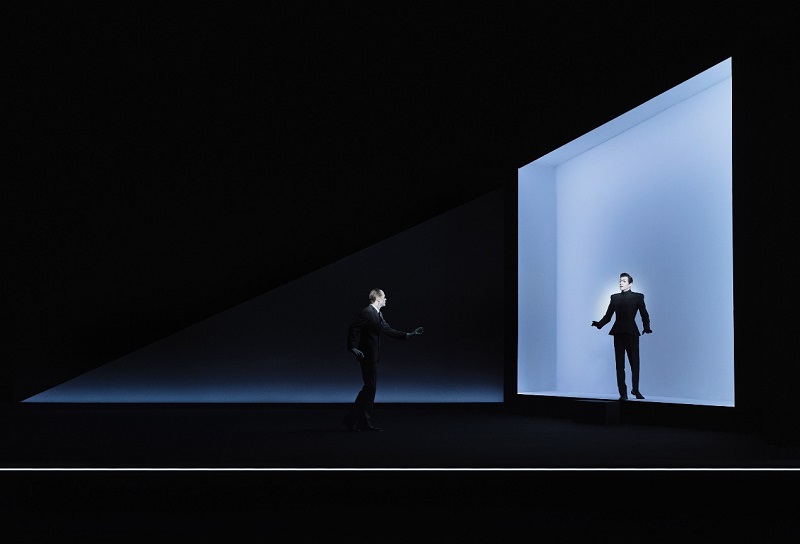
Throughout the performance, the play of binary oppositions never disappears—poetic words intoned in a harsh, anxious register; bright, pure colours set against black darkness; an asymmetrically delineated space; frozen figures framed against the raging ocean backdrop created by video artist Tomasz Jeziorski. Bach’s solemn music alternates with secular rhythms; interludes of Milosz’s lyric verse are punctuated by voice recordings in a domestic register. Even when the audience is presented with a completely white stage featuring white, frozen Lithuanian folklore figures—a bear and a bird—the palm trees and two white monkeys that wander in create a surreal atmosphere. It seems that the Poet and Juan, on their journey, have already crossed the boundary between life and eternity. Yet this is not the end: several more scenes follow, as if the creators hesitate to conclude until the Poet’s and Juan’s spiritual transfiguration—the relinquishing of human frailties and their becoming universal symbols of art—stands beyond doubt.
The final scene opens with an excerpt from Milosz’s essay ”Ars Magna” and contains phrases that also characterise Wilson’s views—referring to the concepts of time, space and matter, the Poet’s rhetorical question is posed: where are they to be found? He answers himself: in motion. “Something is moving, therefore something thinks, so I am.” Read through a Nietzschean lens, that movement is not mere escape but the labour of self‑overcoming—the solitary vocation by which the artist forges new value; the Poet’s obedience to himself echoes the free spirit who must learn to stand alone.
In the closing sequence, titled “Eternal Conversation with the Bird,” the Poet converses with Miglė Navasaitytė’s Bird. The final line of their dialogue is: “Everything was impregnated with another eternity”—an eternity accessible only to those with extraordinary talent.

*Vēsma Lēvalde (Dr. art.) is a Latvian theatre researcher and critic, associate professor at Riga Technical University (RTU) Humanities and Art Centre, and editor and author of the Latvian electronic theatre magazine KRODERS.LV. Her main interests include regional cultural history and its representation in contemporary drama, the digital age and media society, and the interpretation of classical texts in contemporary theatre. She is a member of the Latvian chapter of AITC/IATC. Contact: vlevalde@gmail.com; vesma.levalde@rtu.lv. https://orcid.org/0000-0002-0584-761X.
Copyright © 2026 Vēsma Lēvalde
Critical Stages/Scènes critiques, #33, June 2026
e-ISSN: 2409-7411

This work is licensed under the
Creative Commons Attribution International License CC BY-NC-ND 4.0.
