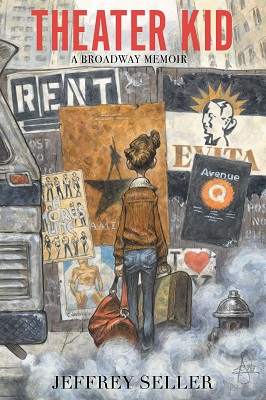
Theater Kid: A Broadway Memoir
By Jeffrey Seller
Simon & Schuster, 354 pp.
Reviewed by Lou Harry*
The Producer as Protagonist
Rent. Avenue Q. In the Heights. Hamilton.
Producer Jeffrey Seller is more than just one of Broadway’s leading hands-on hitmakers. With a guiding hand in two Pulitzer Prize winners and a stack of Tony Award scorers that have become part of the canon of American musicals, he has left an indelible mark on theater in New York and beyond. Chances are anyone living stateside has a production of one of the above within a few hours’ drive of their home on any given weekend, whether that is a national tour, a high school production, or something in between.
So it is no surprise that those interested in musical theater may pick up Seller’s memoir, Theater Kid, expecting a book packed with anecdotes and insight into how these and other shows come to be.
And the book gets to some of that in-the-weeds detail on the creation of those landmarks—eventually. But first, taking a cue from Moss Hart’s classic Act One, it focuses on the author’s backstory.
In this case, it is a very detailed and sometimes graphic account of his upbringing as a multi-level outsider (poor, Jewish, gay) in a Detroit-area housing project, his relationship with his erratic, financially irresponsible father, his first joy at watching the televised Tony Awards—particularly a number from Evita—and his discovery of theater through a synagogue Purim spiel and summer camp jobs.
Just past the 100-page mark, during his camp-counseling years, he is interviewed on local TV:
–Jeff, I understand you’ve been working with these kids all summer… What makes theater so special?
It gives them a chance to make something. It’s not easy, it demands creativity and commitment.
–What do they get from this?
It forces them to work together. They discover they can achieve more together than they ever could by themselves.
Putting aside the question, endemic to many memoirs, of how dialogue from decades past is remembered with such clarity, the lengthy build-up to his first encounter with Jonathan Larson may encourage some skipping ahead. That is no slight on the quality of the writing—it is lucid and layered—but it carries an expectation that what is of primary interest is Seller’s personal life rather than his professional work.
The limbo between amateur hour and blockbuster success provides some insight—and good stories—via an area of show biz rarely, if ever, written about. The ambitious young man, eager to land work in the theater business, finds work as a show booker in the offices of Fran and Barry Weisler. The dynamic duo, best known as the folks behind the record-setting (and still-going) revival of Chicago, at the time were producing a Cabaret revival with Joel Grey, a Robert Goulet South Pacific tour, and more. Sitcom-level conversation peppers this section, and Seller displays his confidence with a willingness to spill tea. For instance, when working with the Weislers’ proposed stage version of the movie Hans Christian Andersen, to be directed and choreographed by Tommy Tune, he writes:
Tommy recruits pal Maury Yeston, who helped save Grand Hotel, to write a new book, which is strange because Yeston is a composer, not a playwright… The exposition is flaccid, there is no major dramatic question, and the show feels purposeless. It’s inert.
After more remarkably remembered conversations, details of his romantic and sex life with composer Andrew Lippa (they are still friends), and a side trip via the Outward Bound adventuring program, it is not until page 191 that Seller checks out a monologue show called Boho Days, the early version of what would become Tick, Tick…Boom!, opening the door to a relationship with upstart composer Jonathan Larson.
A few chapters later, after a side trip to Seller’s involvement in the hit novelty production The Real Live Brady Bunch and a new job where projects include a tour of Cinderella on Ice with Olympians Tai Babilonia and Randy Gardner, he gets to the evolution of Rent (page 233).
In the chapters that follow, while worshipful of what the show eventually became, Seller is not shy about taking credit for guiding it to its destination, making key suggestions along the way. The world tends to anoint a single person as the creator of a work of art—we think of it as Jonathan Larson’s Rent, not Larson, Seller, McCollum, Gordon, Skinner, New York Theater Workshop, et al.’s Rent. But theater, as practitioners well know, is very different from, say, Vincent van Gogh and his iris oils.
After a reading of Rent, Seller notes: “This cycle of songs does not electrify. It numbs. It feels like we are lost in the East Village and cannot find a way out… the first act drones on, clocking in at over ninety minutes.”
Later, after further changes, Seller composes a letter to Jim Nicola, artistic director of the New York Theater Workshop, in which he states, “This new version of La Bohème is three times more complicated than the original and sometimes incoherent… I think the piece is begging for heavy editing, some thoughtful scene shuffling, and a couple new songs… It demands dramatic discipline.”
As we all know, things eventually worked out with that little show that could—except for one major exception.
Jonathan Larson’s death just after the final dress rehearsal is the stuff of theatrical legend. Seller’s play-by-play of the hours and days that followed is, as one would expect, shared in heartbreaking detail.
Unfortunately, the other three landmark musicals mentioned above—Avenue Q, In the Heights, and Hamilton—are consigned to the final fifty pages of Theater Kid, leaving less room for the kind of detail theater lovers may be seeking. For Avenue Q, there is as much attention focused on Tony Awards campaigning as there is on the production. And there is no mention of the controversial decision to forgo a national tour and, instead, open a sit-down production in Las Vegas. There is a brief section on In the Heights that feels top-of-the-head. And the single Hamilton chapter reads like a placeholder.
The uninitiated may finish Theater Kid believing that Seller produced nothing but hits. But in and around the blockbusters and award-winners, he also produced High Fidelity (18 previews, 14 performances) and other shows that came and went quickly, including The Last Ship (with a score by Sting), The Cher Show, and a Broadway mounting of La Bohème directed by Baz Luhrmann.
And no doubt there were other would-be Seller productions that did not make it to the stage.
Anyone who has read stage director Jack O’Brien’s Jack in the Box: Or How to Goddamn Direct, or Hal Prince’s Sense of Occasion, or listened to an episode of Rob W. Schneider’s podcast Broadway Bound: The Musicals That Never Came to Broadway, knows that thoughtful insight into what did not eventually work can be as insightful, instructive, and entertaining as the stories of those that did.
While brightly written and emotionally open as a coming-of-age/how-I-made-it hybrid, without much to balance out its look-what-I-did-ness, Theater Kid feels like a workshop or two shy of reaching its full potential.
Bibliography
O’Brien, Jack. Jack in the Box: Or How to Goddamn Direct. Farrar, Straus and Giroux, 2022.
Prince, Harold. Sense of Occasion. Applause Books, 2017.
Schneider, Robert W. “Broadway-bound: The Musicals That Never Came to Broadway.” Broadway Podcast Network, n.d., podcast.

*Lou Harry’s books include Creative Block (Running Press), Kid Culture (Cider Mill Press), and The High-Impact Infidelity Diet: A novel (Random House) and his produced plays include Rita from Across the Street (American Lives Theater), Going Solo, or Another Song That Isn’t About Danny Koppell (SiteLines Indy) and Popular Monsters (Catalyst Repertory). The editor of Quill, the magazine of the Society of Professional Journalists, he currently serves as vice president of the American Theater Critics/Journalists Association.
Copyright © 2026 Lou Harry
Critical Stages/Scènes critiques, #33, June 2026
e-ISSN: 2409-7411

This work is licensed under the
Creative Commons Attribution International License CC BY-NC-ND 4.0.
