
Technological Weavings: The Good, The God and The Guillotine
Jane Turner*
Abstract
This article examines the collaborative development of The Good, The God, and the Guillotine, a multimedia adaptation responding to Camus’s L’Étranger. Drawing on practice-based research and ethnographic observation, it analyses how intermedial dramaturgy emerges through the collision and convergence of distinct artistic form. Extending Eugenio Barba’s concept of concatenation through the notion of “raw dramaturgy,” this article argues that productive friction between collaborators generated the production’s aesthetic and phenomenological impact. Rather than seeking cohesion, the project foregrounded sensory disorientation and alterity, offering audiences an embodied experience of absurdity, mediation, and technological estrangement through multimedia performance and dramaturgy.
Keywords: raw dramaturgy, intermediality, collaborative adaptation, phenomenology, absurdism
There is a sense of indifference to the world; it is as though disorientation has become a normative condition. For Camus in the 1950s, the condition of modern humanity was that of an outsider; for him, the human condition was on the brink, so that the moment of death provided the most intense experience of life; this is the ultimate paradox, at the core of his novel L’Étranger.
L’Étranger, or The Outsider, was the catalyst for a creative collaborative project that culminated in a multi-media production titled The Good, The God, and The Guillotine. This article charts the creative development of a collaborative theatre project, particularly focusing on the adaptation and dramaturgical strategies engaged with that generated creative collisions and convergences, enriching the audience’s sensorial experience. This article makes a specific scholarly intervention in current debates around intermediality, collaborative dramaturgy, and practice-based adaptation. Drawing on the concept of “raw dramaturgy” introduced below and extending Barba’s notion of concatenation, it argues that the production’s aesthetic emerged not from a unified dramaturgical vision but from productive friction between distinct and uncompromising creative strands. In doing so, it moves beyond production documentation to propose a model of collaborative intermedial practice in which collision and convergence are not incidental features but constitutive of the work’s meaning — thereby contributing to the field’s understanding of how practice-as-research methodologies generate new dramaturgical knowledge.
In The Myth of Sisyphus, Camus comments on humanity’s dilemma, saying,
A world that can be explained by reasoning, however faulty, is a familiar world. But in a universe that is suddenly deprived of illusions and of light, man feels a stranger. His is an irremediable exile, because he is deprived of memories of a lost homeland as much as he is deprived of the hope of a promised land to come. This divorce between man and his life, the actor and his setting, truly constitutes the feeling of Absurdity. (Esslin 23)
Camus’s comments here are inherent to the performance of The Good, The God, and The Guillotine, where, using a combination of simultaneously developing scores, including a lighting score, an animated score, three distinct musical scores, alongside three acted scores, the world experienced by Mersault is presented as both faulty and familiar. He is a stranger both to himself and to those around him. The sense of absurdity and strangeness is exacerbated as the voices of the three ‘singers’ are controlled, manipulated, and disembodied by the three laptop musicians who shared the stage space.
While Camus is mainly known for his novels and philosophical writings, according to Freeman, it was in the theatre that he found the greatest satisfaction. He wrote plays and also worked in Algerian theatre as an actor and director before staging his own work in Paris. Freeman notes that Camus sought myths suited to “an age which lacks a fundamental religious sense of awe” (3), and that his two governing themes were the absurd and a metaphysical revolt — not revolution, but a refusal to accept the absurdity of existence. The avant-garde style of theatre that Camus sought to realize became known as absurdism, but Freeman and Esslin both conclude that, while Camus successfully articulated the absurd as a condition in his writing, he failed to realize his ideas in his attempts at theatrical form. The collaborative project focused on here inadvertently took up Camus’s mantle by challenging the myth of technology and revisiting the notion of revolt as an aspect of the absurd.
Martin Esslin, in his book The Theatre of the Absurd, states that Camus’s notion of the absurd underpins the way in which it is used in conjunction with the Theatre of the Absurd; however, a key deviation is that, while Camus fails to present absurdism in theatrical form, Camus discursively expresses the ideas in the content of his writings. The Theatre of the Absurd merely presents the absurdity of human existence as intrinsic to its form. As Esslin hints in the final pages of his book on the Absurd, what may be beyond the Absurd may be found in the Happenings of the 1960s; in turn, the Happenings have impacted current trends evident in contemporary theatre, thus there is a lineage from Camus’s avant-garde attempts to express a theatrical form that could articulate his ideas and our staging of his novel L’Étranger.
This theatrical collaboration involved Proto-type Theatre and Manchester Metropolitan University laptop ensemble (MMUle). The project set out to explore the potential of interactivity across myriad artistic forms, without requiring any one form to creatively compromise or become subservient to the others. Thus, through performance exchange, the project attempted to apprehend and exploit the potential for formulating a new performance aesthetic.
The Good, the God, and the Guillotine defied categorization because of the innovative, creative strategies employed in its creation. Finally, for marketing purposes, we called the project a “music driven” theatre performance that exemplified many of the challenges and opportunities that existed in the creative process, which engaged with translation (translating the Camus text of The Outsider/L’Étranger), adaptation (the process of adapting the text from page to stage) and dramaturgy (the development of a shared aesthetic and performance language).
There was never any intention to adapt or translate the novel conventionally; one of the project’s aims was to offer a response to it. The Good, The God and The Guillotine was a performance project specifically interested in exploring collaborative approaches to making performance, and thus notions of collision and convergence were integral to the raw dramaturgy that evolved and was manifest in the performance that toured the UK in 2012-13.
The collaboration involved artists from a laptop music ensemble (MMUle), a theatre company (Proto-type Theatre), an animator (Adam York Gregory), and a lighting artist (Rebecca M. K. Makus). I refer to raw dramaturgy as the complexity of the performance project that left the dramaturgical decisions in flux, negotiated with each performance as the collaborators (the insiders) gained further insights into the object they had created and the opportunities it offered.
The relationships between collaborating artists and their dramaturgical responses were foregrounded for the audience as a hypermedial text, producing what might be described as an intermedial, cacophonous experience of sound and visuals — a dramaturgical concatenation. This complex network of relationships is the focus of this article.
As an ethnographer (sitting in on the project’s creative process), I was interested in critically tracking the collisions and convergences among the collaborators and the transformation of the source material into a performance event. I was interested in the diverse ways in which the extended metaphor of The Outsider, resonant in Camus’s novel’s source material, was engaged with through the creative process and impacted the audience’s experience, so my writing offers both an insider’s and an outsider’s perspective. I was the literal outsider – initially an ethnographer observing a creative performance making process, latterly, by necessity, I became involved in a dramaturgical capacity for the final devising and rehearsal periods, thus my position shifted, from one of observing and documenting from the outside, to what might be described as a liminal betwixt and between position, whereby I was both inside and outside the event. The “outsider” metaphor was an evident pathway for me to follow, as not only was it inherent in the text that became The Good, The God and the Guillotine, but it was also evident in the collaborative negotiations that existed between the artists who all, in different ways, were “outsiders” to each other.
Methodologically, this study is situated within practice-based research and employs a reflexive, ethnographic approach (cf. Conquergood; Haseman). Data were gathered through participant observation across five blocks of research and development, supplemented by production blogs, rehearsal documentation, and post-performance reflection. As my role shifted from external observer to embedded dramaturg, the evidentiary basis of the analysis became experiential, performative, and observational — what Nelson terms “inside practice knowledge.” This methodological liminality, occupying a position simultaneously inside and outside the creative process, is itself analogous to the “outsider” metaphor central to the production and enables the dual analytical perspective that structures the analysis throughout this article.
In 2011, the collaborators embarked on a process of creative collaboration with the aim of producing a new performance work that, at first, we all thought might be termed opera or “composed theatre.” The project was developed over two years and comprised five blocks of creative research and development, culminating in performances in 2013 and 2014. Three of the blocks of time were 4-6 days long, and two were 2 weeks long.
The project was initiated by Peter S. Petralia, then director of Proto-type Theatre, who had held a long-term desire to work theatrically with Camus’s novel and had composed a form of written adaptation: this was the first strand, the first dramaturgical response that was informed both by his reading of the novel in his late teens and resonant images on the internet of mountains of digital detritus; waste piles of mobile phones. An underlying theme emerged, one that intensified with the impact of technology on the human condition, as a form of controlling deity. Petralia’s adaptation of Camus’s novel was, like the novel, divided into eleven Chapters but also included a Prologue and Epilogue.
Following an initial intensive week of research and development where the collaborators began to get to know each other and began to form creative dialogues through experimental play, the second block of research and development saw the introduction of the written score and “Chapters” were distributed to the three composer/musicians who then were tasked with transposing the text into song and laptop compositions for the three “singers.”
The “Prologue” identified the narrative weave between the loss of faith in a Christian God, the usurpation of faith by science, in the form of disenchantment, and the resultant deifying of technology. An extract from Petralia’s text follows:
tgtgatg
tgtgatg
(Thymine Guanine Thymine Guanine
Adenine Thymine Guanine)
The Good
The God
And
The Guillotine
A man (a man)
No, a mother (a mother)
Dies
A man (a man)
Her only living son
Walks through life
Floats through life
A man (a man)
Kills a man
It is not clear
If he means too
A man (a man)
No, a dna strand (dna strand)
Dies
We’re only strands
We’re only cells
A man (a man)
Doesn’t need any god
To live his life
What happens now
Happens now
It doesn’t happen twice
We’re only strands
We’re only cells…
The Good
The God
And
The Guillotine
The tgtgatg, as well as being the initial letters of the title, also link with the chemical compounds that constitute DNA; tgtgatg was scored for the ‘singers’ in a style derived from tabla rhythmic counting that formed a foundational rhythmic layer onto which other textures could be added. Here, the theme of human existence begins to be explored in relation to chemical compounds found in DNA strands; existential elements such as the paucity of existence—“we live, we die”—are laid bare, and the metaphor of strands (of theatricality, of DNA) is introduced. Martin Blain was charged with setting the text to music and chose to only orchestrate the three voices of the “singers.”
The composition was arguably the most challenging section for the ‘singers’ as it required them to create unusual harmonies and three-note chords derived from an unconventional octatonic scale. The chords do not resolve in a conventional manner, and thus sound strange or alienating. Dramaturgically, this device was used not only for its strangeness but also to expose the vulnerability and fragility of the human voice, especially given that none of the performers was formally trained. The voices attempted to collectively create a chorale emulating church bells tolling for the demise of human existence; an ethereal sound that juxtaposed with the disenchantment with a fundamental and totalizing belief system. The score used both the individual speaking voice and the collective chorale, a strategy that highlighted the stranger’s and outsider’s inherent ideas, which would be played out in the other dramaturgical scores.
The text for the first chapter of the performance was probably the most evidently and recognizably connected to Camus’s novel. “Chapter 1: The Long Walk” contains the novel’s well-known opening lines, which concern Meursault’s mother’s death. Each of the laptop performers offered a distinct stylistic interpretation of the “Chapters.” Paul J. Rogers, the composer of “Chapter 1: The Long Walk,” produced a score that integrated live sounds produced by the two female singers, captured live and manipulated by the laptoppers, then played back as an additional sound channel that further enriched and intensified the sound composition for the chapter. Rogers’s aim was to simulate a sense of time slowed, frustration with waiting, and the stifling fug of the chapel of rest; the male performer’s voice was processed to sound as though it was being heard through a radio: compressed, distant, strained. An abridged version of the text for the “Chapter” follows:
I got a telegram from the home ‘Mother deceased. Funeral tomorrow. Faithfully yours.’ That doesn’t mean anything. Maybe it was yesterday
Footsteps to the bus. Sputtering engine.
“I suppose you’d like to see your mother.”
Footsteps through the courtyard. Lots of old people chatting in little groups, like the sounds of parakeets. Of parakeets. ‘keets.
Having this presence breathing down my neck was starting to annoy me. The room was filled with beautiful late afternoon sunlight.
I couldn’t breath. He couldn’t breath. The sound of hornets hitting the glass roof repeatedly. Buzz. Buzz.
Night had fallen suddenly. Darkness had gathered, quickly, above the skylight. The caretaker turned the switch and I was blinded by the sudden flash of light.
He smoked a cigarette, together. We drank coffee. There was humming, matches, knitting. It was night time creaking chairs. It was voices, shadows, women in aprons. It is silence.
Soon one of the women started crying. She was in the second row, hidden behind her companions, and I couldn’t see her very well.
Sobbing. Odd rustling, then sobbing. Are these women here to judge him? Sobbing. Odd rustling, then sobbing. She kept crying.
Then she finally shut up.
All these smacking noises (old people sucking the insides of their mouths). So annoying…
Monsieur Perez. His lips were trembling below a nose dotted with blackheads. Strange, floppy, thick-rimmed ears stuck out through his fine, white hair, and I was struck by their blood-red color next to the pallor of his face.
Footsteps. Rustling through the grass. Rustling through the hum of insects. The hum of insects. Through the unbearable heat. Mumbling words.
“Is that your mother in there?” I said, “Yes.” “Was she old?” I answered, “Fairly”
She’s dead. ln a casket, locked with screws. She’s dead. In the burning sun. The tar of the pavement melted under the heat. The footsteps. The footsteps squealed on the tar. On the tar of the pavement which had melted under the heat.
I felt a little lost between the blue and white of the sky and the monotony of the colors around me-the sticky black of the tar, the dull black of all the clothes, and the shiny black of the hearse.
Pounding blood. Footsteps on the long walk. To the church.
“If you go slowly, you risk getting sunstroke. But if you go fast, you work up a sweat and can catch a chill inside the church.” She was right. There was no way out.
Rogers’s preparation for the project was to note each reference in Camus’s novel to sound; similarly, Makkus produced a list of all the references to light. These lists served to inform the dramaturgical scores throughout the devising process and were Rogers’s preparation for the project consisted of noting each reference to sound in Camus’s novel; similarly, Makkus produced a list of all references to light. These lists informed the dramaturgical scores throughout the devising process and were particularly evident in “The Long Walk.” Rogers was keen to compose a sound score that was an integral part of the landscape of the performance rather than merely a musical glue. He notes that, as both composer and performer, he, Blain, and Donovan were operating simultaneously in both diegetic and non-diegetic contexts. They shared the stage throughout the performance and openly acknowledged each other and the three “singers,” thus, they occupied the same fictional world, but they were also outside it as technicians who, like puppeteers, controlled and manipulated it. Rogers’ aim was to integrate both the internal sound world of Camus’ characters and situations, as represented by the “singers,” and the dramatic mood painting for the external landscape. This dramaturgical strategy — dispersing Camus’s prose across competing sensorial media — directly advances the chapter’s central argument: that collision between discrete creative strands is not a failure of cohesion but the primary means by which the production generates its intermedial meaning.
The process of storytelling might be understood as transmedial. Following Hutcheon , the storytelling here is transmedial: the integral elements of the fiction are dispersed across multiple media, generating simultaneous dialogues with the source text. These dialogues were not just developed in the space but pre-existed: Camus’s text already exists in a network of cultural, social, and political dialogues. In particular, the charge against Camus that The Outsider constitutes an inherently colonial and racist text, particularly because the figure of “the Arab” in the novel is not named. In this instance, the treatment of the text provokes a sense of dialogic transposition whereby Camus’s text is acknowledged but radically transformed. There is a reformatting of the prose by the lighting designer, animator, and composers whose texts continually compete and collide in the performance space. The audience’s experience can be described as a “palimpsestuous intertextuality,” a phrase borrowed from Hutcheon (21) that usefully captures the flux and flow of intertextual references across and between the worlds of The Outsider and The Good, The God and The Guillotine. It is in this dialogic space that, whether the audience is a “knowing audience” (fully aware of Camus’s novel) or an “unknowing audience” (Hutcheon 121), that the killing of the Arab inescapably has resonance with current global politics; however, this is one reading amongst many competing interpretations as the coherence of the schemata is orientated around the function of digital technologies and the effacement of ontological presence. The world here is a heterocosm, an “other world” that depicts and plays out the impingement of technology, the effacement of the individual, and the notion that as human beings we have become merely an extension of technology.
Like the composers, the animator (Adam York Gregory) was charged to create animated responses to each “chapter,” and Rebecca M. K. Makkus set about generating a lighting score and creating light objects. These composed/made responses emerged, were thrown out, re-composed, and refined over the following 12 months. Both York Gregory and Makkus (associate artists with Proto-type Theatre) were interested in using their animated and lighting scores to evoke a heightened sensorial experience for the audience. York Gregory wanted to play with the audience’s sense of space by creating depth and intimacy, as well as disorientation, using both a front projection onto a scrim and a back projection onto a screen.
The audience’s sensory identification with the “singers” was further exacerbated by the use of base speakers positioned to produce reverberations that could be tangibly felt by the audience. York Gregory commented that the dramaturgical weave produced a form of “group synesthesia: Transmuting text to sound and sound to image and movement.” As a lighting designer, Makkus stated that it was unusual to be afforded the opportunity to develop a lighting response that was not purely pragmatic. Thus, the lighting score included a range of surfaces that were used to reflect what became intensely bright light, as well as light objects that were lowered into the space and swung like pendulums, light boxes that switched from white light to red light (activated by the musicians thumping the top of the boxes, thus also creating a sound and violent movement that further compounded the effect).
Following the design of the boxes that utilized three rows of three lights, suggestive of a digital circuit board, masks were also designed and worn by the “singers” during “Chapter 10.” The masks flickered and flashed following minute gestures made by the “singers” (the masks were movement sensitive and were operated by the “singers” who wore specially designed gloves). While the audience observed the encroaching technology literally taking over the bodies of the “singers,” paradoxically, it was also made acutely aware of the live-ness of the ‘singers’ as the lights continually tracked their slightest movement.
The musicians were all using Max MSP as a compositional tool and built bespoke software patches for each of the Chapters. These “patches required complex coding that had to be stabilized and repeatable in a live performance context, as well as shared with the other two composers/performers. The patches incorporated found sounds, electronically generated sounds, sound captured live in the moment of the performance, treated, and then played back. There were various moments in each performance that allowed the composer/performers to improvise with the collected sound palette. The overall sound score, while incorporating their different approaches to composition, was layered along with a visual aesthetic devised by the animator and lighting objects conceived and built for use in the performance. The result is an experience that challenges the audience to locate a spatial and aural perspective.
The performance is relentless in its pace and intensity; there are rarely moments of stillness or silence that might allow an audience to pause and reflect. Whilst the audience were sat in a conventional configuration in relation to the stage space, the front of the stage was covered by a huge encompassing wall of scrim onto which York Gregory projected images that at times offered a literal visualization of the events in the novel but at other times served as a further elaboration of the “outsider” metaphor and further, and perhaps most importantly, generated a sensorial experience that many audience members described as “overwhelming” and “disorientating,” thus providing the audience with a visceral experience of being an ‘outsider’ overwhelmed by the inescapable forces of technology.
While it is possible to identify an overarching dramaturgy, it remains largely unformed, unresolved, and emergent: each collaborator retained agency of their own textual thread. Blendings were the result of the performers recognizing moments in the performed score they could incorporate, respond to, reflect on, etc.; thus, throughout the tour, the text continued to mutate at a smooth level but remained constant at the striated level: terms I will return to later in the article.
Nick Donovan elected to compose a score for “Chapter 2: Her Hand.” As the ‘singers’ could not read notated music, the composers were charged to find effective and, in this instance, innovative ways of enabling the “singers” to learn the music and scores. Donovan created a graphic score (Fig. 1) used to help the “singers” follow the passage of sounds. For the most part, the composers taught the melodies through a process of singing: the “singers” repeated, then recorded, then listened and repeated until the melodies had been learned. In this instance, an additional instrument was introduced into the performance space. Donovan built a MaxMSP “patch” to run on his computer tablet to be “played” in the space, “dueting” with the “singer” Leentje van de Cruys. He used the tablet to capture her voice and then shape her voice as it was played back to her. Her digitally processed voice was thrown back in a taunting or teasing manner, further underlining the challenge the ‘singers’ had of retaining subjectivity. As Baudrillard pointedly remarks, “it is the simulation that is effective, never the real” (56).
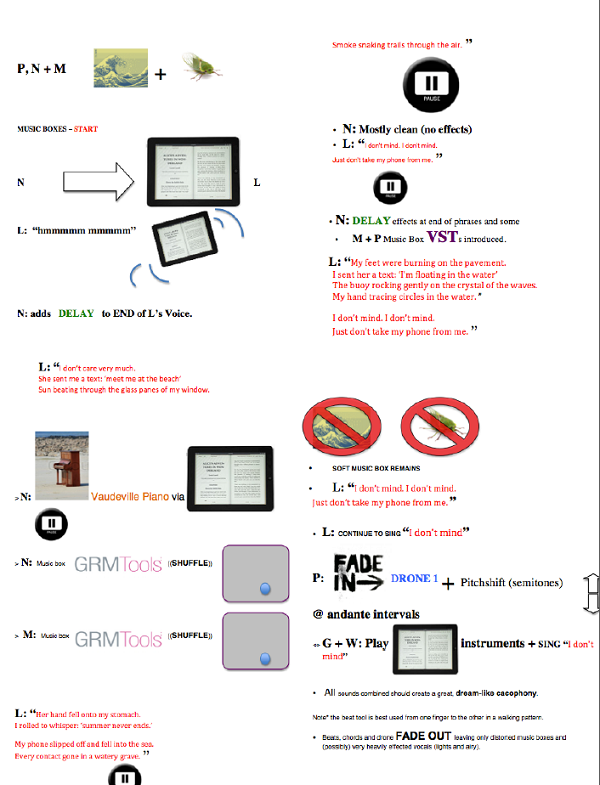
Donovan’s Graphic score effectively used visual representations of the sounds that would be heard, for example, the sea and insects. In addition, it identified the use of instrumentation, here, Donovan’s tablet device. The score operated on many levels as it quickly enabled the “singer” to locate herself in the score (the singer’s text is in red); in addition, it provided a visual text that detailed the range of sounds and the effects being used to manipulate these sounds.
The creative processes discussed thus far reveal strands of interest that the collaborators explored and exploited. These can now be identified but not reduced to relationships between transmediality, hypermediality, and intermediality. The story was treated transmedially (transposed into light, organised sound, image, and vocality); it produced a hypermedial text through the simultaneous convergence of media in non-linear experience; and it generated intermediality in the sense that distinct media were experienced as converging within the event — what Barba calls concatenation, the weave of dramaturgical strands.
As Kattenbelt states, intermediality allows for,
new principles of structuring and staging words, images and sounds; new ways of positioning performing bodies in time and space; of creating time-space relationships; of developing new modes of perception; and of generating new cultural, social and psychological meanings. (21)
In this instance, concatenation, the non-linear dynamics of the intermedial space, allowed for the different art forms to work to generate both an event that appeared cohesive but, within the event, also generated disjunctively placed worlds created by the audio, animations and live performance actions.
In addition to the multiple surfaces used for projecting animated images, the space also contained surfaces for reflecting and intensifying light; surfaces that replaced the singers’ faces with masks that suggested that they/we had become extensions of the machine. These particular images were replicated on the projections, where the silhouetted figures of the performers were also replaced by images where the head was replaced by a square containing nine evenly spaced circles evoking some sort of digital circuit board; there were also surfaces that projected and opened up other spaces, for example, the live stream of the laptop screen: a virtual space that provided the audience with a vantage point on a space that was made visible but not accessible: reinforcing the Baudrillard’s idea that we no longer live in reality, but in images or representations of reality.

This idea of being trapped between the real and a simulation of the real was further substantiated by the singers’ entrapment between reflecting surfaces that obscured their presence and also denied the audience access into a world that was already mediatized (Fig. 2), or, to follow Baudrillard, the real here is constructed by the simulated. All of these elements re-articulated the metaphor of the Outsider being pursued by the collaborators. The dramaturgical strata constructed by the musical soundscore, the animations, and the lighting conspired to obfuscate, digitally manipulate, and replicate elements of the real. The result was an effect that paralleled and/or responded to the novel: the “singers” have a flattened appearance, and their voices were captured, manipulated, and distorted, affecting a sense of effacement, simulation, and disembodiment.
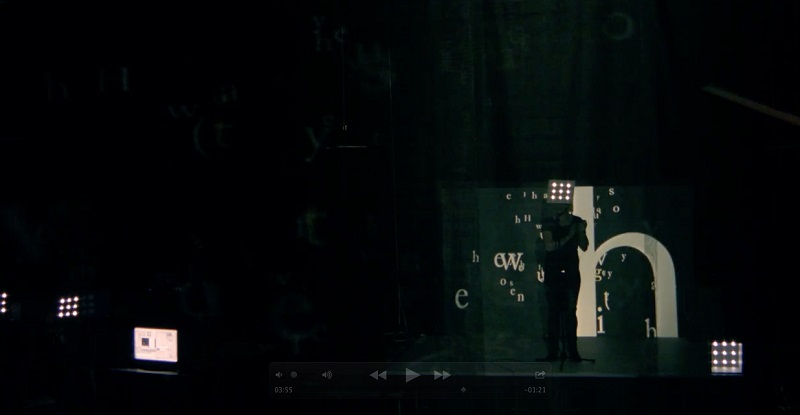
Figure 3 provides a sense of the lighting devices worn as masks by the three ‘singers’ that created a satirical sense that they had been subsumed by technology. In addition, the back projection and front projection both merged here, generating a sensorial experience for the audience that some likened to the sensation of sea-sickness: the projected written text for the Chapter was animated, and Camus’s words were dissolved and dispersed across the different surfaces in the space. Klemans Gruber commenting on the linguistic status of words says that “the field of letters and writing gives us acute access to the dynamics of intermediality” (182); the images illustrate one way in which Camus’s words, as adapted by Petralia, collide and diminish in their potency as linguistic signs. Here, the words are dissected into letters and freed from meaning, which follows what Gruber describes as “freeing letters from linearity [that] allowed them to become pictures again” (191). Here, bodies, speech, and sounds were dissociated and freed in a manner not dissimilar to the Absurdists, who asserted that language was inadequate as a means of communication, that the world was incomprehensible and fundamentally chaotic, yet that each of us gathered them into some form of structured logic. Thus, the notion of concatenation, mentioned above and used by EugenioBarba in his discussion of dramaturgy to describe particular levels of organization, is explicitly evident. He describes the intertwining of dramaturgies as,
a weaving of different threads in a concatenation and simultaneity of different actions or episodes… different layers, each endowed with its own logic and peculiar way of manifesting its life. (Barba 10)
Deleuze and Guattari offer a similar weaving metaphor in their chapter “The Smooth and the Striated,” where they identify that “textures” can be woven from vertical and horizontal combinations, one fixed, one mobile, one smooth, one striated. Striated space relates to a distant vision or aurality (a spectator’s spatial perspective, perhaps); a more open optical and/or auditory space (Deleuze and Guattari 493), whereas the smooth is evident in close-up: often textures are created at close range but experienced at a distance. These ideas are also reflected in chaos theory, which similarly suggests that complex non-linear dynamics can be determined and made predictable; the challenge is to find the pattern.
As an audience member, I found myself at different moments drawn in and overwhelmed by close-ups where I could not find a perspective, only to be pushed out and challenged by a space that was not recognizable because I was outside it and unable to discern the pattern. At other moments, there existed a simultaneity of striated and smooth elements that competed for my engagement. We might describe this experience as the result of complex, apparently arbitrary dramaturgical strands that seem to lead the audience in one direction, only for one strand to deviate and pursue a different path, drawing our attention along with it. This phenomenon is known as the strange attractor (Gleick 140). So, while the event operates with a range of dynamics, an audience might seek coherence in the animated dimension, as it appears to generate a prevailing aesthetic or glue; however, the light objects and soundscapes disrupt the apparent cohesion of the animated images. Applied to this production, the striated represents the overarching structural logic of the Chapters (a distant, organising framework), while the smooth corresponds to the moment-by-moment sensorial immersion generated when the dramaturgical strands converge — reinforcing the core argument that concatenation is both a structuring principle and an experiential effect.
So, what is the dramaturgical impact of employing strategies that weave several, at times disparate, striations into a form of concatenation driven by the ebb and flow of what, in physics, might be attributed to strange attractors?
The event takes the disorientation experienced by Meurseult and creates a phenomenological text for the audience. The audience is not shown Meursault’s journey but is offered an experience of his sense of alterity: being an outsider, unable to process and respond to the incessant bombardment of sensory and cognitive information throughout the performance/novel.
The animator and lighting designer were interested in playing with surfaces, and, scenographically, the space proliferated surfaces; in addition, their aim was to generate a scenography that could be palpably experienced by the spectator, thereby causing a phenomenological as well as cognitive effect.
The three performers from Proto-type Theatre became “singers” for this show, and, while not trained vocalists, their voices offered a raw quality at odds with a sense of smoothness that operated as a discordant thread, reinforcing a sense of being outside the normative expectations of concert audiences. As a text, their voices continually shifted between the voice of Meurseult and a non-specific exterior voice; thus, the performers are never characters, always nameless performers, whose voices are controlled, recorded, manipulated, and played back by the laptop musicians.
An intention was to borrow from Barba, “to multiply the logics as well as oppose the performance’s univocal nature” (11) by encouraging each collaborator to retain agency over their own strand of the weave. A driver was to exploit the sensorial elements and thus do more than adapt the Camus novel but disrupt the audience’s ability to make obvious links between what they were seeing and the novel, and emphasize an experience that opened up for the audience a space where all we know is that a man is born, kills a man, denies God and later dies but this is almost irrelevant in relation to the disorientating experience that maybe better captures what it is to be in the world.
The quality of the voices and distribution of the sung text, on the one hand, creates a polyvocality, but this does not necessarily lead to diverse perspectives: Jon Erickson asks whether:
splitting one monologue into many vocal parts really does indicate ‘multiplicity’ or if it ends up indicating the opposite: a weird kind of conformity. One might then view the multiplicities of the fragmented self as conducive to the habitation of an immense totalizing voice, which is everyone’s and no-one’s. (178)
Perhaps the performer’s voice conveys uncertainty, hesitancy, and an amateur status; the vocal manipulation suggests they are merely an order of the machine.
Who is the outsider, the stranger? Have we all become condemned to be no more than a spectacle, the subject of a gaze, trying to hit the notes, affirming ourselves as credible human beings, neurotypical in our responses? The values attributed to being human have shifted as the simulated replica has become more efficient, predictable, and consistent. The authority of the “singers” is constantly undermined; they are acted upon, but, as such, their vocal hesitancy provides a sense of agency/authenticity that allows them to “stand” in for our experience of the world. They, like us, are amateurs at existence. On one level, the performance appears to reinforce the typical nihilism of postmodernity, questioning what it means to be in this world. While our DNA can be engineered and replicated (like the voices of the “singers”), and while the unfertilized egg may have been replaced by the square circuit board on the projected screen (Fig. 4), one sperm refuses to comply with the others. The single intrepid sperm swims on; it refuses to conform, invoking the best of existential characteristics: unpredictability and individuality. Whether this moment, caught on the screen, suggests optimism is rightly left ambiguous. Does the sperm conjoin with the machine, penetrating the surface, or is it defiant…?

Inadvertently, The Good, The God and The Guillotine created a response to Camus’s novel that embraced key principles of his Absurdist theatre as well as his philosophical ideas. Interestingly, as McCarthy reports, Camus’s productions, like ours, were designed to “jolt the spectator, alternately drawing him (sic.) into the work and isolating him from it” (3). His theatre attempted to realize a stylized mise-en-scene that particularly emphasized mood using sound and light to heighten the efficacy of the work.
The metaphor of the outsider is perhaps best encapsulated by the notion of the strange attractor, evident in the single sperm that swims against the tide celebrating a resilient and reactive humanity. It is maybe fitting, at this final point, to return to Camus and The Myth of Sisyphus:
Man alone is not absurd, the world itself is not absurd, it is the clash between the two that gives rise to the absurd, and while we cannot win and destroy the absurd – as the absurd is a condition – we must still fight the absurd but through conscious will and rebellion we can find meaning in the world and find happiness – this is the first step towards rebellion. (qtd. in Hussey)
Bibliography
Barba, Eugenio. On Directing and Dramaturgy: Burning the House Down. Routledge, 2010.
Baudrillard, Jean. Simulacra and Simulation. U of Michigan P, 1994.
Camus, Albert. The Myth of Sisyphus. Gallimard, 1942.
Camus, Albert. The Stranger. Vintage Books, 1946.
Deleuze, Gilles, and Félix Guattari. A Thousand Plateaus: Capitalism and Schizophrenia. Continuum, 1988.
Erickson, Jon. “Defining Political Performance from Foucault and Habermas: Strategic and Communicative Action.” Theatricality, edited by Tracy C. Davis and Thomas Postlewait, Cambridge UP, 2003, pp. 156–85.
Esslin, Martin. The Theatre of the Absurd. Pelican, 1968.
Freeman, Edward. The Theatre of Albert Camus. Methuen, 1971.
Gleick, James. Chaos. Cardinal, 1987.
Gruber, Klemens. “The Staging of Writing: Intermediality and the Avant-Garde.” Intermediality in Theatre and Performance, edited by Freda Chapple and Chiel Kattenbelt, Rodopi, 2008, pp. 181–94.
Hussey, Andrew. “Albert Camus: Inside the Outsider.” Sunday Feature, BBC Radio 3, 2013. Accessed 21 Nov. 2015.
Hutcheon, Linda. A Theory of Adaptation. 2nd ed., Routledge, 2013.
Kattenbelt, Chiel. “Theatre as the Art of the Performer and the Stage of Intermediality.” Intermediality in Theatre and Performance, edited by Freda Chapple and Chiel Kattenbelt, Rodopi, 2008, pp. 29–40.
McCarthy, Patrick. Camus: The Stranger. 2nd ed., Cambridge UP, 2004.
Proto-type Theater. The Good, The God and the Guillotine. 2014.

*Jane Turner is a Principal Lecturer in Contemporary Arts at Manchester Metropolitan University. Her research explores contemporary performance, intermediality, collaborative dramaturgy, and embodiment ethnography in applied theatre practices. She has published work on performance-making processes, somatic and intercultural performance, and theatre with marginalised communities. Turner is the author of a book on Eugenio Barba and A Poetics of Third Theatre: Performer Training, Dramaturgy, Cultural Action.
Copyright © 2026 Jane Turner
Critical Stages/Scènes critiques, #33, June 2026
e-ISSN: 2409-7411

This work is licensed under the
Creative Commons Attribution International License CC BY-NC-ND 4.0.
