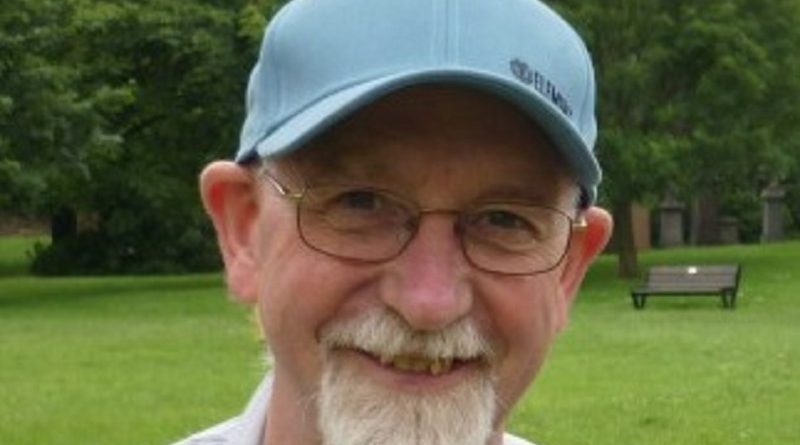
“Less is More”: Remembering Baz Kershaw
Marissia Fragkou* and Philip Hager**
One of the fondest memories we have of Baz Kershaw (1942-2026) was his contribution as keynote speaker at an international conference held in Thessaloniki in 2013.[1] His paper, entitled “‘This is the way the world ends, not’… towards a polis of performing ecology,” developed an argument for degrowth – an argument clearly encapsulated in the maxim “less is more” which he addressed to his audience at the very end by urging us, his “dear colleagues,” to “slow down.” We vividly remember the way the 160-seat amphitheatre – filled beyond capacity – was absolutely silent, almost holding our breath so as not to miss a word. When he finished, the audience applauded with great enthusiasm: as if someone had said the words that set us free from the obligation to constantly increase our value as scholars through excessive productivity. His talk was in multiple ways (also) a gentle call to resist the marketisation of the university and the arts.
This anecdote serves as testament to Baz Kershaw’s ethico-political, pedagogical and ecological principles and his engagement with the political in performance, all stemming from a deep-rooted sense of offering to the community; of working, that is, with and alongside the community. But also, in this instance, one could witness the power of his presence: the way the audience stood still and the enthusiastic applause in the end, marked the creation of a temporary community within that auditorium.
The deep respect that Baz Kershaw has earned throughout his trajectory as a scholar, educator and practitioner is owed to his immense contribution to the field of theatre and performance. He was an astute scholar and educator who inspired “generations of students and scholars” (Hughes 103) at the institutions where he taught (University of Bristol and University of Warwick) and beyond. He developed a pioneering corpus of work (through his involvement with the Welfare State International theatre company, the Drury Lane Arts Lab in London and setting up the Devonshire-based Earthrise Repair Shop) that brought together radical politics and community engagement showing that community work can only make sense – can only have efficacy – if driven by radical politics; that is, when it “participates in the most vital cultural, social and political tensions of its time” (Kershaw The Radical 7).
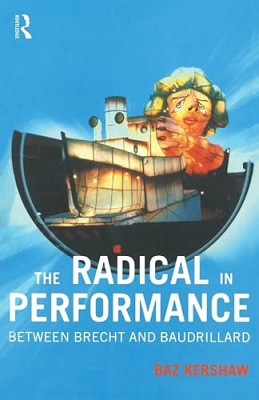
His three monographs The Politics of Performance: Radical Theatre as Cultural Intervention (1992), The Radical in Performance: Between Brecht and Baudrillard (1999) and Theatre Ecology: Environments and Performance Events (2007), alongside his numerous articles and book chapters, still stand as reference points for anyone starting to work on performance, community, politics, eco-activism and theatre history forging a strand of performance studies that is politically engaged, radical and ecologically minded.
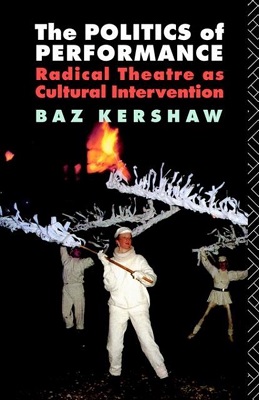
Being unwaveringly committed to radical performance practices, The Politics of Performance presents a comprehensive and rigorous take on performance efficacy, revolving around the notions of community and culture. In doing so, this work also provides a poignant history of the ways in which British alternative theatres mobilised and were mobilised by communities from the 1960s onwards; it maps, that is, movements (political and theatrical) that were “united by resistance to the dominant order”; movements that “maintained at least a modicum of ideological coherence through their commitment to egalitarianism and participatory democracy” (Kershaw The Politics 40). Such a contribution to the study of performance reception extends well beyond the British context as it offers a way of looking at theatre vis-à-vis the cultural and political communities it rallies and in which it operates.
This discussion is further expanded in The Radical in Performance, a study that firmly engages with the paradigm shift brought by performance studies. Here, Kershaw explores the “tension between theatre as a disciplinary system and performance as a liberating radical force” (The Radical 23) and looks for examples of this radicalism in practices beyond institutional forms of theatre: in protests, in alternative theatres and, as ever, in community theatre practices (in prisons, in village halls and elsewhere). This book, permeated by the “pathologies of hope” (Kershaw The Radical 26) seeks to find the radical potential of performance and, in doing so, provides not another history of radical performance, but a way of looking at performative practices that traces their potentialities in transforming the world – always paying attention at micro-narratives, the localities and their specificities.
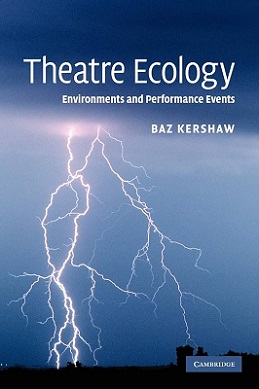
This deep interest in the minute and the non-spectacular, as well as his deep concern about humans’ “performance addiction” imbues his last book Theatre Ecology. This study perhaps best exemplifies Kershaw’s transdisciplinary ethos rooted in his own early training in electro-mechanical design engineering and his later study of English, Philosophy and Drama. At the book’s heart lies a strong interest in the (unwilled) interdependencies between humans and their environments as it examines how different systems of cultural practice and spectatorship, as well as economics and theatre making, interact. Tracing the connections between culture and nature in the context of performative societies, Kershaw turns to the potentialities of “miniaturized spectacle” (Theatre Ecology 232) and “the disappearing act of the human” which, he argues, “might be cause for hope” (237).
What these three works exemplify is Kershaw’s commitment to the ethos of “less is more”: while they develop a specific trajectory in a meticulous and painstakingly rigorous manner, they firmly articulate a resistance to the dominant logic of the neoliberal university and its need to constantly produce and consume research. And, while resisting overproduction, Kershaw was tirelessly working on his theatre and pedagogical practice through his teaching, collaborations and caring for the future of the field.
Indeed, Kershaw had a significant impact in shaping teaching and research communities. He was one of the founding members of Theatre and Performance Research Association (TaPRA) and member of the Executive Board (one of the most collegial research communities we have been involved in). He also set up the Practice as Research Working Group (now titled Performance as Research) of the International Federation for Theatre Research (IFTR).
The latter reflects his own pioneering contribution in creating spaces for the development of practice-as-research in performance during the early 2000s – a field that would later grow significantly in the UK’s Drama Departments. While teaching at the University of Bristol he led PARiP, a five-year project funded by The Arts and Humanities Research board (now AHRC). His last practice-as research project A Meadow Meander, which consisted in creating micro-climates in outdoor spaces as laboratory experiments, harnessed his pedagogical, ecological and applied performance ethos in the most extraordinary way: it tested cross-disciplinary pedagogies of teaching and learning through meandering methods and uncovered the “profound environmental dynamics that bind humans incontrovertibly to Earth’s ecologies, through ephemerally performing together as vitally material life” (Kershaw “Performed by Ecologies” 131).
To those of us who had the pleasure of encountering him and his work, Baz Kershaw has left an indelible mark in terms of thinking, research, pedagogies and academic ethos. We wish to close this short tribute by pondering on his term “ecoumility”: at the end of his essay “Performed by Ecologies” Kershaw says: “I dare to imagine, perhaps unwisely, that the twists and turns of ecological meandering and its likes might perform humans to become vitally fused with ecoumility. But who knows? Yet” (131). It is this call, together with his 2013 urge to “slow down,” that we have to respond to, as scholars, teachers and humans.
Cover Image: Baz Kershaw. Photo: University of Warwick
Endnote
[1] The conference “Viewing of Politics/ Politics of Viewing” was organized by the English Department of the Aristotle University of Thessaloniki.
Bibliography
Hughes, Jenny. “Book Review: Baz Kershaw, Theatre Ecology: Environments and Performance Events.” New Theatre Quarterly, vol. 25, no. 1, 2009, p. 103.
Kershaw, Baz. The Politics of Performance: Radical Theatre as Cultural Intervention. Routledge, 1992.
———. The Radical in Performance: between Brecht and Baudrillard. Routledge, 1999.
———. Theatre Ecology: Environments and Performance Events. Cambridge UP, 2007.
———. “Performed by Ecologies: How Homo Sapiens Could Subvert Present-day Futures.” Performing Ethos: International Journal of Ethics in Theatre & Performance, 2015, vol. 4, no. 2, pp. 113 – 34.

*Marissia Fragkou is Assistant Professor in theatre studies at the Aristotle University of Thessaloniki, Greece. Her teaching and research mainly focus on feminism, precarity and affect in contemporary theatre and performance. She is the author of Ecologies of Precarity in Twenty-First Century Theatre: Politics, Affect, Responsibility (Methuen Drama, 2018) and the co-editor of The Methuen Drama Handbook of Women in Contemporary British Theatre (Bloomsbury, 2025).

**Philip Hager is a European theatre and performance scholar. His teaching and research focus on the relationship between theatre, performance, and politics, with particular interests in the intersections of performance, cultural memory, and urban space in Greek and European contexts. He is the author of Re-imagining Independence in Contemporary Greek Theatre and Performance (Cambridge Elements, 2023).
Copyright © 2026 Marissia Fragkou and Philip Hager
Critical Stages/Scènes critiques, #33, June 2026
e-ISSN: 2409-7411

This work is licensed under the
Creative Commons Attribution International License CC BY-NC-ND 4.0.
