
Iraqi Theatre Between Rupture and Resilience: An Introduction and Two Practitioner Conversations
Farah Ali*
We are condemned to hope, and what is happening today is not the end of history.
When Saadallah Wannous articulated these words in 1996 (World Theatre Day Message, Damascus, 27 March), he could scarcely have anticipated how urgently they would resonate three decades later, in 2026, across Arabic theatre in general and Iraqi theatre in particular. His declaration does not offer optimism so much as obligation: hope emerges not as sentiment but as an ethical stance forged under conditions of collapse. For Iraqi theatre practitioners working amid prolonged war, sanctions, occupation, and sectarian fragmentation, hope is neither abstract nor rhetorical. It is enacted daily through rehearsal, performance, and the persistence of cultural labour.
Modern Iraqi theatre cannot be understood as a stable national institution; it must instead be read as a practice shaped by prolonged crisis and sustained acts of artistic persistence. From its institutional consolidation in the mid-twentieth century through successive authoritarian regimes, international embargo, foreign invasion, and ongoing instability, theatre has functioned simultaneously as a mirror of social fracture and a fragile repository of collective memory. Performance has repeatedly been compelled to respond to violence not from a distance, but from within its lived consequences. Artists have navigated censorship, economic deprivation, and ideological pressure while attempting to sustain theatre as a space of civic encounter.
The Iran–Iraq War (1980–88) marked a decisive shift, transforming theatre into a state-controlled apparatus of nationalist representation. Productions were mobilised to glorify military achievement and reinforce official narratives. This was followed by the thirteen-year embargo (1990–2003), during which cultural infrastructures collapsed, and artists were left without institutional support. Yet this period also generated unexpected aesthetic strategies: Iraqi playwrights increasingly turned to adapted European dramatic texts, particularly works associated with Bertolt Brecht, using allegory and displacement to articulate political critique indirectly. Adaptation became not merely a stylistic option but a mechanism of survival.
The post-2003 era introduced new contradictions. While economic conditions marginally improved and production opportunities expanded, theatre makers encountered fresh constraints shaped by sectarian politics and religious conservatism. Political censorship gradually gave way to moral and communal surveillance. Topics related to belief, gender, and social critique became increasingly fraught, producing what many practitioners describe as a climate of anticipatory self-censorship. Theatre artists now operate within overlapping pressures: institutional oversight, religious sensitivity, and the persistent precarity of cultural labour.
It is within this context of layered restriction and creative endurance that this essay situates two practitioner conversations with Iraqi theatre artists currently working in Iraq: Director Kadhim Nassar and playwright Mithal Ghazi. Both continue to make theatre despite structural barriers imposed by cultural institutions and broader socio-political forces. Their testimonies illuminate how Iraqi theatre has been shaped not only by historical rupture but by sustained acts of artistic commitment.
The first conversation took place on 18 August 2025 in a small café. As Nassar smoked thoughtfully, he traced connections between past and present, reflecting on how Iraqi theatre has continually reconfigured itself in response to shifting political realities. His account moves from war propaganda and embargo-era adaptation to contemporary struggles over religious representation, gender participation, and creative autonomy. What emerges is not a linear narrative of decline or recovery, but a portrait of theatre as an ongoing negotiation between memory and survival, expression and constraint.
Through these practitioner perspectives, Iraqi theatre appears less as a stable national institution than as a fragile, yet persistent practice sustained by individuals who remain, in Wannous’s sense, condemned to hope, and committed to performing that hope in public.
Theatre Under Constraint: A Conversation with Khadim Nassar
Edited and contextualised by Farah Ali
This conversation with Iraqi theatre practitioner Khadim Nassar offers a rare first-person account of the shifting political economies that have shaped Iraqi theatre since the early 1990s. Speaking from his experience working across dictatorship, sanctions, and post-2003 instability, Nassar traces how theatre moved from state propaganda to survivalist commercialism and, more recently, into a fragile space of renewed creativity constrained by religious conservatism and persistent precarity.
Rather than presenting Iraqi theatre as a homogeneous national form, Nassar’s reflections reveal it as a historically contingent practice, continuously negotiating censorship regimes, economic collapse, and social stigma, particularly regarding women’s participation. His testimony foregrounds theatre not merely as representation but as a lived struggle over voice, visibility, and cultural memory.

War Theatre and the Aesthetics of Mobilisation (1993–1990s)
Nassar situates his entry into theatre in 1993 within what he describes unequivocally as “war theatre.” Dramatic production during this period was overwhelmingly mobilised to glorify the Iran–Iraq War and to stage the Iraqi army as triumphant. Theatre functioned as an ideological apparatus, reinforcing nationalist narratives while suppressing dissenting realities.
Yet paradoxically, the years of international sanctions that followed introduced limited aesthetic openings. Iraqi playwrights increasingly turned to adapted foreign texts, particularly works by German dramatists such as Bertolt Brecht, to allegorise Iraqi conditions. Brechtian dramaturgy offered a critical vocabulary through which artists could indirectly articulate scarcity, repression, and collective exhaustion. These openings, however, remained tightly circumscribed. Terrorism, poverty, or marginalised figures such as shoeshine boys were absent from the stage, and theatre was expected to project “higher values,” presenting an idealised image of Iraqi society in opposition to what state discourse framed as Western misrepresentation. In this sense, theatre became a curated space of dignity, one that erased everyday suffering in favour of symbolic uplift.
Sanctions, Commercialisation, and Cultural Survival
The thirteen-year embargo (1990–2003) radically reshaped theatrical production. With state funding withdrawn, artists were forced into commercial theatre simply to survive. Nassar recalls this period as one of profound hardship: serious theatre lost its audience base, while actors and directors pivoted toward entertainment-driven productions in the hope of financial viability.
Yet commercialisation did not bring creative freedom. Ministry of Culture censorship committees, still operational today, rigorously monitored scripts. Any references to electricity shortages, food insecurity, or inadequate salaries were excised. What emerged instead was a theatre of hyperbolic praise, productions centered on glorifying the president, amplifying his achievements, and condemning Western coalition forces. Theatre thus became trapped between economic desperation and ideological enforcement, reduced to a performative extension of sovereign power.
It is against this historical background that Nassar’s later work acquires its satirical force. His 2023 production Happy Life, authored by Ali Abdul-Nabi Al-Zaidi and staged in Baghdad, exposes the gap between official narratives of wellbeing and the lived realities of ordinary Iraqis. Rather than presenting happiness as an achieved state, the play treats it ironically, as a hollow slogan circulating amid unemployment, bureaucratic paralysis, corruption, and the emotional fatigue of post-war life.
At the centre of Happy Life stands a married couple, Farhan (Played by Hasan Hadi) and Farhanna (Played by Labwa Arab), whose names translate as Joy and Delight. Their lives, however, unfold within an emotional economy structured by deferral. Hope is endlessly postponed, and happiness remains just out of reach. Nassar deploys this nominal symbolism deliberately, exposing the cruel disjunction between language and lived experience. What should signify plenitude instead marks absence, turning the couple into embodiments of deferred promise and revealing how happiness operates less as a lived condition than as a linguistic fiction imposed upon precarious lives.
In performance, this irony becomes palpable through affective asymmetry. Farhan frequently leans toward optimism, his expressions registering tentative anticipation, while Farhanna remains guarded, her scepticism shaped by repeated disappointment. Their contrasting bodily registers foreground gendered responses to precarity: where the husband gestures toward belief in the future, the wife embodies caution rooted in lived endurance. Hope, in Nassar’s staging, appears not as certainty but as performance, unstable, negotiated, and shadowed by doubt.

Post-2003: Between Economic Recovery and Religious Constraint
Nassar identifies 2003 as a moment of partial economic relief. Increased resources enabled more production, and ticket prices became accessible to wider audiences. Yet this material improvement was accompanied by new forms of restriction. Where political censorship once dominated, religious rhetoric now exerts a powerful disciplinary force. Artists practise self-censorship to avoid provoking sectarian backlash.
Nassar recounts an incident during a performance in Jordan in which an actor portraying a religious figure removed his beard during the curtain call. The symbolic gesture immediately altered the atmosphere; the following day, the company was summoned to a police station and warned against engaging religious symbols now classified as institutional sanctities. The episode reveals how performance bodies remain tightly regulated, their gestures surveilled for ideological transgression.
Gendered Absence and the Politics of Respectability
One of the most persistent challenges Nassar highlights is the scarcity of female actors. Many women opt for television work, which offers quicker financial returns and fewer rehearsal demands. More significantly, families often discourage daughters from enrolling in Fine Arts colleges due to stigma surrounding gender mixing and public performance.
Acting, across theatre, cinema, and television, continues to be widely perceived as socially undesirable. The few women who do enter the profession typically come from liberal households, and their participation is treated less as a norm than as a fortunate exception. This gendered absence reveals how patriarchal respectability politics continue to shape the limits of theatrical representation, reinforcing women’s marginalisation both onstage and within artistic institutions.
Looking Forward: Festivals and Fragile Optimism
Despite these accumulated constraints, Nassar remains cautiously hopeful. He points to the Baghdad International Theatre Festival as a key platform for regional and international exchange, demonstrating how Iraqi theatre has evolved over the past two decades and creating space for renewed dialogue and experimentation. For Nassar, recovery does not imply a return to a lost golden age; rather, it signals an ongoing process of rebuilding, one negotiated through festivals, collaborations, and the persistent labour of artists working within unstable political and social terrains.

Concluding Reflection
Nassar’s testimony reframes Iraqi theatre not as a passive victim of history but as an adaptive cultural practice continually reshaped by war, sanctions, censorship, religious conservatism, and gendered exclusion. Theatre emerges here as a site of endurance, where creativity survives through compromise, allegory, and strategic silence. In this sense, Iraqi theatre appears less as a national tradition than as a biopolitical practice, one that stages life under constraint, negotiates visibility within regimes of control, and insists, however precariously, on the possibility of collective imagination.
A Theatre on the Thrive: A Conversation with Mithal Ghazi
Mithal Ghazi, who holds a PhD. n Theatre Studies, has invested significantly in reviving Iraqi theatre in the aftermath of the devastation that befell Al-Rasheed Theatre,[1] one of the principal venues where he stages his work alongside the National Iraqi Theatre. His sustained engagement with both institutions reflects a deliberate strategy of working across damaged and institutionalised spaces. By alternating between Al-Rasheed and the National Theatre,[2] Ghazi navigates two distinct modes of post-war performance: one rooted in material devastation and symbolic repair, the other shaped by state-mediated cultural production.
This spatial duality mirrors the broader condition of Iraqi theatre today, caught between reconstruction and regulation, creative urgency and religious conservatism, economic necessity and aesthetic resistance. These venues function not as neutral stages but as active agents in performance-making, shaping how bodies appear, how stories circulate, and how memory is staged. Together, they form complementary sites of endurance: one bearing the visible wounds of conflict, the other sustaining the fragile continuity of Iraqi theatrical life.
Ghazi’s dramaturgy consistently engages contemporary Iraqi realities, as evident in politically charged works such as Feminine Solo (2013) and Extra Time (2026). To navigate censorship, he relies on symbolic indirection rather than explicit representation. In Feminine Solo, the two central women, Noor, performed by the renowned Hana’a Mohammad, and Hayat, played by the acclaimed Asmaa Safa’a, operate allegorically as embodiments of sectarian division during the height of post-invasion violence. Their staged encounter translates geopolitical fracture into intimate dramaturgy, allowing political conflict to materialise through relational tension rather than overt reference.

This strategy emerges directly from the historical conditions in which the play was conceived. Between 2006 and 2008, following the bombing of the Al-Askari Shrine, Baghdad fractured along sectarian lines as neighbourhoods were emptied through displacement, assassination, and intimidation. Everyday life reorganised itself around fear, and for theatre practitioners this period generated what felt like a permanent state of exception, where bodies became precarious and cultural work unfolded under continuous threat.
Extra Time itself bears the marks of these constraints. Its original title, The Night of Desolation, was rejected by the censorship committee because of its religious connotations, referring to the first night spent in the grave. Ghazi was therefore compelled to revise the script and resubmit it under a new title before it could be approved for performance. Such negotiations illustrate how theatrical production in Iraq often depends on indirection, revision, and symbolic coding rather than explicit confrontation.
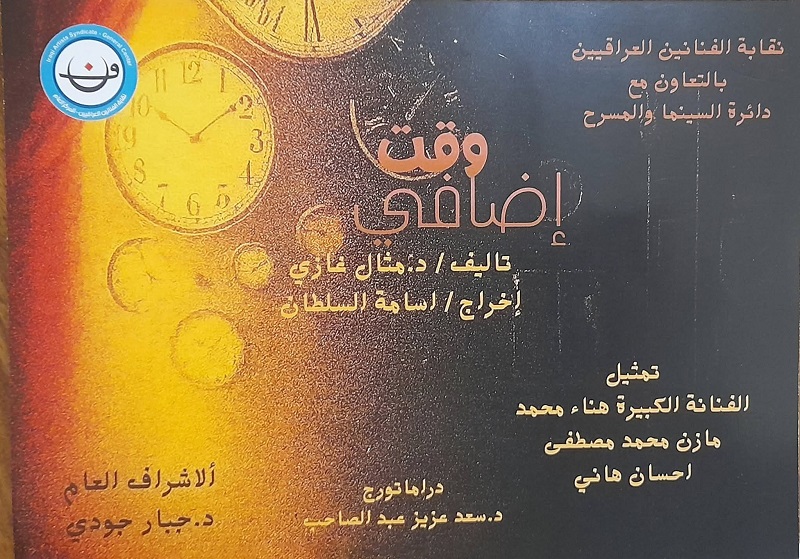
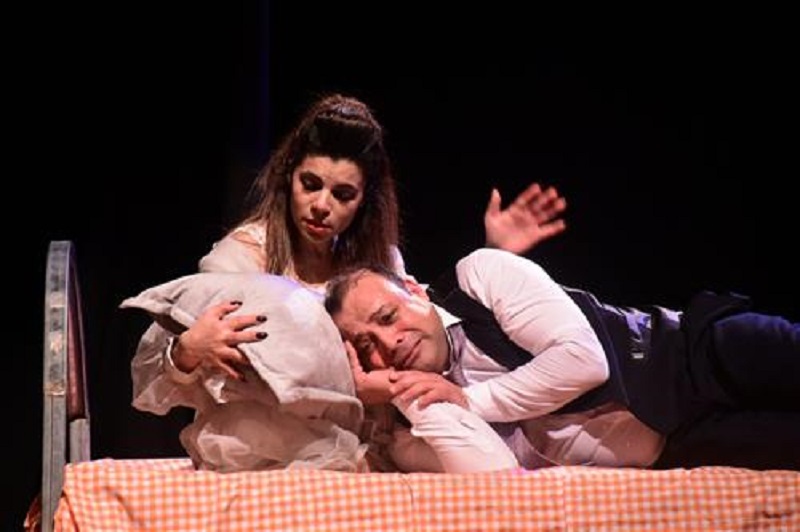
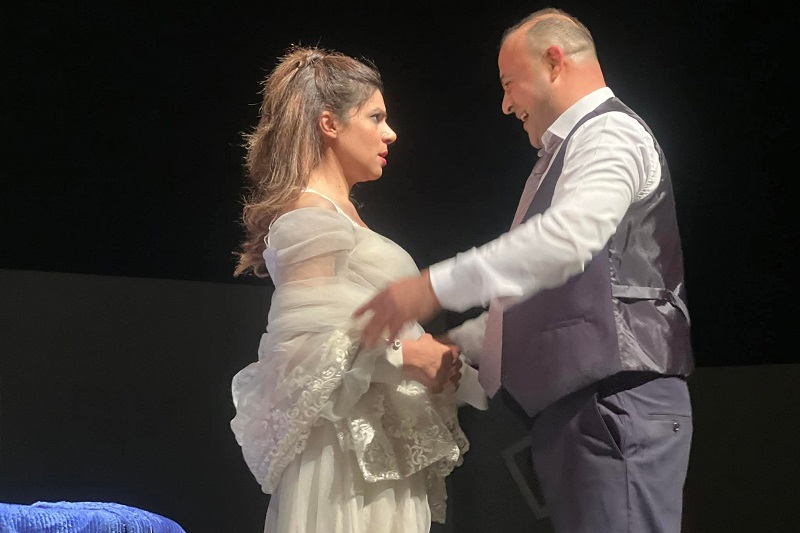
The play centres on a husband, performed by the renowned Mazin Muhammad Mustapha (identified simply as The Man), who is diagnosed with only seven days to live, a narrative device that transforms bodily decline into political allegory. As he gradually relinquishes his aspirations and pleads for “extra time,” his deteriorating body comes to mirror a nation exhausted by prolonged violence and instability. His wife, portrayed by the acclaimed Hana’a Mohammad (designated as The Woman), emerges in contrast as a figure of resilience and historical memory. She reminds him that this is not the first crisis he has endured, an implicit evocation of Iraq’s repeated encounters with war, coups, and reconstruction. Through this relational dynamic, Ghazi frames survival not as accidental reprieve but as a historically sedimented practice.
Ghazi’s refusal to assign personal names to the characters deepens this symbolic architecture. By presenting them as types rather than individuated figures, he allows the couple to function simultaneously as intimate partners, collective subjects, and national allegories. Their anonymity extends the play’s resonance beyond a singular narrative, positioning them as representatives of any community compelled to endure crisis. In this sense, the absence of names operates not as erasure but as dramaturgical method, preserving both the universality of human vulnerability and the political persistence of a nation repeatedly forced to rise from its own ruins.

Staging intensifies this allegorical structure through affective contrasts. In scenes at the husband’s bedside, he appears suspended between disbelief and resignation, his expression marked by hesitant anticipation tempered by suspicion. The wife, however, sustains a quieter but steadier optimism, her insistence on recovery embodying hope as a deliberate practice rather than a passive expectation. Ghazi choreographs this asymmetry to foreground competing responses to crisis, revealing hope not as certainty but as something enacted within intimate relational space.
Visual staging further amplifies this affective architecture. During one hospital scene, the doctor explains the diagnosis while an enlarged X-ray image dominates the stage space. The projection transforms medical evidence into theatrical spectacle, externalising the couple’s psychic devastation and rendering illness monumental and inescapable. Through this device, Ghazi converts diagnostic imagery into spatial emotion, allowing the audience to experience despair not only as narrative information but as environmental presence.
The emotional apex of the play occurs when the wife turns to supplication, appealing to God for her husband’s recovery while he remains immobilised in stunned disbelief. The clinical austerity of the hospital setting amplifies both despair and anticipation, and Ghazi stages the moment as an affective impasse where faith confronts paralysis. Crisis here is not merely medical but existential: hope must be actively performed against the immobilising weight of prognosis.
Ultimately, the husband recovers, defying medical prediction. Ghazi describes this reversal as central to the play’s symbolic economy. Iraq, despite repeated exposure to violence and instability, continues to regenerate itself. The dramaturgical arc thus moves from terminal diagnosis to embodied recovery, transforming illness into a metaphor for national endurance and positioning theatre as a space where collective fatigue can be temporarily suspended in favour of renewed possibility.

Beyond censorship, Ghazi identifies further structural challenges facing Iraqi theatre. The shortage of female actors remains particularly acute, especially for touring productions outside Baghdad. Long journeys, low pay, and social stigma discourage participation, leaving several of his scripts, including some written specifically for all-female casts, unstaged. Acting continues to be perceived as socially undesirable, and this gendered absence reinforces broader patterns of respectability politics that shape both representation and participation in Iraqi cultural life.
Despite these obstacles, Ghazi remains committed to theatre as a democratic space of connection. His preference for writing in Iraqi colloquial Arabic reflects this conviction. He recalls attending a free play as a child and being struck by the diversity of the audience, workers, teachers, drivers, and professionals gathered. Spoken dialect, for him, became a bridge that invited all social groups into the theatrical space. Slang, in this sense, is not casual language but a political tool that expands participation and redefines the audience as a collective public.

Ghazi acknowledges that the current theatrical landscape in Iraq is marked by both hope and uncertainty. Full houses and continued production suggest renewed audience engagement, yet unstable funding and bureaucratic obstacles threaten sustainability. Invitations to international festivals often arrive too late to process visas, infrastructure in many provinces remains inadequate, and institutional planning is inconsistent. Still, Ghazi views the present as a transitional phase rather than a terminal crisis. For him, Iraqi theatre continues to rebuild itself through persistence, adaptation, and the refusal to abandon the stage.
In this light, Extra Time operates not only as political allegory but as affective intervention. By concluding the play on an affirmative note, Ghazi seeks to mobilise optimism as a form of cultural resistance and to encourage audiences to imagine a future beyond crisis. Theatre, in his vision, remains a space where collective exhaustion can be confronted and where the possibility of renewal can still be rehearsed.
Concluding Reflections
Taken together, the testimonies of Khadim Nassar and Mithal Ghazi reveal Iraqi theatre not as a static cultural institution but as an adaptive practice continually reshaped by historical rupture and ongoing negotiation. Both practitioners describe working within layered regimes of constraint, economic fragility, censorship, religious conservatism, infrastructural collapse, and gendered exclusion, yet neither frames theatre as a space of defeat. Instead, their accounts emphasise how performance persists through strategies of allegory, symbolic indirection, linguistic accessibility, and collective improvisation.
Nassar’s reflections foreground theatre as a site of survival under pressure, where artistic practice must constantly recalibrate itself to shifting political economies and social expectations. His work illustrates how satire and affective nuance can expose the disjunction between official narratives and lived realities, transforming the stage into a space where deferred hopes and everyday precarity become visible. Ghazi’s dramaturgy, by contrast, demonstrates how allegory can convert individual crisis into national metaphor, staging recovery not as resolution but as an embodied rehearsal of endurance. Where Nassar highlights theatre’s capacity to reveal structural contradiction, Ghazi underscores its potential to mobilise affective renewal.
What unites these two trajectories is the recognition that Iraqi theatre continues to operate less as an institutional system than as a fragile, yet persistent cultural practice sustained by individuals who refuse to relinquish its civic function. Their work confirms that theatre in Iraq is not merely a medium of representation but a form of social labour, one that negotiates visibility within regimes of control while keeping open the possibility of collective imagination.
In this sense, Iraqi theatre today embodies Saadallah Wannous’s assertion that artists are “condemned to hope.” Hope here does not signify optimism about political outcomes but rather a commitment to continue staging stories, assembling audiences, and sustaining spaces of encounter even when material conditions remain unstable. Theatre becomes a rehearsal of public possibilities, a place where crisis is neither denied nor resolved but transformed into shared experience.
To speak of Iraqi theatre, then, is to speak not of recovery from rupture but of resilience enacted through performance itself. The stage remains a contested yet vital site where memory, survival, and aspiration converge, where hope is not proclaimed but performed.
Acknowledgement: I would like to thank Mr Feisal Farah, as well as Khadim Nassar and Mithal Ghazi, for their generosity with their time and for their invaluable insights. I am also grateful to Mr Hasan Ali Abbas for his crucial interpretive guidance on the Iraqi theatrical landscape. Finally, I extend my sincere thanks to the editors at Critical Stages for their support and guidance throughout the preparation of this piece.
Endnotes
[1] Built in the 1970s as part of Baghdad’s modern cultural expansion, Al-Rasheed Theatre once stood as a central hub for experimental and repertory performance. Prior to 2003, it hosted major Iraqi productions and international collaborations, functioning as a flagship venue for contemporary drama. Following the invasion and subsequent years of instability, the theatre suffered extensive damage, looting, and prolonged closure. Its deterioration mirrored the wider collapse of Iraq’s cultural infrastructure, transforming what was once a vibrant artistic space into a material reminder of war’s aftermath. In recent years, practitioners such as Mithal Ghazi have deliberately returned to Al-Rasheed, staging new work amid visible scars of destruction. This return is not merely practical but symbolic: Ghazi’s use of Al-Rasheed frames theatre as an act of cultural reclamation. Performing in a damaged venue foregrounds absence, loss, and endurance, converting architectural ruin into dramaturgical presence. Al-Rasheed thus operates as a palimpsest theatre—a space where contemporary bodies perform against layered histories of violence, abandonment, and tentative recovery.
[2] The National Iraqi Theatre, by contrast, represents Iraq’s formal theatrical establishment. Founded as a state-supported institution, it has historically served as the country’s primary venue for officially sanctioned productions, festivals, and visiting performances. During the Ba’athist era, it functioned under strict ideological oversight, yet it also provided sustained employment and training for generations of actors, directors, and designers. After 2003, the theatre experienced both disruption and renewal. While funding structures weakened and security concerns reshaped audience attendance, the National Iraqi Theatre gradually re-emerged as a key site for post-invasion cultural dialogue. Today, it hosts a mixture of classical adaptations, new Iraqi writing, and international collaborations, offering a comparatively stable platform within an otherwise fragile theatrical ecosystem. Where Al-Rasheed embodies ruin and grassroots revival, the National Iraqi Theatre signifies institutional continuity. Together, they articulate a divided theatrical geography: one grounded in infrastructural survival, the other in bureaucratic persistence.

*Farah Ali is Assistant Professor of English at Lahore University of Management Sciences (LUMS), Pakistan. She previously held a Post-Doctoral Fellowship at the University of Hull (UK). Her research focuses on Post-War British theatre, with particular emphasis on identity politics, power, oppression, and gender. Her doctoral work on Harold Pinter resulted in the monograph Eroding the Language of Freedom: Identity Predicament in Selected Works of Harold Pinter (Routledge, 2017). Her current research extends to global and Middle Eastern theatre, including work on Iraqi drama that examines gender, trauma, and the violence experienced by women in the aftermath of the American-led invasion. She is also completing a second manuscript on representations of the female figure in diaspora fiction in Europe, and is in discussion with Bloomsbury regarding a book project on African women’s diasporic writing across the continent. Her broader interests include migration narratives, performance, and the politics of representation in contemporary literature and theatre.
Copyright © 2026 Farah Ali
Critical Stages/Scènes critiques, #33, June 2026
e-ISSN: 2409-7411

This work is licensed under the
Creative Commons Attribution International License CC BY-NC-ND 4.0.
