Iona (Jonah) in Translation: Purcărete’s Allegory Between the Local and the Transnational
Ion M. Tomuș*
Abstract
This article examines Silviu Purcărete’s 2025 production of Marin Sorescu’s Iona (Jonah) at the Radu Stanca National Theatre in Sibiu, focusing on its dual casting: Japanese actor Kuranosuke Sasaki and Romanian actor Adrian Matioc. Drawing on theories of intercultural performance, embodiment, and transnational dramaturgy, the article argues that Purcărete does not universalize Sorescu’s historically embedded text but subjects it to a process of productive estrangement. The foreign body defamiliarizes the Romanian cultural specificity of the monologue, while the native body risks domesticating it. Neither casting is sufficient alone; together, they reveal loneliness not as a universal theme but as a formal, culturally conditioned structure that survives translation only by being made strange.
Keywords: intercultural theatre, transnational performance, Silviu Purcărete, Marin Sorescu, estrangement, embodiment, national allegory
The Problem of the Fish and the Strange
Marin Sorescu (1936-1996) was a major Romanian playwright known for his absurdist and poetic dramas that explore existential themes, and his works remain influential in contemporary theatre. He wrote Iona (Jonah) in 1968, as a text that seemed, at least on first view, inseparable from a specifically Romanian (and also Eastern European) historical condition. A man finds himself trapped inside a fish; he cuts his way out, only to discover that he has emerged into yet another fish, and then another. The image is simple, nearly primitive, but its force lies in the structure it produces: enclosure without end, escape as repetition, liberation as a passage into deeper captivity. Read from within the political and cultural atmosphere of late socialism, the play was nearly impossible to understand as anything other than an allegory of communist claustration, of blocked transcendence, of an existence in which every exit turns out to be another interior. Its anguish seemed local, historically wounded and legible through a distinctly Romanian experience of confinement.
And yet that apparent specificity becomes less stable the moment the text is displaced; at that point it must be rearticulated within another cultural horizon. What once seemed inseparable from a Romanian experience of enclosure is forced to pass through a different archive of memory, embodiment, theatrical convention and metaphysical imagination. The text does not cease to signify locally; rather, it begins to oscillate between localities. Its meanings are no longer secured by the cultural ground that first produced them, but are instead exposed to another structure of feeling, another discipline of expression, another inherited relation to solitude, suffering, endurance and transcendence.

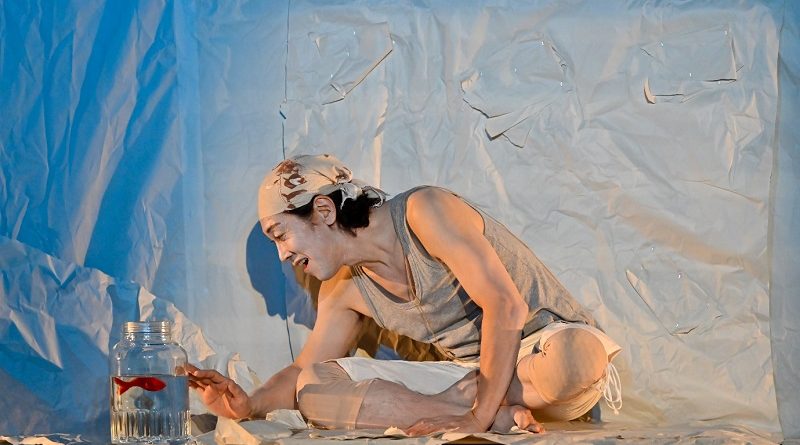
When Iona (Jonah) premiered in 2025 at the Radu Stanca National Theatre in Sibiu (Romania), Silviu Purcărete placed the play in an explicitly transnational frame by casting the Japanese actor Kuranosuke Sasaki in the central role. About six months later, the production was revived on the same stage with the Romanian actor Adrian Matioc, allowing the performance to shift from one cultural embodiment to another without changing its scenographic and directional core.
What happens when a director takes a play so deeply embedded in one cultural and historical pressure system and places a great Japanese actor in its centre? Is something lost in the process, perhaps a density of context, a blurred political resonance or a language of suffering too historically situated to travel intact? Does such a gesture universalise the text too easily, lifting it out of its own conditions and turning it into a vague parable of existential solitude? Or does it expose something more unsettling, an understanding that what appeared to be uniquely Romanian was only one historical habitation of a more radical loneliness?
These are not rhetorical questions, and they should not be dissolved too quickly into celebration. Silviu Purcărete’s Iona (Jonah), in its Japanese and Romanian incarnations, is interesting, not because it proves that great art is universal; that would be the laziest possible conclusion. Rather, it is interesting because it places pressure on the relation between allegory and portability, between national trauma and transnational legibility, between the cultural singularity of a text and the strange afterlives it acquires when spoken by another body, in another language, before another horizon of memory. The production does not simply answer whether Marin Sorescu’s Iona (Jonah) can travel; indeed, it establishes that very ability to travel as the problem.
Marin Sorescu’s Text as a Trapped Object
Sorescu’s Iona (Jonah) is often read as a drama of entrapment, but it may be just as useful to think of it as a trapped object in itself: a text enclosed within the historical, linguistic, and interpretative conditions that first made it legible. The play emerged from a cultural atmosphere in which indirection was an aesthetic preference and, very importantly, a survival strategy. Its allegorical structure – stark, absurd and deceptively bare – allowed it to articulate what could not be stated directly. A man trapped inside of a fish, cutting his way outward only to discover yet another enclosure, became an image capacious enough to hold political claustration, metaphysical bewilderment, and the circularity of self-consciousness under pressure. Yet for all its openness as allegory, Iona (Jonah) also bears the marks of a very specific expressive economy, one shaped by Romanian literary irony, by the pressure of censorship, and by a cultural habit of encoding despair in wit, monologue, and paradox.
This is why the text resists easy extraction from its original context. It is not merely a universal parable of loneliness that happens to have been written in Romania during the 1960s. Its language, rhythms and tonal shifts are deeply implicated in the world that produced them. Sorescu’s agony is never detachable from the gravity it skirts: the humour does not dissolve anguish but rather gives it a means of expression. The play’s peculiar force lies precisely in this unstable oscillation between the comic and the catastrophic, between verbal agility and existential blockage. In that sense, Iona (Jonah) is trapped not only because it stages confinement, but also because it is itself caught within a historically coded mode of saying and not saying, revealing and disguising.
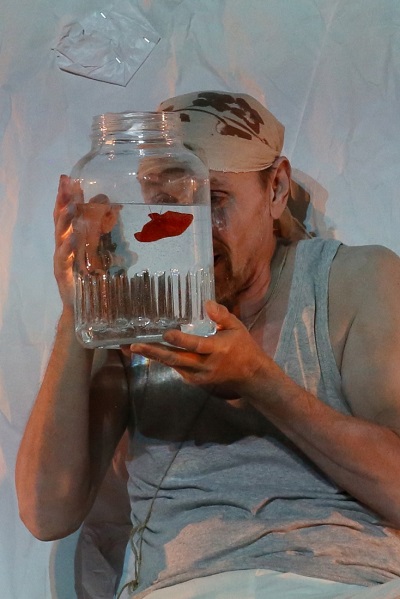
And yet the power of the text lies in the fact that it exceeds this enclosure even as it remains marked by it. Its central image is both local and portable, historically saturated and strangely transferable. The fish cannot be understood as an exclusively local allegorical figure, even though the historical experience of Romania has given generations of readers a particularly acute sense of the forms of enclosure it stages. What the play traps, finally, is not a single political meaning but a structure of recursive captivity: the discovery that escape may produce the logic of imprisonment, and that subjectivity itself may be built as a series of interiors with no final outside. This is what makes the play translatable, while ensuring that translation remains a charged and transformative act rather than a neutral transfer of meaning. The text travels as a burden object and carries its original pressure with it, even when placed in another language, another theatrical tradition and another body.
Purcărete’s Aesthetic Logic – What He Does with National Texts
To understand what is at stake in Iona (Jonah), it helps to place the production within a larger directorial logic. Silviu Purcărete has never approached canonical texts as monuments to be dutifully preserved. Even when working with culturally central material, he tends to treat the text less as an object of national reverence than as a field of scenic testing. This is true of his long engagement with major dramatic and literary works across traditions, but it is especially striking in relation to Romanian material.
Consider his return to writers such as I. L. Caragiale (1852-1912), one of Romania’s greatest playwrights, renowned for his satirical comedies on political corruption and social hypocrisy still central to Romanian theatre today, and Marin Sorescu. Such a preference does not produce an effect of cultural reassurance; on the contrary, it often loosens the text from the habits of recognition that national canonicity normally secures.
Purcărete’s theatre does not ask what a text means within the inherited consensus of literary culture; it asks what pressures the text can still sustain once it is exposed to image, rhythm, distortion, scale and silence. Even the critical discourse surrounding his work repeatedly emphasizes that his theatre disorganizes genres, privileges visual composition, and sustains a relation to the written work that is affective and explanatory rather than merely interpretive.
This is one reason why Iona (Jonah) matters in his hands. Purcărete does not stage Sorescu in order to restore the play to its secure place in the Romanian canon. He stages it to test how much of the text remains legible once its national familiarity is suspended. The result is not an abandonment of the Romanian text, but a refusal to let it remain comfortably owned by its original cultural environment. That refusal is entirely consistent with a body of work built around recomposition rather than illustration. George Banu’s observation in Observatorul Cultural / The Cultural Observer (no. 1010, April 2, 2020) is particularly useful here:
Silviu Purcărete is a director-poet, a dual identity, a communion of two roles that intersect and grant him a distinct status. Purcărete avoids the purity of a single stance; he alternates, associates, disrupts established models, and expresses a constant fear of becoming immobilized. His theatre asserts, on the world’s stages, the presence of an artist, but also that of an interpreter: this is where the uniqueness of his position comes from. It is a dual position, expressed differently from one production to another, yet never excluding the other side, opposite and distinct, because it is precisely this coexistence that fascinates him.
In this sense, the national text is neither discarded nor obeyed; it is placed under formal pressure.
The Radu Stanca National Theatre in Sibiu has been one of the major institutional spaces in which this logic could become durable rather than exceptional. The theatre’s own history records Purcărete’s connection to Sibiu as stretching back for decades, while its current repertory and production model make visible an institution fully at ease with large scale visual composition, multilingual circulation, touring and international collaboration. Faust, a legendary production, premiered in 2007, and The Scarlet Princess (2018), are the best examples in this regard, as they are still being performed today. Iona (Jonah) is not an anomaly in this context. It emerges from a theatre culture in which a Romanian text can become a Romanian-Japanese co-production, can exist in more than one linguistic version and can continue with a different lead actor without surrendering its directorial identity. The production was presented first with Kuranosuke Sasaki, together with Tokyo Metropolitan Theatre, and later with Adrian Matioc, thus marking the duality of the casting as part of the production’s life rather than an incidental substitution.
What makes this especially consequential for Iona (Jonah) is Purcărete’s fundamentally visual theatre. Many critical accounts of his work describe it as one built through framing, tableaux, chiaroscuro, and the fragmentation of perception; meaning is generated not only, or even primarily, through verbal articulation, but also through the arrangement of bodies in space, through rhythm, image, breath, and the pressure of scenic atmosphere. If this is true in general, it becomes decisive in Iona (Jonah). Once the performance’s primary logic shifts from verbal statement to embodied and visual composition, national specificity also shifts. It no longer resides exclusively in the semantic texture of Sorescu’s Romanian, but in the unstable relation between text, body and image. In such a framework, casting a Japanese actor in the title role is not merely a gesture of international outreach; it is a test of whether the play’s allegorical structure can survive transportation into another embodied and cultural register, once the spoken word ceases to be the sole guarantor of meaning.
Kuranosuke Sasaki, the Japanese Actor: Body, Foreignness and the Monologue
At the centre of Purcărete’s Iona (Jonah) lies a decision that cannot be reduced to international casting. To entrust Sorescu’s monologue to a Japanese actor is not to prove that the play can travel; rather, it is to ask what becomes visible when the text is detached from the body, voice, and linguistic environment that Romanian theatre history has presupposed. This matters because the play depends on the spectacle of a man speaking to himself in conditions of enclosure. There is no dialogue strong enough to stabilize meaning from outside, and everything depends on self-address: how speech persists when it has nowhere to go, and how the body sustains that verbal return. To change an actor here is to alter the instrument through which solitude becomes theatrically legible.
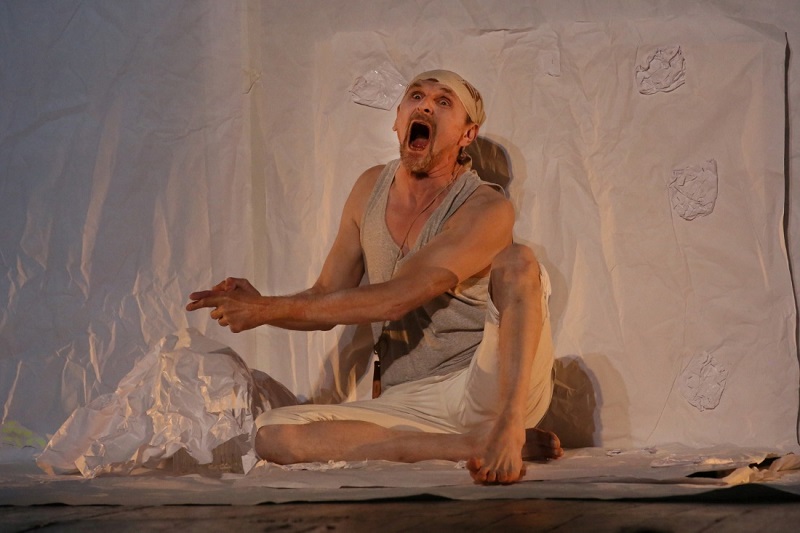
The Japanese casting should therefore be understood as an intervention which shapes the conditions through which a monologue is embodied. Even without relying on cultural essentialism, one may still say that acting traditions do not train the body identically across contexts. An actor formed within or adjacent to Japanese traditions of vocal control, formal restraint, and codified gesture will not inhabit self-address in the same manner as an actor shaped by European habits of psychological realism. The difference is not merely stylistic; it also changes where meaning appears. In the former, inwardness may appear more mediated, more rhythmically controlled, less invested in transparency than in patterned exteriority. That distinction matters for Iona (Jonah), because the play itself oscillated between confession and ritual, between private anguish and stylized repetition. A Japanese actor does not simply perform the role differently; he brings out to the extent to which the monologue is never purely confessional. Indeed, the monologue is already a form and a procedure.
From this perspective, foreignness becomes a dramaturgical device. The most superficial reading of such casting would be that it demonstrates the universality of Sorescu’s text: the play travels; therefore, its meaning transcends national context. But this is the least interesting conclusion one could draw. The more compelling possibility is that the Japanese actor does not universalize the role at all; instead, he estranges it. He interrupts the familiarity through which Romanian audiences have learned to receive the play and exposes the text once more as something uncanny. This estrangement has a precise aesthetic mechanism. Fischer-Lichte describes how contemporary performance places the spectator on “the threshold between two modes of perception, as alternately the actor’s real body and the fictive character step into the foreground”, a state she calls perceptive oscillation (89). In Purcărete’s Iona, this oscillation acquires a further dimension: the spectator is suspended, not only between body and character, but also between two cultural bodies, two histories of embodiment, two different ways of making solitude visible.
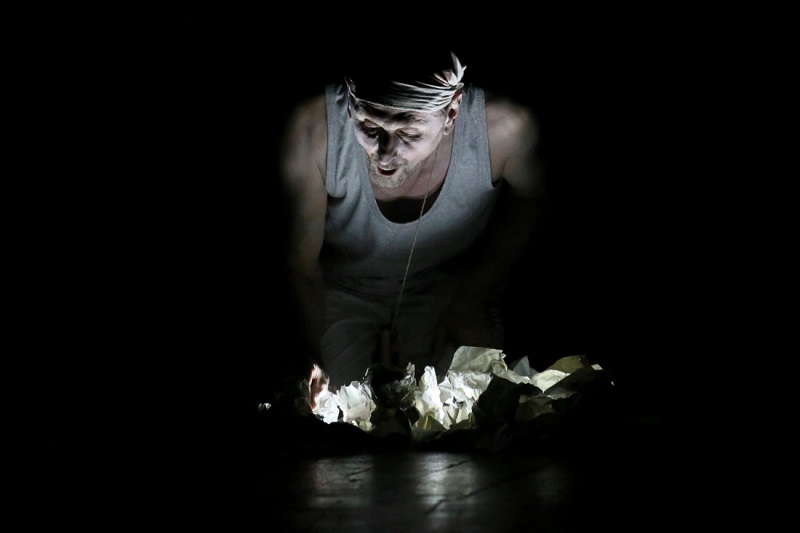
The man inside the fish is more than a recognizable figure of historical allegory; he also reverts back to what he always was, a strange body speaking compulsively into a void. The foreign body does not neutralize the play’s specificity; it reveals that the text’s deepest force may lie in its capacity to become strange even to itself.
That estrangement becomes more radical once the language of performance is included. The production was performed in Japanese, and the monologue spoken in Japanese is no longer foreign production. The text enters another acoustic world and becomes something other than a nationally possessed statement; it becomes resonance, cadence, breath, and temporal pressure. Spectators who depend on subtitles do not receive the text as immediate semantic substance but rather as a split between sound and comprehension, between vocal event and translated meaning, thus intensifying the loneliness of the monologue. The Japanese version staring Kuranosuke Sasaki does not merely translate Iona (Jonah); it reconditions the spectator’s relation to monologue as such.
In Romanian literary culture, the play is burdened by curricular recognition and historical allegorical reading. Such familiarity makes interpretation possible, but it can also domesticate the play too quickly. The Japanese performance interrupts this domestication and suspends immediate ownership, forcing the audience to encounter the monologue less as a known national artifact and more as an event of embodied duration. The question shifts from “What does this allegory mean?” to “What does it mean for a man to go on speaking under these conditions?”
At the same time, the risk of exoticization must be named plainly. There is always a shallow version of intercultural casting in which alterity is consumed as spectacle: the foreign actor becomes a sign of cosmopolitan prestige, and cultural difference is flattened into curiosity. In that register, the production risks being admired for the wrong reasons, as if its achievement lay merely in the novelty of seeing a Japanese actor perform Romanian existential despair. The point is not that Japanese embodiment makes the play more beautiful or more accessible, but rather that it places the text under stress. It tests whether Iona (Jonah) can survive being spoken by a body that does not automatically belong to the cultural horizon that first secured it meanings.
It does not erase the Romanian historical charge of the play, nor does it celebrate a borderless universality. Instead, it relocates the monologue within another embodied and acoustic regime, compelling the text to pass from one cultural specificity into another. The monologue persists, but with a different weight, a different rhythm, and a different solitude. In that altered state, Iona (Jonah) becomes newly legible not because it ceased to be Romanian, but because it has been made strange enough to be heard again.
Adrian Matioc, the Romanian Actor: Recognition, Familiarity and Loss
If the Japanese casting estranges Iona (Jonah) by passing it through another body, another language and another acoustic horizon, the Romanian casting does something no less significant: it returns the play to a field of cultural recognition. But that return should not be mistaken for restoration, as if Adrian Matioc simply reinstated the text in its so-called proper national body after an intercultural detour. The second casting is not a correction of the first, but rather a different embodiment of the same directorial machine, and therefore a different production in effect. What changes is not the scenographic or conceptual structure, but the relation between the role and the cultural codes through which the audience receives it. With Adrian Matioc, Iona (Jonah) does not become more authentic, but rather more familiar, and familiarity is never a neutral gain.
A Romanian actor brings to Sorescu’s text a specific kind of legibility that precedes interpretation. Before the audience processes the allegory, it already recognizes the grain of the body and the voice as belonging to a shared cultural habitus. This recognition is not reducible to nationality in the bureaucratic sense. It consists of subtler residues: ways of weighting silence, of carrying fatigue, of inflecting irony, of allowing resignation to appear without overstatement. A Romanian actor performing Iona (Jonah) does not have to cross the threshold of cultural foreignness before the text can begin to resonate, as he enters the role from within an already available structure of feeling. That proximity may produce density, but it may also produce a dangerous ease. The spectator is no longer confronted with a body that makes the monologue newly strange; he is confronted with a body that seems to know, almost too well, what kind of solitude this is.
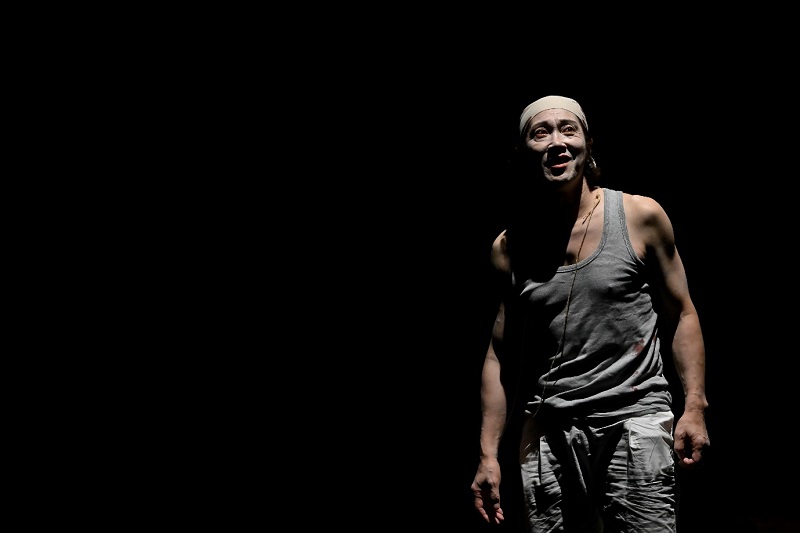
This is where familiarity both helps and hinders. On the one hand, a Romanian performer can reactivate the historical and tonal layers embedded in Sorescu’s language with an immediacy unavailable to the translated version, as irony returns with a native pressure. The oscillation between wit and despair, so central to the play’s texture, can be heard not merely as an intellectual structure but as a lived cadence. The audience recognizes the play’s internal parameters: its dry humour, its reflex of self-distance, its capacity to move from absurdity to desolation without rhetorical announcement. In this sense, Matioc’s presence may deepen the text’s local charge. He restores to the monologue the illusion that it belongs wholly to the language and historical memory from which it emerged.
And yet that restoration comes at a cost. Familiarity can domesticate what ought to remain uncanny. When a Romanian actor performs Iona (Jonah), the audience may recognize the cultural code too quickly and therefore cease to experience the role as a problem. The fish becomes our fish. The enclosure is grasped at once as intelligible, historically ours, already named. What is gained in tonal intimacy may be lost in estrangement. The monologue risks becoming legible before it has had time to become disturbing. This is why the Romanian version should not be romanticized as the more appropriate one. Its very recognizability can reduce the force of the alterity in the text. It can draw the play back into the secure orbit of national allegory, where what matters is not the uncanniness of a man trapped within his own speech, but the reassurance that we know what kind of captivity is being staged.
The difference between the two actors is especially revealing if one thinks in terms of expressiveness. Both Sasaki and Matioc can be described as highly expressive performers, but expressiveness as a quality is not displayed in the same way for each actor. In Matioc’s case, expressiveness may be read through a familiar cultural grammar. The audience can identify its signs more quickly, that is to say, vocal fracture, ironic recoil, embodied exhaustion and the recognizable transitions between intensity and suspension. His expressiveness is therefore not simply greater, but more readily decoded. It reaches the spectator along established channels of emotional and theatrical recognition. With Sasaki, by contrast, expressiveness may require a different kind of attention. It may appeal less as psychological revelation and more as modulation of rhythm, tension, restraint and formal persistence. The spectator must learn how to read it. What is conveyed by one actor as immediate legibility is conveyed by the other as perceptual labour. That difference is not secondary; it shapes the entire economy of the reception.

Barthes’ theory of the grain of the voice is useful here. What matters in performance is what is signified, not only by the voice, but also by the body that carried the voice, that is to say, the material residue that escapes paraphrase, the cultural and physical thickness that cannot be translated into abstract meaning (184-85). In Matioc’s case, the grain of the voice carries a familiarity inseparable from language and cultural memory. Even before the words are interpreted, the voice communicates belonging as it bears the sediment of a recognizable world. This gives the Romanian version a particular density but also imparts a particular risk. The grain can become an instrument of recognition so powerful that it transforms strangeness into cultural intimacy.
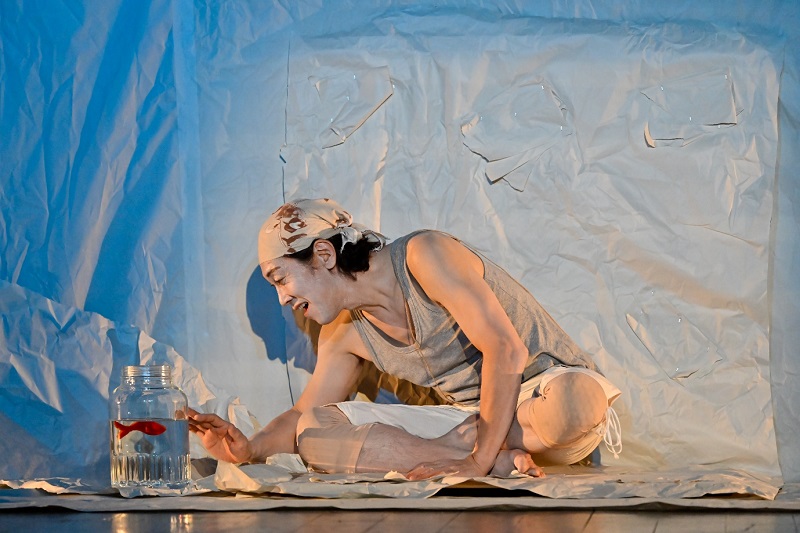
What Matioc offers, then, is not authenticity against experiment, but rather a different balance between embodiment and reception. If Sasaki’s foreignness reopens Iona (Jonah) as a strange event, Matioc’s familiarity reinscribes it within a shared horizon of historical feeling. Neither is sufficient on its own. One exposes what national ownership obscures; the other restores what translation displaces. Together, the two actors reveal that the play does not simply move between local and transnational forms; it oscillates instead between estrangement and recognition, between the shock of hearing the text as if for the first time and the equally charged experience of hearing, in the grain of a native voice, how deeply it has always belonged.
Transnational Theatre and the Question of Ownership
Pucărete’s Iona (Jonah) ultimately raises a larger question than that of casting alone; in particular, it explores at what point a national text becomes a transnational theatrical object, and what is gained or endangered in that passage. A complete understanding depends, first of all, on a distinction that contemporary theatre too often blurs, which is the difference between universalizing a text and transposing it. To universalize a text is to smooth away its historical and cultural resistance in order to extract a supposedly common human core. Such a gesture may make the work portable, but only by flattening the very density that made it worth moving into another embodied and theatrical context while preserving the friction of that displacement.
In a review of Purcărete’s earlier Romanian-Japanese encounter, The Scarlet Princess (2018), I already identified this distinction at work; as I noted, for Purcărete, “multiculturalism is an output of a process that essentializes and radicalizes emotions” and the production does not create emotions in the audience so much as it “ask[s] universal questions” through “music, sound, color and light” (Tomuș). The same logic governs Iona (Jonah). Rather than dissolving Sorescu’s text into a vague parable of existential solitude, Purcărete subjects it to the same process of essentialization. Thus, the historical and cultural specificity of the Romanian original is not erased but rather intensified through its encounter with another body, another language and another theatrical tradition. What emerges is not a universalized loneliness but a loneliness made newly radical by the pressure of displacement. Also, as suggested by Patrice Pavis, intercultural theatre does not transport meaning intact from one context to another; significantly, it subjects the source culture to a series of filters and theatrical operations through which it is reconfigured in the target culture (4-5). What travels, in that case, is not a purified essence, but a tension.
Pucărete’s production belongs much more clearly to the second category. The Romanian essence of Sorescu’s text is not erased so as to make the play legible abroad. On the contrary, it remains audible as a pressure within the performance even when the role is spoken in Japanese, and it returns differently when the production is re-embodied by Adrian Matioc in Romanian. What changes is not the text’s origin, but its framework of appearance. The production does not ask the audience to forget that Iona (Jonah) emerges from a distinctly Romanian literary and historical matrix. It asks instead what happens when that matrix is placed in tension with a body, a voice and a language that do not automatically belong to it. In this sense, the production is not post-national but rather transnational, precisely because it refuses to dissolve origin into neutrality.
All these qualities place Iona (Jonah) within a recognisable European conversation about what directors do with canonized texts once they cease to be treated as sealed cultural property. Thomas Ostermaier’s long engagement with Ibsen, for example, has repeatedly involved versions and re-stagings that insist on contemporaneity rather than heritage, including Nora, Hedda Gabler, An Enemy of the People and most recently The Wild Duck. Ostermeier has approached Ibsen by relocating the plays into contemporary settings, arguing in effect that their structures remain so alive that, once placed in modern surroundings, they scarcely seem to require adaptation at all (75-6). Similarly, Krzysztof Warlikowski’s theatre has become associated with multilayered adaptations and subversive engagements with classical and canonical materials, including Phaedra(s) and other projects that refuse the stable authority of inherited form. The point is not that Pucărete imitates either director, but that Iona (Jonah) enters an existing field of contemporary European directing in which canonical texts are re-situated, re-authored, and made to speak under altered conditions.
The context of Sibiu International Theatre Festival sharpens this contrast even further, as it has for decades presented itself as one of the largest international performing arts festivals in the world, with thousands of artists and broad institutional partnerships across countries, and with associated platforms explicitly devoted to dialogue, exchange, and international collaboration. In such a frame, performing Iona (Jonah) is never only a Romanian act of canon management. The festival setting encourages the production to present itself as an object already in circulation, already speaking across borders. That does not empty the play of ownership, but it complicates ownership decisively. Iona (Jonah) at Sibiu International Theatre Festival was first presented with Kuranosuke Sasaki during the 2025 edition as it was not simply ours: it became legible as a Romanian text that could only fully appear by risking its encounter with what was not Romanian.
Loneliness as a Form, Not a Theme
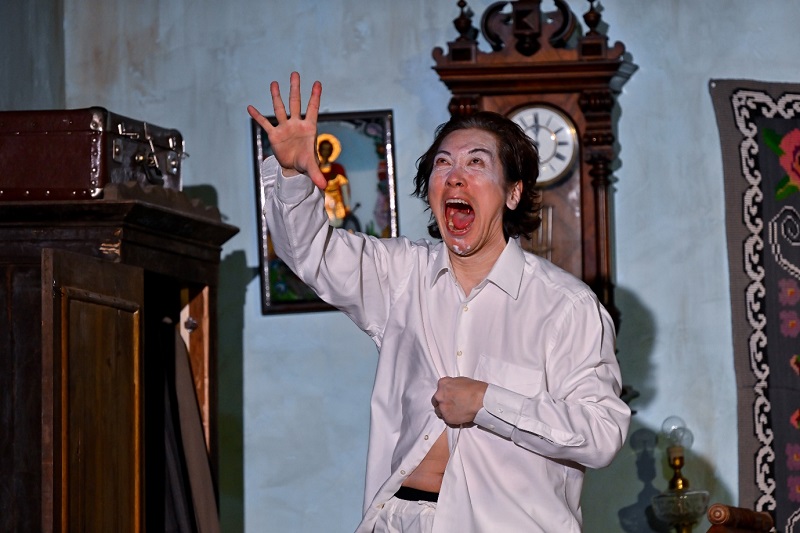
What makes Iona (Jonah) so difficult to stage is that its loneliness is not merely something the play talks about; it is something the play does. Sorescu does not simply give us a character who feels isolated: he constructs a dramatic form in which speech itself becomes the sign of enclosure. The monologue is therefore not an expression added to solitude from the outside; it is the mechanism by which solitude sustains itself. Each utterance delays disappearance, yet each utterance also confirms that no genuine exit from the self is available. The play’s structure is a closed loop: language persists, but it cannot break the walls that require it.
Purcărete’s staging seems acutely aware of this formal problem. Rather than merely illustrating the fish as a symbolic prison, the production builds a visual world in which enclosure is experienced as rhythm, repetition and atmosphere. The scenographic image does not simply duplicate what the text already says; it also amplifies the sensation that Iona inhabits a space without horizon, a world whose material beauty does not cancel its claustrophobia. In this sense, the visual field, as compared to its scenic equivalent, acts less as an escape from monologue. The body remains caught, and the eye, like the ear, is denied easy release.
This is where the transnational casting becomes significant, formally as well as conceptually. A foreign body performing a closed Romanian monologue in Japanese produces a second enclosure within the first, the character is trapped inside a fish, but the actor is also trapped within a text that does not originate in his own linguistic and historical world. Linguistic entrapment does not render the performance inauthentic, as the production allows the structure of captivity to migrate from character to performance itself. The monologue clearly signifies Iona’s imprisonment, yet also it stages the pressure of carrying someone else’s words across cultural distance. This duality may be the production’s most serious achievement. It does not sentimentalize loneliness as a universal feeling, but crucially reveals loneliness as a form which is recursive, embodied, and painfully difficult to escape.
What the Production Asks
The most genuine means of concluding a discussion of Purcărete’s Iona (Jonah) is not to decide whether the experiment succeeded, but to remain with the questions it so insistently stages: What does it mean for a text so deeply marked by a Romanian historical experience of enclosure to be spoken by a Japanese actor on a Romanian stage in Sibiu? Does such a gesture reveal that the play’s loneliness is, in the end, exportable, that its anguish can pass from one language, body, and culture to another without losing its force? Or does it show, just as clearly, that this loneliness carries a specifically Romanian residue that can never be entirely transferred but simply approached from elsewhere?
The production is compelling precisely because it does not resolve those questions, as both positions remain partially true. The Japanese casting makes the text strange again, loosening it from the familiarity of national recognition and exposing the monologue as a more radical structure of isolation. The Romanian casting, by contrast, restores the grain of local memory, allowing the play’s historical and linguistic sediments to be heard from within. Neither version cancels out the other. Each reveals something which the other cannot fully contain. What one gains in estrangement, the other gains in cultural accessibility.
This may be the production’s more remarkable achievement, not that it proves Iona (Jonah) universal, nor that it safeguards the text within national ownership, but that it keeps both possibilities in productive suspension. The coexistence of the two castings is in itself a statement. The play survives both and it is altered by both. It belongs fully to neither. In that sense, Purcărete’s Iona (Jonah) does not offer a final answer about whether loneliness is culturally specific or theatrically translatable. It asks instead whether a national text can remain faithful to its origins precisely by risking estrangement, and whether that risk is the only way it can still speak in the present.
Bibliography
Banu, George. “Purcărete, regizor-poet al scenei: Schiță de portret.” Observator Cultural, no. 1010, 2 Apr. 2020.
Barthes, Roland. The Grain of the Voice: Interviews, 1962–1980. Translated by Linda Coverdale, Hill and Wang, 1985.
Fischer-Lichte, Erika. The Transformative Power of Performance: A New Aesthetics. Translated by Saskya Iris Jain, Routledge, 2008.
Ostermeier, Thomas, and Peter M. Boenisch. The Theatre of Thomas Ostermeier. Routledge, 2016.
Pavis, Patrice. Theatre at the Crossroads of Culture. Translated by Loren Kruger, Routledge, 1992.
Sorescu, Marin. Iona. Edited by Eugen Simion, vol. 2, Opere, Academia Română / Univers Enciclopedic, 2003.
Tomuș, Ion M. “Redesigning Multiculturalism or Japanese Encounters in Sibiu, Romania: The Scarlet Princess, Written and Directed by Silviu Purcărete, Inspired by Tsuruya Namboku IV’s Sakura Hime Azuma Bunshō.” European Stages, vol. 13, no. 1, Spring 2019.

*Ion M. Tomuș is a professor in the Department of Drama and Theatre Studies at Lucian Blaga University of Sibiu, where he teaches the History of Romanian and World Theatre, Drama Theory, and Text and Stage Image. He served as Head of the Department of Drama and Theatre Studies from 2011 to 2019 and is currently Chair of the PhD School in Theatre and Performing Arts at the same university, supervising doctoral research since 2016. He has published extensively in academic journals and cultural magazines throughout Romania and Europe. He is also a long-standing member of the festival team, coordinating Aplauze, the festival’s official daily journal, and overseeing the editorial series Cultural Conversations and the annual Aplauze volume. ion.tomus@ulbsibiu.ro.
Copyright © 2026 Ion M. Tomuș
Critical Stages/Scènes critiques, #33, June 2026
e-ISSN: 2409-7411

This work is licensed under the
Creative Commons Attribution International License CC BY-NC-ND 4.0.
