
“Driven by uncertainty”: Interview with Júlia Rázusová
Dária F. Fehérová*
Female directors are still searching for their place in Slovak professional theatre. With limited opportunities to establish themselves in major institutions, many turn to independent theatres and projects. While this path brings financial challenges, it also offers greater creative freedom. Invitations to regional or national theatres remain rare.
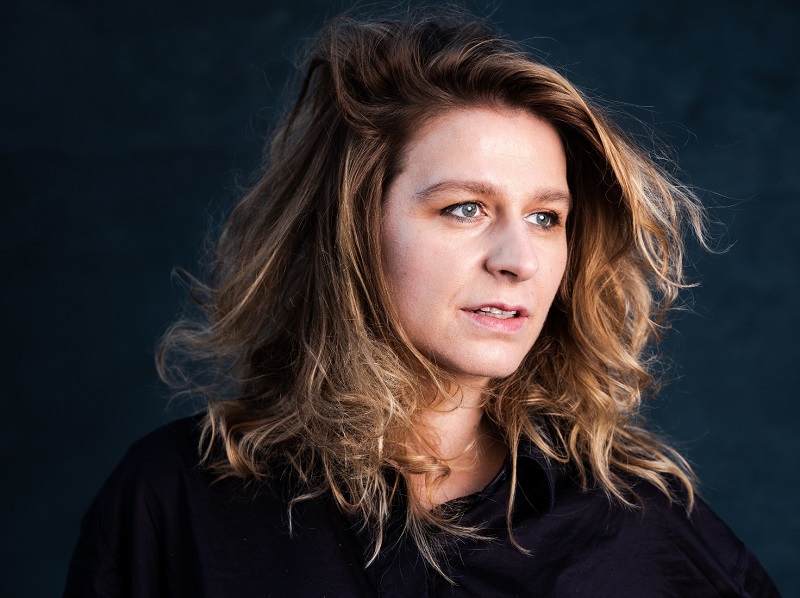
Júlia Rázusová has succeeded in navigating both worlds; she has established herself at the Slovak National Theatre and at her own company, Tears of Ján Borodáč. She dominated the 2024/2025 DOSKY theatre awards: Outcast, based on Stefan Zweig’s work, became the best production of the season at her independent theatre. At the Slovak National Theatre, she won the DOSKY award for Best Director for Ionesco’s The Rhinoceros, and the role of Bérenger also earned the award for Best Actor.
Rázusová graduated from the Faculty of Philosophy at the University of Prešov, majoring in aesthetics, Slovak language, and literature, and from the Academy of Performing Arts in Bratislava, majoring in theatre directing and dramaturgy. While she was still a student, Rázusová’s productions were presented at festivals both in Slovakia and internationally (Czech Republic, Russia, France, Portugal). In 2009, she completed a professional study stay at Rose Bruford College in London, focusing on physical theatre. At the present time, Rázusová directs across theatres in Slovakia and the Czech Republic. From 2013 to 2020, she served as artistic director of the Prešov National Theatre, a journey she continues with Tears of Ján Borodáč, and her work has often been honored with a number of awards.
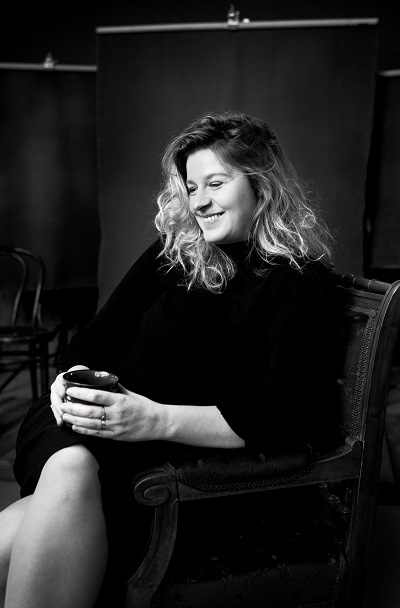
Dária F. Fehérová: Being a female director in Slovakia is still unusual. Although your voice is gradually growing stronger, directing is still seen as a male profession in our country. Do you perceive your directing or your themes as an expression of the so-called feminine?
Júlia Rázusová: My themes and directing are feminine in every sense, but I’m not sure what the word feminine really means in this context. Unfortunately, it often leads to the exoticization of female directors.
The term feminine themes usually refers to a certain perspective or space that we, as women in art, unlike men, are often expected to assert unnecessarily. If feminine means political, subjective, loud, expressive, sensitive, uncompromising and important, then yes, my themes and directing reflect my identity, what makes me who I am, and what truly interests me. On stage, you see my Kurt Vonnegut: Galapagos, my interpretation of Marguerite Duras’ alcoholism, and my dialogue with Darwin in Pop Animal.

You studied aesthetics and Slovak language and literature, continued your studies in directing at the Academy of Performing Arts in Bratislava, and are now a postgraduate student at the Academy of Performing Arts in Prague. What is your current research topic, and why? What does this research give you?
I have an inner need to be on the move, searching, exploring creative uncertainty, constantly discovering new things, keeping my channels open in Prešov, and not isolating myself. I want to continue educating myself, building communities, and developing the so-called social capital that academia offers.
My work focuses on the dialogue between physical action and text, on the one hand, and artistic research, on the other, that is to say, how I create. I am interested in the forms of communication between content and form: with performers, with space and with the audience. I examine the functionality and openness of dialogue, body movement, and words within the staging concept and process. I seek forms of dialogue that can be part of theatre without the production being confined to a specific genre, whether drama, alternative, movement, or physical theatre.
I identify principles and procedures I have discovered for myself and my own directing work, moving toward an acting/performance approach that connects the content with where the action originates. I could talk about this research at length: why actors are drawn to the proscenium, why we tend to recite text directly to the audience, and how we often fear that losing contact with the audience means losing the content. All of this is part of the approach I am developing.

You deliberately create outside Bratislava and actively seek connections. You and Michaela Zakuťanská founded your first independent theatre, after graduating, in your hometown in eastern Slovakia: the Prešov National Theatre. I remember you even had to confirm that you could call it national, even though it wasn’t state-funded. Was that a form of protest?
It was a protest, a provocation, a joke. We wanted to highlight the centralisation of cultural and social life in Slovakia, and the concentration of theatres and professional opportunities in Bratislava. As graduates, playwright Michaela Zakuťanská and I decided to continue creating “without compromise,” as we called it then. This meant that even at 420 km from Bratislava, we would build the theatre we wanted, how we wanted it and with whom we wanted, and we succeeded.
The very titles of our productions reflected our attitude toward life on the other side of the country: Single Radicals, Kinder Surprise, Good Place to Die, Moral Insanity, for example. In my second independent theatre, The Tears of Janko Borodáč, we are now taking this idea further: people from Bratislava travel to attend our acting workshops, so in a sense, we are trying to reverse the flow.
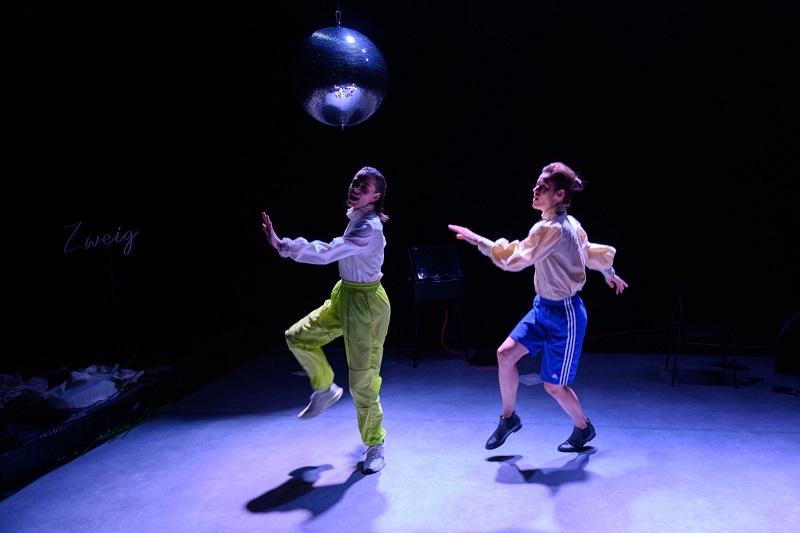
After your experience with the Prešov National Theatre, you founded another group, The Tears of Janko Borodáč. Considering that Ján Borodáč was the first Slovak professional director, do you think he would cry if he saw your performances?
My dream was to move from commercial theatre to a laboratory, a free, experimental, open environment. When we started, many people did not know that Ján Borodáč, born in 1892 in my hometown, Prešov, was the first Slovak to study acting at the conservatory in Prague and then go on to become one of the first founders of Slovak professional theatre, as well as a trainer of actors and directors.
But for today’s students, he is often seen as a symbol of tradition, conservatism, psychological realism, and, in another sense, as a politically unacceptable figure, one who was uncritically aligned with the dominant attitudes of his time. Even after a hundred years, these qualities remain hindrances to art and to the development of openness, tolerance, and humanism in our society. Such attitudes clash with what our group represents. We deal with topics ranging from conspiracy theories to contemporary family models and psychology, and we work with progressive acting methods and techniques, so when I imagine Borodáč seeing this, I think he would probably cry.

You had your own plays staged at the Prešov National Theatre, or you adapted your own works. Now, it seems to me that you are reaching for more classical writers, like Stephan Zweig, and Eugen Ionesco. However, apart from Ionesco, it is hard to find any world-renowned playwrights in your work. Where do you look for authors who inspire you?
I realise that I draw a lot from my own childhood and current parenthood. For me, these are active forms of my being that force me to react and to be alive, to perceive the essential in the present moment. Many themes come to me through my relationships and my work environment, and that defines me. I draw a lot from my need to read and from my first university studies, which were in Slovak; to this day, I feel the need to stay in touch with contemporary Slovak literature.
I continue to be fascinated by language; another discipline I wanted to explore was cultural anthropology. Lately, I have been preoccupied with the theme of transformation and the changes in our relationship to reality, which is present in my latest productions. For example, in the autobiographical story of Nastassja Martin, In the Eye of the Wild, which I staged at HaDivadlo in the Czech Republic, a particular quote ends the production itself: “uncertainty: a promise of life.” For me, this is the narrative that drives me.
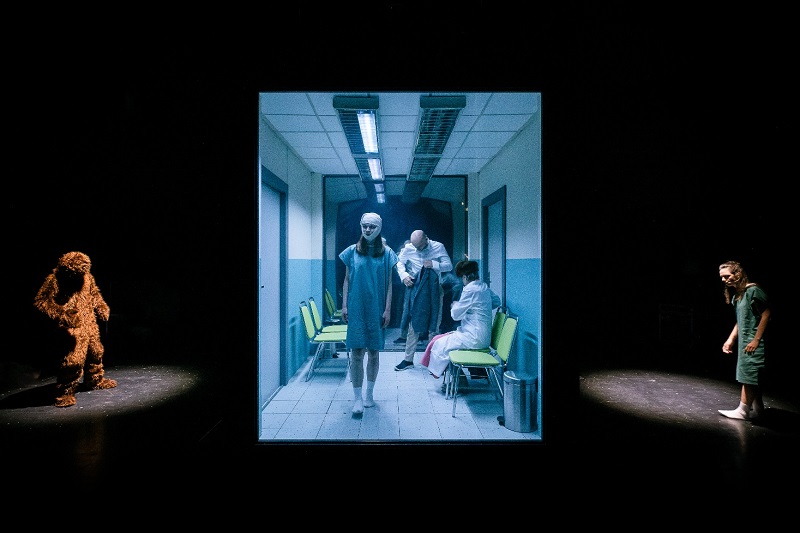
Stanislavski’s technique is foundational in our art schools, but you sought other methods for working with actors. What motivated you to explore beyond Stanislavski, and which techniques resonate most with you?
My approach to directing has been shaped in communication with actors, at school, and later in theatres; it emerged in response to Peter Brook’s questions of the why and how that we should ask ourselves at the beginning of the staging process.
As I worked to define my own methodology of directing, I aimed to develop a specific and previously untested approach to expression through performance.
This was my focus, and I wanted to experience it firsthand so that I could offer more to the actor or actress through our collaboration, as conveyed in subtle notes in the director’s instructions or through informal comments. At the beginning we didn’t use a workshop approach or adopt any of the new methodologies, although I would choose elements from these whenever I needed them.
I also feel that we are limited, and that it is our job, as practitioners and professionals, to push the boundaries of education in art schools and training centers for acting. My doctoral research also deals with the dialogue between physical action and text. I try to find space to support the creativity of actors, where their uniqueness and relationship to their own bodies can shine through, where they can discover new possibilities for working with their voices. Hopefully for them it’s like falling in love with their profession all over again and gaining a new understanding of authorship and interpretation.
I believe that, in addition to Stanislavski’s method, which is useful and effective, we also need mental hygiene in sensitive work such as addressing emotions or trauma. This is where methods such as PEM (Perdekamp Emotional Method) and Alba Emoting come in. Then there are practical concerns, such as the fact that our back side represents a large area of our body, so why should we restrict ourselves, narrow our expression and focus only on our face? But these are things that many actors intuitively know and do.
Most recently, I was intrigued by the core method developed by the renowned theatre scholar Alison Hodge. After her death, seven performers have maintained and developed this method and recorded it for further use, so I am trying to explore it further as well.

Ionesco is rarely staged in Slovakia, and The Rhinoceros has only been produced twice. In May 2025, you directed a new version at the Slovak National Theatre in Bratislava. What was your main premise, and what aspects of the text aroused your interest?
Most of us are probably afraid of loneliness and helplessness, as well as the stupidity and rudeness which emerges unexpectedly in a moment, regardless of whether or not it affects us personally or someone around us succumbs to it. I had had the text on my desk for a long time, but I felt there was a risk of a black-and-white them and us model which could contribute to the polarisation of society.
Together with dramaturge, Miriam Kičiňová, we began to uncover further layers of the text and to analyse them by asking different questions. For me, the game-changer was the question of voluntarily transforming into a thick-skinned person, the idea that someone would voluntarily make this moral choice. The processes that lead to this end state, whether or not a person must have a predisposition to become a rhinoceros, and whether or not someone voluntarily decides to become one, all fascinated me.
The text shows its age, but the Slovak translation is excellent. It required intensive work because a rhinoceros in 2025, as an expression of absurdity, is something else; the text incorporates a number of contexts from the time when Ionesco wrote the play, when his friends and loved ones began to turn into rhinoceroses in connection with fascism.
The media also often mentions this characteristic, that society has become thick-skinned, and I found it interesting to start reading the play from these perspectives. Even the main character, Bérenger, is afraid of becoming infected because having a thick skin is epidemic. I was also interested in him as a hero because, in the final battle for survival, he experiences many transformations around him. Observing him with close friends, his professional community, we gradually move from public spaces to the office and then to his home, and see his transformation as a personal experience. He is an interesting hero because, from the beginning, he does not show any qualities of someone who could save the world, but we see his growth through his reactions and situations. We begin to explore themes of conformity, culture, morality, the emergence of a certain school of thought, and how it can be contagious.

Do you see differences in acting between large and small theatres, or between Slovakia and the Czech Republic?
Lately, I’ve gotten the feeling that it all starts and ends with first-reading rehearsals, with the text on the table, regardless of whether it’s a national theatre or an alternative project. It’s about how the initial impulse unfolds, what arises at the beginning, and the relationship to the theme and previous experience. Depending on this, there will be intersections of energies and settings that will either keep the project going and developing or start to slow it down.
Through practice, I have learned that I need to communicate any specific requirements well in advance, before rehearsals begin, to avoid potential clashes. Adequate time for creation is still key for me. Lately, I have been touched by the fact that the actors themselves are initiating additional rehearsals, and it would be wonderful for me if the necessary chemistry develops there. An important factor for me is creating a safe environment so we can inspire each other. In the Czech Republic, I have more experience directing in another language. Although our languages are very similar, I notice differences in perception among the younger generation, which can lead to misunderstandings, especially when combined with more experimental approaches.

I read that you were influenced by a workshop on Rudolf Laban’s technique, focusing on building a relationship with the body and on physical action and movement in general. How does this approach work in drama?
Meeting Anna Sanchéz Coldberg during my studies in London was a great experience for me. Suddenly, I saw a 60-year-old woman in front of me putting on a miniskirt, lying on the floor without using her hands. The minutes it took her to do this were, for me, an image of imagination, tension, and energy that resulted from her physical action and her very position in the room. It influenced my thinking about theatre. I also find a parallel in my expressive language with choreographer Pina Bausch, who confessed in an interview that she loved dance because she was afraid to speak. She wanted to express something urgent that she couldn’t express in words; she hated it when words were not enough and could not use them to describe what she felt. I feel a connection there.
When I am creating a stage situation or thinking about one, I am also examining what my directing instructions for that action would look like. It is about spatial rules; an actor delivering a monologue on the proscenium looks different from one in the corner of the stage, which creates an interesting tension. In this respect, Rudolf Laban is a great help to me in thinking about the body in space and the speed of movement, also important for us as the creators of drama.
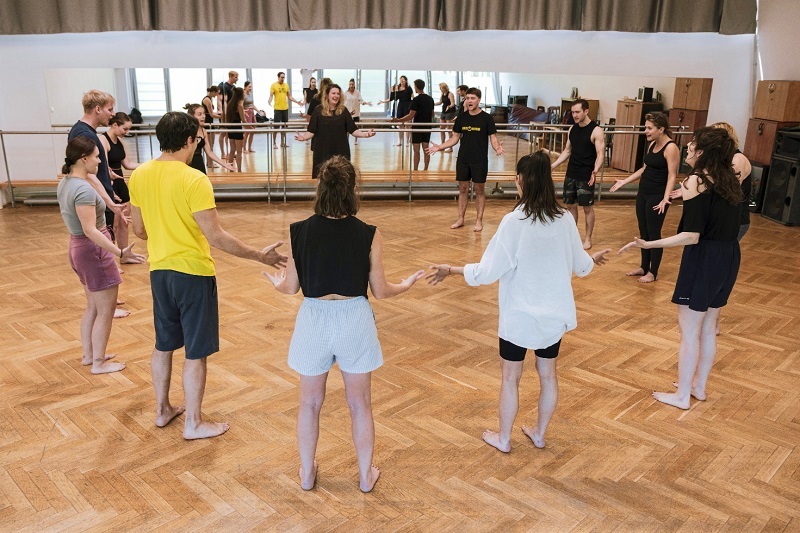
Should theatre be political, or is it political in your opinion? How can theatre be apolitical?
There is currently more political inference behind non-political theatre than behind political theatre. Theatre that arises from a committed idea risks formal flatness in terms of content and meaning. I am very careful about my starting points and my search for themes so that as a creator, I don’t fall into the trap of chasing current topics or presenting and supporting certain theses. I can always verify this stance in specific situations, relationships and processes, so that the actors on stage adopt an attitude towards a given theme and create original content that may not be reflected in the result but is present in the process. I always prefer discussion to lecture, experiment to extremism. We in the theatre must also remain open and find very specific representations of states and emotions; for me, this is the search for truth, even if it is not always in pleasant forms. This means that we don’t attempt to build an either-or, but rather we aim to explore the whole spectrum of forms. And it is precisely in this search for truth that theatre is political for me.
Your theatre is one of the contemporary groups that did not receive support from the Slovak Arts Council. The Slovak Arts Council includes nominees from the Ministry of Culture, and I am sure that none of them are familiar with your work. Why do you think this happened? How will you continue to operate? What can you do to remain active without the state’s financial support? Are there any chances for you at all, given that Slovakia is facing widespread consolidation?
I take a pragmatic view of this. I see opportunities in international co-productions, in seeking new sources of funding and in collaborating with the third sector. We are exploring opportunities for cooperation with academia, and students attend our workshops. I would like to highlight the Artorium festival, which invited unsupported theatres. It is difficult to answer at the moment; we are living in the present and, as with our work, we are looking for boundaries and possibilities.

*Mgr. Dária Fojtíková Fehérová, PhD. (1984) studied theatre science at the University of Performing Arts in Bratislava, completed complementary pedagogical studies focused on children’s creativity, and pursued postgraduate studies at the Department of Aesthetics, Faculty of Arts, Comenius University in Bratislava. She is a theatre critic and historian who actively participates in domestic and international professional events, conferences, and festivals. Her research focuses on contemporary Slovak drama, new tendencies in staging, and Slovak theatre directors. She works at the Theatre Institute Bratislava, where she serves as Director of the Nová dráma/New Drama Festival and currently as Interim CEO. She regularly publishes in theatre magazines and scholarly journals and is the author or co-author of several theatre anthologies.
Copyright © 2026 Dária Fojtíková Fehérová
Critical Stages/Scènes critiques, #33, June 2026
e-ISSN: 2409-7411

This work is licensed under the
Creative Commons Attribution International License CC BY-NC-ND 4.0.
