Guest Editors’ Note. Dramaturgies of Interstitiality: Technology, Fragmentation, and the Composite Body in Contemporary Performance
Nelson Barre* and Stephanie Sandberg**
This special section of Critical Stages gathers four essays, each of which initially appears to trace a distinct progression through contemporary theatre scholarship. Graça P. Corrêa examines ecocritical implications of digital technologies in her multimedia performance Automata; Emma Cole proposes Beckettian dramaturgy as a translation methodology for fragmentary Greek tragedies; Jane Turner explores collaborative adaptation in The Good, The God and The Guillotine; and Bernadette Cochrane theorizes digital dramaturgy as “composite-body making” through The Hunger Games: On Stage and Paddington: The Musical. Yet, despite these divergent focuses, a connective thread emerges: a shared preoccupation with dramaturgies of interstitiality. Specifically, the essays collectively investigate the spaces between bodies and technologies, between presence and mediation, between wholeness and fragmentation, and between human and posthuman meaning-making in theatre.
Interstitiality offers a productive lens for reading these contributions, not as discrete studies but as complementary investigations into how contemporary dramaturgy operates in gaps, seams, and bonds between heterogeneous elements. To clarify, whether examining interfaces between performers and digital environments, lacunae within ancient fragments, collisions of multiple artistic forms, or distributed agency across puppeteers and technological systems, each author treats theatre as a fundamentally composite practice—generating meaning through calibration, collision, or preservation of constituent parts. Collectively, these essays illuminate a critical shift: scholars move from understanding theatre as either live or mediated, whole or broken, human or technological, toward recognizing that contemporary performance is constructed through bonds whose visibility, ethics, and affective consequences demand sustained attention.
First, all the essays use posthumanist frameworks which distribute agency across human and nonhuman elements. Corrêa, using Guattari’s ecologies, sees consciousness as environmental. Cole’s Beckettian fragments create unknowable, split identities. Turner’s concatenation blurs individual agency. Cochrane thinks of bonding as what makes an entity. This approach rejects humanist ideas and examines how presence derives from relations among bodies, objects, and systems.
Second, each author attends to the ethical aspects of bonding, collision, or separation. Corrêa insists the home must be reclaimed as a space of “psychic-physical flourishing” against surveillance systems. Cole’s preservation democratizes interpretation, resisting foreclosure. Turner’s concatenation enacts absurdism’s ethical demand. Cochrane frames dramaturgy as an ethical practice, determining whether spectators experience dread, care, or complicity. Dramaturgy emerges as an ethical practice—decisions carry consequences for how audiences feel, judge, and act.
Third, all four articles contest dominant paradigms. Corrêa calls for criticism, interrogating how technologies “flatten every place into homogeneous sameness.” Cole contests supplementation practices, proposing that fragmentation allows texts to “defy our expectations.” Turner resists subordination in collaboration. Cochrane reframes dramaturgy away from device-description toward infrastructural analysis. These interventions model scholarship questioning inherited assumptions about wholeness, medium specificity, and technological neutrality.
Technological Interstitiality and the Ethics of the Oikos
Corrêa’s essay “Towards a meta-technological ecocritical dramaturgy” sees digital technology as a force that changes how people experience their lives, not simply a tool. Drawing on Guattari’s concepts of the mental, social, and ecological spheres, Corrêa explores how Automata uses the very digital devices it questions to demonstrate technology’s effects on the body. Her central argument is that the production enacts paradox: it simultaneously critiques technological mediation while remaining ontologically dependent upon it.
Corrêa’s attention to oikos—home as both private dwelling and as the root of ecology—provides a spatial structure for understanding how dramaturgy negotiates the digital penetration of private domains. In Automata, home becomes “superspace,” connected to surveillance cameras, escort services, and social media, rendering intimacy obsolete. This collapse is revealed through patriarchal structures: the automaton Náná reprogrammed as “maid and sexual slave,” and humanoid sex robots that reinforce female objectification whilst promising social solutions through commodification.
Corrêa’s “ecophilosophical approach” goes outside environmental issues and includes the mental and political ecology of people as fundamentally environmental. Her warning, via Edward Bond, is clear: “We evolved in a biosphere, but we live in what is more and more becoming a technosphere.” The space between the biosphere and technosphere is now a key area for contemporary dramaturgical study.
Fragmentation as Dramaturgical Preservation
Cole’s “Beckettian Dramaturgy and the Translation of Fragmentary Greek Tragedies” theorizes fragmentation as a viable—indeed preferable—dramaturgical form. She challenges dominant translation paradigms that supplement ancient fragments toward narrative completion, proposing Beckett’s late dramaticules as models for translating fragments as fragments instead.
Cole’s central insight concerns democratizing interpretive possibility. Supplementation imposes singular readings; translating through Beckettian strategies—fragmented prose, repetition, psychological and physical fragmentation—allows “not just scholars but also artists and audiences to hypothesize about what might have filled the gaps”. This places readers in Anne Carson’s “third place” of active meaning-making.
Cole identifies three Beckettian techniques:
- fragmented prose through punctuation (the micro-lacunae of ellipses in Not I) and repetition (the cycling patterns of Come and Go);
- fragmented bodies that are absent or disembodied (Not I‘s suspended mouth); and
- fragmented characterization that resists knowability (Rockaby‘s bifurcated identities). Each offers permission to preserve uncertainty, refuse to attribute lines, and embrace contradiction as a feature rather than an error.
The fragment ceases to be an exceptional case and becomes a revelatory instance, exposing all dramatic texts as provisional, multiply authored, and constructed through interpretive chains. In Cole’s interpretation, Beckett’s strategies honor that provisionality rather than conceal it.
Technological Collision and Concatenated Dramaturgy
Turner’s “Technological weavings” extends both Corrêa’s technological mediation and Cole’s fragmentation through her 2012 collaborative adaptation of Camus’s L’Étranger. Where Corrêa stages technology’s self-critique and Cole preserves textual gaps, Turner documents a creative process predicated on “collision and convergence.” It is a deliberate refusal to subordinate any artistic form.
Turner’s innovation is found in “concatenation,” borrowed from Eugenio Barba: “the intertwining of different threads” and “layers, each endowed with its own logic”. In The Good, The God and The Guillotine, this manifested through simultaneous scores—lighting, animation, three musical compositions, three “acted” scores by singers whose voices were controlled and disembodied by laptop musicians. Spectators experienced not narrative but phenomenological disorientation, bombarded with competing sensory information.
Drawing on Chaos Theory, Turner’s “strange attractors” provide vocabulary for how concatenated dramaturgies manage attention. Audiences seek coherence in animation only to have soundscapes disrupt unity, pulling attention toward competing centers. This dramaturgy refuses interpretive mastery, enacting Camus’s absurdity through form rather than content.
The production reframes Camus’s title as a trinity: “The Good, The God, and The Guillotine.” This makes digital technologies more than tools. They become forces that reshape ontology. Performers embody technological subjection, and agency is split across humans and nonhumans.
Composite Bodies and the Ethics of Bonding
Cochrane’s “Digital Dramaturgy as Composite-Body Making” systematizes how commercial theatre creates presence. It does this by binding separate components into integrated performance entities. She says digital dramaturgy should be seen as an “ethics of bonding: the calibration of composite infrastructures so that recognisability, affect, and moral pressure operate at a theatrical scale.”
Cochrane’s “composite body” comes from posthumanist performance scholarship. Bodies are defined by specific bonding and the movement it allows. Paddington is a suit-body, facial mechanism, and voice. Panem is arena architecture and broadcast logic. Audiences are cast as “Games’ viewers.” These are all results of orchestrated bonds. Theatre’s success depends on how closely infrastructure matches affective and moral demands.
Comparing shows reveals different calibrations. The Hunger Games does “arena compositing,” making spectators complicit consumers. Its extraordinary legibility supports this. Yet critics say it does not always generate dread. When bonds aim for coherence over complex relationships, ethical friction turns into excitement.
Paddington is calibrated for “creature intimacy,” achieving “warmth as infrastructural achievement.” The bear acts via distributed agency—suit performer and remote facial operator. This creates micro-expressivity that is clear even at a distance. Technical density forms an “enabling envelope” that keeps emotional stability.
Cochrane focuses on “seams”—moments when distributed agency shows itself. The key is not whether labor is visible, but how bonds are set up so that these moments either redirect or stay compatible with ethical connection.
Interstitial Dramaturgies: Shared Preoccupations
Read together, these essays map a space defined by interstitiality: gaps, seams, and bonds made visible in contemporary performance. Many shared concerns suggest a move toward theatre as a composite practice.
The dramaturgies theorized here represent a broader turn: from theatre as textual, authored, bounded toward infrastructural, distributed, composite. This shift possesses consequences for labor, pedagogy, and methodology. Dramaturgical work increasingly occurs through the coordination of heterogeneous systems rather than a singular vision. Training must encompass technical literacies for collaboration. Critical frameworks must address how meaning emerges through relations among elements rather than elements themselves.
These interstitial dramaturgies invite reconsideration of theatrical presence, agency, and meaning. When presence emerges through bonds, agency distributes across actants, and meaning accumulates through collision rather than linear development, inherited vocabularies strain. The contributions show that this strain is productive—attending to gaps, seams, and bonds open paths to understanding how performance generates ethical, affective, and political pressures. In an era defined by residence in “technosphere” and disorientation becoming normative, dramaturgies of interstitiality offer not fantasies of wholeness but strategies for inhabiting, examining, and possibly transforming composite conditions of contemporary existence.
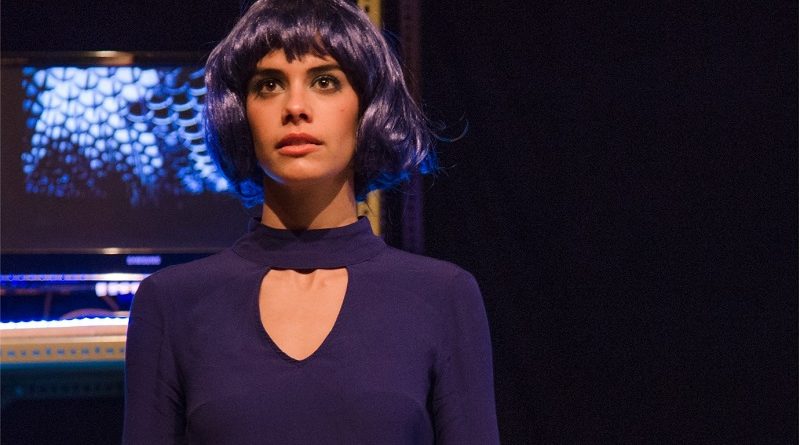
Cover Photo: José Teresa Marques. Automata. Reproduced from Graça P. Corrêa’s article, “Towards a Meta-technological Ecocritical Dramaturgy: Entangling Digital Environments with Human ‘Lived’ Bodies in Automata,” included in this section.

*Nelson Barre is Associate Professor of Theatre at Roanoke College where he teaches courses in Theatre History, Dramaturgy, Directing, and Musical Theatre. His research focuses on dramaturgy in contemporary theatre practices, particularly those related to adaptation. That work has been published in the New England Theatre Journal, Comparative Drama, the New Hibernia Review, as well as various essay collections. He holds a PhD from the University of Galway where he wrote about ritual, memory, and performance in the works of Enda Walsh.

**Stephanie Sandberg is a theatre professor, director, dramaturg, and documentary filmmaker at Washington and Lee University in Lexington, Virginia. She is the creator of the documentary Intimate Violence and a founding member of New Views Theatre Company, where her work centers on theatre as a catalyst for social dialogue and community transformation. Her scholarship and practice span contemporary American drama and global theatrical traditions, examining how performance across cultures interrogates race, history, and identity. She has directed productions and presented research at academic conferences on adaptation, dramaturgy, and the role of theatre in civic life. Her teaching integrates cinema history, AI in the arts, and performance pedagogy.
Copyright © 2026 Nelson Barre and Stephanie Sandberg
Critical Stages/Scènes critiques, #33, June 2026
e-ISSN: 2409-7411

This work is licensed under the
Creative Commons Attribution International License CC BY-NC-ND 4.0.
