Distributed Bodies and Automatic Sensorium: AI in Performing Arts (four case studies)
Horea Avram*
Abstract
This study investigates how artificial intelligence (AI) and machine learning algorithms shape contemporary performing arts, impacting bodily presence, human–machine relationships, and spatial–temporal situatedness. Bodily presence is extended beyond traditional corporeal or sensorial control, while the distinction between human input and automatically generated content becomes increasingly blurred, producing what may be termed the posthuman body. The integration of AI disrupts conventional models of performance and spectatorship, including technologically mediated scenography, and challenges traditional binaries such as presence/absence and actual/virtual. By decentering the human subject, AI-driven projects paradoxically revive questions of medium specificity and liveness, though these concepts become increasingly unstable in AI contexts. What emerges is a new mode of corporeality—expanded, distributed, and mediated by automated sensory operations—here described as a “meta-body.”
Keywords: AI, performing arts, liveness, medium, meta-body
Introduction
Well before digitalization transformed almost everything, artists were already exploring how different forms of media affect artistic content and how to combine live and mediated experiences via technology, and actually how to extend the presence of the body, its function and sensorium. In performing arts, the preoccupation to expand the theatrical discourse has led to the integration of various moving images and film in stage performance as early as late 19th century, from the Théâtre Optique of Émile Reynaud to Georges Méliès and Jenö Janovics who projected short films within their stage shows (Mannoni 551; Giesekam 27-30; Enyedi 45–51).
Although intermediality remained relatively rare in the decades that followed, a number of influential theatre directors began to explore how moving images, sound, and projection could transform live performance. Erwin Piscator, for example, incorporated newsreels, slides, and cinematic devices into his “epic theatre” in order to provide social and political context. Max Reinhardt experimented with projections and film to enhance stage realism and atmosphere, while Oskar Schlemmer integrated dance, costume, geometry, and mechanical or multimedia aesthetics in ways that anticipated later developments in multimedia performance art.
In subsequent decades, an increasing number of artists incorporated film, video projection, chance operations, digital technologies, and networked practices into their work. To name a few: Robert Wilson, The Wooster group, Robert Whitman, The Builders Association, Lightwork company, Josef Svoboda, Robert Lepage, Laurie Anderson and many others, too many to be mentioned in this assumedly short introductory framing. All of them, in one way or another, aspired to problematize, to implement and explore various forms of distributed bodies and automatic sensorium (Dixon 11; 16, 83; Klich and Scheer 4).
This essay investigates the ways in which the use of artificial intelligence [AI] and machine learning algorithms in performative contexts not only builds upon this rich tradition of multimedia use in performance but also expands, diverts, and fundamentally challenges the performative experience altogether. The integration of AI technologies marks a paradigmatic transformation in performing arts practice, producing critical consequences at multiple analytical levels: bodily presence (now enhanced beyond corporeal and/or sensorial control), the human-machine relationship (seemingly affected as the line between human input and automatically generated content becomes seriously blurred, producing what we call the posthumanist body), as well as spatial and temporal situatedness (which suggests liveness may no longer be a defining criterion). So, what could be different this time?
Distributed Bodies
A work that connects to the idea of “distributed” bodies, fragmented, multiplied, technologically mediated through specific AI-based multimedia elements (which I will further explain below), is Una isla [An island] (2023) by Agrupación Señor Serrano, a theatre company based in Barcelona, Spain that creates original productions about discordant aspects of today’s human experience, blending live feed video, scale models, text, performance, sound and objects.
Running for cca 65 minutes, the performance reimagines the castaway narrative—drawing on tropes like Robinson Crusoe, to explore themes of coexistence, diversity, and community-building in a fragmented world. Directed and performed by Àlex Serrano and Pau Palacios, with contributions from performer Valeria Gallardo, the piece combines physical theatre, movement, holographic videos, video morphing, textual projections, music, etc. in a visually and sonically rich staging. AI functions primarily as a pre-production contributor, infusing the work’s poetics and visual structure rather than operating live during performances.
The creators engaged in extended dialogues with various AI models over the course of a year, using these interactions to generate core elements of the piece. This process reflects a “philosophy of the machine,” understood broadly as a multidisciplinary framework for examining the cognitive, epistemological, ethical, and organizational transformations introduced by artificial agents. In this context, AI is prompted to ideate solutions for building what we might call “better worlds,” particularly in response to human failures of inclusion.
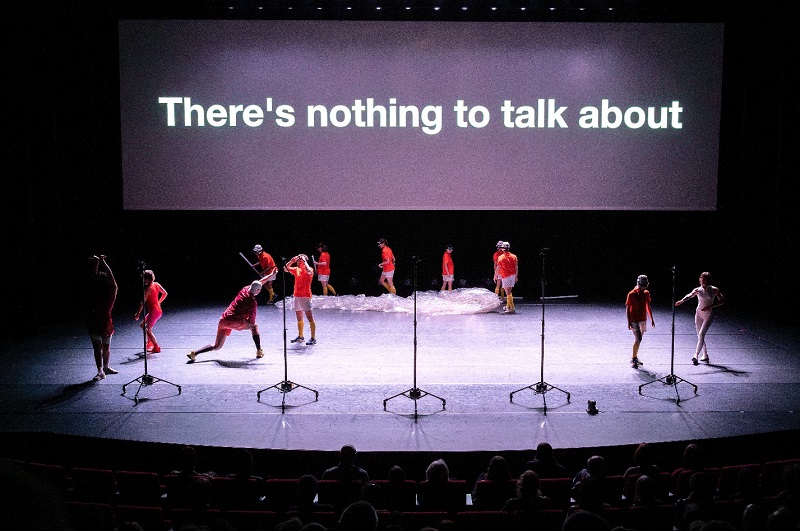
Onstage, AI manifests through hybrid elements at every component, text and narrative generation, visuals, music and sound design, choreography and movement, design elements, that blur performer-audience boundaries: projected dialogues facilitate real-time exchanges between the performers and an “AI respondent.” These drive the action, with AI’s responses (for instance, proposing community-building strategies) prompting physical responses such as synchronized movements or object manipulations. Holographic projections and AI visuals (created using AI image generation tools like DALL·E, StableDiffusion, Midjourney) interact with live bodies, creating “floating islands” (Delgado) of content that evolve in response to the performers’ actions. This generates a dynamic, non-linear structure where movement, sound, and visuals co-emerge. Then, the use of AI articulates the concept of the “island” as both a literal and metaphorical construct, an isolated entity seeking connection. This duality parallels broader human negotiations of diversity and inclusion. The algorithm’s limitations, such as the production of formulaic or derivative outputs, are recontextualized as poetic devices that expose the paradox of seeking empathy through machinic mediation (Serrano).
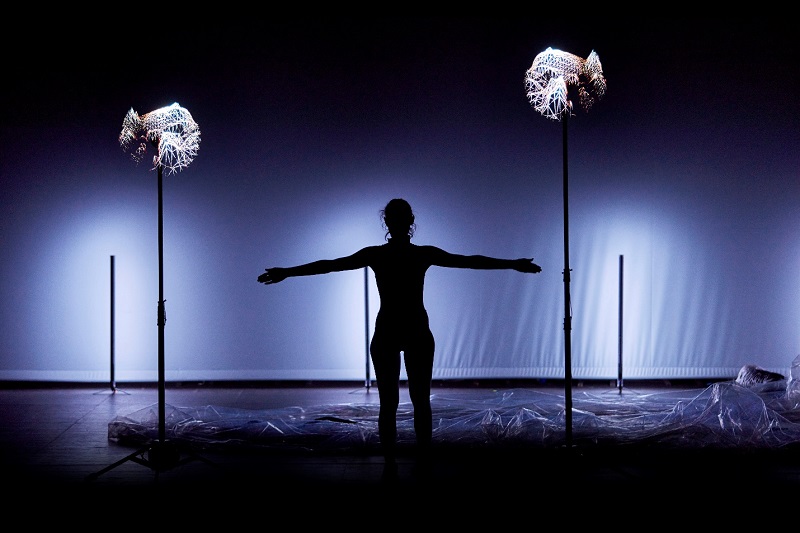
In Una isla, the use of AI foregrounds intentionality and process over immersion or illusion, aligning with the “creators” stated desire to “show people our processes” rather than construct “a lie that is theatre” (Serrano). This self-reflexive approach situates the work within a meta-theatrical framework that resists representational realism in favor of procedural transparency. By exposing the dialogue between humans and machine, Una isla displaces the spectator’s expectation of narrative absorption, redirecting attention toward the act of collective meaning-making. This emphasis on process—one that is significantly marked by AI mechanisms—becomes integral to the piece’s broader utopian aspiration—to imagine a “we,” a collective and inclusive form of belonging, within a cultural landscape marked by fragmentation and individualism.
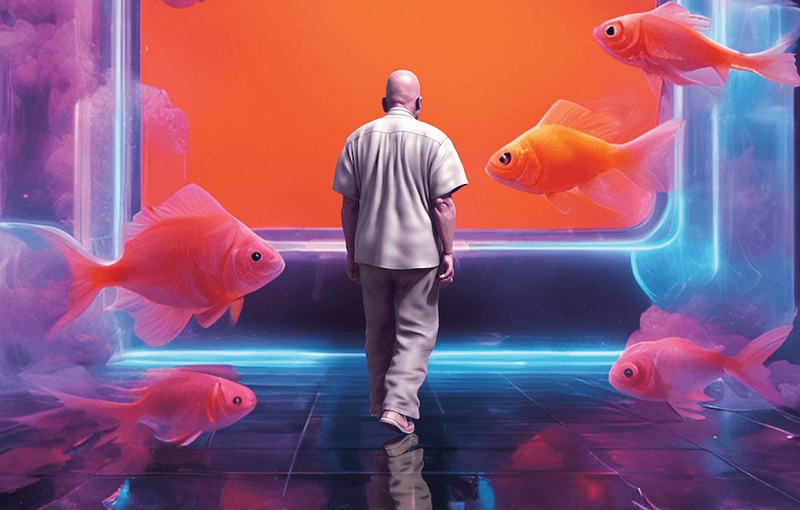
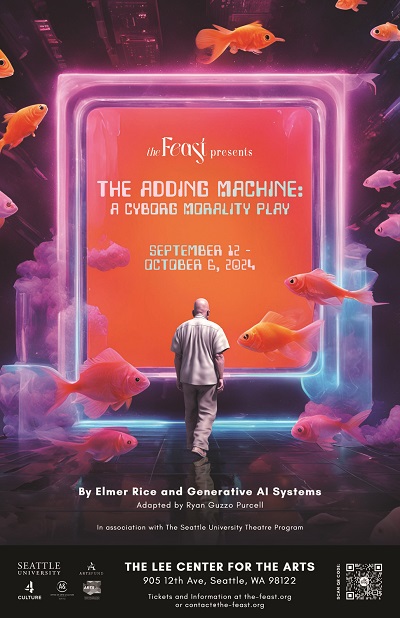
Another work that programmatically explores corporeality as something that exceeds singular, bounded body and instead operates across various AI platforms and visual technologies is The Adding Machine: A Cyborg Morality Play (2024) by The Feast Theater. The work is a meta-theatrical, multimedia adaptation of Elmer Rice’s 1923 Expressionist drama, The Adding Machine. Presented by The Feast (formerly The Williams Project), the production is a direct exploration of the fears surrounding AI by re-framing the original play’s themes of automation and labor exploitation for the 21st century. The core narrative remains the same, with the main character, Mr. Zero, losing his job to a machine and embarking on a hallucinatory journey through “internet culture, the legal system, the underworld, and the future” (Rabinowitz);
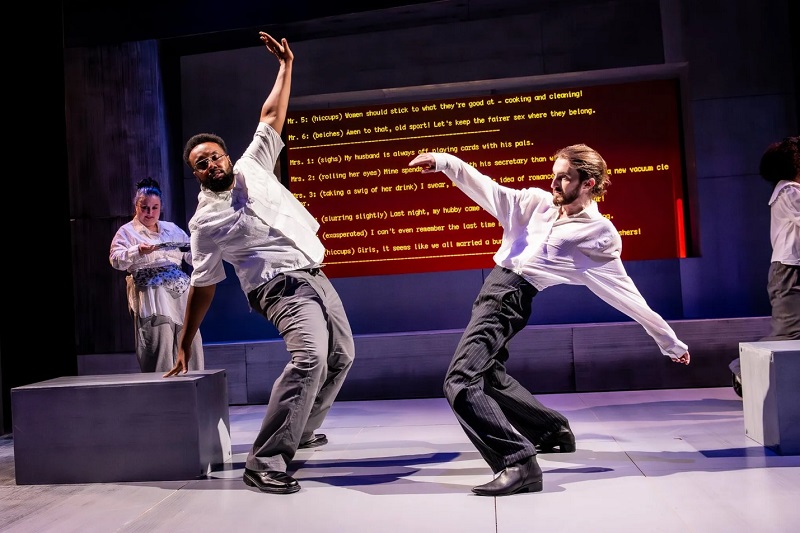
The work integrates generative AI tools (including ChatGPT and Claude) to create interactive characters, dialogue, and music, blurring lines between human performers and machines. AI is used in dozens of ways, often prompted live by actors via phones or laptops, to reframe scenes around themes of dehumanization and automation. Approximately 80% of the script is fixed, but the remaining portions are dynamically generated, requiring the cast to improvise and justify the AI-generated lines, whose content is unpredictable and can sometimes be nonsensical or biased. AI tools were also integrated into the creative process for the scenic, costume, and projection designs, visually illustrating the blurring line between human ingenuity and machine intelligence (Rabinowitz).
Both projects model a different ontology of the body and agentivity, which I call distributed bodies. In this model, agency and embodiment are not located exclusively in an individuated human subject but are produced across networks of human and non-human actors, performers, algorithms, sensors, texts, lighting rigs, audiences, and, perhaps most notably, AI platforms, which distinguish these projects from earlier uses of media technology on stage.
Una isla and The Adding Machine equally de-privilege singular human authorship (the “author” is co-distributed across human input and algorithmic processes), and they materially reconfigure embodiment: bodies on stage are enmeshed with prompts, code, screens, and sensorial networks, so that what the audience perceives as “actorly agency” becomes a different, hybrid effect.
To be sure: ideas somewhat similar to the concept of distributed bodies and automatic sensorium are not new in artistic practice, nor are its theorization. For example, Donna Haraway’s influential “A Cyborg Manifesto” (1991) offers a formulation of the body as a machine-organism hybrid, using the cyborg figure to dissolve the clean distinctions between human and technology in digital contexts arguing that identity and agency are hybrid, constructed through human–machine assemblages rather than founded in pure biological individuation.
Arguing on the same lines, Bruno Latour in his Reassembling the Social: An Introduction to Actor-Network-Theory (2005) insisted that not only human bodies, but also non-humans can be treated as actants (entities that act within networks) thus helping us treat tools, machines, or media environments as genuine contributors to agency in theatre and visual arts.
About posthuman embodiment and distributed cognition, N. Katherine Hayles emphasizes that cognition and subjectivity are not located solely in disembodied “minds” but depend on embodied forms and technological prostheses; the boundary between “human” and “machine” becomes a site of co-construction. In such circumstances, we enter “into a cybernetic circuit” that splices us “into a distributed cognitive system in which represented bodies are joined with enacted bodies through mutating and flexible machine interfaces” (xiv).
However compelling these theoretical positions are, in AI-driven circumstances such as those discussed above, we can speak neither of a replacement of the body with a machine-organism actant or cyborg, nor of a mere prosthetic extension of the body, nor even of a conflation of materiality (body) and information as posthumanist accounts propose. Instead, we encounter a distributed embodiment where agency emerges from ongoing interactions between human performers and AI systems, neither fully material nor purely informational.
Indeed, rather than erasing human subjectivity or the body altogether, these projects distribute embodiment across networks where humans and machines coexist, persuading us to reconceive bodies, responsibility, and authorship as distributed, as emergent from human-AI collaboration rather than individual human agency. Therefore, agency becomes perspectival and partial, an effect of network configurations, since no single node (the actor, the director, the AI) has full causal privilege. At the same time, embodiment is extended and mediated, while the performer’s gestures are shaped by on-the-fly text outputs, sensor data and precomposed machine music, thus turning the “performer” into a node in a distributed system. Similarly, theatrical bodies are conceptually produced by a choreography of code, stagecraft and technology, where generative AI becomes one of the material-discursive practices.
Automatic Sensorium
Building on the concept of distributed bodies outlined above, the following discussion explores how AI technologies function not as external apparatuses but as integral elements of performance-making—a framework that allows us to understand staged AI as co-producing performer cognition and response.
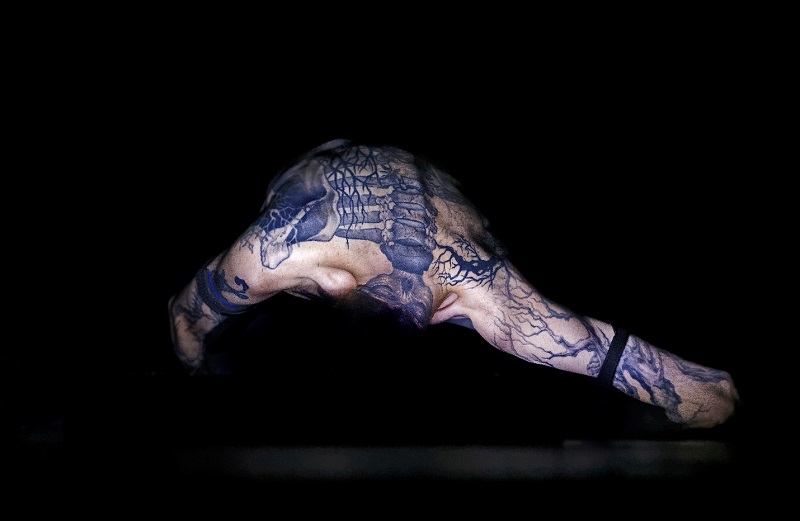
Marco Donnarumma’s Corpus Nil (2016) is a performative, body-centered piece lasting 20-25 minutes and an early example of work employing AI prior to the recent boom (it won Award of Distinction 2017 at Ars Electronica Festival). It is a music performance that explores hybrid forms of identity and musicianship. It does so through an intense and ritualistic interaction between an AI musical instrument, a human body, and sound. The work begins with the question: what if artificial intelligence could be used to contaminate human bodily experience, rather than the other way around as one might expect (Donnarumma)?
In complete darkness, the performer, whose body is partly naked and partly painted in black, executes a tense choreography while biosensors transmit data from his body to software. Chip microphones capture sounds from muscles and internal organs (MMG) and electrodes capture muscle voltages (EMG). The instrument uses filters to analyze the amplitude and frequencies of sounds produced within the performer’s body (1-40 Hz), then re-synthesizes them through a feedback network of twenty digital oscillators. Because the choreography demands slow, subtle actions, the resulting music is equally slow and recursive, mutating across microtonal variations. The instrument also learns the nuances of the performer’s movement, muscular tension, gesture abruptness, rate of relaxation. Based on what it observes, it chooses whether to mute or activate particular oscillators and how to regulate volumes, phases, glissandos, multi-channel diffusion, and feedback amounts. The performer cannot control the instrument but only learns how to affect it and be affected by it.
The piece discards conventional performer-instrument relationships—founded on the performer’s full control of the instrument—in favor of an unstable corporeal engagement between the two. Through the rhythm of sound, vibration, and light, the performer’s body and the instrument mutate, physically and conceptually, into something “other”; an unfamiliar creature defying common definition of the human. As the artist describes the experience: “It is unclear whether the new body is human enough, or perhaps, the common meaning of ‘human’ is not enough to describe it” (Donnarumma).
Worth noting is that an important predecessor in this regard is Stelarc’s Ping Body (1996). Equipped with a muscle-stimulation system and a robotic “third hand,” Stelarc employs pinging as a control mechanism for his body: proprioception and musculature are stimulated not by the internal nervous system but by Internet activity itself. The variation in ping values depends on both the distance and the level of traffic on the Net. The data thus collected are used to trigger a multiple stimulator that activates muscles by tiny electrical currents. In this way activity on the Net is converted and used to set a body in motion.
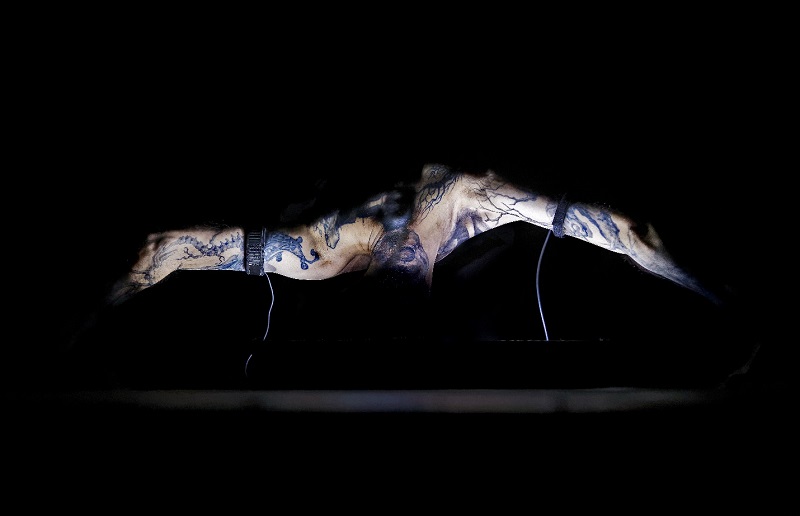
However, in Corpus Nil, Marco Donnarumma not only delegates bodily functions to the machine but effectively blurs any boundaries between the two, creating something more complex than a simple feedback mechanism. As the artist describes it:
In an unstable feedback loop, the body and the machine pollute each other. The amorphous being on stage slowly evolves into an unfamiliar creature. It reconfigures its parts through a sensuous choreography pushing the limits of muscular tension, limbs torsion, skin friction and equilibrium.
This “pollution” enacts a radical questioning of the body where the body becomes absence, emptiness, or void, signaled actually by the work’s title meaning “the body is nothing.” Indeed, the performer undermines his own anatomy through a process of abstraction: the body remains neither fully material nor purely informational, its anatomical specificity rendered vague through technological mediation. Visually minimal yet technologically compelling, the work presents a posthumanist body in which the artist abandons much of his identity as autonomous creator, instead embodying a decentered human subject whose agency emerges only through entanglement with the AI system.
However, this is not merely a question of conceiving the image or the performance as a “body-brain achievement,” as Mark B.N. Hansen maintains (15) with reference to the internal, bodily space for sensation in virtual situations. According to him, in new media—that is, digital media—the body is the original site of information and images, thus the sensorium is the medium through which we experience the digital. Hence, Hansen affirms, the need for “refunctionalization of the body as the processor of information” (22).

Nevertheless, I would argue that AI changes in a profound way this sensorial-digital economy. As the examples discussed here demonstrate, AI (use) is neither something internal nor produced by the performer’s (or spectator’s) affective body. AI is—or can be—not only disembodied, but altogether autonomous, operating apart from the body and its agency. Moreover, according to more pessimistic voices, AI can become the agent that will surpass and ignore humans entirely.
Another work that delegates the creative mechanisms beyond the body, articulating what Caroline A. Jones (2) describes as “an amplified, connected, expanded but also disequilibrated corporeality—a new sensorium” is Prometheus Firebringer (2023) by Annie Dorsen (ca.45 minutes).
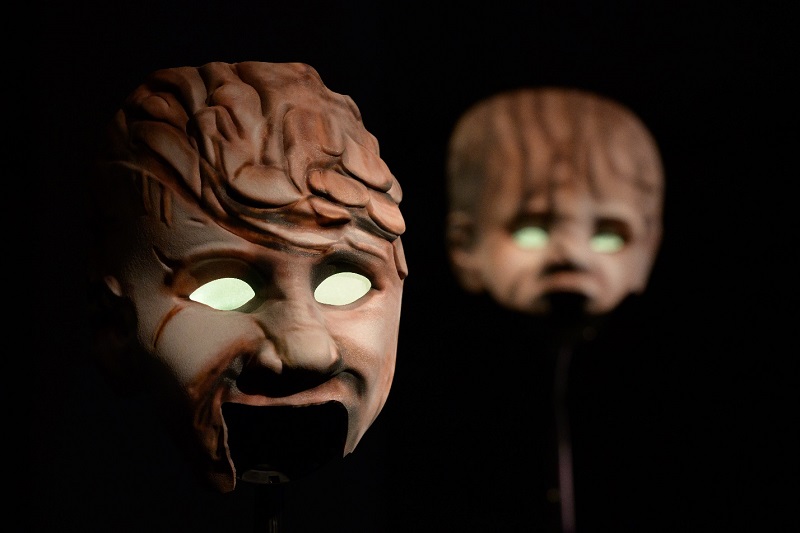
The piece is a deeply thought-provoking “hybrid lecture-performance” that grapples with the role of generative AI in our lives, framed through the Greek myth of Prometheus, the Titan who stole fire from the gods to give to humanity, a metaphor for technology, knowledge, and creative power. It references the Prometheia trilogy (attributed to Aeschylus), of which only Prometheus Bound survives.
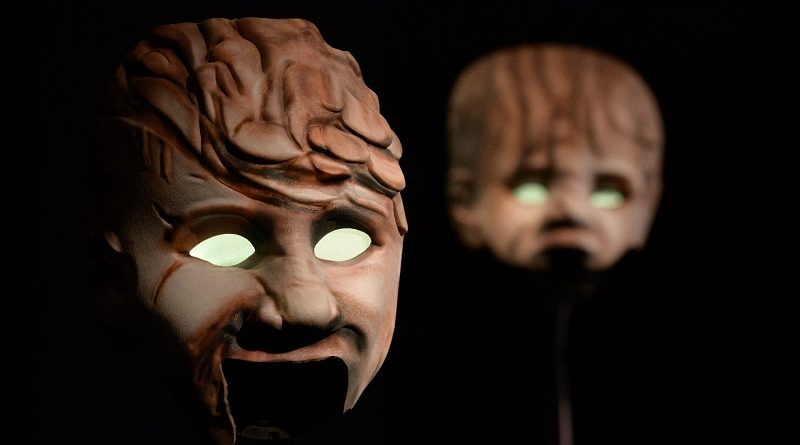
Dorsen uses a predictive text model (GPT-3, or in some contexts GPT-3.5 / GPT-4) to generate speculative versions of this “lost” play. These AI-generated texts are “performed” by a chorus of Greek-style theatrical masks, 3D-printed, with voices synthesized via AI. Dorsen sits on stage at a simple desk delivering a lecture composed entirely of curated quotations from the internet on tragedy and memory, what machines are learning from us, about knowledge and ignorance, projected on a screen as she speaks. Dorsen asks herself if AI is indeed unprecedented and new reflecting “openly on her influences, standing in contrast to how the black box of AI operates. How do we decide to act when we can’t trust our sources? And who do we become in the face of a technology controlled by a select few, especially when its workings remain a mystery?” (Dorsen)
By contrasting the Promethean myth of technology as a liberating “fire” with the “black box” operation of modern AI, Dorsen asks whether the surrender of human intellect and creative capacity to these autonomous systems is a new, inescapable fate within this “techno-epistemological world”—where knowledge, creativity, and truth are increasingly shaped and often obscured by opaque computational systems. By using the same tools she critiques,
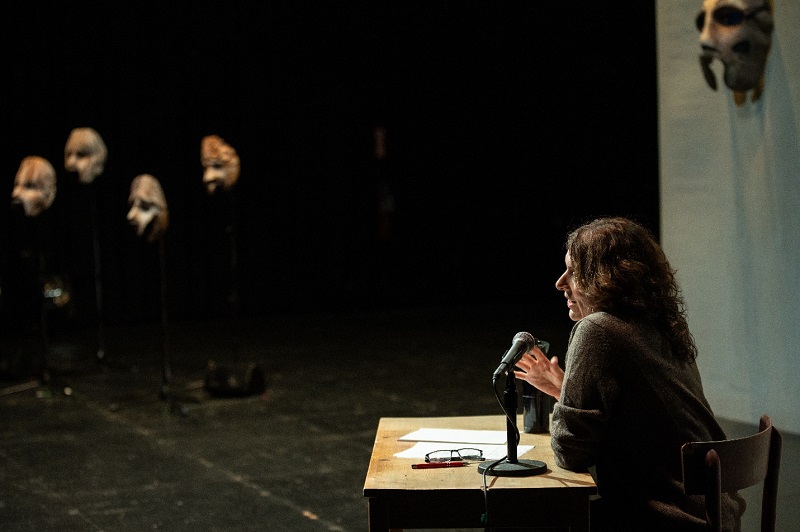
Dorsen forces the audience to confront the paradox of AI: we build it, we rely on it, yet we may not fully control it or even understand it.
Prometheus Firebringer is often discussed as a meditation on “algorithmic theatre” (artist’s term describing modes of algorithmic practice that challenge traditional notions of what theatre is and how it functions), but also on authorship, and the politics of AI. But, understood through the lens of the automatic sensorium, the work reveals a deeper critique of how perception itself is being reorganized by contemporary technologies. Indeed, the spectator, as well as the artist herself, does not simply take part in a performance; she is situated inside a perceptual apparatus whose outputs are to a great extent automated. And in this sense, the performance is less about “AI making a play” and more about performing the condition of being surrounded and deeply determined by automatic/autonomous discursive machinery. This condition, I would claim, fundamentally reshapes the coordinates of performance itself. In what follows I will attempt to unpack the consequences that this condition of distributed bodies and automatic sensorium has for medium, liveness, and the definition of the body.
Liveness Revisited
A major outcome of AI’s integration into the field of performing arts, as illustrated by the projects discussed above, is a renewed emphasis on the process: the strategies, methods, and operational frameworks at play. This reorientation shifts attention away from earlier concerns with timing, simultaneity, and reproduction, as specific problematics in performing arts. By destabilizing binaries of presence/absence and actual/virtual that have long shaped the discourse in the field, AI paradoxically revives, both critically and in unresolved, aporetic ways, the debate over liveness itself.
The polarization between live and mediatized/mediated performance is often framed through the contrast between the opinions expressed by Peggy Phelan and Philip Auslander. Phelan argues that live performance holds a unique ontological status because it disappears in the very moment of its occurrence, resisting reproduction and thus maintaining an authenticity that the mediatized can never match (“it becomes itself through disappearance” (146).
Auslander challenges this hierarchy, claiming that live and mediatized forms are mutually dependent and culturally intertwined; rather than occupying separate realms, they continuously shape and define one another. Both, he argues, are shaped by mediatization, since live events borrow formats, aesthetics, and expectations from media: “the very concept of live performance presupposes that of reproduction—that the live can exist only within an economy of reproduction” (57).
However, as Auslander himself admits, liveness is not an ontological condition but a variable cultural construct that shifts over time. For this reason, I contend that under the conditions produced by AI, liveness must be redefined. While both authors highlight the ongoing tension between immediacy and mediation in contemporary performance, liveness should be understood neither as a question of ontological precedence (as in Phelan) nor primarily as a function of reproduction (as in Auslander). Neither position fully accounts for the distinct experience produced by AI at the levels of both production and reception.
As the works discussed above attest, the performative process unfolds in the “now,” but not entirely in the “here,” and equally right “here,” yet not fully in the “now.” It is simultaneously reactive and anticipatory, prefigured and unpredictable. A reconsideration of the concept of liveness is therefore necessary to account for the radical shifts introduced by AI.
Signaling the need to move beyond the opposition between the live and the mediated, Rosemary Klich and Edward Scheer introduce (or rather adapt) the term “intermediality” in the performing arts, where “‘inter’ implies a between space, and intermediality exists between previously assumed ideas of medium specificity” (71). More precisely, they explain, “in intermedial performance, the realms of the live and the mediated develop reciprocity and are framed as complementary and symbiotic elements of the performance whole” (71).
Although the ambition to cut across famously opposing terms is welcome, the notion of “Intermediality” as it is defined by the two authors seems less suitable in this context since, while appropriately emphasizes betweenness, it maintains the question of medium (un)specificity, which in my view, is not a determinant issue in AI. It is just as irrelevant as the idea of liveness.
These conceptual frameworks are rooted in human-centered performance theory and presuppose phenomenological conditions that AI cannot inhabit. At the temporal level, AI operates outside conventional performance time structures: it executes computational processes without the immediacy or concern with mediatization that define traditional liveness discourse, this remains true even in performances, like those examined here, which integrate pre-produced AI components with live theatrical presentation. Consequently, liveness lacks ontological grounding in AI operations. The disembodied, data-reflective, and algorithmically persistent nature of AI fundamentally destabilizes the anthropocentric premises underlying both dominant positions in liveness debate, rendering the concept itself increasingly untenable.
At the same time, it is also relevant to emphasize that AI output is not medium-dependent. For example, Una isla by Agrupación Señor Serrano, employs various forms of collaboration with AI at the level of text and narrative generation, visuals, music and sound design, choreography and movement, as well as set design. The same is the case with The Feast Theater’s The Adding Machine: A Cyborg Morality Play, where the script, the scenic, costume, and projection designs all are produced (also) via AI. Similarly, Marco Donnarumma’s Corpus Nil and Annie Dorsen’s Prometheus Firebringer are composite works with AI playing on multiple discursive levels. Furthermore, AI-based performances delegate in part human agency and subjectivity. If traditional liveness presumes predictable, embodied intentionality (such as rehearsal and improvisation), AI performances, however, enact “spontaneous order” via neural networks, where patterns self-organize from distributed interactions, unknowable in totality.
There are grounds to suggest, therefore, that neither body-centered liveness nor tangible, material medium are essential notions for AI since, in their traditional understanding, both are inextricably human: the former assumes embodiment and ephemerality, the latter sensory expression and deterministic agency. AI, as disembodied reflection and atemporal algorithm, demands new theoretical probes—perhaps, Hayles’s idea about “how we became posthuman” or Latour’s evaluation of “actor-networks”—unburdened by analog nostalgia. These critiques not only extend AI analysis beyond outdated paradigms but put at the forefront the very definition of the human (perception) and the body (Arielli 95-118; Zylinska 91).
Meta-body
There is a general consensus that we inhabit a posthuman paradigm, one in which the body is displaced from its privileged position as the locus of experience and intentionality. Agency, the theory goes, no longer resides exclusively in human corporeality but disperses across computational systems, datasets, and algorithmic processes that function independently of human bodily presence. Surely, metaphors construing the body as a technical entity (mechanical, informational, computational) extend back at least to Julien Offray de La Mettrie’s L’Homme Machine (1747). Yet what emerges here differs from the established theoretical models: it is neither N. Katherine Hayles’s “embodied virtuality,” Donna Haraway’s “cyborg,” nor Mark Hansens “bodily framing.”What we discern, rather, is the presence of a “meta-body.”
My understanding of the meta-body is informed by the established notion of meta-medium, a valuable theoretical tool gaining renewed interest especially in the context of AI artistic production. The term “metamedium,” coined by Alan Kay and Adele Goldberg in their seminal 1976 essay “Personal Dynamic Media,” conceptualizes the computer as a revolutionary platform that transcends individual media forms. Unlike traditional media (such as text, print or film), which are passive and fixed, the computer functions as a metamedium by simulating and embodying all other media through programmable embedding and viewing methods. Its significance lies in its active and interactive nature: it enables a “two-way conversation” between user and content, fostering dynamic creation, simulation, and personalization, exemplified in their vision of the Dynabook, a portable device that “give out information in quantities approaching that of human sensory systems” (394). This reconceptualization shifts media from static representation to flexible tools for thought and expression, prefiguring personal computing’s democratizing potential.
Lev Manovich rereads and extends Kay and Goldberg’s concept in works like The Language of New Media (2001) and Software Takes Command (2013), reframing the metamedium through the lens of the software. He emphasizes its “permanent extendibility” since “new properties can always be easily added” (92): software not only simulates legacy media but remaps and hybridizes them via modularity, variability, and automation, creating a “common grammar” for cultural production. Manovich’s extension of the concept highlights meta-media’s properties, data translation across domains, user-driven mapping of old to new forms, and infinite remixability, transforming the computer into an ever-evolving ecosystem that blurs medium boundaries and amplifies cultural evolution.
With the expansion of AI art, the metamedium re-enters theoretical vocabulary as an invaluable paradigm for understanding generative and multimodal creation. AI systems based on diffusion models (such as DALL·E or Stable Diffusion) embody this by converging disparate media—text, image, sound, 3D animation—into a singular, probabilistic interface, dissolving medium specificity and enabling hybrid outputs from prompts alone. This extendibility empowers artists to automate variation (e.g. infinite stylistic iterations), simulate cross-modal translations (text-to-video, for example), and co-create with non-human agency, fostering emergent aesthetics unbound by traditional constraints.
Ultimately, AI art leverages the metamedium to democratize experimentation, challenge authorship, and redefine creativity as a fluid, data-driven convergence rather than fixed craft. Moreover, it reframes the body itself, turning it into a meta-body: a human form not as fixed flesh but as a dynamic, hybrid interface that embeds, simulates, and remixes bodily expressions, gestures, and perceptions across physical and digital realms—much like the metamedium’s “two-way conversation” with content. The body is no longer a singular, bounded entity but a distributed, processual phenomenon: simultaneously data source, algorithmic output, simulated presence, and performative absence. A distributed body. An automatic sensorium. A meta-body.
Bibliography
Auslander, Philip. Liveness: Performance in a Mediatized Culture. 2nd ed., Routledge, 2008.
Delgado, Maria. “Floating Islands of AI: Agrupación Señor Serrano’s ‘La isla/The Island’ in Madrid.” The Theatre Times, 27 Oct 2023.
Dixon, Steve. Digital Performance: A History of New Media in Theater, Dance, Performance Art, and Installation. The MIT Press, 2007.
Donnarumma, Marco. Corpus Nil. 2016. Personal website, Works.
Dorsen, Annie. “Prometheus Firebringer.” 2023. Artist’s website, Projects.
Enyedi, Delia. “Here First!: Young Jenő Janovics and the Moving Pictures.” SCIA.TMC – Studii şi Cercetări de Istoria Artei. Teatru, Muzică, Cinematografie, new series, vol. 14, no. 58, 2020, pp. 45–51.
Giesekam, Greg. Staging the Screen: The Use of Film and Video in Theatre. Palgrave Macmillan, 2007.
Hansen, Mark B. N. New Philosophy for New Media. The MIT Press, 2004.
Haraway, Donna J. “A Cyborg Manifesto: Science, Technology, and Socialist-Feminism in the Late Twentieth Century.” Simians, Cyborgs, and Women: The Reinvention of Nature, Routledge, 1991, pp. 149–81.
Hayles, N. Katherine. How We Became Posthuman: Virtual Bodies in Cybernetics, Literature, and Informatics. The U of Chicago P, 1999.
Jones, Caroline A. Sensorium: Embodied Experience, Technology and Contemporary Art. The MIT Press, 2006.
Kay, Alan, and Adele Goldberg. “Personal Dynamic Media.” The New Media Reader, edited by Noah Wardrip-Fruin and Nick Montfort, The MIT Press, 2003, pp. 391–404.
Klich, Rosemary, and Edward Scheer. Multimedia Performance. Palgrave Macmillan, 2012.
Latour, Bruno. Reassembling the Social: An Introduction to Actor-Network-Theory. Oxford UP, 2005.
Mannoni, Laurent. “Emile Reynaud.” Encyclopedia of Early Cinema, edited by Richard Abel, Routledge, 2005.
Manovich, Lev. Software Takes Command. Bloomsbury Academic, 2013.
Phelan, Peggy. Unmarked: The Politics of Performance. Routledge, 1993.
Rabinowitz, Chloe. “The Feast to Present AI-Infused Adaptation of ‘The Adding Machine.’” Broadway World, 21 June 2024.
Serrano, Alex. “SIFA 2024: An Interview with Alex Serrano, Co-Creator of AI-Driven Dance Performance ‘Una Isla.’” Bakchormeeboy, 15 May 2024.
Zylinska, Joanna. AI Art: Machine Visions and Warped Dreams. Open Humanities Press, 2020.
*Horea Avram is Associate Professor in the Department of Cinema and Media, Faculty of Theatre and Film, Babeș-Bolyai University, Cluj-Napoca, Romania. He researches and writes about art and visual culture in relation to media technology. He has contributed to Encyclopedia of Aesthetics (Oxford University Press, 2014), Theorizing Visual Studies: Writing Through the Discipline (Routledge, 2013), and Encyclopedia of the Imaginaries in Romania (Polirom, 2020). He has served as President of AICA-Romania (International Association of Art Critics) from 2020–2026. Email: horea.avram@ubbcluj.ro.
Copyright © 2026 Horea Avram
Critical Stages/Scènes critiques, #33, June 2026
e-ISSN: 2409-7411

This work is licensed under the
Creative Commons Attribution International License CC BY-NC-ND 4.0.
