Disappearing Acts: Two Trips to the Theatre in France on the Edge of War
Rachel Shteir*
Abstract
On the edge of a war, the writer of this report goes to France for a writer’s residency. She sees Bertolt Brecht’s Fear and Misery in the Third Reich in Toulouse and Here Be Dragons Second Era in Paris at Théâtre du Soleil. She has already seen The First Era in 2024. She cannot escape war but she loses herself in these productions if only for a moment.
Keywords: Mnouchkine, France, Brecht, Théâtre du Soleil, Julie Duclos
In March, in the evenings just before the war in Iran starts, in a paradise writers’ residency in South-Western France, I watch streaming series about young people disappearing. Swallowed up by monsters, lost to cults, taken by psychopaths. These series exist in America but they leave a bad taste. Here they seem poignant. They prove the superiority of the French understanding of humanity, the necessity of protecting art. I want to believe such things. That’s why I keep coming back.
I flew into Toulouse a few weeks ago. It’s near the residency. But also I wanted to see Brecht’s Fear and Misery in the Third Reich at The City Theatre. Brecht is rarely done – or done well—in the U.S. so I couldn’t forego it. The show was completely sold out but I was able to score a strapontin or jump seat, as far as I know a uniquely French thing where you basically pay to sit in the aisle.
Fear and Misery, which I’d never seen before, stuns me. Written between 1935 and 1938, during Brecht’s exile, with Margarite Steffin, Fear and Misery strips away illusion to show Nazism poisoning the lives of everyone from judges to butchers. This production, directed by Julie Duclos, a success at the Odeon in Paris last year, presents most of Brecht’s 24 vignettes against a grim grey set.
Brecht is a genius at controlling what the audience sees. And doesn’t: Blood, murder, throughline, all off stage. This is not a film. Front and center, episode after episode, you see the rise of fascism creating chaos and slippery moral slopes in everyday life. One person after another panicking, scrounging for a shred of humanity, cornered into impossible choices. Garden-variety bullies become regime thugs, terrorizing neighbors with salutes. A Jewish woman telephones her friends one by one to tell them she’s leaving for Amsterdam then informs her non-Jewish husband of her plans. He barely protests. Parents agonize over whether their Nazified child will turn them in.
In one of the most famous scenes, a judge (the amazing Philippe Duclos, who played a magistrate in the brilliant French TV series, Spiral and is the father of the director) worries about how to handle a case in which storm troopers rob a Jewish jewelry store. The judge has to deliver a ruling but Brecht wants to show audiences the contortions he has to make. It would be a comic scene if it weren’t so tragic. As Brecht writes in The People’s Judge (German: Der Volksrichter):
The judges follow limply
They were told that justice is simply
What serves our people best
They objected: how are we to know
But they’ll soon be interpreting it so
The whole people is under arrest.
After the show, ferocious clapping. Fourteen curtain calls. People know what they saw.
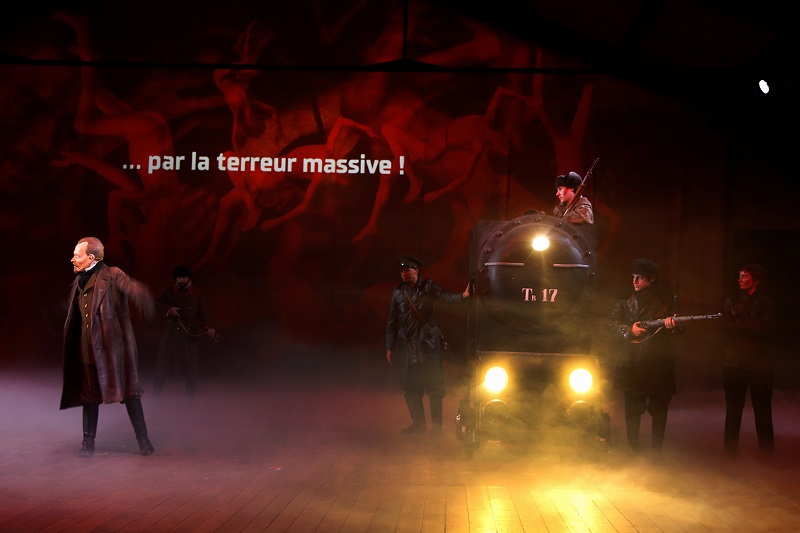
In April, on my way back to Chicago, I stop in Paris. I want to see Ariane Mnouchkine’s show at Théâtre du Soleil, Here Be Dragons, Second Era. This company-created docu-fiction work in 36 short scenes is set between 1918 to 1933, roughly the same period in Brecht’s Fear and Misery. The two shows form a conversation between a giant of twentieth-century theatre and one who straddles the twenty first as well.
I am a longtime fan of the company Mnouchkine, now 87, founded in 1964. I first saw her tender romantic 1978 film, Moliere—a love letter to the playwright—shortly after it came out. I still remember a scene from Moliere’s early years traveling around France where his troupe of performers chases another troupe of performers whose makeshift stage the Mistral blows across fields. It says something about the fragility of theatre. As did Mnouchkine’s whirling Indian Les Atrides (The Oresteia), which I saw in 1992 at the Park Slope Armory in Brooklyn. It was so beautiful it changed what I thought theatre could be.
Mnouchkine’s great theme, or one of them, is how time blows away everything. The theatre is always historic,” she writes. In a preface to Ici Sont Les Dragons, Première Époque, Helene Cixous balances the darkness and the light, “history is a nightmare that deposits us on the shore of another dream.”
I saw Here Be Dragons, First Era: Victory Was in Our Hands, in 2024. The subtitle comes from one of the notebooks of Nikolai Soukhanav, an economist who was shot in 1940 and who is a character in the show. The phrase also evokes a theme that Mnouchkine and Brecht share—the regularity, the consistency with which the strong seize power from the good. Mnouchkine’s beautiful work doubling as a history lesson and a nightmare begins with Putin’s face on a huge screen. The Mnouchkine stand in, Cornelia, who first appeared in a 2018 show, A Room in India, rushes to tear down Putin. She only half succeeds. This is the power of the screen. And then three witch-like figures enter. After that, the show concentrates on 1917, the year of the Russian Revolution. Stephane Courtois, whose introduction to the controversial 1997 best-seller The Black Book of Communism: Crimes, Terror, Repression equated the crimes of that ideology with those of Nazism, is listed as an advisor to Dragons.
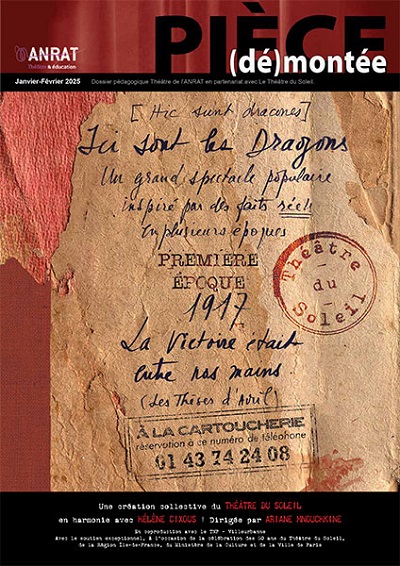
Here Be Dragons, P ends with a sublime image of The Constituent Assembly, right before the Bolsheviks dissolved it. Cornelia appears once again to project the image of the maquette from her cellphone to the screen Putin’s face was on at the beginning of the show. The maquette looks like a dollhouse.
I have to talk about what’s going on behind the scenes as well as what’s on stage. In March and April, when I was in France, Mnouchkine was fighting #MeToo charges levied against the company. One group of the charges, which surfaced in the spring of 2025 in a public hearing, alleges that two male actors in the company tried to rape—and did rape—a 16-year-old female actor. (Both men, who are no longer in the company, deny the charges.) Subsequently, exposes in the online investigative magazine, Mediaparts, seemed not only to be arguing about these charges but that the company’s systemic inequity allowed abusers and abuse to flourish. In other words, as you see so often in the states, the media held a tribunal over sexual abuse in theatre and even pronounced Théâtre du Soleil DOA. External and internal investigations took place. In May, The Ministry of Culture ruled that the theatre, which the state funds annually at two million Euros, needed to strengthen certain of its protocols around preventing sexual violence. But many other protocols were found to be working.[1]
I don’t want to get distracted by these exposes or what by American standards an amount of money seems like an enormous amount for non-commercial theatre. It’s impossible to compare Théâtre du Soleil to any theatre here. It’s not just a company. It’s a utopian experiment of 80 employees. Everyone earns 2000 Euros a month. For a long time, everyone worked in the kitchen.
I also want to be clear that I’m neither defending Théâtre du Soleil against #MeToo accusations nor arguing that Mnouchkine treated them with anything but gravitas. But I do want to mark here that this is the second time I am aware of that Mnouchkine has had to defend of her artistic practices and the company’s, taking courageous positions that would be unthinkable in the U.S., where such media-Internet tribunals nearly always end in the death of the theatre concerned.
I am thinking specifically of the 2018 controversy, after First Nation activists capsized a Théâtre du Soleil collaboration with the Canadian director Robert LePage about the history of the suffering of indigenous people for not hiring either actors or consultants from their community. Mnouchkine eventually produced a version of the show in Paris. But then, as now, she elegantly laid out her artistic position. It appeared in an interview with Telerama (later published in the now defunct journal PAJ and on the blog of Jonathan Kalb, Theatre Matters): “cultures are not anyone’s property. No bounds limit them because, precisely, they have no known geographical or, especially, temporal boundaries.”
Since the pandemic, if anything, the hysteria around these identity-based protests has gotten worse. I don’t have statistics but I see it happening. This is why I quote in detail Mnouchkine’s brave February 26 response to the recent accusations on the Théâtre du Soleil website, which she began by listing her own failures. But then she attacked “media vitriol” and “certain self-appointed purifiers.” She committed to doing an internal investigation, whose results she promised to release. But for me the most moving piece of her message was her confession, with its ring of a soliloquy from a great tragedy:
That I have, therefore, lacked discernment during the sixty-two years of my professional life, I obviously do not deny. But does that mean that I was wrong, throughout those years, to trust the many people who have always remained worthy of that trust and friendship? I don’t think so. Is trust a risk? Yes. Can one live, love, create, without taking that risk? I don’t believe so. But, in this instance, that risk, taken by me, has been paid for, it seems, and without my knowledge, by others. *
The idea that it requires faith and sacrifice to make great theatre is missing from conversations about the form in the U.S. It has for some time. The fact that some people in France still believe it makes theatre there unique, it gives me hope. Yes, some young French theatre workers I know seemed dissatisfied with Mnouchkine’s response to the #MeToo accusations. But I found her mixture of humility and defiance inspiring, even more so in the shadow of the horrifying Gisele Pelicot affair. It takes courage to publicly reject the role of monster, to shun those trying to turn your life’s work into a monster-factory.
Another section of Mnouchkine’s response argues that the attacks are part of a larger attempt to destroy her theatre. Or her. Or theatre itself. At least one essay, by the theatre scholars Isabelle Barberis and Beatrice Picon Vallin, gives a historical perspective on this view, connecting it to the phenomena of the cabal.[2] Which seemed correct to me. In general media exposes of theatre do seem to want to go beyond reporting to annihilating the form. They want to announce the long-awaited death of theatre, whose longevity in the digital age is unknown. An article exposing an artist who spent her entire life representing injustice on stage as guilty of injustice—or at least turning away from injustice—is more clickable than an essay about a beautiful spectacle.
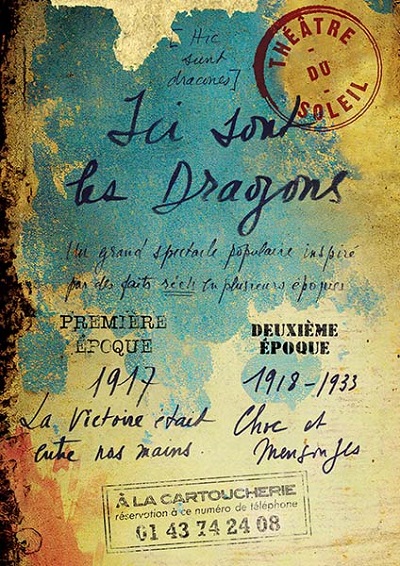
The exposés generated fallout. A film and an academic symposium were cancelled. A museum exhibit was postponed. When I was in France, an online ticket venue offered half-price seats (though maybe that is happening in all theatre). Mnouchkine has named a successor and intimated that she will step down after next year. Nonetheless, she opened Ici Sont Les Dragons Deuxième Époque on time, in March 2026. By the end of April, 15,000 people had seen it.[3]
***
The Sunday before I return to the U.S., on a beautiful morning, I schlep out to La Cartoucherie, a former munitions factory in the magnificent Bois du Boulogne, on the edge of the city. Making the journey is part of the magic. For this production, the famous egalitarian theatre begins with seat selection—a process which here requires you to stand in no fewer than 3 lines. One to trade your pre-ticket for a ticket, one to select a seat, and one, finally, to enter. The mood in the lines is friendly although in the second line, there’s a lot of joking and anxiety about whether everyone will get a seat.
Mnouchkine, in a blue sweater vest and a grey shirt and black pants, stands at the entrance, greeting ticket-holders, as she has for years. She looks everyone in the eye and says a few words. At what other theatre in the world does this happen.
In the enormous main room before the show, the audience queues up again at a counter to order the one meal on the menu—borscht, pierogi, and panna cotta. Everyone eats at trestle tables. The point is to commingle with strangers. And it does work. It is impossible not to exchange a few words.
There is also a book kiosk where you can also buy volumes on Soviet history and theatre. The theatre is located in the next room. You can look through cut outs in a linen curtain to see the actors getting ready. Their dressing room is light and airy with a beautiful carpet. Mnouchkine makes the magic available to us. The seats—on risers facing the stage—offer pretty much the same perspective.
***
At the writer’s residency, we are sheltered somewhat from the world. Somewhat because with the Internet it is impossible to sever yourself the way you used to be able to do, at residencies. Before cell phones, I mean, before the Internet. But most people are trying.
Several times a week, I bike to the farmstand along beautiful country roads, passing houses protected by high fences and large dogs. As I pass one of them, a dog runs the length of the yard barking at me. One time, though, a young guy astride a bike is in the driveway revving his engine. I don’t know if he’s connected to the house. Every time he revs the dog barks. The dog is going crazy. I want the guy to stop. In my head I scold him, as a French person would. But in real life I just bike by and we exchange generic greetings. I’m a bybiker.
***
Like The First Era, Here Be Dragons, Second Era has a narrator, Cornelia, the Mnouchkine stand in. “I think it’s time for an intermission now” she says to much laughter, after about an hour and a half that includes a scene in which stage-hand push a chanteuse on a rolling platform across the stage as she croons a song titled “It’s The Jews’ Fault.”
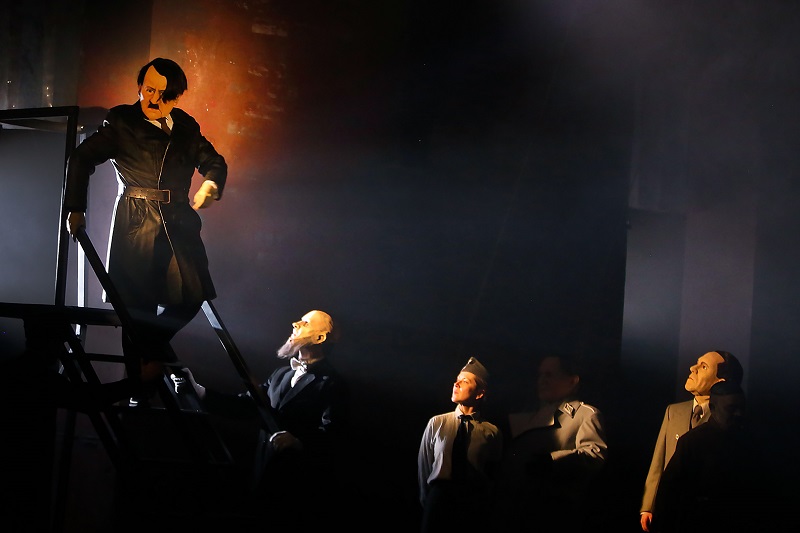
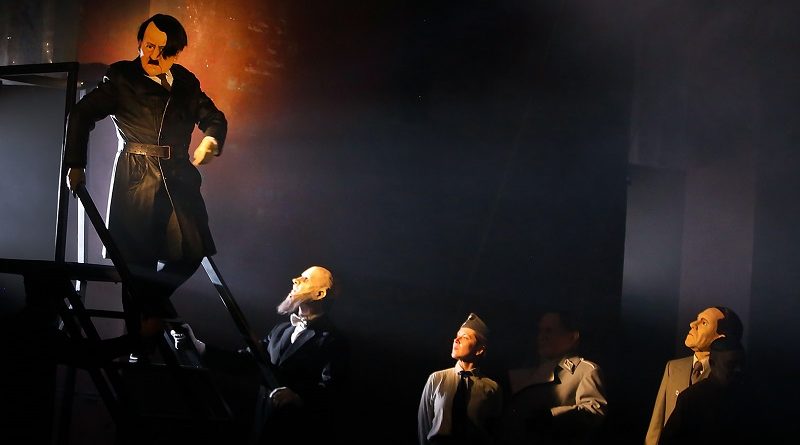
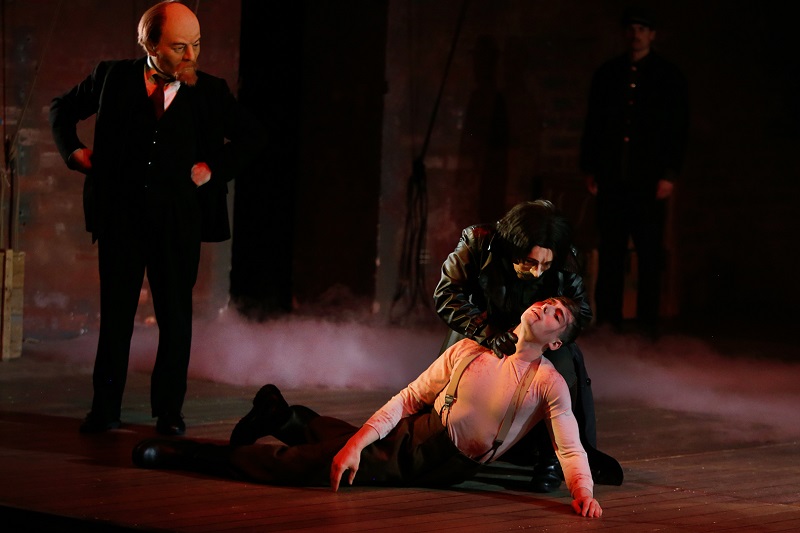
Dragons, the longest show I saw in Paris this spring, was the best not just because of its mordant humor. Its fluidity was remarkable, the way it picked you up and carried you along. As in The First Era, the major historical figures—Stalin, Churchill, Hitler—wear the sort of masks robbers wear during heists. (Created mostly by Erhart Stiefel, who died this year, from neoprene or leather.) They challenge audience empathy and give the historic figures mythological vitality. Bodies dangle below giant masked heads, turning actors into puppets, like something Edward Gordon Craig wrote about, or Bobble-heads. As in The First Era, the text, soliloquys pieced together from historical speeches, news accounts, and archival fragments, is delivered in pre-recorded voice overs in English, German, Russian and Japanese (with French supertitles). Or from backstage.
The historical reenactment/living diorama sweeps cinematically and globally through the years. Where Brecht focuses on ordinary people on stage, Mnouchkine puts them next to evil tyrants. Her mise en scene goes farther than Brecht. She is less interested in psychological realism or virtuosic naturalistic acting than status, legend and iconicity. Churchill broods about the world from his bathtub (as he did in real life) Stalin pays a visit to Lenin, old and infirm in a wheelchair, and tears up a letter warning the world of his capriciousness. Bulgakov makes an appearance, as does Henry Ford jousting with a factory worker. As do the American journalist Dorothy Thompson, Oswald Mosely, and Goebbels. It’s fast moving and exciting.
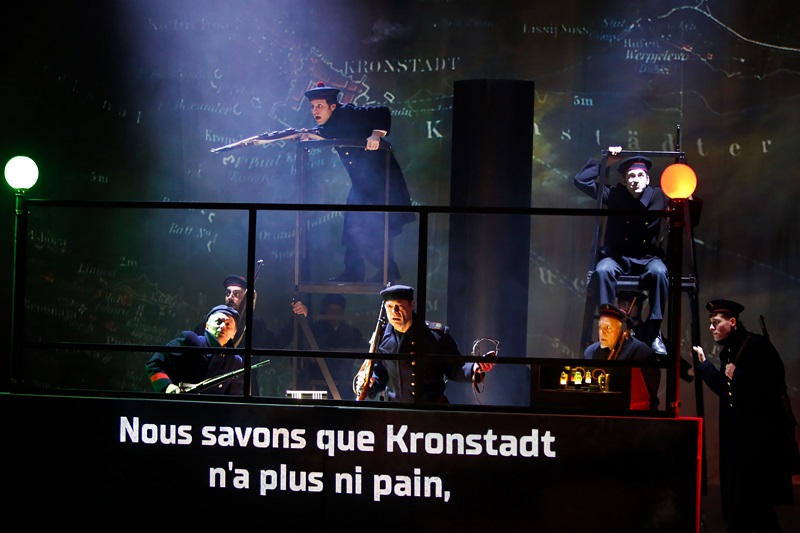
It’s possible that Here Be Dragons felt less like a history lesson than The First Era because of me. A new war had started so I wanted to escape into story. Or maybe I was more immersed because The Second Era covered a longer time span than The First. But I felt especially enchanted by the beautiful images of cities and landscapes floating by on a screen, part of an inaccessible past. And Mnouchkine’s controlled maximalist staging—especially her use of moving wooden platforms like those developed by director Vsevolod Meyerhold, whom Stalin had executed in 1939—contained and advanced action with exquisite precision.
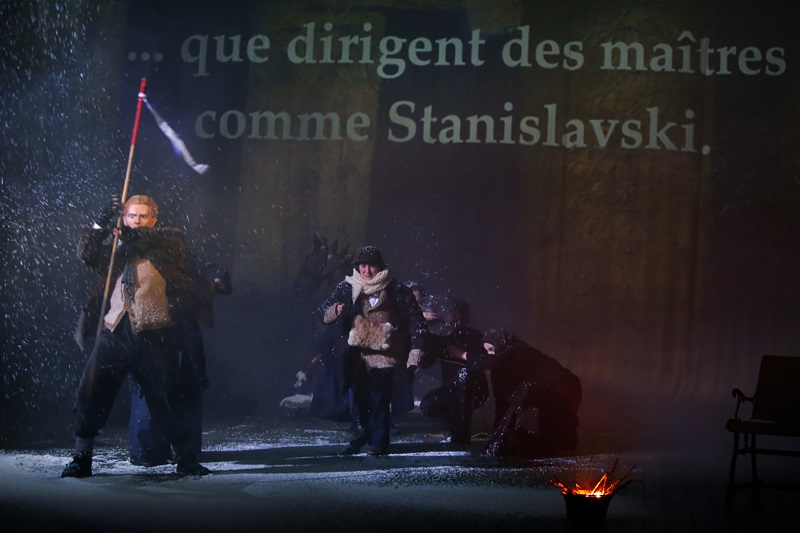
Black clothed stagehands roll these platforms up and downstage, from one side to the other, creating mini environments that then disappear. A premonition of how the audience will forget this, and all theatre. In one scene, set during a blizzard, the stagehands stand behind the characters shivering. But Mnouchkine doesn’t hide the stagehand. She lets the audience see the magic and see how it’s made. He holds a portable fan and throwing confetti in front of it to make the blizzard. It’s almost ebullient.
As with The First Era, The Second ends with an astonishing final scene, “La Manche Inquiète.” The English Channel is worried. Churchill delivers a rousing warning against Hitler. But will anyone hear it? Beautiful billowing waves made from a gigantic parachute cloth spread across the whole stage (again operated by stagehands) toss him around. He keeps shouting but he disappears. “To Be Continued.” The Third Era will open soon.
***
At the residency, at night, I can’t sleep. I lie awake in bed listening to my heartbeat like thunder. (Did you go see a doctor, someone asked me? Missing the point entirely.)
Maybe it’s the TV shows? I stand at the window looking out at the night sky, the bright stars. France! Will you protect theatre? Or disappear? I already have.
Note 1: Here Be Dragons First Era, Victory Was In Our Hands, 1917, and Second Era: Shock and Lies’,1988-1933 (both created with Helene Cixous and the Théâtre du Soleil company). Directed by Ariane Mnouchkin. La Cartoucherie (Paris). 2024-2026 seasons Fear and Misery in The Third Reich (by Bertolt Brecht). Directed by Julie Duclos. City Theatre (Toulouse). 2026 season.
Note 2: All translations mine.
Endnotes
[1] Théâtre du Soleil website.
[3] Théâtre du Soleil website.

*Rachel Shteir, a 2025-6 Guggenheim fellow, is the author of four books. Her most recent book, Betty Friedan: Magnificent Disrupter, was a finalist in biography for the National Book Critics Circle Award and a New Yorker Best Book of the year. Her journalism has appeared in many newspapers and magazines including The Wall Street Journal and The New York Times. She is the founder of the Dramaturgy/Criticism Program at The Theatre School at DePaul University.
Copyright © 2026 Rachel Shteir
Critical Stages/Scènes critiques, #33, June 2026
e-ISSN: 2409-7411

This work is licensed under the
Creative Commons Attribution International License CC BY-NC-ND 4.0.
