
Dejvice Theatre Showcase 2026: a Closer Look
Kamelia Nikolova*
Dejvice Theatre Showcase, 29–30 April 2026, Prague, Czech Republic.
One of the most interesting and well-established theatres in the Czech Republic—Dejvice Theatre in Prague—presented its first showcase at the end of April 2026. Its aim was to declare the experimental company’s aspiration to open up to the international audience. Over the course of two days, theatre experts, programmers, curators and festival directors were given the opportunity to see significant and emblematic performances, epitomising the specific aesthetic profile of Dejvice theatre.

Dejvice Theatre (Dejvické divadlo – DD) was founded in 1992 in Prague’s Sixth District. Under the management of its initiator and long-standing director Eva Kejkrtová Měřičková the theatre established itself as a leading independent professional company and has been playing a prominent role in Czech theatre life for over three decades. In the last two decades DD has invited many significant Czech directors to work on its performances. Among notable creative collaborations are those with the famous playwright and film and theatre director Petr Zelenka (b. 1967) and with the director, playwright, actor and television presenter Jiří Havelka (b. 1980), with whom Dejvice Theatre has created its most interesting and award-winning productions.
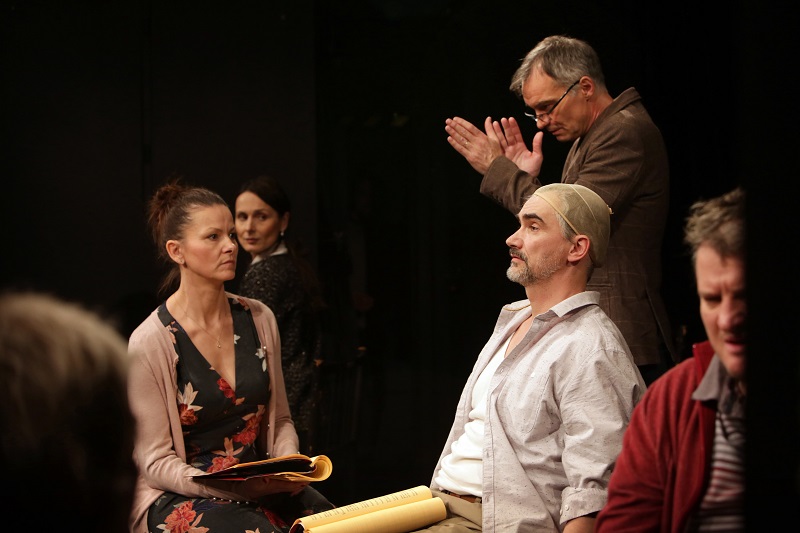
Jiří Havelka’s extremely productive work with the actors of the company in performances such as The Black Hole (2007), The Murder of Gonzago (2017) and The Battle of Hernani by V. Hugo and other authors (2023) led to an invitation to take over the management of the Dejvice Theatre. Havelka accepted the offer, gathered a new team and became the theatre’s artistic director at the beginning of 2025. The new management has built on the theatre’s acclaimed artistic profile, defined by a pronounced interest in contemporary dramaturgy, outstanding quality of acting and engagement with political and social issues, by adding a strong emphasis on the devising process in the development of its performances, characteristic of Havelka.
Furthermore, the new artistic management of Dejvice Theatre is highly focused on international dialogue. Having already asserted itself as a remarkable presence on the Czech stage, the company is now striving to find ways and opportunities for international tours, participation in festivals and collaborative projects. Dejvice Theatre Showcase 2026, as a first step in this direction, was skilfully conceived and organized. It featured three recent performances representative of the company’s aesthetic profile and ranking among its major achievements, which are also suitable for touring and likely to be well received by an international audience. The two event-packed intensive days included a useful parallel programme of meeting sbetween the showcase attendees and the theatre management, represented by artistic director Jiří Havelka and playwright Marta Ljubkova, as well as other events.
The three productions performed at the Dejvice Theatre Showcase 2026 were The Servants, written and directed by Wayne Jordan (based on plays by Marivaux); The Murder of Gonzago by Jiří Havelka and DD, directed by Jiří Havelka, and The Slap by Jiří Havelka, a devised performance by Havelka, Dědeček, Ljubkova, Letakova, Košťák, Smutná, Patzel, Davídek.
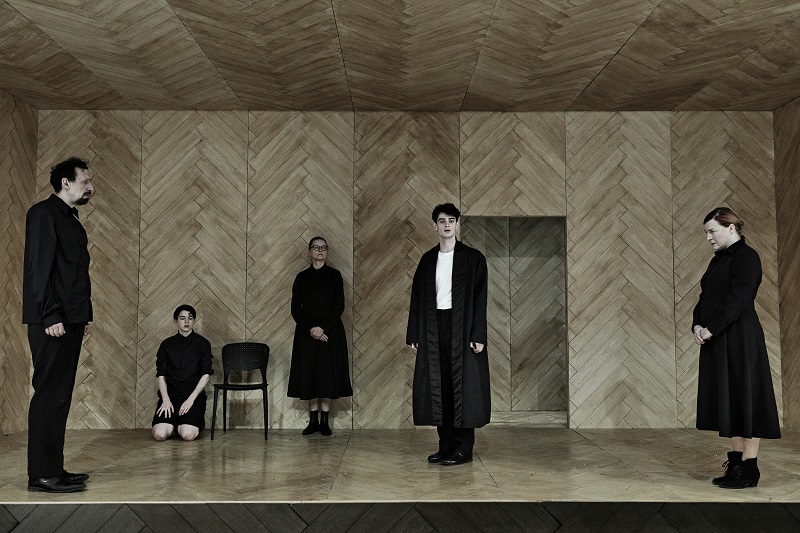
The Servants is Dejvice Theatre’s latest production—it premiered on March 31, 2026. The performance is the result of the company’s collaboration with the Irish director Wayne Jordan. For his work with DD, he wrote an original text, inspired by the plays of Pierre de Marivaux. Jordan’s approach to the meticulously written and complex comedies of the French classical dramatist, multifaceted in their ideas and intimations, is defined by his strong interest in Marivaux’s concept of the world as a long-established mechanism of hierarchies, social rituals, roles and role-playing games, driven by the energies of power and submission. Jordan’s play is entirely directed at our contemporary world and its people. Its action takes place in an abstract closed space, only tentatively defined as the “master’s house.” The main characters are the servants in that “house” who, in order to secure a better positions for themselves, are constantly performing, without much thought, various rituals and roles which they use to manipulate, outwit and oppress the other inhabitants and especially those who came from the outside—till the tables turn and the roles are reversed. The sharply critical perspective of the text on the indifference of modern man towards his own life finds a strong visual expression in Marek Cpin’s scenography and in the actors’ presence, which combine grotesque, stylized movements and contemporary emotional reflection.

The Murder of Gonzago is a theatrical text created by Jiří Havelka, inspired by Hamlet and, more precisely, by the play-within-a-play about the murder of Gonzago, presented by the actors in the emblematic Shakespearean tragedy. The main question that the director poses is an extremely important one. Today, in the age of relativism affecting the notions of truth and falsehood, of fake news and fading value criteria, can theatre continue to function as a place for discovering the truth, as a forum for frank debate on the most painful issues of our time? The production and its reception by the audience provide a categorically affirmative answer to this question. Since its premiere at the Dejvice Theatre in late 2017 to the present day, The Murder of Gonzago enjoys a prominent place in the repertoire and every single performance is met with passionate empathy and approval by the audience.
The performance consists of two parts, which naturally flow into one another. The first is entirely the product of a devising process involving the entire cast. Each of the actors shares with the audience their personal story as a performer, talks about their professional journey that brought them to the theatre, what made them choose the acting profession and what keeps them in it. In the second part, created in accordance with the aesthetics of documentary theatre, the same performers, similarly to their colleagues from the Shakespeare’s play, present a modern story about a particularly insidious murder—the poisoning of Alexander Litvinenko, the former Russian spy, who left the Russian secret service and was subsequently assassinated by them in London. Here, as in Hamlet, the truth is revealed through a theatrical performance.
Six of the leading actors of Dejvice Theatre, three women and three men, meticulously reconstruct Litvinenko’s slow agony and death over the course of 23 days, from taking the poisoned cup of tea through the gradual realisation of what happened to the inevitable fatal end. A wonderful example of a masterful combination of documentary and devised theatre, a clear political statement and a profound artistic experience, the performance convincingly affirms that the truth-revealing mission of the theatre today is not only possible, but also of great necessity.

The Slap is a verbatim performance created by Jiří Havelka and built on previously prepared material by him and a creative team (Havelka, Dědeček, Ljubkova, Letakova, Košťák, Smutná, Patzel, Davídek). The production is based on the real case of the unintentional killing of an elderly man after a seemingly “harmless” argument in the Prague metro in which he was slapped by a young man and, as he fell, sustained a fatal head injury. The team collected and arranged publicly available interviews, publications and documents pertaining to the case in order to pose the complex question of guilt, punishment and forgiveness. A powerful performance that not only demonstrates the director’s and actors’ mastery of the techniques and strategies of verbatim theatre but also manifests their aspiration to penetrate the deep layers of the human psyche and the complexity of human relationships. Unobtrusively, but extremely poignantly, the team unites around one particularly anguished sentence uttered by the victim’s daughter: “I lost my father and I don’t want to ruin another person’s life.”
The first Dejvice Theatre Showcase in Prague was successful and beneficial. In a well-thought-out, convincing and engaging way it fulfilled its goal to introduce the invited theatre experts, curators and guests to the aesthetics of the famous Czech theatre company and to facilitate the inclusion of its best recent performances in the international theatre exchange. Moreover, Dejvice Theatre Showcase 2026 accomplished another important goal—it once again demonstrated how necessary and effective such forums can be today.

*Kamelia Nikolova (PhD, DSc) is a theatre researcher, historian and theatre critic. She is Professor of History of European Theatre at the National Academy for Theatre and Film Arts, Sofia, Research Fellow at the Theatre Department of the Institute of Art Studies, Bulgarian Academy of Sciences and a visiting professor at other universities. The list of her publications includes eleven books, among them Bulgarian Theatre after 1989 and New British Drama (2013, 2018);Theatre Directors in the European Theatre (2021) and Bulgarian Theatre 1856-2026 (2025). Editor-in-chief of SCENArt and deputy editor-in-chief of NATFA Yearbook and Art Studies Quarterly.
Copyright © 2026 Kamelia Nikolova
Critical Stages/Scènes critiques, #33, June 2026
e-ISSN: 2409-7411

This work is licensed under the
Creative Commons Attribution International License CC BY-NC-ND 4.0.
