Choreographing Expenditure: The Politics of the Erotic in Bloody Moon
Paraskevi Tektonidou*
Bloody Moon by Marina Mascarel, Danish Dance Theatre, Matadero 11 April 2026 [Outdoor premiere 10 August 2024 Copenhagen, Denmark].
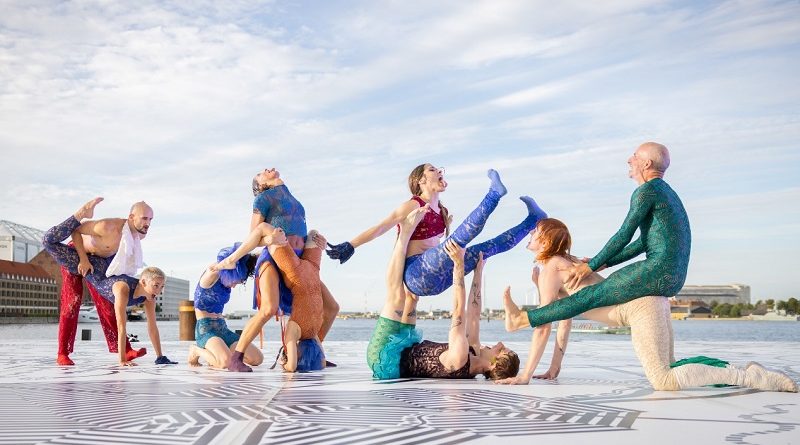
Ten performers—Jessica Lyall, Lukas Hartvig-Møller, Bradley Waller, Leticia Silva, Yi- Shao Li, Wolf Govaerts, Amancio Gonzalez, Carlos Luis Blanco Ramos, Lola Potiron and Reiko Ohta—enter the stage of Matadero theatre, in silence, one by one. Each introduces themselves through a solo dance. Although each follows a different kinetic trajectory, their movements share a common energy and an equally striking performative quality, at once soft and precise.

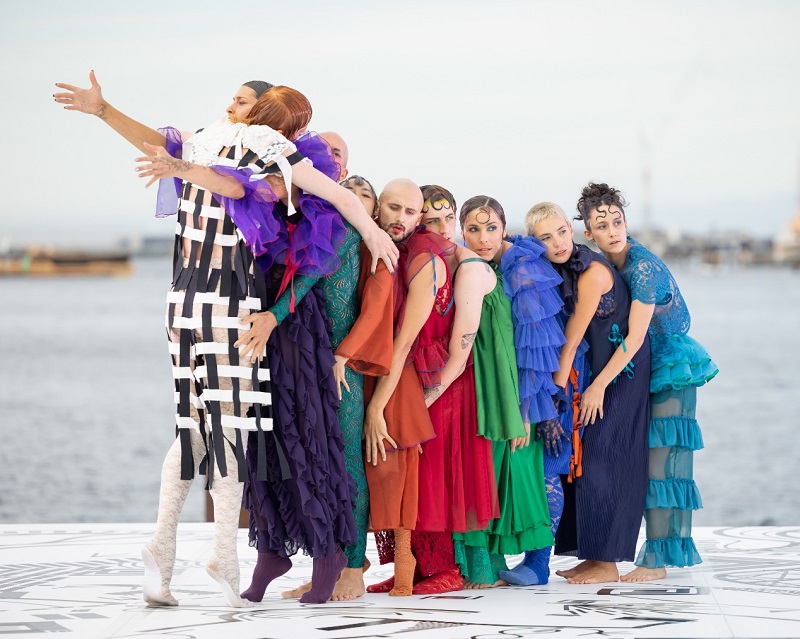
They wear highly distinctive, monochrome costumes in deep green, red, purple, orange and black-and-white, designed by Nina Botkay, constructed through layered lace and tulle. These garments, evoking birds and other animal figures, suggest aesthetic references indirectly. They bring together traces of baroque cabaret, commedia dell’arte, vaudeville and circus. These vibrant motifs evoke a festive atmosphere, gradually shifting from playfulness to ecstatic, carnivalesque intensity.

The ten performers form a line, creating a variegated sculptural composition. They begin to move slowly together, introducing one of the piece’s central theatrical “contracts”: a statue-like ensemble in motion, characterised by plasticity, ductility, pliancy and flow.
Their gestures, poses and movements are not rigidly synchronised; as the performers traverse the stage, actions align, colours blend and forms subtly cohere. Their expressive faces—unusual within the typically neutral register of contemporary dance—foreground an extroverted, overtly performative presence. The collective form continually carves the space. Soft shimmying gestures, expansive and generous limb movements, stretching torsos, bending heads, swaying and undulating bodies enact a finely attuned coexistence. This produces a multicoloured cohesion in dialogue with Yamila Ríos’ score: an electronic synthesis woven with textured drones that produces a space both monumental and paradoxically intimate.
As rhythmic drumming gradually replaces glissandi within the trippy soundscape, the movement shifts from softness to a more staccato energy, building towards an ecstatic, carnivalesque rite; a progressive crescendo of collective experience. The music both follows and leads, alternating between propulsive, unsettling, and sensually charged tones, drawing on patterns reminiscent of world music. Familiar yet estranged, these references underscore the tension, vibration and excitement generated by Marina Mascarel’s choreography.

A gradual spatial, physical, sensory and perceptual escalation allows spectators and performers alike to coalesce into an ephemeral, situated community. Within this shared dynamic, individuality is not dissolved. One by one, the dancers step forward again: under the insistent pulse of the drum, each performs a distinct solo, now visibly sustained by the collective.

As the group opens space for each soloist, the dance becomes a form of exchange. Within this shifting interplay, the performers begin to exchange lace and tulle elements of their costumes. As colours accumulate across their bodies, an increasing sense of interconnection and permeability emerges. The persistent beat anchors this evolving constellation, guiding a choreography rooted in collectivity; individual vitality becomes inseparable from the group.
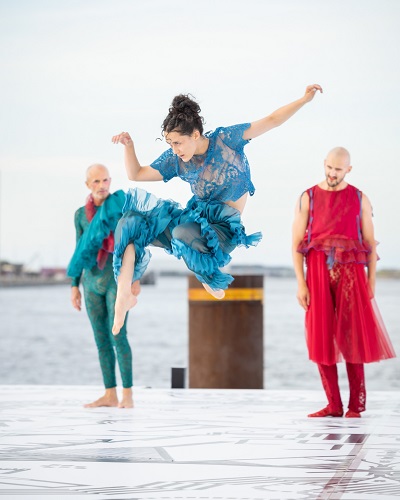
This shared physical impulse deepens into something fleshy, lush and sensuous. Curving bodies come together generating a convivial, celebratory effervescence. Proximity and attunement foster a sense of playfulness, desire and awakening. What emerges is a heightened euphoria, charged with emotional, sensorial and physical intensity. The stage gradually transforms into a transitional space—an environment where sensory thresholds intensify and begin to unsettle “expected” behaviours, both theatrical and everyday.

Through this shared celebration, the dancers revel in a fundamental vitality, affirming both the pleasure of having a human body and the joy of being alive together. This heightened state of physical and emotional release generates a high-voltage sensory environment in which multilayered eroticism surfaces.
Eroticism here is not limited to sexual activity; it unfolds as an intensified body-to-body awareness, where the boundaries between self and group begin to blur. This choreographic exploration of excess, transgression and desire aligns, as noted in the performance note, with Georges Bataille’s writings on eroticism, particularly his reflections on the eroticism of the body, the heart and the sacred.
For Bataille, eroticism cannot be reduced to sexuality as an act; rather, it constitutes a mode of inner experience, a movement toward the dissolution of the bounded, individual self. Central to his thought is the distinction between discontinuity and continuity. Human beings, he argues, exist in a state of discontinuity: separate, self-contained entities, defined by their limits. Eroticism, however, is one of the privileged domains through which this discontinuity is momentarily undone.
Erotic experience, through intimacy, intensity or ritual, offers a fleeting sense of continuity, loosening the boundaries of the self. The performers’ proximity and shared movement echo this shift from isolation to collective continuity.
As the performance unfolds and the performers gradually undress, their attunement becomes both more pronounced and more differentiated, continually reshaped through touch. This growing intimacy is at moments reminiscent of animals at play. What first appears as carnivalesque spontaneity, on closer attention, gives form to Bataille’s link between eroticism and transgression. A brief, silent moment foregrounds touch as the central principle guiding this shared presence. In such proximity, the dancers’ engagement with bodily fluids and uninhibited physicality does not register as gratuitous provocation but rather as a structured transgression, exposing the limits imposed on bodies and desires, both within the live encounter and within the choreographic frame. The stage thus becomes a space in which codes of behaviour are simultaneously acknowledged and exceeded.

In this sense, the performance gives embodied form to Bataille’s thought: every society, he argues, establishes taboos around the body, sexuality, death and the sacred to maintain order and stability. Eroticism emerges not through the absence of these prohibitions, but through their conscious suspension or violation.
As the music returns with a more vivid, presto-like rhythmic drumming, the performers’ collective momentum intensifies. Moving, touching, descending to the floor, following the pulse and undressing in unison propels the group into what reads as a ritual phase, where action becomes both shared and tightly composed in its intensity.
Within this framework, Bataille’s tripartite understanding of eroticism—of the body, the heart and the sacred—finds a clear resonance. The eroticism of the body emerges through the immediacy of physical sensation, the rhythmic enactment of sexualized movement, and tactile contact; that of the heart unfolds through shared affect, collective vitality and the group’s emotional intensity; while the eroticism of the sacred becomes perceptible in the gradual dissolution of individual boundaries, as the performers seem to enter a state akin to ritual or collective trance. These layers do not appear separately but rather coexist and interweave: the proximity of bodies, the exuberance of shared presence and the charged atmosphere of release together compose a dense and stratified erotic field.
It is within this density that the choreographer’s construction produces a shift in perception. In slow motion, the collective force becomes magnified, even as individual dancers begin to detach from the group while retaining the same overwhelming sensorial intensity. Their separation does not signal a loss of connection, but rather a transformation through the process itself. This transformation through process opens onto a more conceptual lens.
One might think here through the distinction in the Spanish language verbs ser and estar: while estar describes a temporary, embodied state, ser points to a more essential mode of being. What unfolds suggests a passage whereby, through estar with the other—through the sustained, lived intensity of the moment—the performers move towards ser with the other, as if the transient condition crystallises into a transformed state of presence, if only briefly.
This passage, from a heightened state into a transformed mode of being, can be understood through Bataille’s notion of expenditure (dépense). Against the logic of productivity and utility that governs everyday life, Bataille valorises forms of unproductive expenditure, laughter, sacrifice, eroticism, festivity, as moments where energy is spent without return. Celebration, in this sense, is not merely pleasure or entertainment, but a necessary excess: a release of forces that cannot be contained within functional structures.
The dancers in Bloody Moon inhabit this excessive spending of energy, through insistence, shifting intensities, and the pushing of the body beyond functional limits. The concentrated force of their dancing becomes a celebration of transformation itself. What stabilises momentarily as ser is not a fixed essence, but the residue of expenditure: a mode of being forged through the very act of energetic loss. The concentrated force of dancing, its overflowing intensity, resists containment and reaffirms life precisely through its excess.
Thus, Bloody Moon enacts a Bataillean dispositif that extends beyond theoretical illustration into embodied practice. It constructs a world in which bodies enter states of heightened intensity, transgress normative limits, and experience fleeting moments of continuity, where individuality dissolves into a shared, vibrating field of presence. In doing so, it proposes an alternative mode of existence within a neoliberal landscape of isolation—one in which the self is not approached as a pre-existing, autonomous entity that enters into relationships, but as a subject continually formed through relation itself: shaped, negotiated and transformed in interaction with others, and only ever becoming within history, in and through others. And, perhaps, in this shared becoming, something fragile yet persistent remains: a way of being with one another that briefly illuminates what bodies can still make possible together, claiming the festive, political force of the erotic.

*Paraskevi Tektonidou is a multidisciplinary dramaturg, dance researcher, critic, curator and educator based in Athens. She holds degrees in flute and musicology, an MA in Drama and Performance Theory, and a PhD from the Athens School of Fine Arts (ASFA). Her work focuses on dramaturgy, choreographic methodologies, participatory practices and the political dimensions of choreography. She teaches at the Athens School of Fine Arts and the National School of Dance. A member of the International Association of Theatre Critics (IATC) in Greece since 2018, she served as dance curator for the Athens and Epidaurus Festival (2022–2025).
Copyright © 2026 Paraskevi Tektonidou
Critical Stages/Scènes critiques, #33, June 2026
e-ISSN: 2409-7411

This work is licensed under the
Creative Commons Attribution International License CC BY-NC-ND 4.0.
