Butoh-fu as a Devising Tool in Mixed-media Performance Making
Eleni Kolliopoulou*
Abstract
This article develops an understanding of Butoh-fu as a dramaturgical tool by focusing on its subtextual qualities, rooted in the subjective, sensory, and affective textures of lived experience. Drawing on practice-based postdoctoral research, it examines Butoh-fu—Tatsumi Hijikata’s image-based notational system—not as a fixed choreographic score, but as a flexible methodology for devising performance and mixed-media work. Originally conceived as a dynamic archive of studio practice, Butoh-fu is recontextualized here as a matrix of embodied prompts that generate complex atmospheres and reshape performers’ and audiences’ perceptions of time and space. By framing Butoh-fu as a compositional system of affects rather than representational imagery, the article argues for its relevance beyond Butoh and dance, suggesting applications in experimental film, sound composition, visual art, and interdisciplinary performance.
Keywords: Butoh-fu, Tatsumi Hijikata, devising tool, mixed-media performances
Research Context
This article presents practice-based postdoctoral research exploring the creative potential of Butoh-fu (Butoh notation), with a particular focus on the embodiment of time. Butoh-fu, conceived and developed by Tatsumi Hijikata,[1] functioned as a dynamic archive of studio practice used to generate choreographic scores for Butoh performance. This research proposes that Butoh-fu can also operate as a devising tool, informing a dramaturgical model grounded in embodied experience. It highlights the flexibility of Butoh-fu and examines how it can evoke complex atmospheres across artistic contexts. The postdoctoral project provided a framework for refining this methodology and applying it to performative practices, including experimental film and mixed-media performance. Drawing on embodied practice, the study demonstrates how engaging with Butoh-fu can transform performers’ and audiences’ perceptions of time and space. In this context, Butoh-fu is proposed as a generative matrix in the early stages of artistic creation, particularly within studio-based processes, where it can stimulate a range of interpretative responses.
The potential of Butoh-fu in performance-making has been explored by Butoh scholar Kurt Würmli in his doctoral research The Power of Image: Hijikata Tatsumi’s Scrapbooks and the Art of Butoh. He observes, that Butoh-fu prompts, function as visual guides for inspiration rather than as prescriptive instructions for dancing or as records of existing notation. Würmli emphasizes that Butoh-fu, in its original conception, was not intended as a rigid, codified system; rather, it can be understood as an artist’s notebook. Butoh dancers were encouraged to maintain personal Butoh-fu diaries to aid memory, teaching, and the preservation of Hijikata’s work.
Seen in this light, Butoh-fu can be understood as a rich source of imagery and multisensory stimuli, inviting a wide range of associations and psychic representations through dancers’ embodied practice, which in turn resonates with audiences (Fraleigh). Building on Würmli’s insights, this article suggests that Butoh-fu can also provide a fertile inventory of material for various time-based art forms, including experimental film, musical composition, and visual art. Moreover, a Butoh-fu–inspired dramaturgical approach to mixed-media performance may enrich meaning, expand interpretive possibilities, and encourage a polysemic reception by audiences.
Ankoku Butoh: Dancing the Unknown
At the end of the 50s, Hijikata created together with Kazuo Ohno a new dance form: Ankoku Butoh (although Hijikata’s original term was Ankoku Butoh, commonly the term Butoh is being used for simplification). In Japanese, the word Ankoku means “utter darkness,” referring to the darker aspects of human life, all those that are unknown, hidden, and not easily accessible. Ankoku Butoh was sacrilegious by nature, showing a strong character of protest against the fast-evolving society of Japan that has been forced to change abruptly due to the overwhelming defeat of the Japanese after World War II. In the aftermath of war, people were compelled to forcibly suppress the parts of their psyche to align with the expectations of the new era. Hijikata undertook the task of releasing the stored tension and sense of despair among the Japanese people through his dance. Therefore, Butoh aesthetics reflect the liminal state between life and death, eros and disappearance, connected to the chaotic frenzy inflicted on them by war. Since the emotions and behaviours associated with war are diachronic and enduring, Butoh continues up to date, to uncover fundamental aspects of the human condition.
During a field trip to Tokyo in April 2023, I conducted archival research at the THA, Keio University Art Center. There, Kae Ishimoto, a Butoh dancer, choreographer, and scholar, introduced me to audiovisual materials of performances directed by Tatsumi Hijikata and second-generation Japanese Butoh masters, alongside a wide range of Butoh-related books and scholarly articles from around the world. Ishimoto also provided a guided tour and presentation of theatrical costumes and props from Hijikata’s performances.
In his book Hijikata Tatsumi’s Notational Butoh: An Innovational Method for Butoh Creation, Takashi Morishita, a Butoh scholar and director of THA, examines Hijikata’s philosophy and artistic process. He demonstrates how Hijikata’s notational method shaped Butoh’s distinctive aesthetic, including extreme physicality, slow, deliberate movements, and the embodiment of powerful emotional themes. Morishita further argues that Hijikata’s exploration of the body’s limits reflects his engagement with suffering, human vulnerability, and the grotesque.
Similarly, Butoh dancer and scholar Kayo Mikami recounts her first-hand experience as a Butoh trainee and its intersectional impact on everyday life: “Walking and standing are the foundation of Butoh training [and their] requirements work as an image-language intended to generate a form of awareness that results in real changes and movements within the body” (81). She describes an expansion of temporal and spatial perception during dance, experiencing what is often called Butoh space-time: “Through conditioning [their] consciousness, Hijikata guided his pupils on a journey from daily life to non-daily life. A journey towards Butoh space-time” (94). This transformation, however, was rarely straightforward, as Hijikata frequently pushed dancers to the edge of mental and physical endurance.
Mikami explains that this state of “methodological confusion’ is a method cultivated by Hijikata that aims to overcome the Cartesian dualism between body and mind and to ‘transform the body into an object” (120). Ultimately, Tatsumi Hijikata’s approach created the conditions for exploring the body’s latent potential and challenging the dominance of the rational mind. Similar principles can be found in other psychophysical performance practices, such as the Suzuki Method developed by Tadashi Suzuki and the Poor Theatre training associated with Jerzy Grotowski, among others. The antithetic and often contrasting themes of Butoh-fu can be seen as alluding to the paradox of life and death. This paradoxical quality was deliberately deployed to create a state of confusion not only for the dancers but also for the audience. In this article, I suggest that this aspect is particularly relevant to dramaturgies that seek to explore complex phenomena such as interpersonal conflicts, warfare, and the ephemerality of life.
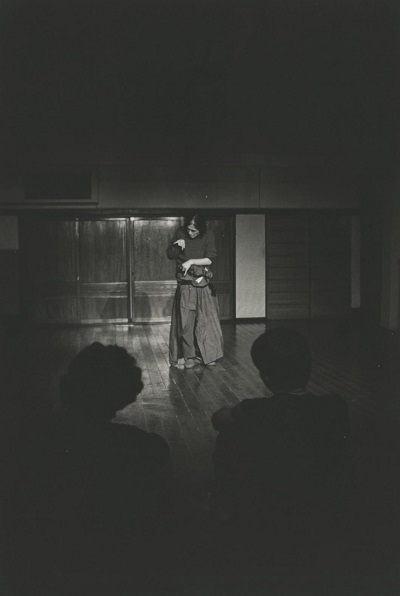
Hijikata’s Butoh sought to bridge the perceived divide between mind and body through a creative fusion. According to Mikami, “the ultimate state of the Butoh dancer [is] an extreme awareness that oscillates between the intoxication of belief and a sense of awakening” (103). In his final years as a choreographer (1974–1976), Hijikata developed Butoh-fu as a method for documenting his discoveries at Asbestos Studio (Asbestos Kan); Butoh-fu is an idiosyncratic notation system that codifies movement scores into words and images. The following section examines the mechanisms of Butoh-fu with the aim of distilling its essential principles.
The Birth of Butoh-fu
Hijikata’s choreographic method evolved significantly over time. His early creative phase was deeply shaped by post-war traumas following Japan’s defeat in World War II. Born in Akita Prefecture, one of the country’s poorest regions, Hijikata grew up in an impoverished family and witnessed profound suffering, including the deaths of several of his brothers returning in funeral urns from the battlefield and the sexual exploitation of his sister. These experiences instilled in him an acute awareness of human fragility and cruelty, which he sought to express through Butoh.
Fusako Innami, a performance studies scholar specializing in modern and contemporary Japan, observes that “the theme of transformation, indefinite form, and falling apart haunted Hijikata, who confronted death and life head-on in the postwar confusion” (4). During this period of social upheaval, Hijikata assembled a group of dancers, both experienced and novice, who worked intensively at Asbestos Studio.
Butoh-fu emerged as a novel form of notation, intended to capture and catalogue Hijikata’s creative process. He produced scrapbooks in which images—often cut from contemporary art magazines—were paired with notes or poetic phrases. Butoh-fu was never formalized as a codified theory; only fragments remain today. Its preservation is largely credited to his disciple Yukio Waguri, a second-generation Butoh dancer and choreographer, who compiled and edited the notes into the Waguri/Butoh Notation. Waguri is the only known student to have systematically digitized and archived Hijikata’s studio notebooks, providing a crucial record of his image-based method.
Butoh Kaden (translated as The Secret Transmission of Butoh) exists as a virtual repository for the Waguri/Butoh notation, which is now exhibited physically exclusively at THA. Literally, Kaden means “Flower Transmission” or “Transmission of the Flower.” In the context of traditional Japanese arts, the term denotes the secret or essential teachings of a school or art form, that typically was passed from master to disciple and carries both poetic and esoteric connotations.[2] In his book, Morishita explains that each of Hijikata’s pupils possessed their own Butoh notebook, which could be called “Butoh Notation.” Michael Hornblow, a multidisciplinary artist and academic with expertise in Butoh, affirms that “Hijikata was encouraging his students to generate their own Butoh-fu schemas for discovering their own Butoh” (73). Accordingly, Butoh-fu may be more accurately described as a methodology rather than a fixed entity, as its essence was developed and thrived within the studio’s creative process, reflecting the relationship between Hijikata and his dancers.

Butoh scholars Jean Viala and Nourit Masson-Sekine note that Hijikata often favoured Western artists over Japanese ones, showing particular interest in the controversial Irish painter Francis Bacon. A recurring quality in Butoh-fu is its attachment to imagery of human suffering, pain, and crisis, often interwoven with fragments of otherworldly beauty. Hijikata drew inspiration from marginalized individuals, social outcasts, devastated metaphysical landscapes, legendary figures, and fantastical creatures. His dance has frequently been described as spiritual or transcendental.
As Innami observes, Hijikata pursued “the precarious, unbalanced, and disintegrated body, and particularly, the bodily ‘becoming’” (7). His subjects—whether human or natural—often exist in liminal states between life and death, reflecting rites of passage within the life-death cycle. In this framework, Hijikata’s characters do not inhabit linear narratives nor serve as conveyors of traditional plot. Instead, they resemble dreamlike landscapes, articulating the subconscious in its fluid, magmatic dynamism.
One of the fundamental structural features of Butoh-fu is its composition of qualia—poetic fragments—which can be divided and recombined endlessly to generate new forms of expression. Morishita (2015) employs the metaphor of LEGO blocks to illustrate the nearly infinite combinations in which qualia can be organized within Butoh-fu. Just as standardized LEGO pieces can be reassembled in countless ways, qualia can be linked to form novel configurations of Butoh-fu. Accordingly, this paper contends that Butoh-fu functions as a metaphorical box of LEGO: available to be constructed by the choreographer, enacted by the dancers, and perceived by the audience. This capacity for freely composing almost unlimited qualia-based imageries relates to their inherent aptitude for suggesting metaphors and symbols rather than depicting the natural world. As Hornblow observes, we cannot—and should not attempt to—translate Butoh-fu literally; instead, it should be conceived in terms of “texture, temperature, humidity, weight or gravity (etc.), qualities that draw out the specific materiality of the image” (93), thereby allowing imagination to generate diverse qualia assemblages.
Morishita also provides an overview of Hijikata’s so-called “gestic items,” later incorporated into Butoh-fu. These gestic items consist of compositions of qualia designed to inspire possible dancer movements. He identifies a total of sixty gestic items, categorized into seven themes: images of modern European paintings, specific places or scenes, concrete individuals (such as stereotypes or famous figures), abstract expansive spaces, concrete forms of animals or plants, heightened sensory sensitivity, and natural phenomena (110).
Butoh-fu can thus be understood as a palette of poetic phrases, whose transitions and coexisting fragments are meticulously embodied by dancers and composed by Hijikata in a nontraditional manner. This approach strategically elicits creative ambiguity in the audience. Butoh dances are non-linear choreographies, structured around precise embodiments of surrealist mental imagery, portraying particular moments in the human lifespan, daydreams, living creatures, or phenomena in the process of becoming.
For example, in the Butoh-fu “Dove” from the World of Birds and Beasts, a detailed scene is articulated through the assemblage of disparate qualia organized into a narrative structure:
The dove is inflating its feathers on the chest roundly. White dove.
There is a scarf around its neck. It coos, it purrs.
Again, it inflates its feathers.
It raises its head slightly and thrusts the forehead.
Again, the chest is inflated, and it flaps its wings.
It coos and becomes round chested again.[3]
In this instance, Butoh-fu presents cues of a dove enacting a precise sequence of movements and gestures, implying a choreography that is simultaneously sensory and formally structured. However, the image is discontinuous—the dove emerges and vanishes without contributing to a linear narrative. It serves as an allusion to a sensorial experience, orchestrating emotion and symbolism.
Applying Butoh-fu in Performance Dramaturgy
Hijikata’s choreographic method deployed mythological imageries, symbols and metaphors to engage with the dancers in a total and radical manner, training them to bare their truth before the eyes of the audience. All of these developed a revolutionary movement vocabulary emancipated from socially constructed beliefs and aesthetic rigidities, which were encapsulated in Butoh-fu. While contemporary Butoh may not preserve the radical freshness of its original aesthetic, I suggest that contemporary performance-makers can draw inspiration and enrichment by engaging deeply with its vast realm. In this section, I will discuss how Butoh-fu can be employed by artists, drawing upon my firsthand experience. The following chart summarizes my research findings.
Butoh-fu may be employed as a creative tool in performance-making, where improvisation in the studio is inspired by Butoh-fu imagery as a starting point. Utilizing the bittersweet and otherworldly themes intrinsic to Butoh-fu, performers can explore the imaginative space and be guided to create their own Butoh-fu. In principle, Butoh as a choreographic method focuses on the embodiment of transition, paying great attention to the transformation of the performer from one state to another or even from the coexistence of contrasting themes-scores happening inside the body. This element is especially pertinent when a performance maker wishes to create a tragic or tragicomic atmosphere. Furthermore, the article proposes that, by addressing the performers’ sensorial and emotional states, Butoh-fu may function as a creative tool in multiple art forms. As noted earlier, Hijikata utilized a “methodology of confusion” to disrupt audience attention, a strategy that can be realized through the interplay of diverse artistic media.
Another important aspect of Butoh-fu as a devising tool is its emphasis on the embodiment of transition. In Butoh choreography, the physical expression of transition—whether internal, emotional, or external—constitutes a central component, serving as a means to generate dynamic movement and shape performance structures. This methodology encourages choreographers and dancers to explore not only static images but also the ongoing processes of change. In movement-based performance, the arrangement of stages functions analogously to montage in cinema, highlighting the importance of allowing transitions to unfold fully. Such an approach privileges process over finished outcomes, often yielding unexpected results and fostering creative experimentation within an open framework.
By adopting the fluid, non-linear approach of Butoh-fu, artists can draw on its immersive, multisensory qualities to expand their creative output. Visual artists, musicians, and writers can use Butoh-fu as a source of inspiration, promoting integrated, cross-disciplinary collaborations. This is possible because Butoh-fu is deeply rooted in sensory experience and encourages full-bodied engagement from participants—whether performers, audience members, or other collaborators.
Consequently, creators exploring complex subjects may use mental Butoh-fu imagery as a wellspring of inspiration, focusing on:
- aspects of the human condition, including corporeal beauty and decay, illness, sexuality, and childhood;
- the mythical, encompassing imaginary creatures, landscapes, and talismans;
- the animal and ecological realms;
- the materiality of natural phenomena.
Examples of a Butoh-fu inspired dramaturgy: Carpe diem 2, Möbius Strip, Platelets
As previously mentioned, a key feature of Hijikata’s Butoh was the “methodology of confusion,” which was used to challenge the audience’s attention, often through the unexpected combination of disparate artistic media. This paper argues that, through this disruption of conventional expectations, the audience is prompted to re-engage with the performance on a deeper pre-reflective level. The unexpected juxtaposition of visual, auditory, and physical stimuli generates a sense of disorientation, prompting the audience to question their perceptions and engage more actively with the work. In this sense, the audience is invited to contemplate their own embodiment in order to make sense of the performance, thereby becoming critically engaged in Brecht’s Verfremdungseffekt (Willet). However, it is important to note that achieving and maintaining a balance between these elements often proves to be a delicate task, as this methodology risks leading the audience to distraction.
In everyday life, our perception is often dormant, dispersed among the myriad stimuli arriving simultaneously in a chaotic manner. Hijikata sought to organize and crystallize this chaos into Butoh-fu. As an artist-researcher, my task has been to elaborate on this system and create conditions that allow audience members to engage deeply with their own subjective experience. Butoh-fu is a notation system combining words and images, characterized by a non-linear structure; understanding its fundamental essence and structure is therefore essential for adapting it to new forms of artistic research.
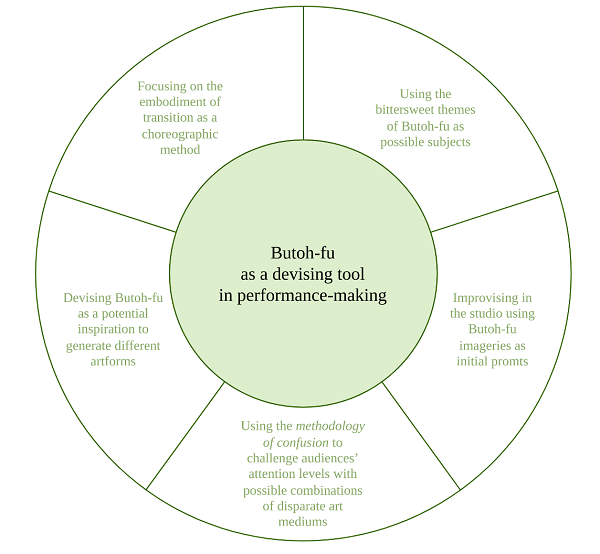
Mikami notes that “Hijikata’s language could not be divided into parts; it formed a stream of images that worked as a technique of methodological confusion” (103). As a choreographer, Hijikata sought to provoke sensations and emotions in audiences, moving them through the atmospheres generated by the dancers. These atmospheres emerged from the dancing body, excavated through the stimulation of imagination, memory, and desire during rehearsals and performances. This process ultimately gave rise to what became known as Butoh-fu. The Butoh-fu-informed chart (Fig. 4) offers flexible pathways for artistic experimentation rather than prescribing fixed rules. This openness reflects the nature of Butoh itself: an inherently fluid and unfinished art form that resists rigid definitions and embraces diverse modes of expression. Its malleability is also evident in its choreographic methodology, demonstrating significant potential for generating mixed-media performances that draw on its intensity, richness, and nonsensical qualities.
This section draws on examples from my postdoctoral research to outline practical steps for employing Butoh-fu–informed dramaturgy. Prior to selecting a Butoh-fu as a dramaturgical instrument, I focused on developing full awareness of the subject, including its abstract dimensions. In Möbius Strip, for instance, I explored the phenomenon of war through a non-scripted methodology, while in Αιμοπετάλια/Platelets, I engaged with Calvino’s narrative as a guiding framework. In both cases, I consulted 7 Worlds of Butoh-fu, keeping in mind the atmospheres I sought to evoke. I then selected Butoh-fu elements that resonated with my topic and began either imagining the performers’ actions on stage or envisioning corresponding video sequences.
The next stage involved studio experimentation, creating short performances and video sequences inspired by the images arising from my research into the selected Butoh-fu. With this new material, I returned to the initial selection, gradually narrowing the focus to a single Butoh-fu. The creative process is inherently complex and highly subjective, often iterative, as new material is added, extraneous elements removed, and the remaining components composed into a coherent work. Coming from a painter’s background, I liken this methodology to the continual layering and erasing of color on a canvas until the painting fully emerges.

The experimental video Carpe Diem 2 (Kolliopoulou 2024) provides another example of Butoh-fu being deployed as a devising tool. Butoh-fu is organized in 7 Worlds. These are symbolic, metamorphic realms—arranged along a spectrum from darkness and chaos toward dissolution into light and space.
Carpe Diem 2 and the performance Möbius Strip (Kolliopoulou 2023) were inspired by the Butoh-fu “Burnt Bridges” from the World of Burnt Bridges:
Wanting to live.
Wanting to survive in any cost.
Dirtiness of bearing the pain.
The pillar between heaven and earth is charred by the hellfire of life.
The soul torn apart. Pain is proof of life.
Person at the war-ravaged city.[4]
This Butoh-fu contains evocative sensations, atmospheres or emotional states referring to the state of horror experienced in front of massive death tolls and destruction during wartime.
Möbius Strip is the outcome of a 9-month process. For the first three months my co-performer and I had been working in the studio with the imageries of the Butoh-fu “Burnt bridges” and sensations, exploring thematic improvisations. Meanwhile, we filmed our rehearsals in the studio, aiming to analyse the recordings and finally selecting a few of them to further explore. Alongside this practical work, I engaged in several weeks of brainstorming, envisioning performative scenes that were then translated into score suggestions for experimentation in the studio. The performance was loosely structured within the first six months of rehearsals. At that moment, Möbius Strip was a puzzle of dynamic scenes that ‘narrated’ the story of two soldiers who discover their humanity during wartime. By the final stages of the project, the necessity of integrating the scenes into a cohesive narrative became clear. The last three months were used to refine the performance and resolve dramaturgical and practical issues ahead of the final presentation.

Carpe Diem 2 accompanied the mixed-media performance Möbius Strip (Kolliopoulou 2024). The Butoh-fu Burnt Bridges inspired the atmosphere of the video frames, which depicted decay, interspecies rivalry in nature, and found-footage documentary extracts from specific historical moments of human conflict. Additionally, the edited video included a recording in which I performed the Butoh-fu The Falling Ash of a Cigarette.
I first practiced this Butoh-fu many years ago as a student in classes led by dancer and educator Stefania Lo Maglio in Turin, Italy. The embodiment of the work was retained within my body for years until I felt the urge to re-enact it and incorporate its recordings into Carpe Diem 2. This illustrates a central principle for deploying Butoh-fu in dramaturgical practice: first-hand experience of Butoh is essential. Embodied memories of past Butoh-fu can surface naturally during artistic creation, becoming an integral part of the creative process.
Möbius Strip was performed at Polytechno, Corfu (2023), and Fournos Lab, Athens (2023), exploring the interplay between video projections and live performance as a dramaturgical strategy to evoke—and sometimes blur—multilayered meanings through the combination of media. The audience was seated in a horseshoe formation, facing one another. This spatial arrangement created tension by compelling spectators to confront each other directly, forming two distinct groups, symbolically representing the deepening divisions that occur during wartime.
Another example of Butoh-fu-informed dramaturgy is Αιμοπετάλια / Platelets: A Site-Specific Performance on Healing (Kolliopoulou 2023), the third artistic research project of my postdoctoral study. Platelets are small, colorless cell fragments essential for blood clotting. When a vessel is injured, platelets gather at the site, forming a clot that stops bleeding and initiates healing. In this project, I used the concept of platelets as a metaphor for human behavior in times of crisis: people, like platelets, instinctively seek connection and support, forming protective bonds that enable survival. The silent alliance of platelets at a wound parallels the human tendency to seek comfort in one another to alleviate pain and strengthen resilience in the face of threat.
The performance was a poetic enactment of Italo Calvino’s novel Waiting for Death in a Hotel, which narrates the story of two World War II prisoners who became friends during their final hours before execution. After reading and analyzing the text, we recorded it in full. In parallel, I explored the appropriate Butoh-fu to inform the performance score. This project sought to merge Calvino’s narrative recordings with movement-based performance, guided by the Butoh-fu vocabulary. Its performative dimension was specifically informed by the Butoh-fu Walking Just as a Pure Measure from World of Abyss.
You are walking only as measurements.
You are merely a measurement between heaven and earth.
There are nerves that I don’t know that run through my body and stretch out into the universe.
Walking is nothing but an attempt to desperately hold together what is being steadily destroyed.

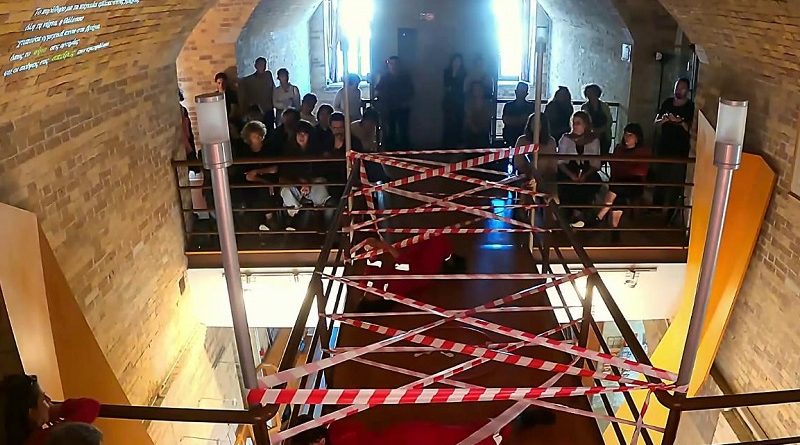
Αιμοπετάλια/ Platelets featured a sequence of symbolic actions interwoven with the recorded and projected narrative of Calvino’s story. We had been rehearsing in the studio with this Butoh-fu and improvising with its literal meaning as well as its metaphoric allusions. As a result, the performance featured the action of a variety of walking, mostly in a slow and contemplative pace. To illustrate the methodology, I highlight several studio experiments with the Butoh-fu Walking Just as a Pure Measure: walking both individually and collectively, approaching and distancing from one another, measuring space and each other with our bodies, delineating the space with red and white warning tape, and using a hula-hoop to unify the fragmented areas defined by the tape. The subsequent step involved filming the Butoh-fu–inspired improvisations, applying the same methodology as in Möbius Strip. Throughout the creative process, I progressively discarded scores that did not align with Calvino’s novel, concentrating on those that most effectively captured the text’s atmosphere. Once identified and assembled as a “chain” of movement-based imageries, the linkage between scores emerged either through our improvisation or through brainstorming possible creative solutions.
In Αιμοπετάλια (Platelets), the audience listened to the recording of Waiting for Death in a Hotel while at the same time a performative action unfolded, primarily based on walking and measuring. Walking, after all, is one of the few activities even prisoners are allowed to do; to carry themselves through space. The recording was synchronized with a video projection, featuring Calvino’s text scrolling down the wall.
Αιμοπετάλια/ Platelets was fundamentally a site-specific performance that took place on the indoor bridge of the remaining Renaissance architecture of the Central Public Historical Library of Corfu[5] (hereafter CPHLC). This bridge provided both a vivid scenography and a rich symbolic context. Softly illuminated by natural light through windows at either end, it served as an artificial stage, whereby the audience “surrounded” the performers. The bridge, located on the first floor of the building, was sparsely decorated, with a simple wooden floor and metallic rails. Despite its small size, the space gave the feeling of being open and airy, creating a sense of suspension and intermission within the solid structure of the library. The bridge also symbolized a passage: making time “visible” in space. As such, the bridge served as a physical manifestation of the theme of death understood as a transition in Calvino’s story.
The PCHLC is situated within the old Venetian fortress of Corfu, whose massive brick walls convey a sense of strength, solidity, and impenetrability. These walls, averaging one to two meters in thickness, are punctuated by deep window openings that allow light to filter through, casting dramatic shadows and emphasizing the contours of the ceiling. The soft light entering the shadowed and constrained space of the bridge heightened the sense of ephemerality, fragility, and suffocation experienced by the two imprisoned comrades in Calvino’s story. The spatial qualities evoked Plato’s allegory of the cave, intensifying the urgency and despair central to Calvino’s narrative.
The choice of site was significant, as the bridge both connects and separates two distinct areas, amplifying the tension between them. The indoor bridge served as the stage for the performance, linking the entrance to the remainder of the library while acting as a dramaturgical counterpoint within the architectural flow. Incorporated into the performance, this feature emphasized the interplay between connectedness and separation, producing a heightened experiential engagement for both performers and audience. The bridge’s symbolism was enacted through the performers’ movements: entering slowly from one side, positioning themselves on either edge, and gradually converging at the center while manipulating warning tape to form a dense web. Crawling and creeping beneath the tape, the performers embodied the prisoners’ physical and emotional strain, conveying the anguish of confinement depicted in Calvino’s story.
The performance design also considered the historical and architectural significance of the library. The CPHLC, the oldest public library in Greece, is located in the south wing of the former British barracks building in the Old Fortress. Originally housing British colonial soldiers in the 19th century, the site carries connotations of power, control, and conflict. The dramaturgical use of this space reinforced these themes, while the integration of the audience in close proximity to the performers allowed them to participate directly in the enactment of Italo Calvino’s narrative, symbolically becoming part of the confined crowd of prisoners.
This article explores the potential of a Butoh-fu dramaturgical model by examining the history of Butoh and positioning Butoh-fu as an innovative choreographic method. By contextualizing the rich origins of Butoh and tracing its evolving role in contemporary dance, the article highlights the unique qualities of Butoh-fu and its capacity to transcend traditional choreographic boundaries. From this exploration, multiple approaches to employing Butoh-fu in performance-making emerge, offering creatives, artists, and authors a practical framework to foster experimentation, imagination, and interdisciplinary creativity.
Note: This work was funded by the Hellenic Foundation for Research and Innovation.
Endnotes
[1] Japanese choreographer who emerged after World War II.
[2] The word Kaden appears in the famous “Fūshikaden,” a 15th-century treatise on Noh drama by Zeami.
[3] “Butoh Kaden – Dove.” Butoh Kaden. Accessed 1 Aug. 2025.
[4] “Butoh Kaden–War Ravaged.” Butoh Kaden. Accessed 4 Aug. 2025.
[5] “Corfu Holograms” Corfu Holograms. Accessed 5 Aug. 2025.
Bibliography
Brecht, Bertolt. Brecht on Theatre: The Development of an Aesthetic. Edited and translated by John Willett, Methuen, 1964.
Calvino, Italo. “Waiting for Death in a Hotel.” Last Comes the Crow, translated by A. Chrysostomidis, Kastanioti, 2010.
Fraleigh, Sondra Horton. Alchemy of the Body in Butoh. U of Illinois P, 2010.
Hornblow, Michael. Special Affects: Compositing Images in the Bodies of Butoh. Doctoral dissertation, University of Technology Sydney, 2004.
“Butoh Kaden.” Butoh Kaden, n.d..
“Butoh Kaden–Walking Just as Pure Measurement.” Accessed 24 Mar. 2026.
Calvino, Italo. “Waiting for Death in a Hotel.” Last Comes the Crow, translated by A. Chrysostomidis, Kastanioti, 2010.
“Corfu Holograms” Corfu Holograms. Accessed 5 Aug. 2025.
Fraleigh, Sondra Horton. Alchemy of the Body in Butoh. U of Illinois P, 2010.
Hornblow, Michael. Special Affects: Compositing Images in the Bodies of Butoh. Doctoral dissertation, University of Technology Sydney, 2004.
Innami, Fumika. “Falling Dance: Hijikata’s Recomposition of the Body via Bacon.” The Senses and Society. vol. 16, no. 1, 2021, pp. 1–15.
Kolliopoulou, Eleni. “Enacting Peripeteia in Möbius Strip: Adapting Butoh Principles in Mixed-Media Performance.” Choreographic Practices, vol. 14, no. 1, 2023, pp. 27–49.
Kolliopoulou, Eleni. “Αιμοπετάλια / Platelets: A Site-Specific Performance on Healing.” International Conference of Performance Art, University of Vigo, 31 Oct.–2 Nov. 2025.
———. Carpe Diem 2. Vimeo, 2023.
Mikami, Kayo. The Body as a Vessel: Approaching the Methodology of Hijikata Tatsumi’s Ankoku Butoh. Ōzaru Books, 1986.
Morishita, Takashi. Hijikata Tatsumi’s Notational Butoh: An Innovational Method for Butoh Creation. Keio University Art Center, 2015.
Shively, James, translator. The Spirit of Noh: A New Translation of the Classic Noh Treatise the Fushikaden. Shambhala Publications, 2013.
Viala, Jean, and Nourit Masson-Sekine. Butoh: Shades of Darkness. Shufunotomo, 1988.
Würmli, Katharina. The Power of Image: Hijikata Tatsumi’s Scrapbooks and the Art of Butoh. PhD dissertation, University of Hawai‘i, 2008.

*Eleni Kolliopoulou is a mixed-media visual/performance artist and researcher, particularly interested in the intersection between performance and philosophy. She has completed an H.F.R.I.-funded postdoctoral research project entitled “Enacting multisensory embodiment: exploring the deepening of subjective time embodiment in mixed media performative art praxis via the lens of Butoh notation” hosted by Ionian University, AVARTS, 2022-2024. She has been an adjunct lecturer at the Performing and Digital Arts Department, University of Peloponnese, since 2021/2022. e.kolliopoulou@go.uop.gr.
Copyright © 2026 Eleni Kolliopoulou
Critical Stages/Scènes critiques, #33, June 2026
e-ISSN: 2409-7411

This work is licensed under the
Creative Commons Attribution International License CC BY-NC-ND 4.0.
