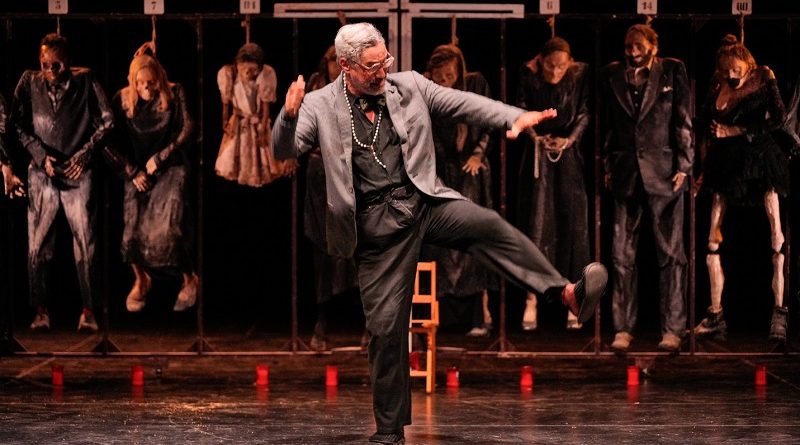
Between Otherness and Roots: The ALTERnative Biennale Teatro 2026
Savas Patsalidis*
Abstract
This essay examines ALTERnative, the curatorial framework of the 54th Venice Theatre Biennale under Willem Dafoe, as both a thematic proposition and an interpretive lens for contemporary theatre. Moving beyond a play on alternatives, the concept foregrounds alterity in its multiple dimensions, i.e., memory, identity, history, community, and the self, and also raises questions of origin and belonging. Through selected works by Mario Banushi, Dorcy Rugamba, Emma Dante, and Arturo Cirillo, this essay explores how contemporary theatre stages the encounter with the Other as a central aesthetic and ethical concern. Despite their stylistic differences, these works all suggest that contemporary theatre is a privileged site for negotiating absence, memory, and transformation. The Biennale thus emerges as a laboratory for rethinking human coexistence, where theatre becomes a space for encountering the Other as both origin and condition of subjectivity.
Keywords: alter, native, experimental, memory, performance, physical acting, Golden Lion, Silver Lion
For Greek theatre, this year’s Venice Theatre Biennale was of particular significance, marked by the awarding of the Silver Lion to Mario Banushi, a distinction granted for the first time to such a young artist. At the same time, The Golden Lion was awarded to Emma Dante, one of Italy’s most acclaimed theatre directors. These two choices are not merely symbolic; they belong to a broader curatorial orientation of the Biennale, one that seeks to redefine the boundaries of stage-making and theatrical language. Within this framework, they offer a compelling starting point for a closer reading of the productions I was able to see.

The Heterotopic Landscape of the Biennale Teatro
The Biennale Teatro is part of the historic La Biennale di Venezia, an institution that has functioned for more than a century as a site of international artistic exchange. The theatre section, however, stands out for its more radical orientation; it is not limited to presenting completed productions, but also functions as a site for research, experimentation, and reflection on the very conditions of theatrical practice.
Unlike festivals that focus on showcasing major artistic achievements, the Biennale Teatro retains, to a certain extent, the character of a laboratory and work-in-progress site. Here, new dramaturgies, stage languages, and technological applications are presented, not necessarily as finished products, but as processes still in formation.
Within this framework, artists from different geographies and traditions engage in a continuous field of exchange. European stage forms enter into dialogue with Asian ritual practices, African narrative traditions, and contemporary performance work. What matters is that the Biennale does not merely register this coexistence; it actively produces it. It can therefore be understood, following Michel Foucault’s notion of “heterotopia,” as a temporary cultural “other” space in which different times, memories, and modes of existence do not simply coexist, but are brought into relation and renegotiation.
From Heterotopia to Alterity
This year’s edition carries the umbrella title ALTERnative, a term that functions both as a play on words and as a curatorial statement. The emphasis on the Latin root alter signals notions of otherness, alterity and transformation. The concept of alternative is not understood here as a simple deviation from the dominant, but rather as a process of encountering difference and of rethinking the very terms of representation.
At the same time, separating the terms alter and native reveals a second, equally central vector of the programme: the sustained tension between encountering the Other and returning to roots, memory, and cultural origins. Accordingly, the sense of alternative invoked here does not imply a rejection of identity but rather its ongoing negotiation through exposure to difference.
From this perspective, ALTERnative theatre is not organised around fixed oppositions, but around shifting relations between the familiar and the unfamiliar, the local and the global, tradition and transformation. The question is not how identities are transcended, but how they are produced, reshaped, and tested on stage.
In this sense, the Biennale Teatro 2026 operates not only as an international festival but also as a field of experimentation in which this tension is put to the test through performance practices and artistic languages.
Performing the Alter of Origins: Romance Familiare: Chapter 1 – Ragada
The first stop in my journey through this year’s Biennale Teatro was Romance Familiare: Chapter 1 – Ragada by Mario Banushi, a performance that enters into an organic dialogue with the festival’s central framework of ALTERnative.
Born in Greece to a family of Albanian origin, Banushi has consistently drawn on his lived experience of multiple belonging. Migration, family history, and the ongoing negotiation of cultural references are not merely thematic material in his work, but instead comprise elements of his existential condition. In this sense, alterity does not appear as an external Other, as it is already embedded in the very fabric of lived experience.
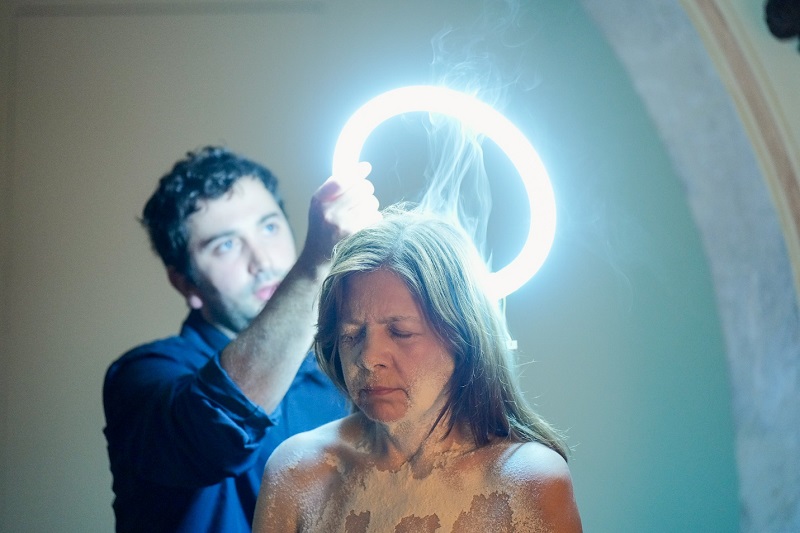
The work, which was created during the pandemic, still retains something of the enclosed, inward-looking quality of that period. The performance emerges from a private, sealed-off space of memory, which gradually opens itself toward the collective through fissures and shifts. The title is therefore no coincidence. Ragada, meaning a small crack or fissure that never fully disappears but persists as a trace, becomes a metaphor for familial trauma, loss, and displacement, experiences inscribed in the body without ever fully emerging as open wounds.
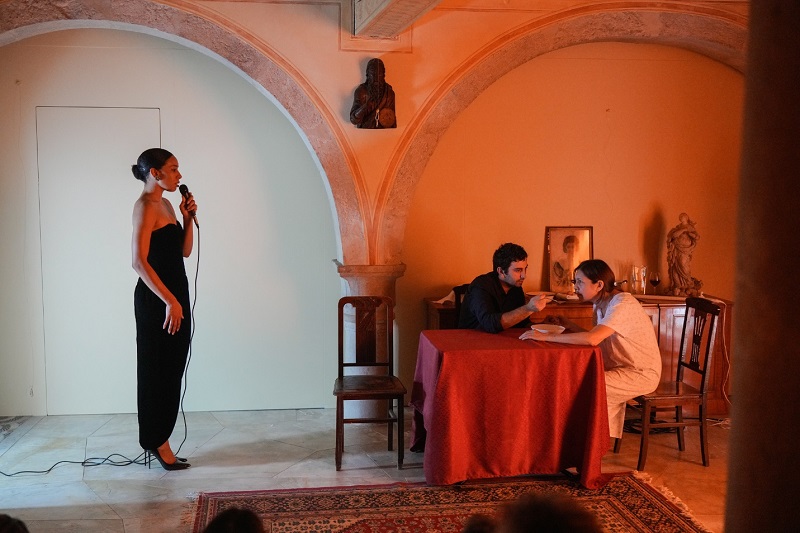
The figure of the artist’s mother, a midwife by profession, appears throughout the work as an embodiment of origin and birth, a carrier of memory and continuity. Her migration from Albania to Greece does not function as narrative in itself, but as a sedimented layer of experience, language, and cultural residue passed silently from one generation to the next.
Banushi, however, deliberately avoids biographical realism. He moves away from the logocentric tradition of Western theatre and constructs a dramaturgy grounded in materiality and the senses. Water, milk, flour, mask, light, shadow, and sound acquire equal dramaturgical weight, turning the stage into a field of embodied experience. The performance does not tell a story; instead, it generates conditions of presence.
Seen through the lens of the festival, this choice is not only aesthetic but also conceptual. The work does not simply address alterity but also proposes a different mode of theatrical existence, whereby experience precedes interpretation. The spectator is not invited to decode meaning but rather to enter a process of lived perception, in which images succeed one another like living compositions and the personal gradually becomes collective.
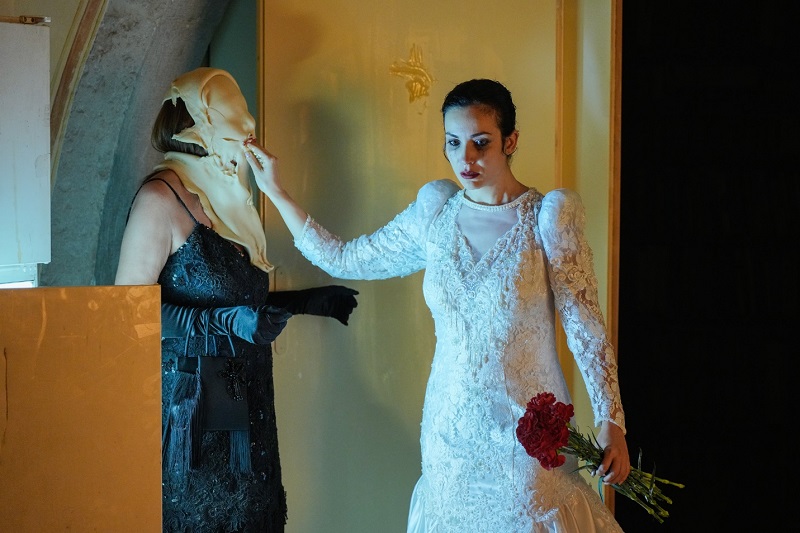
Central to this shift is Banushi’s own lighting score, which operates as a fundamental dramaturgical mechanism. Light does not merely accompany the action; it structures, disassembles, and reassembles it. The slow movements of the bodies acquire a ritual dimension, turning the performers into carriers of memory rather than psychologically fully developed characters. This aesthetic inevitably recalls the visual theatricality of the renowned Greek choreographer Dimitris Papaioannou and the poetic abstraction of Romeo Castellucci. Yet Banushi does not follow either; instead, even within the expected uncertainties of an early creative phase, he searches for a personal language in which Balkan memory, family experience, and ritual can coexist organically.

The fact that the performance was presented in a small, almost domestic space further intensifies this effect. The proximity to the performers, the subtle shifts in movement, the small objects, scents and sounds all create a state of sensory co-presence that would be difficult to translate into a conventional theatrical venue. In this sense, the performance is not merely watched but is almost inhabited, and perhaps this is where its essence lies.
In an age of information overload and constant verbal excess, Banushi turns to silence not as absence but as a mode of knowledge. Rather than narrating memory, Ragada transforms memory into experience. In doing so, it brings into focus one of the core meanings of ALTERnative: the search for other ways of seeing, other ways of telling, and ultimately other ways of being in the world.
Staging Absence as Alterity: Taverna Miresia– Mario, Bella, Anastasia
Goodbye, Lindita is the chronological sequel to Ragada by Mario Banushi. Since I had already seen it in Athens and Thessaloniki, though not in Venice, I will not elaborate on it here. It is enough to note that the Romance Familiare trilogy gradually forms a distinctive mapping of memory and alterity. If Ragada turns toward the mother and Goodbye, Lindita toward the stepmother, then Taverna Miresia turns toward the father, completing a cycle that concerns not only the family, but also the very construction of identity itself. With this work, Banushi reaches the core of his personal mythology, and at the same time addresses one of the most complex aspects of human experience, that of confronting the void left behind by a loved one after death.

The title refers to the family tavern where the wake preceding the father’s funeral took place. As in Ragada, in Taverna Miresia Banushi is not interested in a realistic reconstruction of the event, but in the moment in which death irreversibly transforms both a family and a place. Here, alterity concerns not only the deceased father, but also the space itself, which shifts from a site of shared life to a site of absence. The tavern ceases to be a setting of everyday presence and becomes a stage of mourning. Banushi turns this transition into a central dramaturgical event, highlighting how spaces continue to carry the traces of those who once inhabited them.
Particularly striking is the image of the father’s jacket on the empty chair. It does not merely signify absence; it embodies it. It is a seat that can no longer be occupied, and thus provides the material form of a void around which the entire performance is organised. Around it, the scattered elements of Sotiris Melanos’s set design, including white tiles, a washing machine, basins of laundry, a clothesline, a stove, a shower, a sink and an old transistor radio, form a world at once familiar and uncanny, subtly illuminated by Eliza Alexandropoulou’s lighting score.
Water, which recurs in the form of both sound and material presence, acquires particular significance. At times it functions as an element of purification, while at other times it serves as a reminder of time’s relentless flow. It becomes the image of a life that continues to move forward even as loss seems to have brought everything to a standstill. Unlike other Biennale performances in which the dead return as ghosts or narrative presences, here they return through objects themselves.
Music also plays an important role in the performance. The voice of Savina Yannatou, combined with the composition of Jeph Vanger, who brings together Epirus traditions, Albanian folk elements, and funerary lamentations (vajtim), creates a deeply ritualistic sonic landscape. As in the creator’s previous works, music does not accompany the action, but rather becomes the voice of what cannot be articulated.
The members of the cast, Savina Yannatou, Rita Litu, Katerina Christo, Mario Banushi, and Eftychia Stefanou, function as a unified choric body. The performers do not embody characters, but instead share a common experience of loss, allowing a personal story to expand into a collective one.
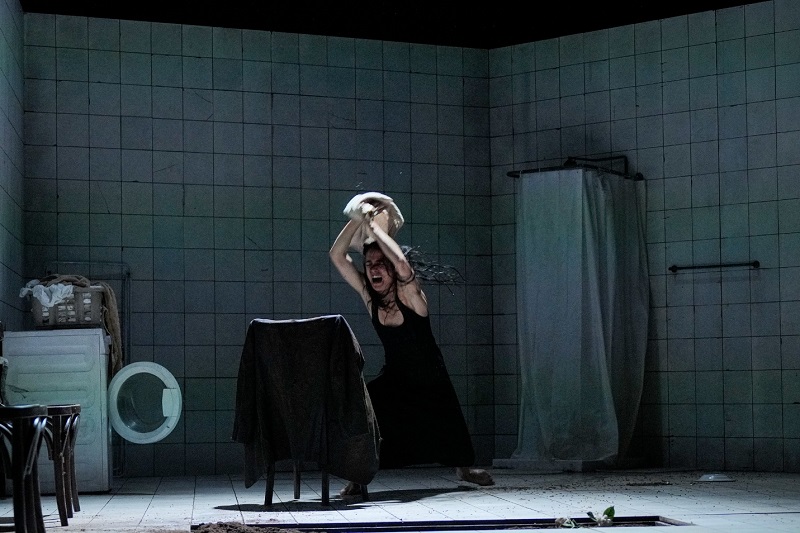
Despite its strong emotional impact, however, Taverna Miresia does not reach the dramaturgical density of Goodbye Lindita. At times, Banushi’s visual refinement risks becoming self-sufficient in its beauty. The image briefly detaches itself from the trauma that generates it, turning emotion into an aesthetic event. Nevertheless, the performance ultimately avoids this pitfall, sustained by the sincerity of experience that runs through it.
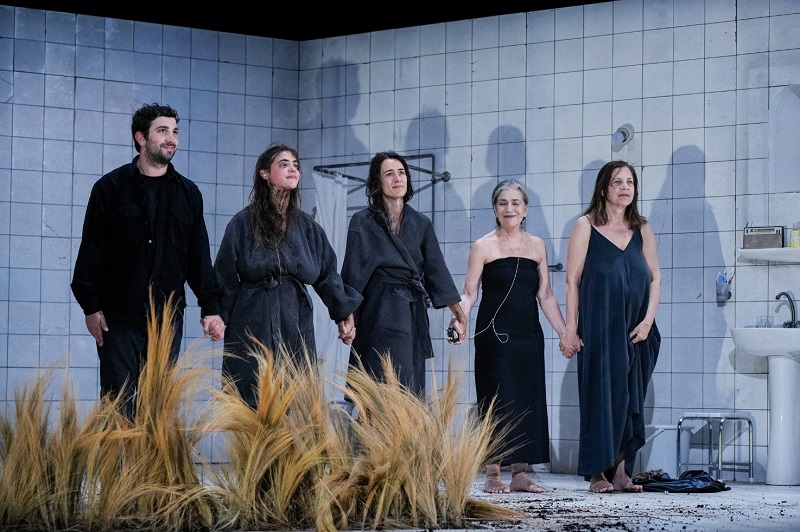
As the final part of the Romance Familiare trilogy, Tavern Miresia feels less like a narrative and more like a ritual of remembrance, a memorial not only for the artist’s father, but for all those who live on through the traces they leave behind. It is a study of the alterity of absence and the persistence of presence within the void. In my view, this is why it stands as the fitting conclusion to a trilogy that began by searching for origins and ends by confronting loss.
The Alterity of the Dead: Hewa Rwanda: Letter to the Absent
With Hewa Rwanda: Letter to the Absent, the Rwandan artist Dorcy Rugamba addresses his own departed loved ones: his father, his mother, and the relatives and friends lost in the 1994 genocide against the Tutsi. Rather than staging violence or embedding it within a historical narrative, he constructs an act of remembrance in the form of a letter to the absent, in which theatre becomes a space of ethical reconnection with lives that history risks reducing to numbers.

One morning in 1994, in less than forty-five minutes, Rugamba’s family was annihilated in Kigali. This event does not function as a theme in dramaturgical terms, but instead provides a traumatic rupture from which the entire narrative unfolds. From there, the narrator-performer returns to the world before the catastrophe, to faces, daily habits, and the small gestures that once composed a shared life. The family is not presented as an idealised construct, but as a living organism of contradictions, faith, and intimacy.
This shift from historical event to personal connection forms the political core of the work. In a world where collective trauma is often mediated through statistics and abstract references, Rugamba insists on the irreducible singularity of each life. The spectator is not asked to remember an event, but to confront the loss of specific people. Memory here is not archive; it is an ethical relation.
The figure of the father occupies a central place in the narrative, along with the education he transmitted through faith and everyday conduct. The family past is presented as a complex space of formation, concrete rather than idealized. The recurring image of the family portrait, towards which the narrator repeatedly turns, condenses the logic of the performance. Although the dead do not return, the relationship with them remains active.
In this sense, the work speaks directly to the conceptual framework of this year’s ALTERnative Biennale, placing at its centre the Other as the absent who continues to inhabit the lives of the living. Here, alterity concerns not only the dead, but also the narrator himself: the return to memory is simultaneously a return to a previous version of the self that no longer exists.
However, the performance articulates this complex relationship primarily through language. The epistolary form provides immediacy and emotional force, but it also confines the work within a sustained monologic structure. The dead are those who are spoken to rather than those who speak, while the stage writing rarely introduces ruptures or shifts that might multiply perspectives on absence. Even the musical contribution of the Senegalese multi-instrumentalist Majnun, whose work blends Afrobeat, jazz, funk, trance, and West African traditions, functions more as an emotional extension of the text than as an autonomous dramaturgical layer.
This does not diminish the work’s impact, but it does reveal its limits: its ritual form, however coherent, tends to stabilise rather than destabilise memory. Where the thematic material opens onto alterity and absence, the dramaturgical construction often tends towards a notable homogeneity.

Nevertheless, Hewa Rwanda: Letter to the Absent remains a profoundly human act of remembrance. It is less concerned with representing genocide and more focused on restoring presence to those erased by it, shifting attention from violence to life, from event to experience, from documentation to personal memory. As Rugamba himself writes: “Some blows you do not recover from. Some blows are impossible to give back.” The performance does not seek to heal these wounds, yet insists on refusing to let them be forgotten.
Coming of Age in Alteration: Quindici ragazze con qualche esperienza
Quindici ragazze con qualche esperienza by Arturo Cirillo shifts attention toward a different terrain of human experience, that of youth, coming of age, and the fluid formation of identity. The performance foregrounds living bodies as it explores the contradictions, expectations, and uncertainties of a group of young people trying to find their place in the world.

The play is based primarily on two early works by Enzo Moscato, Festa al celeste e nubile santuario and Ragazze sole con qualche esperienza, as a tribute to the Neapolitan playwright. Its dramaturgical conception already contains a form of alterity: rather than presenting an autonomous text, Cirillo enters into dialogue with Moscato, transforming his material into a new stage form. The alter here operates not only as thematic content but as method itself, a co-presence with a pre-existing voice, a form of intertextual encounter.
The work belongs to contemporary Italian theatre that remains deeply rooted in dramaturgical tradition while responding to ongoing social and artistic transformations. Through fifteen young figures from Naples, Cirillo explores identity, desire, loneliness, sexuality, and gender expectations, not as fixed categories but as processes in constant formation.
From its very title, the irony is evident. The so-called girls with some experience do not embody mature identities but subjects in transition. Experience is not presented as knowledge but as a fragile, contradictory process. The work unfolds in an in-between zone, neither childhood nor adulthood, but distinctly liminal.

This threshold condition becomes the core of its alterity. The alter is not an external Other but rather the unstable self, searching for direction. The characters confront a form of estrangement from themselves within a world that shifts faster than their ability to assimilate it.

Cirillo is clearly not interested in constructing realist, psychologically rounded characters. Instead, he places them within a choral structure in which multiple performers inhabit the same identity. This accordarsi di voci e corpi (interplay of voices and bodies) produces a collective portrait of a generation shaped by desire, insecurity, the need for acceptance, and the tension of confronting social stereotypes.
The relationship with Moscato is decisive. His figures never conform to rigid categories of gender or identity; they are already fluid, poetic and metamorphic. Cirillo’s choral structure does not modernise them so much as extend them, embedding them in a constantly shifting, rippling environment of transformation and movement, where the alter is also inscribed at the level of gender.

The ragazze cease to function as a stable category and become theatrical positions that can be inhabited by different bodies. The use of both male and female performers for the same roles is not a mere device but a deliberate destabilisation of gender certainty. Identity emerges as performance rather than essence.
At the same time, the choral structure challenges the very notion of a unified subject. No character remains coherent or intact. Each identity is fragmented into voices, desires, and contradictions. The “I” appears as a collective field rather than an individual constant.
On an aesthetic level, Cirillo relies primarily on language and acting, reaffirming the capacity of dramatic theatre to remain politically and emotionally charged without excessive visualisation. The intensity here arises less from image than from linguistic precision and performative economy.
Of particular interest is the constant oscillation between the comic and the dramatic. Humour operates as a mechanism for exposing social stereotypes, while an underlying melancholy exposes the weight of the passage into adulthood. The desire for freedom continually clashes with social expectation.
Within the framework of the Biennale Teatro and its core theme ALTERnative, the work acquires a clear theoretical position. Here, the alter does not refer to the dead or the absent, but to the living self in the process of becoming. Otherness is not absence but internal instability. At the same time, the dimension of the native is also activated. Naples does not function as a backdrop but as a cultural substratum. Through Moscato and Cirillo, local theatrical tradition is not reproduced but transformed, continuing to generate new forms.
In this sense, the work proposes a form of community grounded not in fixed identity but in fluidity. The alternative is not outside society, but within the possibility of coexisting versions of the self. Overall, Arturo Cirillo composes a performance that combines dramaturgical precision with social observation. Without resorting to spectacle, it illuminates the contradictions of a generation learning to exist without a safety net or comfort zone, and this, ultimately, is the clearest articulation of the alter.
Alter and Native: Ghosts of Popular Memory in I fantasmi di Basile
With I fantasmi di Basile, Emma Dante brings to a close a long-standing creative dialogue with the work of Giambattista Basile, one of the key figures of Neapolitan and more broadly European narrative tradition.
Author of the celebrated Lo cunto de li cunti (1634), Basile was among the first in the 17th century to record literary versions of tales that would later be reworked by Perrault and the Brothers Grimm. Yet his universe is far removed from the softened, domesticated form of the modern fairy tale. It is a baroque world, violent and carnal, saturated with transformation, death, desire, magic and social inversion.

Dante does not attempt a straightforward stage adaptation of these stories. Instead, she draws on Basile’s universe as a reservoir of images and phantoms, constructing a performance that operates less as narrative and more as invocation. As she herself has suggested, Basile’s characters have gradually become part of a private imaginative family, with figures that are at once intimate and threatening, and return insistently to speak to the present. This family includes the two elderly sisters who use their voices to deceive the king, the monarch with a chicken lodged in his body, and the old man who waits for his deceased relatives on the Day of the Dead, only to fall asleep beside them, like Vladimir and Estragon in Waiting for Godot. Through this mosaic of stories, Dante weaves a hybrid universe in which the comic and the tragic, the grotesque and the tender, the fairy-tale and the existential coexist without hierarchy.
The fairy tale no longer opens a space of innocence, but creates instead a field where the contradictions of the human condition are laid bare. The ghosts of the title include not only the deceased but also the presence of persistent desires, returning memories, and inherited traumas. What emerges is a theatrical anthropology of the uncanny, where the supernatural becomes a means of accessing what is most deeply human. Gestures, cries, choreographed clashes, bodily distortions, and direct address to the audience form a language that draws on popular ritual, commedia dell’arte, religious ceremony, and carnivalesque grotesque.

Here lies a fundamental distinction from the work of Mario Banushi, for example. Where Banushi seeks silence and poetic stillness, Dante constructs a theatre that is excessive, kinetic, and bodily, one in which bodies do not suggest but occupy space.
As in her broader oeuvre, Dante privileges corporeality over language. Her three performers do not embody fixed characters; instead, they constantly transform into carriers of energy, memory, and desire. Read through the curatorial framework of ALTERnative, the alter becomes bodily: ageing, exaggerated, grotesque bodies remain open to transformation, while the ghost emerges as the Other who returns from the past, the memory that persists, the dead who continue to converse with the living. At the same time, the native dimension evokes popular memory, oral tradition, and cultural inheritance that survive beneath official narratives. Difference is therefore not a deviation but a condition of existence.
Dante approaches Basile not as a classic author, but as the bearer of an unruly popular imagination. The work thus proposes an alternative genealogy of European culture, not the domesticated fairy tales of modernity, but their darker, more grotesque and bodily roots.
In an age increasingly marked by the homogenisation of narratives, Dante chooses to reactivate an untamed and unorthodox tradition. Here, ALTERnative refers not only to the Other as ghost, but also to the survival of alternative forms of memory and collective identity. These ghosts do not arrive from an alien world; they emerge instead from the most familiar cultural substratum.

Overall, I fantasmi di Basile confirms Emma Dante’s position as one of the most significant voices in contemporary European theatre. It is a theatre of ghosts, not in a metaphysical sense, but as the ongoing return of everything that constitutes cultural memory.

Rethinking ALTERnative: Concluding Remarks
It is evident that the thematic title ALTERnative, chosen by the artistic director Willem Dafoe and his collaborators for the 54th Theatre Biennale, is more than a clever wordplay or a general reference to alternative artistic visions. Rather, it is a substantial interpretative framework integrated within much of the programme, placing at its centre the relationship with the Other, the human being, memory, the past, family, community, homeland, and ultimately the self.
Despite the significant aesthetic differences separating the artists discussed here, their works share the common concern of how theatre, as the quintessential space of alterity, might reconnect contemporary subjectivity with what is absent, lost, or under threat of erasure.
In Mario Banushi, this inquiry takes the form of a return to familial roots. The dead, parents, childhood experiences, and cultural inheritances function not as objects of nostalgia but as active forces within the present. Silence, image, and ritual form a vocabulary for engaging with what can no longer be spoken.
In Hewa Rwanda, Dorcy Rugamba shifts the focus from family memory to the terrain of history. Personal loss becomes collective remembrance, and the stage is transformed into an ethical act of commemoration. The dead do not return as ghosts of a past time, but as presences that continue to structure relationships with the living.
Arturo Cirillo approaches the alter as an internal splitting of the subject. The characters of Quindici ragazze con qualche esperienza are shaped through the tension between personal desire and social injunctions, where the Other is not an external figure but the imposed image of the self.
In the work of Emma Dante, the alter acquires both a spectral and corporeal form; ancestors, marginal figures, fairy-tale beings, and the excluded re-emerge in a grotesque universe that disrupts linear historicity. Through the body, excess, and popular ritual, Dante reminds us that identity is never fixed, but rather emerges as the product of a continuous co-presence with what exceeds it.
Perhaps it is this concern that stands out as the most coherent thread of this year’s Biennale. Despite the diversity of aesthetic languages, including image-based theatre, testimonial performance, bodily theatre, or dramaturgical theatre, the works converge in a shared insistence on rethinking absence as an active component of experience. Memory does not appear as archive, but rather as a force that continues to generate relation.
In this sense, the Biennale Teatro 2026 functioned not only as a platform for presenting artistic tendencies, but also as a laboratory for rethinking forms of coexistence. This shift in focus opens up a space in which the present cannot be conceived without its absences, the individual without the collective, or identity without its constitutive otherness.

*Savas Patsalidis is Professor Emeritus in Theatre Studies at Aristotle University of Thessaloniki, where he taught at the School of English for nearly thirty-five years. He has also taught at the Drama School of the National Theatre of Northern Greece, the Hellenic Open University, and the graduate programme of the Theatre Department of Aristotle University. He is the author of fourteen books on theatre and performance criticism/theory and co-editor of thirteen more. His two-volume study Theatre, Society, Nation (2010) received the First Prize for Best Theatre Study of the Year. His recent books include Theatre & Theory II: About Topoi, Utopias and Heterotopias (2019) and Comedy’s Encomium: The Seriousness of Laughter (2022), both published by University Studio Press. He has also written extensively as a theatre critic. He serves on the Executive Committee of the Hellenic Association of Theatre and Performing Arts Critics, is a member of the curatorial team of the Forest International Festival, and is Editor-in-Chief of Critical Stages/Scènes critiques, the journal of the International Association of Theatre Critics.
Copyright © 2026 Savas Patsalidis
Critical Stages/Scènes critiques, #33, June 2026
e-ISSN: 2409-7411

This work is licensed under the
Creative Commons Attribution International License CC BY-NC-ND 4.0.
