And the Rest is Silence …
Dieter Topp*
Hamlet Mortuus Est, after Hamlet by William Shakespeare. Adaptation, dramatization & text by Mona Donici. Concept, direction & performance: Levente Kocsárdi. Composer & live music: Sergiu Cătană. Choreography: Anca Stoica. Video design: Sebastian Hamburger. Set design: M.C. Donici. Light design: Dorian Bolca. Lighting and video mapping: Sorin Mocan, Zoltán Makkai. Performance in Romanian, with English surtitles. Not recommended for ophidiophobes (people with a fear of snakes). A production of the independent theatre company Arte-Factum. Premiere date: January 30, 2025. Seen at BABEL F.A.S.T., Tony Bulandra Theatre, Târgoviște, Romania, June 7, 2025.
Another new project by the independent Arte-Factum Association from Timişoara, Romania (artefactum.ro), raised hopes in 2025 of something exciting and particularly unusual after their earlier, highly acclaimed Monologues of Solitude. This time, the team of Mona Donici and Levente Kocsárdi has ventured into a new Shakespeare realization.
Following the global success of the One Man/One Woman productions, the tried-and-tested duo presents something completely new with Hamlet Mortuus Est, a one-man show destined for Romanian and Moldovan festivals.
Hamlet Mortuus Est is a postdramatic parable about time and power, an almost surgical reflection on the sense of cosmic compression of time and the recoil of power. The premise from which the spectacle unfolds is the feeling that time no longer suffices for us; that, unlike the generation of our grandparents, who seemed to have time to work, to build houses, families, children, to read and to enjoy themselves, and, from time to time, to wage war, we, today, live in a continuous crisis of time. We all live in “projects,” we live multiple lives, trying to cheat time. The appetite for life grows sharper in the proximity of death, when the time crisis is most acute.
The planetary scourge of the time-crisis and the effect it has on power, the obsession with immortality that every dictator, great or small, pursues as an antidote to the time crisis, take the form of a funeral cabaret, a party with subtle goth undertones. Two gravediggers, eternal witnesses—narrators of humanity’s passage—are set to exhume graves to make room for other dead, in the endless line of those who have spent their time. In their labor, by no means easy, the two gravediggers need an illusion, their own fiction. They end up exhuming the royal crypt—or perhaps only imagining that it is the tomb of those Danish kings—and, one by one, all the dead from Shakespeare’s signature play are conjured.

Here we already meet the protagonist, Levente Kocsárdi, on his mission.
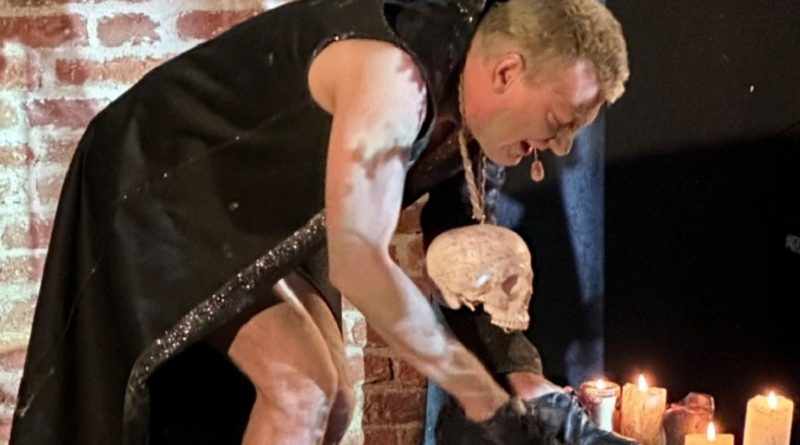
He wanders through the darkness, feeling his way forward without making out anything in particular. His eccentric demeanour, shaped by fragments of his experiences, continues in the following scene (framed by Mihai Donici’s minimalist stage design) as he—also in the role of a gravedigger—rummages through the remains of those shaped by history, and realises that a worm can eat its way through the remains of anyone, be they good, evil, honest or a dictator. What remains is the dirt, a loamy earth with which the later (un)dead try to fill the holes in their bodies. Without success. Kocsárdi slips into the roles of those who moulded him.

Acting, music, dance, puppetry, tap, opera, stand-up comedy, lavish projections, ice skulls, plenty of red clay, dried roses, and, to the audience’s amazement, a live king python—an avatar of the perfidious King Claudius—bestow on this show a magical aura and a contemporary cabaret atmosphere, delivering an exceptional acting performance.

Indeed, it is the details that give subtlety to the vision: the gravediggers unearthing the “shrouds” of the royal dead, (which are, as in many cultures, but rough cloth) that instantly become sumptuous costumes, with 3D effects or precious details; each character bears a theatrical mark in costume or prop—a snake for Claudius, a rat for Polonius, flowers for Ophelia, feathers for Gertrude, etc.—and Hamlet ultimately buries, with his own mortality, his tap-dancing shoes.

An ad-hoc seance of spirits ignites with lavish doses of humor, sarcasm, a playful spirit, but also melancholy, militancy, surrealism. The dramaturgy of the show is essentially built on the last lines spoken by the Hamlet characters before they die and on those passages in the play that speak of death, capturing each character’s attitude toward the end. Their coalescence into a new, original play is remarkable for its logic, its philosophical substrata, its semantic and meta-textual complexity, aided by textual inlays from Beckett’s Texts on Non-Being and from Shakespeare’s Sonnets.
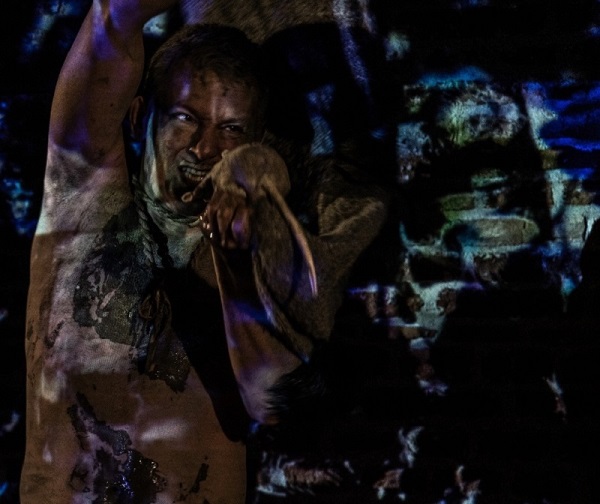
The interpretive mobility of the show’s protagonist, actor Levente Kocsárdi, is altogether remarkable: with seemingly simple, visible means, and with the precious aid of sonic innovation secured by Sergiu Cătană, who—through a subtle technological process—gives voice to the characters, achieves a startling metamorphosis from one character to another, at a rhythm that keeps the audience’s sensibility alert at every moment.
A multi-layered interweaving of Donici’s text and Kocsárdi’s performance/concept is equally fascinating, captivating the audience with inspiration. Sergiu Cătană weaves a tapestry of noise with live sound and music, flooding the play with space and time.
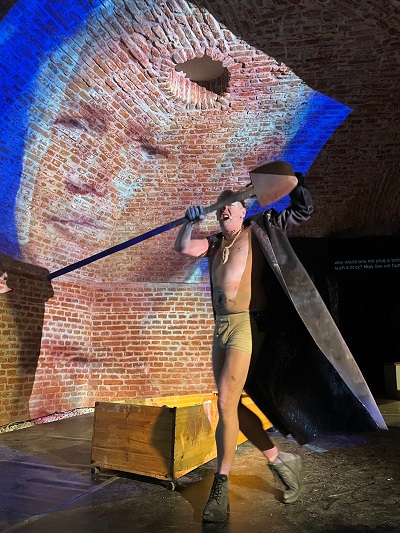
We are all, this spectacle tells us, good people or not so good, great or small dictators, kings or ordinary folk, merely a handful of clay sufficient to plug a barrel’s hole with all our ambitions. And the rest is silence.
Here, the Arte-Factum Association celebrates a feast for the eyes and ears on a shoestring budget against a turbulent backdrop spanning centuries; the production is brimming with original ideas, and one can be sure that this play will attract the attention of international festivals—definitely worth a visit!
*Dieter Topp is journalist, curator, cultural manager and art advisor (festivals), director of the PPS Press Office Press Agency in Cologne, Germany (specialized in culture, particularly social/cultural topics, theatre, ballet, music and musical theatre).
Copyright © 2026 Dieter Topp
Critical Stages/Scènes critiques, #33, June 2026
e-ISSN: 2409-7411

This work is licensed under the
Creative Commons Attribution International License CC BY-NC-ND 4.0.
