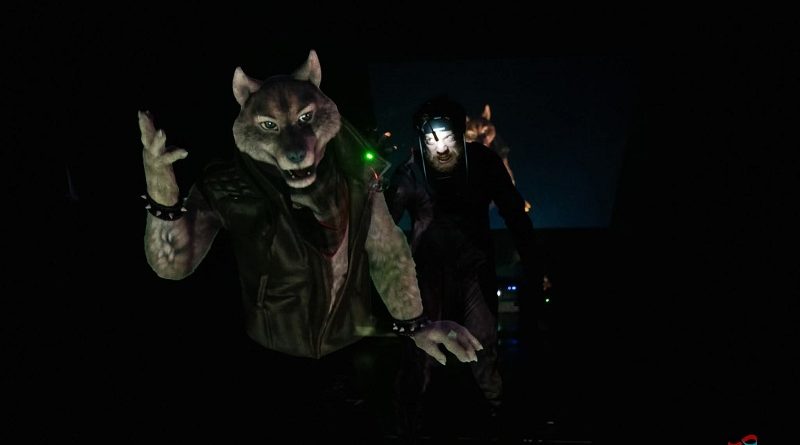
Acting in VR Theatre Productions: Performance Capture
Anca Ghenoside*
Abstract
Motion capture (mocap) and performance capture (Pcap), mostly used in gaming and cinema, are now entering theatre, allowing creators to explore new means of expression. Virtual reality (VR) is seen as both a tool for accessibility and immersion and a threat to theatre’s human essence. This paper explores the physical divide between performers and audiences, examines actors’ roles in creating virtual characters, and considers how acting techniques can adapt to mocap and Pcap to enhance authenticity and balance vocal and physical intensity in performance capture.
Keywords: Pcap, mocap, digital avatar, actor training, acting, VR, embodied cognition
Introduction
The ongoing developments in performing arts are enhanced by the accelerated rhythm of everyday life, rapid technological advancement, and the emergence of a new spectator whose perception of reality and expectations do not align with those of the traditional theatregoer (Runcan 73). Virtual images are omnipresent and, as the technical and scientific advances penetrate almost all aspects of life, the border between the real and the virtual became fluid and permeable (Salter 13), situating us, as Causey et al. observe, in a post-digital, “biovirtual” era, in which the virtual is not separate from, but integral of the real (2). The contemporary world is poetically, yet very accurately depicted by the visionary Peter Brook who, in the opening of the first digital edition of The Empty Space, emphasises the shift from physical, fixed entities and experiences to dynamic, virtual ones, as digital technology integrates into quotidian existence:
When this book started, it was a world where a book was a beautifully crafted object, an object to be kept visibly on a shelf and occasionally on a coffee table. Today, all this has gone with the wind, and now we are in a world with its own magic, in which the object is as invisible as the ether. (i)
As scholars predict major changes in the way theatre will be consumed in the foreseeable future — where the content will be generated and transmitted mainly digitally (Delbridge 3; FutureStage Research Group; Masura 2)—this new reality generates opportunities and challenges regarding both acting techniques and the performer’s interaction with audiences and imposes new perspectives on actor training.
In 2015 Delbridge observed that, even though Pcap needs defined operational principles—since it is the only contemporary technology that can become a central method for creating and recording performances—, most theatre institutions and academic programs had yet to plan and prepare for its integration, as it was still mostly absent in academic literature and research. In the last decade, steps were made towards including mocap and Pcap both in institutional theatrical productions and in academic research and practice (Delbridge 3-4). Our aim is to contribute to the development of a structured theoretical and technical approach to this technology, to offer actors a minimal set of tools to adapt effectively, enhance their creative potential, and ensure this new medium is integrated thoughtfully and ethically into contemporary performance practices.
The present study emerges from our theoretical research preceding a mocap workshop scheduled for September – November 2025, and presents historical and technical aspects of mocap, examines the transformation of the traditional actor-spectator relationship dynamic and considers how acting techniques may adapt to overcome physical boundaries and enhance the audience’s experience. As our findings suggest that acting in Pcap techniques may benefit from Rhonda Blair’s interpretation of embodied cognition, this is one of the trajectories we aim to follow in future research.
From Motion Studies to Performance Capture: a Brief Historical and Technical Overview
The term motion capture (mocap) refers to a technical method utilised in the military, medical, sports, and entertainment fields, and implies recording movement and subsequently transferring it onto a digital model. In the game, cinema, and theatre industries, mocap is used to record actors’ body movements and employ this data to animate three-dimensional virtual characters. When the process includes detailed facial expressions and hand gestures, it is referred to as performance capture (Pcap).
At the turn of the 20th century, long before digital technology, photographers Eadweard Muybridge, Étienne-Jules Marey, and Harold Edgerton laid the foundations for motion capture (mocap) and performance capture (Pcap) by focusing on recording and analysing movement (Chatzichristodoulou and Jefferies 44). Muybridge’s zoopraxiscope (1879) created the illusion of motion through rapid projection of still image, Marey’s chronophotographic camera (1882) recorded sequential images of a moving subject on a single plate, using reflective limb lines, and in the 1930s, Edgerton adapted stroboscopic lights to capture fast movement on film, marking a significant step in the development of optical mocap.
In 1915, Max Fleischer developed rotoscoping – tracing filmed performances frame-by-frame to create realistic animation – and Disney Studios adopted the technique for Snow White and the Seven Dwarfs (dir. David Hand, 1937). From Lee Harrison III’s 1950s experiments with potentiometer-equipped suits to the 1980s development of active-marker systems (potentiometers) and subsequent advances in medical movement analysis, motion capture technology evolved rapidly across the latter half of the 20th century (Dower and Langdale 10).
Dower and Langdale identify three main methods employed for capturing motion and animating digital 3D avatars in use now (11-7). Optical (line-of-sight) capture records the positions of reflective markers within a 3D space, translating them into a cluster of dots that map the performer’s skeleton and joints. Systems typically use 3 to over 300 infrared cameras, with providers including Vicon, Motion Analysis, and OptiTrack. Inertial capture is less precise, relying on sensors (gyroscope, magnetometer, accelerometer) placed on the body, which transmit data wirelessly to construct the digital skeleton; leading developers include Xsens, Noitom, and Rokoko.
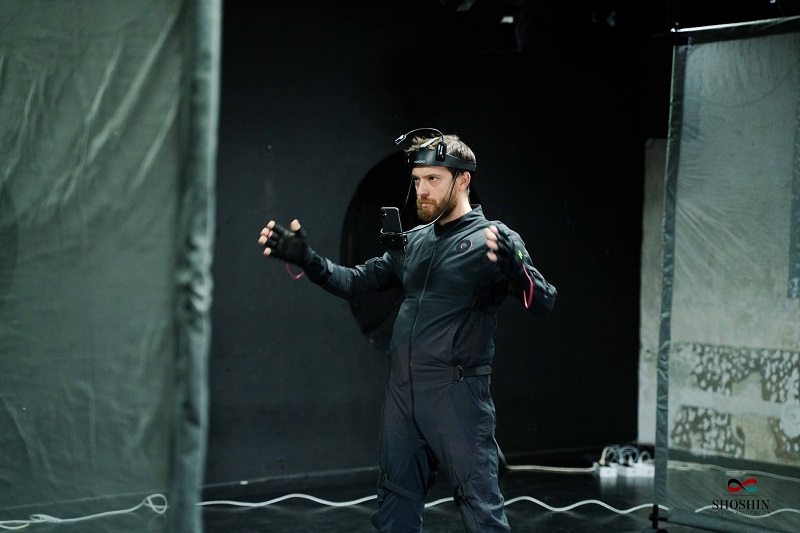
Markerless, or AI-powered, capture offers a more affordable alternative, using algorithms to identify and segment the human figure directly from video footage.
Considerably more intricate than basic mocap, Pcap is usually realised within an optical mocap system, and the data is used to generate, in a virtual environment, digital assets (such as objects or characters) that are further manipulated in real time, with digital visual effects (VFX) through a real-time game engine – such as Unreal Engine from Epic Games or Unity (Dower and Langdale 9). With ongoing developments, new solutions for Pcap continue to emerge, such as DI4D, a technology that captures facial nuances with precision, enabling highly realistic digital animations via stereo photogrammetry and pixel tracking.[1]
Motion Capture and Performance Capture in Video Games, Film and Theatre
The industry that has most extensively employed mocap and Pcap in their productions is the gaming industry, starting in the 1980s, when Jordan Mechner used rotoscoping to create smooth, realistic sequences in Prince of Persia (1989) (Mechner). This was followed by the highly realistic martial arts movements in Mortal Kombat 4 (1992), the first game to feature fully computer-generated characters and mocap-animated models (Bhokare and Vidyapeeth).
Following the productive interdisciplinary exchange between game development and film, many mainstream cinematographic productions now incorporate mocap and Pcap for realistic digital characters, with significant examples including The Lord of the Rings Trilogy (2001 – 2003), Rise of The Planet of the Apes (2011), The Hobbit: The Desolation of Smaug (2013), Avatar: The Way of Water (2022), where performance-driven digital avatars intensify audience experience. Similarly, the gaming industry has borrowed greatly from cinematic techniques, blending immersive storytelling with high-fidelity motion capture to create touching characters and narratives: Hellblade: Senua’s Sacrifice (2017), God of War (2018), Assassin’s Creed Odyssey (2018), Assassin’s Creed Valhalla (2020), Cyberpunk 2077 (2020).
Moreover, the use of mocap and Pcap has extended into theatre, where experimental and contemporary productions use the technologies to create hybrid performances—integrating live actors with digital avatars and/or virtual environments—, and as of late full-VR shows. The world’s first real time performance capture of a Shakespearian scene was shown at the Canada 3.0 Conference in April 2012 (Stratford Festival), with basic technology (Dower and Langdale 205); in 2018, a full-length hybrid production of Shakespeare’s The Tempest at Royal Shakespeare Company implied inertial motion capture and Unreal Engine to render Ariel’s airy, shapeshifting nature through a projected 3D digital avatar, while the actor was physically present on stage (BVE Expo).
As part of their ongoing government-funded research on audience of the future and exploration of live performance in the context of technological development, in 2021, the Royal Shakespeare Company broadcasted Dream (2021), adapted fromA Midsummer’s Night Dream by William Shakespeare, a VR immersive live production that involved performance capture, Unreal Engine, and interactive audio (Royal Shakespeare Company). Observing the extraordinary technical progress over one decade, Pascal Langdale predicts that, as these means develop and become more accessible, they will greatly influence the emergence of new theatrical forms (Dower and Langdale 205). The blend between theatre and digital art forms may allow for innovative storytelling, breaking traditional physical boundaries, and engaging audiences in immersive, interactive experiences (Andreadis et al. 148-52).
In Romania, virtual reality (VR) theatre productions have been slowly emerging over the past decade with one of the earliest examples being Ilegitim, directed by Adrian Sitaru and staged at the Hungarian State Theatre of Cluj-Napoca in February 2018. This hybrid production offered spectators a dual experience: without a head-mounted display (HMD), the audience viewed a minimalist green set and the live performance on stage; with the VR HMD, they were immersed in a new reality, where actors’ previously recorded performance was rendered in a digitally produced version of the mise-en-scène, while the public was hearing live audio from the physical stage (Balázs).
In response to the crisis provoked by the COVID-19 pandemic, Romanian theatre explored new digital forms. ACEA launched 88/89 in 2019, the first immersive, site-specific VR production, filmed in 360 degrees (Observator Cultural); this was followed by the launch of TeatruVR.ro, in 2020, an archive platform hosting 360-degree VR adaptations (TeatruVR), and Turnul (2021), an original digital production by Teatrul Basca (Stage ON). Most recently, in 2024, UNATC presented Ecoul meu virtual, a hybrid VR – theatre project focused on drug prevention (UNATC).
To our knowledge, however, Romanian theatre productions have not yet employed motion capture or performance capture techniques, either in fully virtual or hybrid forms. This may be due to the costs such productions imply, the lack of specialised training among the professionals, and a certain inertia in our professional environment. In our view, theatre academies should invest in training and research in this field, offering future practitioners elementary preparation to open the way for new creative developments. Responding to this need, UNATC Bucharest established CINETic (The International Center for Research and Education in Innovative Creative Technologies), which integrates mocap and Pcap technologies in its research, that is aimed at advancing artistic innovation and strengthening the role of art in society.[2] A strong collaboration between departments within academic institutions and amongst different academic and production entities nationally and internationally is essential for advancing motion capture and performance capture acting, as it could offer a rich environment for knowledge exchange, cross-disciplinary innovation, and the evolution of groundbreaking artistic practices.
The Shift. Democratisation of Access and New Expressive Forms
In traditional, physical theatre the actor performs in front of, and interacts intimately with, a relatively homogeneous audience, whose experience is dual, as they respond to the performance both as individuals—immersing themselves in narratives most often enacted on a proscenium stage, with an archway that gives access to an imagined world (Wales et al.)—and as members of a group, where the simultaneous presence in the same material space generates a sense of communion and belonging (Arman Mehr and Askarzadeh 50).
Space, time and presence are being redefined in VR theatre, since performers and audience members, while physically located in different material spaces, access a shared virtual environment at the aid of devices or interfaces that mediate communication and interaction. Nadja Masura and Aleksandar Sasha Dundjerović are two practitioners who explore digital theatre both theoretically and through their artistic and pedagogical experience; they both adopt Peter Brook’s definition of theatre—“a man walking across an empty space while someone else is watching him” (1)—as a starting point in analysing the paradigm shifts caused by the inclusion of new technologies in theatre productions, and their differing opinions exemplify the contradictory positions scholars take regarding the definitions of time, space and presence.
Masura defines liveness as the physical mutual presence of at least a portion of the total number of actors and audience members at the site of the main performance event and identifies this condition as essential for an artistic production to be considered (digital) theatre (7). Dundjerović expresses a different view on space and presence in digital theatre, stating that both audiences and performers have a convention of sharing transtopic locations, or “socially constructed communication spheres” encompassing physical and digital spaces or a computer-generated virtual platform, a foucauldian heterotopia, “‘a placeless place’ … where illusion becomes a representation of something real” (67). Sharing a similar perspective, Philip Auslander goes even further, including time as negotiable element, and states that from the viewer’s perspective, all mediated content functions as a live performance, blurring the line between reproduction and genuine liveness (81- 2).
Several scholars argue that mediation threatens human interaction and connection: headmounted displays (HMDs) can distract, touch is absent in current systems, and a performer’s embodied presence cannot be fully replicated; devices may separate users from their physical surroundings and from one another (Camilleri 5-6). Their position is challenged by researchers affirming that younger, digitally native audiences do not perceive interfaces as barriers (Kuksa and Childs 8), as they inhabit a world in which subjectivity is distributed across virtual and physical realities; rather than opposing one another, these realities are intertwined and mutually enabling (Causey et al1). Furthermore, Gargoles states that, when accessing virtual reality, the spectators temporarily forget they are using devices and experience the environment directly, connecting to the sensory qualities of the artwork (163). Also, technology is evolving rapidly and becoming more accessible, as head-mounted displays are being redesigned for comfort and ease of use, haptic gloves and suits are improving in fidelity, virtual environments are growing more convincing, and motion-captured avatars are gaining the ability to represent finer nuances of gesture and expression. As these technical limitations are addressed, performers can adapt their craft for virtual embodiments, developing new techniques to achieve a more convincing theatrical presence in VR.
Another critique is that, despite technical advances, a persistent shortcoming of current VR productions lies in their limited capacity to replicate the social dynamics among audience members: while the technology has made notable progress in delivering individualized immersion and interaction, it falls short in reliably producing the shared, synchronous experiences that define live theatre and are essential for a sense of authenticity (Gagneré and Ternova 3; Camilleri 4). Yet is interaction among audience members truly indispensable to the theatrical experience?
Revisiting Wilfried Passow’s schema of five aspects of theatre interaction (237–54), Miruna Runcan emphasises that two elements are of constitutive importance: “a scenic interaction within the ‘make-believe world’ (fictitious scenic interaction) and the interaction of the audience with this ‘make-believe world’.” She stresses that the spectator’s intimate motivation for engaging in a theatrical event resides in their “voyeuristic need,” aiming for a cathartic reaction, and not necessarily an interaction with other members of the public. According to Runcan, the spectator mainly seeks to imaginatively embody a character, aligning oneself with the narrative or concept, and deriving personal enrichment through the mediated experience of inhabiting an alternative, novel identity (41–2).
We can infer that VR performance productions satisfy the conditions for offering a genuine theatrical experience, as they enable mediated interaction both among performers within and with the virtual space, and between the spectator and the digitally generated imaginary world. Moreover, considering Philip Auslander’s note that even spectators who prefer live theatre “nevertheless consume mediatized performances far more frequently than live ones” (81), we can deduce that access to artistic productions that cannot be physically attended is of higher importance than the condition of tangible co-presence. Also, as the presented evidence suggests, for digital native audiences, mutual presence doesn’t necessarily entail spatial and temporal simultaneity, as they readily embrace the convention of sharing virtual locations, and immerse themselves in the virtual surroundings, engaging and empathising with the characters they encounter, both as individuals and as members of a new, broader community: a digital agora (Dundjerović 87).
Therefore, a key opportunity offered by the exploitation of technological developments lies in the democratisation of cultural access (FutureStage Research Group), moving beyond the video livestreams that proliferated during the Covid‑19 pandemic (and opened the path to VR spectatorship) towards affordable immersive experiences that deepen human interconnection and foster both individual and collective belonging (Samur 244). Consequently, even if physically separated from the public, theatre actors may reach wider audiences, with their work having potentially greater impact through increased accessibility. However, in line with Kuksa and Childs, we argue that technology should not be confined to its function as a tool for capturing and transmitting performance. Instead, research should primarily focus on the development of new theatrical forms that emerge in response to technological innovation. (Kuksa and Childs 2-4). Technologies should be regarded as essential and integrated creative resources within a production, rather than used merely for broadcasting or archiving (Dundjerović 187), as the essence of the digital format lies in its flexibility, adaptability, mutability, and ability to be processed in real time (Masura 7, 9). Accordingly, with respect to actors, we believe that the acquisition of technical skills in performance capture constitutes not only a practical competency, but a transformative extension of actor training, that provides new creative ways through which artistic development can be enriched and theatrical practice reimagined across diverse forms.
Acting in Mocap and Pcap
A debate surrounds the actor’s role, significance and agency in mocap and Pcap productions, the most common counterargument to embodying virtual characters being that the actor becomes a puppeteer (deGraf and Yilmaz 44), as their art is reduced to recording the skeletal movements that then navigate a digital avatar (Dower and Langdale 11). We are opposing this view, considering that practitioners who have consistently worked in the system, like Andy Serkis or Neil Newbon, describe motion capture as “pure acting” (Dower and Langdale 7), that “requires a lot of the old skills of acting in theatre and film technique … taking the best from both worlds, pushing them together, adding in a lot of imagination” (Newbon). More so, Dower and Langdale consider performance capture a most challenging form of acting, that requires a psychologically motivated and physically embodied performance, and forces actors to create whole worlds relying only on their imagination, in an empty space, a 360 degrees black box, with no physically present audience (Dower and Langdale 33–5). In addition, by permitting the uninterrupted recording of a full performance in one take, Pcap is considered fundamentally theatrical, an organic medium for acting (Delbridge 5), that exists inside a digitally created world and is transforming the human tradition of storytelling (Dower and Langdale 4).
In theatre, empathy remains a central affective response shaping audience appreciation, and much of that empathy is traditionally grounded in the actor’s embodied presence: vocal timbre, breath, micro‑gesture, and the visible risk and vulnerability of live performance (Camilleri 8). In the VR environment, two intertwined factors determine whether comparable empathic responses can be elicited: the technological capacity to convey presence and the performer’s skill to adapt their craft for motion capture and virtual embodiment.
With technological advancements soon allowing for affordable, credible creations of virtual scenic spaces and characters, the primary role of the actor remains the same: to craft original and impactful art that may transform the audience by employing their instruments—body, voice, imagination, emotions, intellect, and personal experience. Nevertheless, specialised preparation and adaptation in acting techniques are necessary for delivering strong, meaningful performances in virtual environments (Masura 100), as well as for developing innovative means of theatrical expression.
Imagination, commitment, mastery of the actor’s craft, and the ability to embody characters vastly different from themselves—in terms of height, age, body type, or skin colour—are identified as core traits of performance capture (Gibson 46; Dower and Langdale 4; Newbon). In the early film era, actors became the original intermedial voyagers, directly participating in the shift from theatre to film, from analogue to digital representation, rather than merely observing it (Remshardt 42-3); in the biovirtual era, they are required to navigate an in-between space, learning to think of their body, face, and voice both as separate tools and as interconnected channels of expression that shape presence once translated into a digital avatar. Although facing significant technical challenges, their physical body extended (Matei 46), they also gain the opportunity to create characters and worlds previously impossible, with a potential impact surpassing that of traditional theatre.
Actor’s Training for Motion Capture and Performance Capture
Actor training for mocap and Pcap should focus on adapting existing skills acquired through previous tuition to develop a heightened and integrated control over the body, face, and voice—both as distinct and integrated instruments of artistic expression—within the specific demands of digital performance environments. We identified a two-stage model of preparation for actors engaging with mocap and Pcap.
The first stage focuses on precision in movement, vocal articulation, and facial expressivity, laying a foundation for later technical integration, and can be implemented in any standard acting studio, as it does not require access to specialised hardware or software.
The second stage focuses on familiarisation with the technologies and environments specific to motion capture, and includes training with wearable sensors, facial rigs, and virtual reality (VR) systems, enabling actors to refine their skills by embodying and navigating avatars within immersive digital spaces.
The first stage of training: in the studio: Training for mocap is centered mainly on the cultivation of a strong body-mind connection and relies mostly on observation and practice. Actors must become capable of nonverbal storytelling, credible interaction with imaginary objects, to prepare for truthfully embodying a digital avatar, whose features may significantly differ from their own, all within an empty space, where the elements of the virtual mise-en-scene are barely marked, while their performance is being captured from multiple angles.
According to Dower and Langdale, training should focus on proprioception (the awareness of one’s body position in space), kinesthesia (the sense of bodily movement through space), and mind-body connection. They propose a series of foundational exercises (32–50) that may form part of a broader training routine, as they also recommend Michael Chekhov’s psycho-physical approach or Laban Movement Analysis (Ewan and Sagovsky) as effective methods. They stress that a crucial step consists of the actor identifying and analysing their natural way of walking, their so-called “physical fingerprint,” and learning to move beyond, to create believable dramatic characters. As each person’s walk is unique and implies a specific center of gravity, body position, limb movement, rhythm, length of step, and breathing pattern, the actor will have to master these elements to credibly embody an other. Subsequent training involves observing animals and other humans to identify their specific movement, psychological and physiological features, and replicate these elements veraciously and comparatively, to be able afterwards to interact with and manipulate imaginary objects of various textures, weights and sizes, while maintaining the character’s physical and psychological integrity.
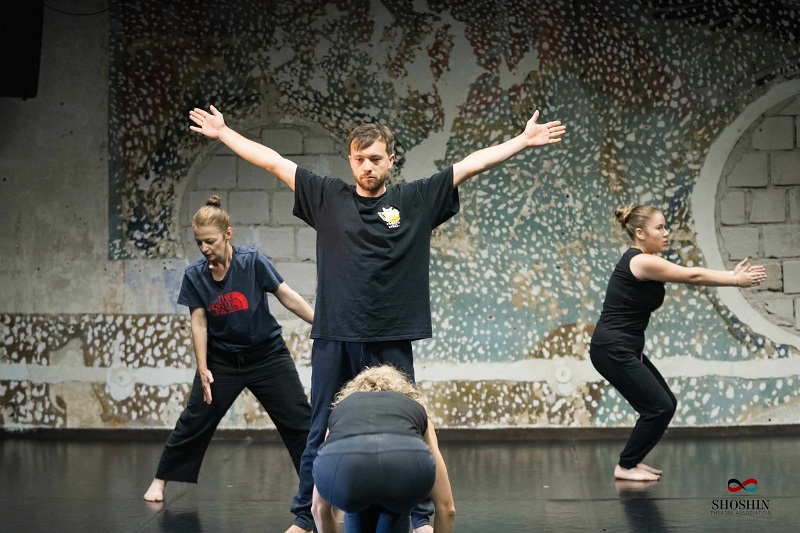
Richard Dorton, a leading mocap and Pcap trainer in Hollywood, employs a combination of techniques to assist actors in producing credible performances. These include the use of masks, minimal props, and detailed descriptions of the imaginary environment, situation, as well as of the character’s physical, psychological, and physiological attributes (Dorton). We find that the two training programmes share similar principles, as both rely on a strong mind-body connection, commitment, imagination, and embodiment.
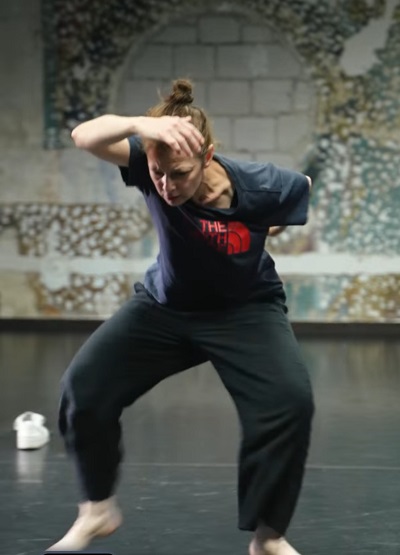
In addition, we believe that Jan Fabre’s approach to actor training—particularly the exercises outlined in Chapter 2 (Fabre and Van den Dries 61-217)—should serve as a valuable source of inspiration for this module, as they highlight the role of physical commitment and imaginative transformation as essential to performance. Likewise, the use of mental/motor imagery, as discussed by Rhonda Blair, could provide an internal tool for mapping the actor’s evolution through space and for developing a dual perspective, as the performer experiences the role from within and – using their imagination – observes the self from outside simultaneously (86). In these practices, that are inspired by theories of embodied cognition (Varela; Thompson; and Rosch), imagination and bodily awareness are seen as essential for presence. Integrated into mocap and training, these methods can assist performers in visualising and controlling their avatars within virtual environments. In this sense, the actor’s concentration on self – mediated through observation and imagination – functions as a reconfiguration of embodiment that bridges physical performance and its digital extension.
The final phase of the studio training stage needs to be dedicated to Pcap acting and should focus on fine-tuning the expressive, theatrical body movements with subtle demands of cinematographic facial expression, and vocal modulation: a hybrid mode that places performers between theatrical and cinematic expression. We propose a three-step exercise based on a pre-learned text. First, the actor performs the scene through the body alone, without words, focusing entirely on physical expression and repeating the action, so the body memorizes the movements. Second, they shift to the opposite mode, repeatedly delivering the text in an intimate, filmic manner that relies solely on facial expression, vocal modulation, and intensity, without any body movement. Finally, they perform the scene integrating the body, face, and voice into a unified expression.
The second stage of training: inside the volume: The emphasis will be placed on the precise adaptation of the abilities acquired during the initial phase to the specific hardware and software used in motion and performance capture. According to Delbridge, this stage should involve three essential steps for effective adaptation (66). First, the actors must familiarise with the physical environment and the technical devices: the LYCRA® suit, tracking markers, and head-mounted camera rig.
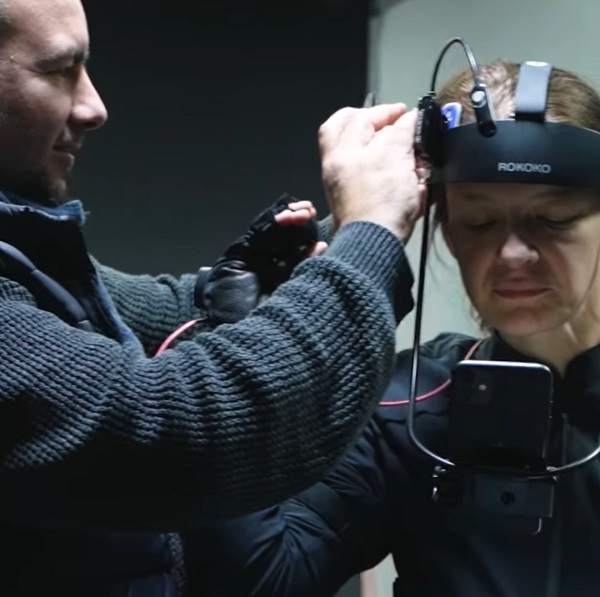
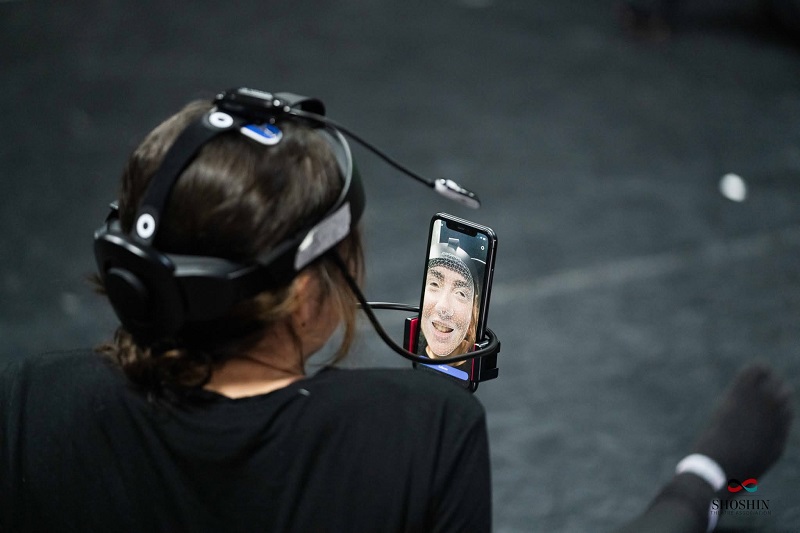
The second step consists of introducing the performer to the previsualisation environment, a neutral avatar—capable of undertaking data from any performer—, and basic 3D objects within the screen space.
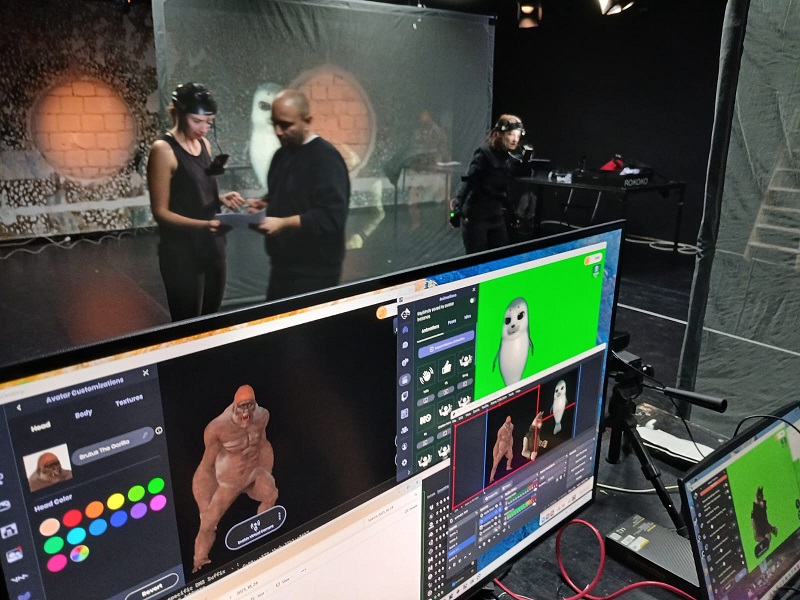
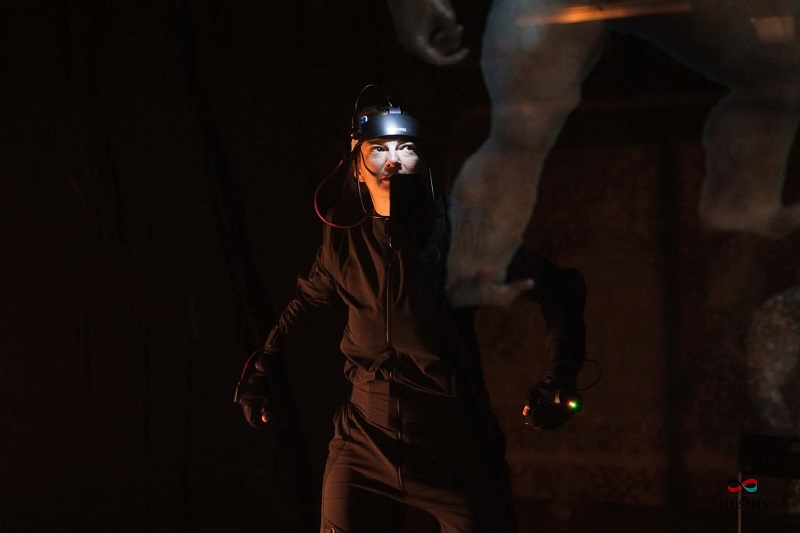
For the final step, the avatar becomes “characterised” by the actor’s movement and interacts with various 3D virtual objects that have no physical counterparts, as the actor guides it around and through those elements, using the previsualisation screen, then gradually internalises the digital environment by creating a mental map of the spatial relationship between the 3d character and the virtual objects. The final step, where the actor performs without reliance on the control screen, navigating the avatar within the volume intuitively enables them, in Delbridge’s view, to cross the border into virtual space and fully inhabit their avatar.
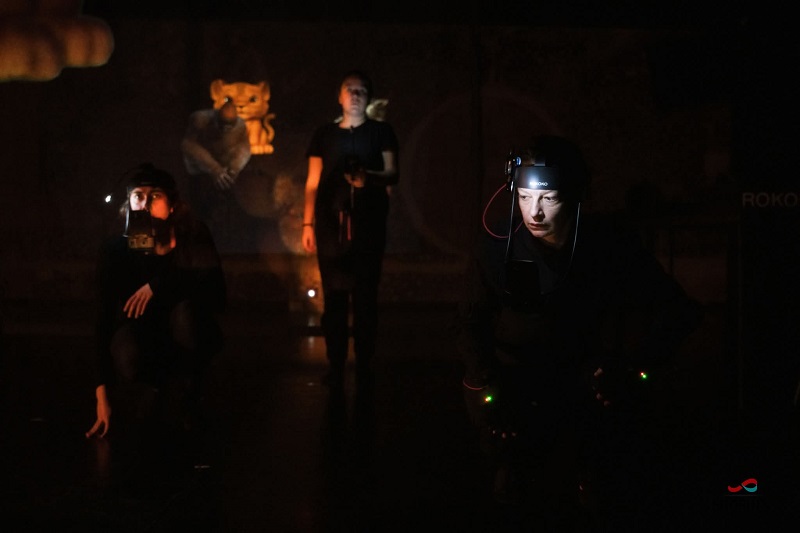
A similar method is illustrated by Darren Daly who, while describing a mocap acting workshop at Salford University, states that Michael Chekhov’s imaginary body technique (95-106) was used for finding agency within pre-existing avatars, while observing their evolution on screen in real time, as they responded to the performers’ input (270–76).
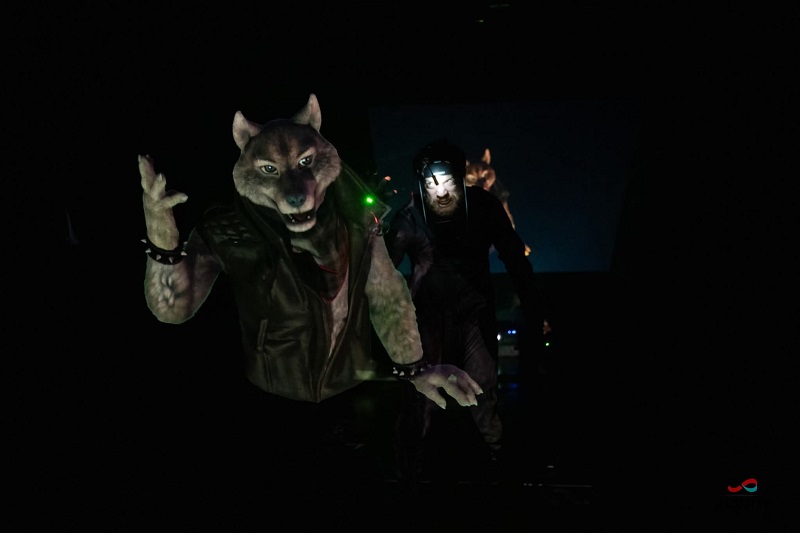
We believe that the methods outlined above could be significantly enriched by applying Rhonda Blair’s cognitive-scientific reading of acting, which highlights the interdependence of imagination and embodiment. A simple task—such as reciting a short, familiar text while guiding a pre-existing avatar along a precise route in virtual space and interacting with virtual objects—can be transformed into a heightened creative exercise through the application of principles of embodied cognition. The actor is guided to construct very detailed mental images of words in the text, the relationship with the audience, the space they are leaving, the space they are entering, their initial physical and physiological state, and how this state changes as they advance through the environment and engage with its elements. They must assign and imagine concrete sensory qualities in extreme detail—light, temperature, smells, sounds, textures, and colours—within the environment, observing how interactions with each element resonate in their body and alter their state, and responding spontaneously in the moment. This type of exercise is not aimed at constructing a fully developed character but prioritizes the images that arise or persist in the actor’s body, aiming to activate it through mental engagement (Blair 87–9). In our view, fully engaging with an imaginary body and the environments it interacts with can transform the projection of oneself into an avatar from a merely technical procedure into an embodied cognitive process, in which imagination, bodily awareness, and digital mediation merge to generate presence within virtual environment
Conclusion
The ongoing development of technical means and intimately intertwined coexistence of physical and virtual realities can enhance the evolution of new forms of theatrical expression. The actors’ contribution remains substantial, as their presence is essential to communicating ideas and generating empathy. Therefore, actors should adapt their craft to create credible, living characters that fully inhabit virtual environments.
Pcap training not only equips actors with the basic skills for performing in the medium but enriches their creative exploration by heightening their awareness of the body in relation to character, space, and environment. It is a demanding, provocative form of acting in which the actor must commit fully to achieve a strong presence and convey ideas and concepts to audiences experiencing them through virtual characters and environments, relying solely on their own self (1)—as defined by Rhonda Blair—without the support of mise-en-scène or a physically present audience, yet surrounded by cameras that capture every nuance of their performance. Alongside other training methods, approaches based on embodied cognition theory may offer additional tools for Pcap training.
Our future research aims to evaluate the potential of bridging the existing methods with embodied cognition principles applied to acting, and to assess their value for further training. Performance capture training is becoming indispensable within academic curricula, thus the need for further research and collaboration between departments and institutions to elaborate consistent learning modules for the new generations of actors.
Endnotes
[1] See “DI4D Facial Performance Capture.”
[2] For further details, see “About CINETic,” CINETic.
Bibliography
Andreadis, Anthousis, et al. “Real-Time Motion Capture Technology on a Live Theatrical Performance with Computer Generated Scenery.” Panhellenic Conference on Informatics, IEEE, 2010, pp. 148–52.
Assassin’s Creed Odyssey. Ubisoft Quebec, Ubisoft, 2018.
Assassin’s Creed Valhalla. Ubisoft Montreal, Ubisoft, 2020.
Avatar: The Way of Water. Directed by James Cameron, 20th Century Studios, 2022.
Balázs, Nóra. “Tot timpul avem o cască virtuală cu noi: Un interviu cu Adrian Sitaru.” LiterNet.ro, 20 July 2018. Accessed 22 Aug. 2025.
Bhokare, Sandip, and D. Vidyapeeth. “Motion Capture’s Significance in Contemporary Animation.” Tuijin Jishu / Journal of Propulsion Technology, vol. 45, no. 3, 2024.
Blair, Rhonda. The Actor, Image, and Action: Acting and Cognitive Neuroscience. Routledge, 2007.
Brook, Peter. The Empty Space. Nick Hern Books, 2019.
Camilleri, Garret. Virtual Reality in Theatre: A Survey of Audiences’ Empathy. Graduate Library Research Awards, 2020.
Causey, Matthew, Emma Meehan, and Neill O’Dwyer. The Performing Subject in the Space of Technology. Palgrave Macmillan, 2015.
Chatzichristodoulou, Maria, and Janis Jefferies, editors. Interfaces of Performance. Routledge, 2016.
Chekhov, Michael. On the Technique of Acting. Harper Perennial, 1991.
Cyberpunk 2077. CD Projekt Red, CD Projekt, 2020.
Daly, Darren. “Finding Agency in the Imagined Body through Unreal Engine’s Live Link Performance Capture.” Theatre, Dance and Performance Training, vol. 15, no. 2, 2024, pp. 270–76.
Delbridge, Matthew. Motion Capture in Performance: An Introduction. Palgrave Pivot, 2015.
Dorton, Richard. “I Learned Hollywood Motion Capture.” YouTube, uploaded by Michelle Khare, 2024. Accessed 22 Aug. 2025.
Dower, John, and Pascal Langdale. Performing for Motion Capture: A Guide for Practitioners. Methuen Drama, 2022.
Dundjerović, Aleksandar Sasha. Live Digital Theatre. Routledge, 2023.
“Ecoul meu virtual.” UNATC – Universitatea Națională de Artă Teatrală și Cinematografică. Accessed 22 Aug. 2025.
Ewan, Vanessa, and Kate Sagovsky. Laban’s Efforts in Action: A Movement Handbook for Actors. Methuen Drama, Bloomsbury Publishing, 2018.
Fabre, Jan, and Luk Van den Dries. De la act la performare: Un ghid pentru performerul secolului al XXI-lea. Presa Universitară Clujeană, 2023.
FutureStage Research Group at metaLAB at Harvard. “A Manifesto for the Future Stage: Performance Is a Human Right. How We Can Make the Most of the Possibilities of Liveness, Technology, and Human Innovation.” American Theatre, 5 Nov. 2021. Accessed 14 Aug. 2025.
Gagneré, Georges, and Anastasiia Ternova. “Keeping the Living Bond between Actors and Remote Audiences in Distributed Virtual Theater.” Proceedings of the 10th International Conference on Digital and Interactive Arts (ARTECH’21), Oct. 2021.
Gargoles, Maria. “Embodied Cognition and User Proprioceptive Processes in Artistic Virtual Reality Environments.” Art Vision, vol. 29, no. 51, Oct. 2023, pp. 162–69.
God of War. Santa Monica Studio, Sony Interactive Entertainment, 2018.
Hellblade: Senua’s Sacrifice. Ninja Theory, 2017.
The Hobbit: The Desolation of Smaug. Directed by Peter Jackson, Warner Bros., 2013.
Iudova-Romanova, Kateryna, et al. “Virtual Reality in Contemporary Theatre.” Journal on Computing and Cultural Heritage, vol. 15, no. 4, Dec. 2022, article 75, pp. 1–11.
Kuksa, Iryna, and Mark Childs. “Theatre in the Virtual Day and Age.” Making Sense of Space, 2014.
The Lord of the Rings Trilogy. Directed by Peter Jackson, New Line Cinema, 2001–03.
Masura, Nadja. Digital Theatre. Palgrave Macmillan, 2020.
Matei, Cosmin. “The Intersection of Theatre, Motion Capture, and Digital Avatars: Exploring New Horizons in Children’s Theatre.” Theatrical Colloquia, 2024, pp. 36–67.
Mechner, Jordan. “How the Original ‘Prince of Persia’ Changed Video Game Animation.” Interview by Seth Porges. Forbes, 19 Dec. 2017.
Mehr, Aria Arman, and Sahar Askarzadeh. “An Introduction to Hybrid Theater Forms: A Multifaceted Exploration of Acting, Aesthetics, and Audience Engagement in a Comparative Analysis of Physical and Digital Theater.” International Journal of Latest Research in Humanities and Social Science (IJLRHSS), vol. 7, no. 10, 2024, pp. 46–64, ijlrhss.com.
Newbon, Neil. “Performance Capture, Acting and DOUBLE.” YouTube, uploaded 27 Aug. 2024. Accessed 22 Aug. 2025.
Passow, Wilfried. “The Analysis of Theatrical Performance.” Poetics Today, vol. 2, no. 3, 1981, pp. 237–54.
Remshardt, Ralf. “The Actor as Intermedialist: Remediation, Appropriation, Adaptation.” Intermediality in Theatre and Performance, edited by Freda Chapple and Chiel Kattenbelt, Rodopi, 2006, pp. 41–54.
Rise of the Planet of the Apes. Directed by Rupert Wyatt, 20th Century Fox, 2011.
Runcan, Miruna. Signore Misterioso: O Anatomie a Spectatorului. Unitext, 2011.
Samur, Sebastian Xavier. “Comparing Stage Presence and Virtual Reality Presence.” Revista Brasileira de Estudos da Presença, vol. 6, no. 2, May–Aug. 2016, pp. 242–64. Accessed 13 Aug. 2025.
Snow White and the Seven Dwarfs. Directed by David Hand, Walt Disney Productions, 1937.
Stage ON. Turnul #următorulnivel. YouTube, Dec. 2021. Accessed 22 Aug. 2025.
“TeatruVR.” TeatruVR.ro. Accessed 22 Aug. 2025.
Varela, Francisco J., Evan Thompson, and Eleanor Rosch. The Embodied Mind: Cognitive Science and Human Experience. MIT Press, 1993.
Wales, Michaelah, et al. “Process, Roles, Tools, and Team: Understanding the Emerging Medium of Virtual Reality Theatre.” Proceedings of the 2024 CHI Conference on Human Factors in Computing Systems (CHI ’24), Association for Computing Machinery, 2024, article 99, pp. 1–14.

*Anca Ghenoside holds a BA in Theatre and is currently a PhD candidate (at the Doctoral School of the Faculty of Theatre and Film, Babeș Bolyai University) researching digital theatre. She has acquired experience across various media, having performed in theatre, film,television, radio, and as a voice-over artist. She has participated in interdisciplinary international projects that focused on the interaction between artists and technology. Her current work focuses on the interchange between human presence and technological mediation in theatre. anca.ghenoside@ubbcluj.ro.
Copyright © 2026 Anca Ghenoside
Critical Stages/Scènes critiques, #33, June 2026
e-ISSN: 2409-7411

This work is licensed under the
Creative Commons Attribution International License CC BY-NC-ND 4.0.
