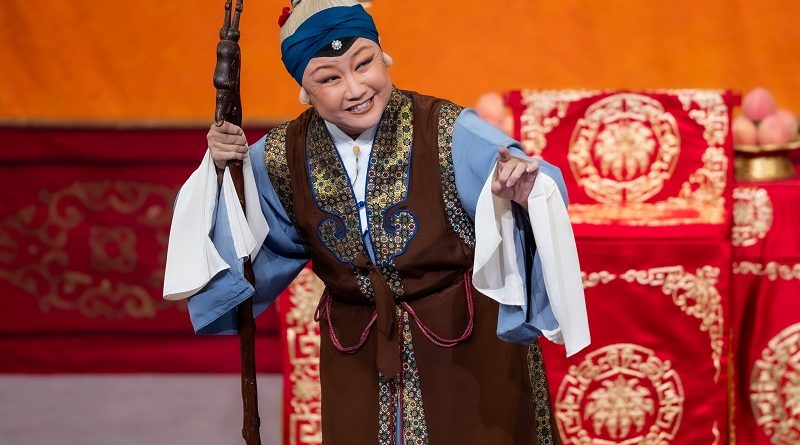
A Portal with an Unusual Code? Reflections on Peking Opera
Kalina Stefanova*
Abstract
This essay is an attempt to delve into the world of Peking opera, a world which looks as beautiful as a flower garden, but often, or at least initially, tends to be as incomprehensible to us, foreigners, as an alien language. The text’s main aim is to find some clues for the code to this, en effect, portal to the heart of Chinese culture. Drawing from personal experience, the author argues that the code does not comprise a concrete “set” of knowledge, but rather a predisposition for a specific way of perceiving the world and human’s place in it.
Keywords: Chinese National Peking Opera Company, The Record of Music, harmonization, fine frequencies, eyes of the heart
At first encounter, the Peking Opera can easily be perceived by the unprepared foreigner as simply a typical colorful arch-like portal – into a hutong in Beijing, an old neighborhood in any Chinese city, or even the so-called China Towns found in many big cities around the world with large Chinese communities. One passes through this portal and finds oneself amidst the characteristic gaiety and bustle of narrow streets decorated with red-and-yellow lanterns, colorful tassels and various gadgets intended to bring well-being and health. Then, upon leaving, all this remains behind as nothing more than a pinch of exotic local color, a touristy-like impression of a foreign culture. And that is all.
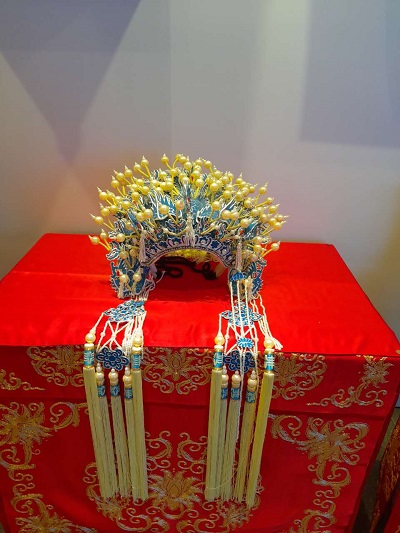
The exact opposite is also possible: one attends Peking Opera fully prepared. One knows all facts regarding Mei Lan Fang’s tours of the USA and the USSR, in the 1930’s, and the influence he exerted on Bertolt Brecht for the development of the alienation effect. One has studied the concrete parameters of the Peking opera – the different schools in it, the types of roles and the respective rules in singing, recitation, acting and acrobatics. One is also aware that every movement on stage follows an almost prescribed trajectory, whether it be the arc of a fan or the manipulation of the long sleeves—folded between elbow and palm—which, at a given moment, are released outward like a gymnast’s ribbons.
From the numerous books one can learn about the makeup specific to each role, why the set traditionally consists of only a table and two chairs, what instruments are used by the musicians, seated in a special square “courtyard” on stage, from where, a special drum beat announces the entrance of the characters as well as other highlights of the action.
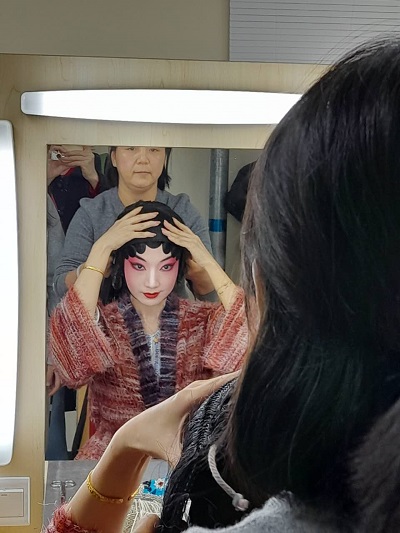
However, does familiarity with the highly stylized, sign-laden stage language of Peking Opera provide a reliable key to its interpretation? Only to a limited extent, it would seem. More precisely, only insofar as it enables one to follow the plot. However, the stories in Peking Opera are only a “pinch” of reality in a stage world that has almost nothing to do with realism; nothing to do with the traditional European perception of theatre.
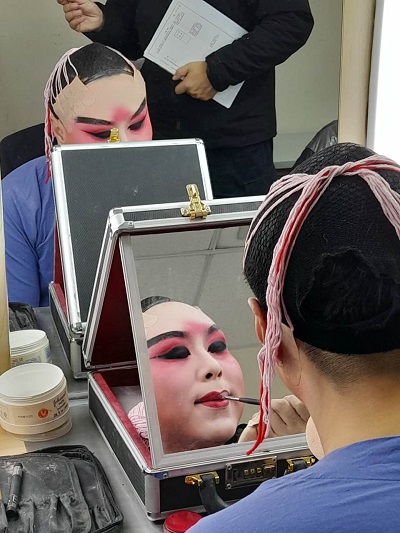
The traditional European type of theatre has a strong earthly gravity. It “teaches” us life, so to speak, the hard way, via the experience of the difficulties we, humans, go through; it is these difficulties, which are most often its focus. And, as we well know, if it achieves a purifying effect, it is through the transformational power of suffering, which we, as an audience, emotionally share with the characters.
Peking Opera, for its part, very elegantly manages to avoid getting into the quagmire of passions. With its emphasized stylization and the beauty in nearly everything on stage, its overall focus is on perfection – perfection as visible and invisible harmony that lifts us above the pernicious grip of human’s wrong choices.
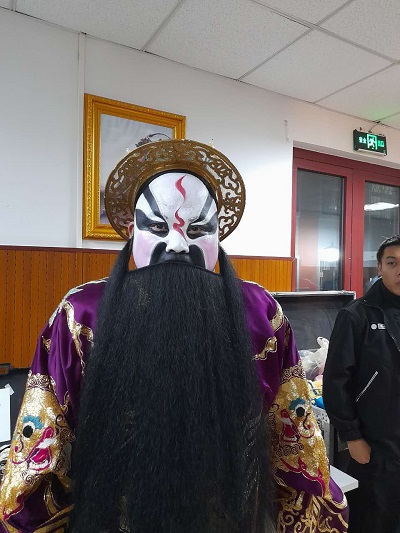
It is as if good-willed dwellers of an above-earthly, perfect world have landed before us, on stage, and, to get in contact with us, have disguised themselves as people in human stories. Yet, because beauty constitutes their primary medium and instrument, both the stories and their characters do not appear fully of flesh and blood but rather resemble an unearthly mirage that flickers before our eyes.
Nevertheless, communication does occur, for this mirage, as it were, “speaks” to something within us, which is also not of flesh and blood. And the conversation between the dwellers of the above-earthly world and us, humans, unfolds in a no-words tongue – the tongue of the fine frequencies, which, as it turns out, is as much theirs, as it is ours, albeit somewhat forgotten tongue.
The fine frequencies of music, of sounds, of colors, even of the finesse in the stylized movements on stage, the fine frequencies of beauty, all of them exert a harmonizing effect. And one starts to experience a sense of harmonious communion not only with this other supra terrestrial realm, but also with oneself too, with other people around, with one’s own earthly world. This, it seems to me, is the overall impression that Peking opera imparts.
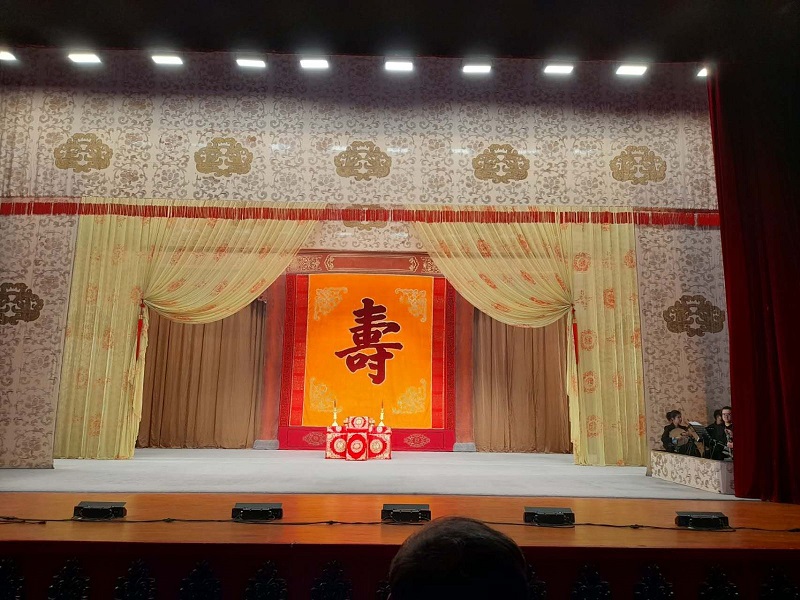
Harmony, frequency and purity – these, I believe, are the key words for understanding this unique stage genre. I include purity too, because, according to tradition, before the performance, the performers must free themselves from all tension and strive to achieve inner peace – only in this way can they become instruments through which the audience is attuned to the waves of harmony.
If one looks at Peking opera through the prism of reason alone, seeking to understand it, and, even more so, to judge it by “assembling” what one knows about its individual elements, it can still remain largely a mystery. To gain insight into its essence, to experience its – I dare say – great therapeutic power, one must not so much try to rationally comprehend it as much as to perceive it with the heart.
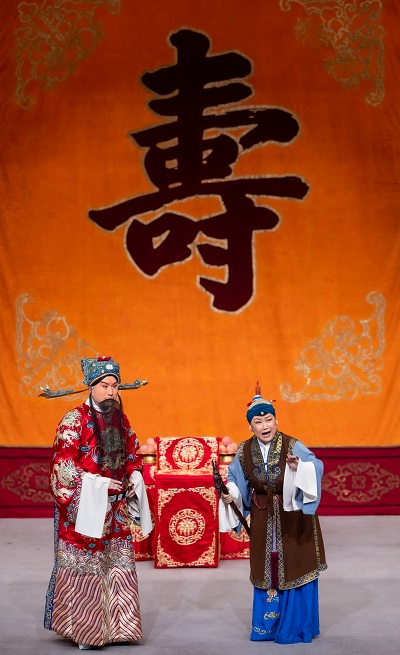
In other words, one must approach it with the “eyes of the heart” (The Book of Psalms, Troparion Ch. 6). Only in this way can one genuinely experience the impact of the supra-terrestrial realm, which “speaks” to us via Peking opera in an attempt to attune us to a higher, supra-mundane frequency. Indeed, ancient Chinese thought likewise: that people think with the heart.
In short, the code for Peking Opera – a world which looks as beautiful as a flower garden, yet often, at least initially, as incomprehensible to us, foreigners, as an alien language – does not comprise a concrete “body” of knowledge, but rather a predisposition for a specific way of perceiving the world and human’s place in it.
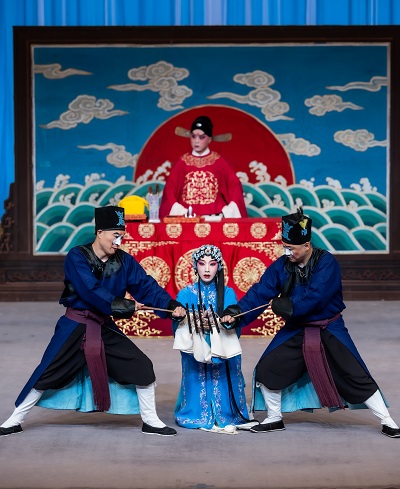
This code, it seems to me, has its roots in the idealistic theory of the origin of music, as described in the chapter “Record of Music” in the Book of Rites, one of the canonical works of Chinese culture, dating back centuries before Common Era. According to this view, the source of music is not external, but arises from the nature of the human heart. However, since human nature is not just a material given but is bestowed upon us by heaven, the ultimate source of music is, in fact, Heaven itself. The human heart thus embodies the “divine principle.”
Back to Peking Opera of today: the effect of its pursuit of perfection can best be felt when experienced together with a local audience. The audience’s reaction, its palpable savoring of the perfection on stage, effectively doubles the theatrical event, situating it simultaneously on stage and in the auditorium.
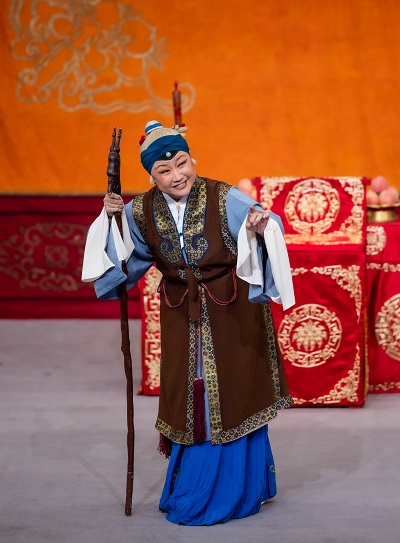
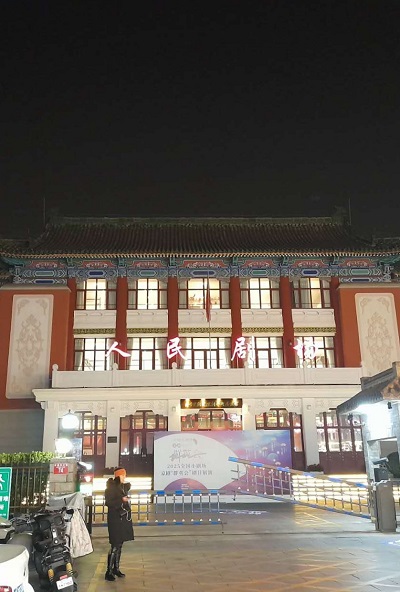
Such was the case with the performance by the Chinese National Peking Opera Company of Chen Sanliang in the Courtroom, Calling Off the Feast, and The Town of Chisang, which I had the chance to see in its theatre – one of the oldest operating theatres in Beijing.
The audience consisted mostly of connoisseurs who had come not just to be entertained, nor for the narratives of the three miniatures, which, to all appearances, they well knew. They had come for much more than that. Armed with tea bottles – recalling traditional Chinese practice of performing stage genres in teahouses– and with mobile phones set to recording mode, they met every perfectly struck or long-held note, every perfectly executed characteristic curve of the voice, with loud and soaring cries of “Ha-aa” (a shortened form of Hao –meaning Good! Nice!). It was as if the hall, like an echo champer, responded to the stage.
The same thing happened at each highly exquisite gesture and especially with the special movements of the long sleeves, which resemble sea waves – not by chance are they are known as “water sleeves.” This reaction of the audience was, yes, an expression of appraisal, but even more so an expression of special, sort of homely joy. While shouting in this way, the spectators impetuously stretched their arms towards the stage, as if they were at home and a familiar child or a guest of theirs had managed to sing or dance something virtuoso and, delighted and happy, they wanted to hug them.
You may say that in the European-type opera, too, the audience goes to enjoy the performance. Yes, but the audience there is much more restrained in its reactions and even somehow more distant. Often there’s something like an invisible barrier – a demarcation line – between the stage and the hall, and at times in the air there is even a whiff of snobbery, reminiscent of the courtly past of European opera. Moreover, approval and delight are expressed mainly through applause and only rarely with shouts of “Bravo” usually rather scattered sparsely throughout the hall.
In Peking Opera, the audience’s approval is noticeably individualized, and the atmosphere is more casual, more benevolent, creating a truly homely type of warmth in the theatre.
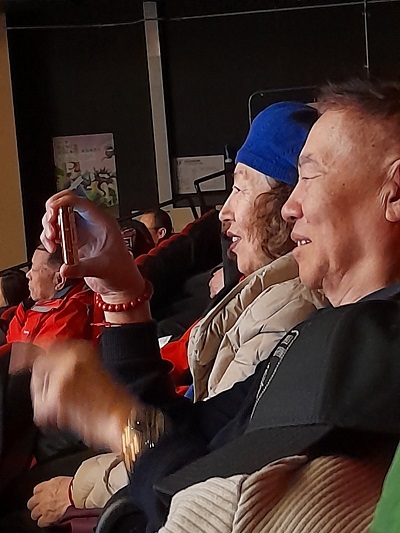
I will never forget the pair of spectators next to me: their joy was so genuine, their faces beaming with such wide smiles, and their responses to the performers’ virtuosity so enthusiastic that, from a certain point onward, I found myself watching them as much as the stage. I even took the liberty of photographing them in order to capture the unique, so to speak, “double” performance I had the privilege to witness.
The bursts of joy in the hall, in turn, naturally resonated with the performers on stage– you could see it in their eyes. Even the stylization of their makeup and movements couldn’t hide it. The effect was like that of connected energy vessels: each new peak in mastery on stage elicited an immediate rise to a new joyous burst in the audience as though the very air of the theatre—and even the cells of our bodies—were being saturated with joy, like oxygen.
It has happened to me to go to theatrical productions of European style while running a high fever and, when they were truly brilliant, have felt almost cured by the end. Exceptional productions of European types of theatre have had an eye-opening and life-changing impact on me.
The effect of this performance by the Chinese National Peking Opera Company was quite different: I got to feel somehow more ethereal – as though an invisible burden was lifted from my shoulders. I was overcome by a special calm joy, with that feeling of flight that seems characteristic of Chinese culture, in which the brushstrokes of the calligraphy, the sleeves of operatic figures, and even the edges of the roofs are all as if in a process of take-off, of ascent.
During the performance, the text in modern Chinese ran on side-screens. This was aimed predominantly at the young viewers, who might not fully understand what the actors were singing and reciting, as I was kindly informed by theatre staff.
It turns out that the reason for this necessity is in the very history of Peking Opera’s creation. In 1790, on the 80th anniversary of the then emperor of the Qing Dynasty, several very popular traditional-opera troupes from Anhui were invited to Beijing. Not only were they very well received but soon began to work together with other traditional-opera troupes from other provinces that happened to be performing there. Over the years, the cooperation gradually expanded and, in the following decades until the mid-19th century, a new genre emerged. It mixed the melodic systems, stylized movement, costumes, make-up and music from the operas of different provinces, all the while also borrowing from folk traditions. The language of this new genre was a mix too: it combined the rhythm of speech from one province with the pronunciation of another and had the Beijing accent added specifically for a softening effect. In the end, this, to a great extent, specially designed amalgam of cultures from different regions of the country was named Peking opera and evolved into a kind of “national theatre” of China.
As a foreigner fascinated by Chinese culture, I find the genesis of Peking Opera highly revealing of the significant role music has played throughout China’s millennia-long history. According to the already mentioned Book of Rites, only sound, combined with morality, could count for music. Again there, music is also defined as the harmony of Heaven and Earth and as the blossom of morality.
It is striking that imperial courts across different dynasties maintained specific institutions responsible, so to speak, for the “regulation” of music, based on the belief that social and inner harmony could be cultivated through musical order. It was also believed that the music of a well-governed country would be calm and joyful, while poor governance would produce angry and resentful music. For that reason, special authorities were dispatched to different regions of the country in order to listen to local musical practices, so that through its rhythms and melodies they could get an impression of the state-of-being of local people, and, thus, take the pulse of the nation. It was believed that music could help people change for the better; what’s more: that appropriate music could spare the state the necessity for applying strict laws.
In brief, music is part of the Confucian ideal of a harmonious world because it connects the inner state of human beings with the state of society and the universe. Peking Opera was created to serve precisely this ideal.
In China, one can also encounter a lot of European type theatre, including so called “spoken drama” and its different modern variations. Yet, no matter how diverse it could be and where you see it, European theatre is in the end quite similar, across different contexts worldwide. By contrast, Chinese traditional operas are something unique, a form that is rarely encountered outside of China.
That’s why, for me, the performance of Chinese National Peking Opera Company that I had the opportunity to watch remained, for me, the most exciting theatre experience during my entire stay in China this time. It was also the most memorable experience for one more reason, not directly related concretely to theatre.
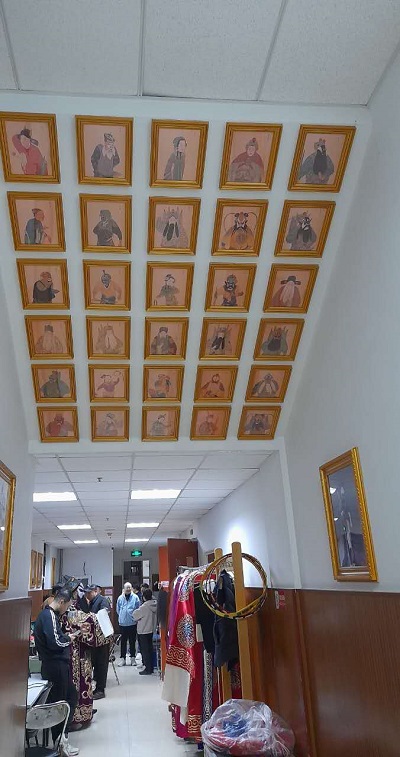
In Beijing, there are places and moments in which one feels as though the present, the past, and the future coexist simultaneously. And this is not like entering a museum or the home of a famous historical personality, temporarily leaving the present behind. No. The present seems to carry within itself both the past and the future, while the future, in turn, appears at times to have been conceived long ago. In other words, there are places and moments in Beijing when time resembles something like a set of Matryoshka dolls, but in an unusual, non-linear order. So to speak, Chinese-style Matryoshka dolls.
During the performance of Chinese National Peking Opera Company, in the theatre too, I experienced this unique, seemingly improbable, but obviously genuine convergence of temporalities.
Also, this performance saw me off charged with the special inner calmness which as though envelops people on the streets of Beijing with an invisible veil and doesn’t allow the tension of the city’s head-spinning dynamics – of traffic, work and communications – to overwhelm them.
In brief, attending – or rather experiencing – this performance by the Chinese National Peking Opera Company in Beijing felt like entering a portal to the very heart of Chinese culture, across multiple dimensions. A portal with an unusual code.

*Kalina Stefanova (PhD) is Full Professor at the National Academy for Theatre and Film Arts, Sofia, Bulgaria, and the author or editor of 17 books. These include 15 books on theatre—five published by Palgrave Macmillan, Routledge, and St. Kliment Ohridski University Press—and two works of fiction. Her books have been published in 11 countries. She has held visiting scholarly and teaching appointments worldwide. In 2016, she was appointed Visiting Distinguished Professor at the Arts School of Wuhan University and Distinguished Researcher at the Chinese Arts Criticism Foundation. She served as Vice President of the International Association of Theatre Critics from 2001 to 2006 and as Director of its Symposia from 2006 to 2010.
Copyright © 2026 Kalina Stefanova
Critical Stages/Scènes critiques, #33, June 2026
e-ISSN: 2409-7411

This work is licensed under the
Creative Commons Attribution International License CC BY-NC-ND 4.0.
