
Second Troupe of Peking Opera Performing a Mongolian Classical Drama
Tumurkhu Namaa*, Dashdondog Batsaikhan**, and Altangerel Munkh-Orgil***
Abstract
The Three Hills is a representative work of Mongolian classical theatre and an important achievement in the history of Mongolian performing arts. Its success was shaped not only by its artistic merits but also by the social transformations and political context of the period in which it was produced. Within this historical framework, the staging of The Three Hills in the People’s Republic of China constitutes a significant event in the history of Sino–Mongolian cultural exchange. The performance provided a valuable practical example of cross-cultural interaction in theatrical practice and contributed to subsequent developments in artistic and literary collaboration between the two countries. In addition, this production had a notable impact on the evolution of Peking Opera, particularly in terms of role typology and performance techniques, and has therefore become an important subject of discussion in contemporary theatre studies.
Keywords: Peking Opera, Buyang role type, reform and innovation
The Staging of The Three Hills in Mongolia and Its Revision by Ts. Damdinsüren
The director of The Three Hills and writer Donrov Namdag recalled how the play was created. In the spring of 1934, he left the State Central Theatre, known as “Bumbugur Nogoon,” and visited his friend Dashdorj Natsagdorj At that time, the theatre lacked new plays. During their conversation, Natsagdorj spoke about his idea to write a lyrical tragedy. The idea was based on real events from the life of a man named Yunden Güü, who was known for his beauty and singing during the period of autonomy. This discussion became the starting point of Uchirtai Gurvan Tolgoi (The Three Hills), a tragic love story about Yunden, Nansalmaa, Balgan, and Khorolmaa, set near three small hills on the steppe (Union of Mongolian Writers 20–22). From its first performance, The Three Hills strongly affected audiences and became an important work in the history of Mongolian theatre.
Dashdorj Natsagdorj wrote The Three Hills during a difficult period of his life. He had recently returned from his studies in Germany and was facing serious personal problems, including separation from his wife, Pagmadulam. The characters in the play have clear symbolic roles. Khorolmaa, who falls in love with Yunden, becomes lonely and desperate because of her harmful and misguided actions. Her character highlights the loyalty and emotional purity of Yunden and Nansalmaa. This contrast increases the tragic impact of the play. In addition, Natsagdorj’s unjust imprisonment influenced the work and reflects his personal suffering.
In 1943, The Three Hills was revised and staged as a Mongolian opera by People’s Writer and Academician Tsend Damdinsüren. This revision marked a new stage in the history of the work. Damdinsüren’s version reflected the political ideas of the time and the expectations of the audience more clearly. Themes of politics and class struggle became more visible. As a result, the tragic ending of the original play was changed to fit a new ideological perspective. According to Narantsetseg:
Tsend Damdinsüren begins the drama with the defeat of the enemy, the conferral of titles, and scenes of celebration. The work likewise concludes in an atmosphere of triumph. Rather than depicting decline, the narrative follows an upward trajectory, representing a period of historical victory and progress. These structural and tonal shifts are deliberate rather than incidental. Damdinsüren replaces the pessimistic tone of Natsagdorj’s sung drama with a more optimistic worldview characteristic of Natsagdorj’s earlier creative period. Furthermore, he structures the drama in accordance with the four seasonal motifs outlined in Natsagdorj’s poem Four Seasons, transforming the imagery from autumn to summer—a season traditionally associated with vitality and happiness (Narantuya 10).
Many scholars have studied the relationship between D. Natsagdorj’s original version of The Three Hills and the revisions made by Tsend Damdinsüren. Their studies offer new and valuable interpretations. Professor Choijilsuren Jachin provides a clear quantitative comparison:
The original version by D. Natsagdorj contains 990 lines of verse. Of these, 264 lines belong to Yunden, 375 to Nansalmaa, 88 to Balgan, and 151 to Khorolmaa. In contrast, the 1943 version includes 733 lines: 168 for Yunden, 140 for Nansalmaa, 56 for Balgan, and 134 for Khorolmaa. This shows that the 1943 version is much shorter. Yunden’s sung parts were reduced by 96 lines, and Nansalmaa’s by 235 lines. Despite these large numerical reductions, the qualitative change is not equally radical, which is especially important. (26)
The Staging of The Three Hills in China
Peking Opera (Jingju) has a long history in China and holds a central place in traditional Chinese theatre. Over many centuries, it has developed a distinctive artistic system with fixed character types, stage conventions, music, vocal styles, and performance movements. Within this context, the staging of the Mongolian play The Three Hills in China represents a special and notable case in the history of cultural exchange and Peking Opera studies.
In 1950, the Embassy of the Mongolian People’s Republic was established in Beijing. On 4 October 1952, Yumjaagiin Tsedenbal and Zhou Enlai signed the Agreement on Economic and Cultural Cooperation Between the People’s Republic of China and the Mongolian People’s Republic (Dashdavaa and Bold 34). This agreement facilitated official cooperation in the economic, cultural, and educational spheres. In 1953, the Daily Newspaper of the Inner Mongolia Autonomous Region published an article titled “The Artistic Ornament of the Mongolian People’s Republic,” which stated:
On October 1, we watched Uchirtai Gurvan Tolgoi, the famous Mongolian sung drama and a major work of the State Musical Drama Theatre. The play has been performed more than one thousand times and has attracted wide public attention. Through the love story of two young people, it vividly depicts the cruelty of feudal lords and the struggle of the herding people. (95–96)
This report shows that The Three Hills made a strong and positive impression on Chinese audiences and helped them better understand the play and its themes.
In an interview about the performance of The Three Hills in China, Danzen Dugarsüren, Honored Worker of Arts of Mongolia, stated:
In 1952, the play The Grey-Haired Woman was staged in Mongolia. I believe this experience later influenced the decision to stage The Three Hills in China. At that time, important cultural and artistic exchanges took place, and they had a strong impact on the development of our national arts.
It is important to note that the idea to stage The Three Hills in China first came from the actors themselves. This clearly reflects the creative motivation and artistic interests of theatre practitioners. Zhang Yunshi, who played the role of Yunden in the production titled Three Mountains (San Zuo Shan), later recalled:
In the winter of 1952, I traveled to Ulaanbaatar with a Chinese cultural delegation and watched the Mongolian national opera Three Mountains. The performance left a strong impression on me and gave me the idea to adapt it into a Peking Opera. When I returned to China and shared this idea, many people were surprised, some laughed, and only a few supported it. (13)
One reason for choosing The Three Hills was the similarity between the costumes in Three Mountains and those used in Peking Opera. It was believed that Peking Opera performers wearing traditional Mongolian deel costumes would be readily accepted and understood by Chinese audiences. Zhang Yunshi further explained: “In short, I hoped to create a foundation for performing modern drama through Peking Opera. I also believed that international cultural exchange should involve not only cultural export but also cultural reception” (13). This statement reflects how The Three Hills was perceived and evaluated outside Mongolia.
In the mid-1950s, theatre scholar and director Ma Yanxiang, together with his wife Yun Yanming, created the first modern Peking Opera adaptation of Three Mountains. The work was adapted from a Mongolian opera of the Mongolian People’s Republic. Scholar Wang Bo’ao notes that this production was the first modern Peking Opera adapted from a foreign theatrical work after the founding of the People’s Republic of China.
Ma Yanxiang not only directed the production but also played an active role in adapting and preparing the script. Yun Yanming, who performed the leading female role, devoted more effort to this production than to traditional performances. She worked to master established techniques while simultaneously developing new performance methods. As a result, the singing, pronunciation, movement, and stage combat were redesigned and refined.
To bring the work closer to Mongolian folk life, the creative team invited dance specialist Jia Zuoguan and Peking Opera composer Liu Jidian to collaborate. This production became the most demanding and labor-intensive project in the artistic careers of Ma Yanxiang and Yun Yanming. Committed to realism, Ma pursued authenticity with exceptional seriousness. He even arranged for his pregnant wife to live in border regions of Inner Mongolia in order to observe local life firsthand. After more than a year of sustained work—often late into the night—the team meticulously refined every element of the production, including music, melody, dance, makeup, and costume. The large-scale work, starring Zhang Yunshi and Yun Yanming, was eventually staged and attracted widespread public attention (Wang Bo’ao).
Director Fan Junhong wrote in the preface to the play script Three Mountains, published in Beijing in 1957, that the script had been revised and adapted on the basis of the core content of the well-known opera Three Mountains, written by the Mongolian poets D. Natsagdorj and Tsend Damdinsüren. These revisions were made to meet the structural requirements of Peking Opera. In the adapted version, new characters were introduced and the sequence of events was reorganized. All such changes received approval from the relevant authorities.
Fan Junhong acknowledged that representing Mongolian life through the artistic form of Peking Opera was a challenging undertaking. Adapting a renowned foreign work required innovation across multiple dimensions, including the script, performance style, and musical composition. Throughout the creative process, the team encountered persistent difficulties in balancing the stylistic conventions of Peking Opera with Mongolian national artistic traditions. Some of these tensions remained unresolved in the script.
When the Second Troupe of the China Peking Opera Theatre staged Three Mountains in mid-June 1956, the production attracted considerable attention from theatre professionals and Peking Opera audiences, generating widespread discussion. The revised script was subsequently published in the August 1956 issue of the journal Playwriting, incorporating further modifications based on stage practice. Fan Junhong expressed the hope that its publication would encourage more informed and constructive debate in the future (1).
When Three Mountains was staged, Mongolian cultural perspectives exerted a distinct influence on Chinese theatrical practice, particularly in the transformation of traditional Peking Opera stage design. Ma Yanxiang was appointed director of the production. The Mongolian side regarded the staging of The Three Hills in China as a major cultural event and provided extensive materials, including the script, musical scores, visual references, stage designs, and costume sketches. The creative team included director Fan Junhong, composer Liu Jidian, choreographer Jia Zuoguan, and other specialists. The principal cast featured Yun Yanming as Nansalmaa, Zhang Chunhua as Buyan, Jin Rongqin as Balgan, Ye Shengchang as Yunden’s father, and Zhang Yunshi as Yunden.
During the production process, the creative team deliberately challenged the fixed conventions of traditional Peking Opera. Their aim was to represent Mongolian modern life in a manner that conveyed its vitality, historical depth, and artistic strength. To achieve this, they moved away from the highly symbolic staging characteristic of Peking Opera and introduced more realistic scenic elements. This shift not only clarified the thematic focus of the play but also intensified its dramatic tension. The contrast between traditional Chinese spatial aesthetics and the vast Mongolian steppe was expressed visually through the recurring image of mountains, which functioned as a metaphor for social inequality and class conflict between the wealthy and the poor.
Although the fundamental performance conventions of Peking Opera were formally maintained, the staging of Three Mountains incorporated significant elements from Mongolian operatic design. Tall trees, rocks, and sloping terrain were arranged around the central playing area. While these features suited the movement vocabulary of Mongolian opera, they posed challenges to the combat-oriented spatial dynamics of traditional Peking Opera. Nevertheless, the artists consciously embraced innovation, adhering to the principle of “creating the new from the old.” Zhang Yunshi described this creative process as follows:
As the saying goes, difficulty gives rise to change. Because the stage space was limited, I was compelled to explore new ways of expressing Peking Opera movement and to redesign the combat scenes. This involved staging fights around large trees, chases across open ground, rolls and grappling sequences on elevated terrain, and leaps and strikes near stone obstacles. Through these experiments, I developed precise and character-specific movement patterns. By incorporating Mongolian knives, lassos, whips, hunting forks, axes, and wrestling techniques—and adapting them to particular dramatic contexts—the combat scenes became more coherent and visually expressive. The characters were rendered more distinct, and the production was renewed in both content and form. These innovations in stage combat later exerted a lasting influence on the development of Peking Opera. (13)
This reflection demonstrates that Three Mountains exerted a lasting influence on Peking Opera performance practice.
The artists also devoted considerable attention to revising the dramatic script. In the process of adaptation, the storyline was reorganized as follows: the hunter Yunden falls in love with the herdswoman Nansalmaa, and the two plan to marry. Prince Balgan, who covets Nansalmaa, conspires with Khorolmaa to separate the couple and compel her to marry him. When this scheme fails, he plots to kill Yunden. As oppression intensifies, Yunden and Nansalmaa escape from the palace with the assistance of the singer Buyan. Balgan and his soldiers pursue them toward the Three Mountains. There, the oppressed people unite with Yunden to resist their rulers. Ultimately, the love between Yunden and Nansalmaa overcomes all obstacles. By foregrounding collective resistance and social conflict, the narrative places strong emphasis on class struggle, reflecting the ideological climate of the period.
In staging Uchirtai Gurvan Tolgoi, numerous modifications were introduced to align the work with Chinese theatrical conventions. One significant change was the rejection of the traditional “star-centered system” of Peking Opera (Fu Jin 47). This shift enhanced the authority of the director and reconceptualized the production as an integrated whole rather than as a vehicle for a single leading performer. All characters, including supporting roles, were developed in accordance with the overall dramaturgical structure. In addition, new musical compositions and choreographic designs were created to serve the dramatic narrative, rather than relying exclusively on established performance conventions.
In summary, Ma Yanxiang sought to make Peking Opera more accessible to modern audiences by applying the principle of creating new art from traditional techniques. In adapting The Three Hills into Three Mountains, four new characters were added, and the role of Khorolmaa was significantly expanded to intensify dramatic conflict. Through her narrow and possessive understanding of love, the play suggests that genuine love requires selflessness, whereas possessiveness leads to destruction. Without Khorolmaa, the relationship between Yunden and Nansalmaa would appear less elevated and less dramatically tested. Her presence therefore enhances narrative coherence and sharpens thematic contrast.
In traditional Chinese thought, Confucian ethics place strong emphasis on filial piety (xiao) and on parents’ authority over marriage. Filial piety is seen as a basic moral duty. Marriage is not viewed as a personal choice but as a matter concerning the family as a whole. For this reason, family relationships in the play reflect traditional social order and cultural values. Parental involvement in marriage represents the combined influence of Confucian ethics, clan interests, and social structure. To express these values in Three Mountains, the characters of Yunden’s father and Nansalmaa’s mother were added.
Another important addition was the character Buyan, a singer. This role matches the aesthetic expectations of Chinese audiences, who often prefer stories with a clear moral direction, especially narratives in which good eventually defeats evil. This preference reflects a long-standing Eastern worldview and the historical experience of imperial China. In the past, ordinary people lived under hardship and oppression, and theatre offered emotional comfort, hope, and a sense of justice.
From this perspective, Peking Opera can be understood as an art form shaped by the shared emotions and values of the people. Although it has changed over time, it has remained closely connected to popular life and cultural needs. At the same time, it has developed its own stable aesthetic system. To support this orientation, Peking Opera follows clear principles that govern ideology, artistic form, and performance technique. Because its stories often include separation, death, and moral conflict, Peking Opera usually combines tragic and comic elements. It typically ends with a moral resolution in which good is rewarded and evil is punished, clearly distinguishing right from wrong (Zhang Geng & Guo Hanqing 52–59).
To preserve the traditional ideological framework of Peking Opera, the character Buyan serves as an important link between The Three Hills and the stylistic and emotional logic of Peking Opera, as well as between the opera and the people. At the beginning of Three Mountains,[1] for example, Buyan brings good news to Yunden’s father. This scene creates a joyful atmosphere and confirms Nansalmaa’s destined role as Yunden’s future wife.
In Peking Opera dramaturgy, despair and suffering do not represent surrender to fate. Instead, they emphasize endurance, hope, struggle, and justice. The tradition affirms that moral commitment and perseverance allow good to overcome evil. Characters are therefore expected to embody kindness and a high level of moral awareness. Through such characters, goodness is rewarded and wrongdoing is punished (Zhang Geng & Guo Hanqing 68).

From this perspective, Buyan’s role becomes clear. He helps Yunden and Nansalmaa escape from Prince Balgan’s palace, which moves the story forward and reinforces the opera’s moral direction. In one scene, Buyan appears as follows:
Buyan (looking at Nansalmaa, hiding his true intention):
At the prince’s banquet hall, I was told to change my costume.
I searched everywhere—where is the new bride?
Khorolmaa (pointing at Nansalmaa): This is our prince’s new consort!
Buyan:
So this is the prince’s new consort. Greetings, my lady.
It was not easy to meet you.
Nansalmaa:
Before all the guests arrive, why such haste to change clothes?
Day and night I think of the one I love;
at this moment, I long to hear a voice that reminds me of him.
- Khorolmaa: The new consort wishes to hear a song about longing for one’s beloved. Sing it for her.
- Buyan: That is not allowed. This is the prince’s order, not your personal wish. My lady, you look like a celestial maiden. A celestial maiden should be wise. Put on your new clothes and prepare for the ceremony.
- Nansalmaa (frightened): What are you singing about?
- Buyan: All the guests have arrived. Your beloved is waiting for you.
- Nansalmaa: Oh… the guests have all arrived?
- Khorolmaa: Yes. The guests have been waiting for a long time. Prince Balgan will soon appear.
- Buyan: Your beloved is waiting for you.
- Balgan: Yes. Have you grown tired of waiting for me?
- Khorolmaa (seeing joy on Nansalmaa’s face, takes the clothes from the maid): My lady…
(Nansalmaa takes the clothes and moves as if entering the inner chamber.) - Balgan (pleased): Take good care of her and serve her well.
(The lights fade.)
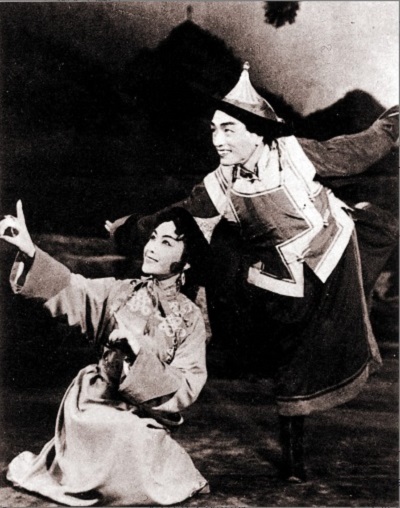
In this scene, Buyan secretly informs Nansalmaa that Yunden has arrived among the guests to rescue her. Because Buyan and Nansalmaa already know each other, she immediately understands his hidden message. Prince Balgan, however, misunderstands the words and assumes they refer to himself. As a result, he remains unaware and allows the plan to proceed.
A key aesthetic principle of Peking Opera is expressed in the idea that suffering is followed by happiness. This principle emphasizes harmony, justice, and final reconciliation. As the audience watches families torn apart and good characters endure hardship, strong emotional tension is created. The final resolution, in which the oppressed are vindicated and happiness is restored, provides emotional relief and inner calm.
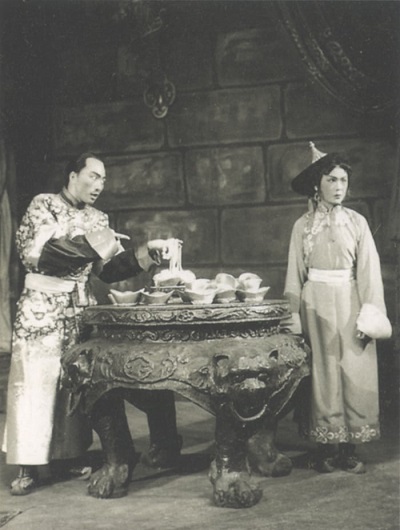
These scenes clearly demonstrate that Buyan plays a pivotal role in linking the narrative episodes of Three Mountains. At the same time, he embodies what may be understood as the moral and spiritual center of the production. In this adaptation, several additional characters—such as the Tibetan merchant and Hunter A—were introduced to resolve structural difficulties and to strengthen narrative continuity. As Dr. Baatarjav Munkhbayar observes:
The Tibetan merchant functions as an indirect link among the opera’s central conflicts, characters, and events. The role may also reflect Mongolian perceptions of outsiders—particularly Tibetans and Chinese—who lived among Mongols during the 1920s–1940s. In this sense, the character mirrors the social realities of the period. Another figure, Hunter A, serves as an important intermediary and messenger. At the beginning of the play, an unnamed hunter explains why Yunden and the others go hunting. For instance, the detail that Nansalmaa wishes for a coat made of deer hide—thereby motivating Yunden to hunt—reflects not only narrative logic but also a cultural imagination shaped by Chinese national discourse of the time.
Preparation for the production began in 1953 and continued for more than a year. In the summer of 1954, the work was staged as a Peking Opera under the title Three Mountains, achieving considerable success. Reflecting on the production, Zhang Yunshi remarked:
This production reached a high artistic level in all respects. Under the director’s careful guidance, skilled professionals contributed to the script, music, dance, stage design, visual composition, and lighting. I am especially proud that the combat choreography I supervised attracted significant attention.
Recalling her portrayal of Nansalmaa, the female lead in Three Mountains, Yun Yanming stated:
To perform this role well, I devoted myself completely—from singing to acting. I gave everything I had. However, it remains a regret that such a high-quality production was staged only a few times and was not preserved within the classical repertoire.
In 1956, People’s Artist of Mongolia Sangijav Genden visited Beijing and delivered a report on Uchirtai Gurvan Tolgoi. In this report, he made the following observations:
- The adaptations made to The Three Hills for Peking Opera audiences contained no ideological or artistic errors. On the contrary, they clearly expressed the struggle between the people and feudal forces.
- Because costumes, stage sets, and props had already been prepared, adapting them to Mongolian historical conditions was the most difficult task. Based on discussions of life in pre-revolutionary Mongolia, inaccurate elements were corrected.
- I personally participated in daily rehearsals with the actors of the Beijing People’s Theatre and guided them in the use of costumes and props.
- I gave four lectures to the entire creative team on the core ideological themes of the play, as well as Mongolian customs and daily life.
- In terms of direction, Khalkha national movements and manners, such as walking, sitting, and gesturing, were incorporated into each scene.
- I personally instructed each actor on proper costume wearing, especially belts, makeup, and ornaments.
- I provided detailed explanations of Mongolian appearance and behavior to photographers, stage designers, costume makers, sculptors, and prop specialists.
- I commend the production for preserving the political and artistic intent of the original work. However, the limited use of Mongolian operatic melody and movement remains a weakness. (Tövshintögs, Enkhbat 598–99)
The staging of Mongolia’s iconic The Three Hills in a neighboring country is therefore significant not only for theatre history but also for scholarly evaluation and cross-border appreciation within theatre and performance studies.

Criticism and Revisions
After Three Mountains was staged as a Peking Opera, it attracted widespread public attention, particularly from theatre scholars and critics. Many commentators focused on its innovations and formal transformations. On July 29, 1956, the People’s Daily published an article by Wu Zuguang titled “Some Thoughts on the Peking Opera Circle’s Three Mountains.” In this essay, Wu argued that the production departed from Peking Opera tradition in three principal respects.
First, Wu contended that the adapted The Three Hills failed to handle spoken dialogue in accordance with established Peking Opera conventions. In traditional Peking Opera, dialogue is divided into two primary forms: melodic recitation and Beijing vernacular speech. Role types—including elderly characters, warriors, generals, young male roles, and painted-face roles—generally employ melodic recitation, while certain attendants and some female roles use vernacular speech. These vocal forms are closely tied to costume and role classification and have been standardized over centuries. Experienced audiences can often anticipate how a character will speak or sing simply by observing the costume. In the adapted Uchirtai Gurvan Tolgoi, however, costumes primarily signaled gender and age rather than role type. As a result, the traditional correspondence between costume and vocal style was disrupted, creating confusion for audiences accustomed to conventional Peking Opera practice.
Second, Wu observed that traditional Peking Opera makes minimal use of realistic scenery, instead relying on symbolic performance to suggest time, space, and action. By contrast, The Three Hills employed realistic stage settings, including the Three Mountains and Prince Balgan’s palace. Wu argued that this approach resembled European opera and undermined the symbolic performance system central to Peking Opera aesthetics. In his view, the core issue was the failure to integrate realistic scenography with the stylized theatrical language of Peking Opera, resulting in a tension between realism and traditional expressive form.
Third, Wu maintained that the dramatic structure of the adapted The Three Hills did not conform to Peking Opera compositional principles. Rather, it retained the multi-scene structure of the original Mongolian play. Consequently, the work appeared closer to a Western-style sung drama than to a traditional Peking Opera piece (Tövshintögs and Enkhbat 615).
In contrast, critic Gong Hede disagreed with Wu Zuguang’s assessment. Gong argued that realistic representation was necessary for works addressing modern themes. He emphasized that innovation should proceed through absorption and integration rather than through rigid preservation of tradition. Rejecting Wu’s claim that realistic sets—such as solid mountain constructions and visible staircases—violated the Peking Opera principle of imagined space and disrupted the circular stage aesthetic, Gong maintained that such staging choices were demanded by the revolutionary subject matter. By rendering feudal oppression in concrete visual form—most notably through the Three Mountains as symbols of dominant oppressive forces—the production enhanced the audience’s comprehension of class ideology. In Gong’s view, this effect could not have been achieved through abstract symbolic staging alone.
Conclusion
The Mongolian masterpiece The Three Hills holds substantial artistic, cultural, and historical significance. In Mongolia, it became a canonical work that shaped the development of modern national theatre. At the same time, its international staging contributed to broader recognition of Mongolian theatrical art. When Chinese artists adapted Uchirtai Gurvan Tolgoi, they sought to preserve its core spirit and artistic integrity while introducing modifications suited to local theatrical conditions. In doing so, they directly challenged established conventions within Peking Opera.
These adaptations generated divergent responses. Some critics praised the production for modernizing Peking Opera and expanding the expressive range of Chinese traditional theatre. Others regarded it as a hybrid form that blurred established genre boundaries. From a scholarly perspective, Wu Zuguang’s proposal to distinguish Three Mountains from traditional Peking Opera and to classify it as a new operatic form (Tövshintögs and Enkhbat 613) raises an important question concerning the position and long-term influence of The Three Hills in the historical development of the genre.
Ma Yanxiang effectively recalibrated traditional performance techniques to meet modern theatrical demands. Without abandoning the principle of creating new opera through inherited methods, he introduced new thematic emphases and formal strategies. One notable innovation was the incorporation of Mongolian wrestling into Peking Opera combat choreography in Three Mountains, which significantly expanded the genre’s performative vocabulary.
The adaptation of The Three Hills into Peking Opera thus constituted not only an effort to modernize the genre but also a meaningful experiment in intercultural exchange. By introducing Mongolian theatrical elements into Chinese stage practice, the production fostered a broader artistic dialogue. Its importance was recognized even at the highest political level. Mao Zedong famously remarked: “It is neither a horse nor a donkey—yet even as a mule, it works. In fact, it is a fine play” (qtd. in Yunxi 13).
These assessments suggest that the staging of The Three Hills in the People’s Republic of China represented both a significant artistic innovation and a serious attempt to revitalize national theatre traditions. Within Three Mountains, the character Buyan serves as a structural and ethical anchor: he links narrative episodes, clarifies dramatic conflicts, and articulates moral values for the audience. In this sense, Buyan embodies the people-centered aesthetic ideals central to Peking Opera and functions as a key vehicle for expressing its ethical orientation.
The production also strengthened cultural exchange between China and the Mongolian People’s Republic. When an art delegation from Mongolia visited China in 1953, images of Yunden and Nansalmaa were displayed alongside portraits of Khorloogiin Choibalsan in public spaces in Beijing (Baigal and Bayarmaa 166). This visual juxtaposition testifies to the profound impression the play made on Chinese cultural consciousness at the time.
Ultimately, examining the international staging of Uchirtai Gurvan Tolgoi offers new insight into its dramaturgical structure and opens productive directions for further research. It highlights the formative role of intercultural exchange in the modernization of Peking Opera. The play fulfilled an educational and cultural mission in Mongolia while simultaneously introducing new artistic concepts into Sino-Mongolian cultural relations. The adaptation of Three Mountains subsequently laid an important foundation for staging modern-themed dramas through Peking Opera techniques.
Endnote
[1] This excerpt is drawn from the script of Three Mountains, directed by Fan Junhong and published in Beijing in 1957. It is included here in part for the purpose of providing an analytical exposition of the character of the singer Buyan.
Bibliography
Mongolian-Language Sources
Baigal, Tvuchuud, and Amarjargal, Bayarmaa. Days Spent with Na. Sainzogt’s Mongolian State Art Brigade and Related Materials. Nandir LLC, 2023.
Dashdavaa, Chuluun, and Chimed-Ocor, Bold. Zhou Enlai and Mongolia. Ulaanbaatar, 2014.
Dugarsüren, Danzen. “Interview with T. Namaa: ‘On The Grey-Haired Woman.’” 2024.
Jachin, Choijilsuren. A Study of the Manuscript Originals of Dashdorjiin Natsagdorj. Vol. 3, Ulaanbaatar, 2002.
Mongolian Writers’ Union. Memoirs and Notes on D. Natsagdorj. Ulaanbaatar, 1966.
Narantuya, Radnabazer Tsend Damdinsüren’s Experience in Adapting the Sung Drama “Uchirtai Gurvan Tolgoi” into an Opera. Ulaanbaatar, 1998.
Tövshintögs, Tseren, and Olgarjav, Enkhbat. A Brief Chronicle of the Historical Records of “Uchirtai Gurvan Tolgoi” – Part 1. Nandir, 2022.
Uchirtai Gurvan Tolgoi in the Perspective of Comparative Literary Studies — Inner Mongolia Academy of Social Sciences (in Mongolian).
Chinese-Language Sources
Fan, Junhong. Three Mountains (Peking Opera). China Theatre Publishing House, 1957.
Fu, Jin. The Theory of Chinese Theatre Art. Shanxi Education Press, 2003.
Gong, Hede. Commentary on Three Mountains. 1956.
Wang, Bo’ao. “In Memory of Yun Yanming.” Chinese Actors, no. 6, 2010.
Zhang, Geng, and Guo Hanqing. General Treatise on Chinese Opera. China Theatre Press, 2010.
Zhang, Yunxi. “‘Neither Donkey nor Horse, Even a Mule Is Fine’: Recollections of Chairman Mao Personally Reviewing Three Mountains.” Chinese Theatre, no. 7, 1992.
*Tumurkhu Namaa is a doctoral candidate in Art Studies at the School of Arts and Culture, Mongolian National University of Arts and Culture. Born in Hohhot, China, she received her Bachelor’s degree in Acting from the School of Theatre at Nanjing University of the Arts in 2015. Since 2018, she has been pursuing doctoral research on Sino–Mongolian Theatrical Relations: Case Studies of Plays Since the Twentieth Century. In 2020, she worked as assistant art designer for the documentary Local Chronicles of Inner Mongolia, and in 2025, she served as assistant director of the ten-episode documentary series Northern Frontier. Her ORCID iD is 0009-0004-2721-3951. Email: namaa1015@gmail.com

**Dashdondog Batsaikhan, Doctor of Arts in Theatre Studies, is an Associate Professor at the School of Theatre Arts, University of Arts and Culture of Mongolia, where she teaches theatre theory, history, and criticism. She has been engaged in theatre education and research since 1995. In 2014, she earned her Doctor of Arts degree from the University of Arts and Culture of Mongolia with a dissertation entitled Some Issues of Aesthetic and Policy Reform of Mongolian Theatre in the Democratic Period. Dr. Batsaikhan is the author of five books and a contributor to more than 30 collaborative publications. She has published over 75 articles in the field of theatre criticism, with a total scholarly output exceeding 100 publications. Email: bajgana2002@gmail.com
***Altangerel Munkh-Orgil (Ph.D.) is an Associate Professor and Lecturer in the Department of Literature and Art Studies at the National University of Mongolia. His research focuses on the theory and history of modern Mongolian literature. He has authored 11 monographs, more than 40 conference papers, and approximately 60 scholarly articles. Email: amunkhorgil976@gmail.com
Copyright © 2026 Tumurkhu Namaa, Dashdondog Batsaikhan, and Altangerel Munkh-Orgil
Critical Stages/Scènes critiques, #33, June 2026
e-ISSN: 2409-7411

This work is licensed under the
Creative Commons Attribution International License CC BY-NC-ND 4.0.
