Digital Archiving of One-to-One Performance: From Singular Co-Presence to Collective Engagement
Ana Tecar*
Abstract
One-to-one performances are understood as intersubjective encounters grounded in the ontology of presence and co-presence shared between a single performer and a single participant. Consequently, theoretical discourse has considered co-presence within one-to-one relational experiments only in a limited way. Researchers such as Rachel Gomme, Rachel Zerihan, and Dominic Johnston, along with one-to-one performance practitioners, have approached these relational contexts through the particularized co-presence established exclusively between two subjects: the performer and the participant-coauthor. The paper analyzes the works Footwashing for the Sole by Adrian Howells, Rope Piece by Tehching Hsieh, and Marina Abramovic’s The Artist is Present, questioning: How the singular, ontological co-presence is deconstructed in the condition in which these performances are archived through digital documentation? How do the artists of a one-to-one dialogue perform the personal encounter with one spectator, given that the interaction also involves the participation (at a distance) of a third spectator-witness or a community of participants to whom the performance was not intentionally addressed in the performative present? Finally, the paper suggests rethinking the typology of one-to-one performance, not as an exclusively dialogical co-presence, but also as a collective engagement and reception that is destructuring the emotional proximity between the performer and the participant.
Keywords: collective one-to-one performance, co-presence, intersubjectivity, third other, performance documentation, “performative now”/recorded time
The Ontology of Presence and Co-Presence in One-to-One Performance: From Ephemerality to Documentation and Representation
One of the fundamental characteristics of one-to-one performance typology lies in the fact that this practice has often been theorised through a model of reception that entails the spectator-participant’s engagement in corpore, in praesentia. The participatory model, as discussed by theorists of one-to-one, is that of a singular, intersubjective co-presence shared between a single performer and a single participant.
The main objective of this work is to investigate the manner in which the participatory model of one-to-one interactions also engages a dimension of shared participation once the performer resorts to digital archiving and documentation tools. I aim to explore how, through documentation, the singular co-presence shared in the one-to-one relationship between performer and participant becomes a plural co-presence, one that implies collective participation and reception. In this way, the dyadic relationship extends towards audiences or communities of spectators who have not attended the performance in praesentia.
This singular co-presence, as explored within the dialogism of one-to-one performance, is correlated with the ontology of performance art and with a presentist essence of this practice. The ontological understanding of one-to-one performance, as articulated by practitioners, revolves around a specific expectation: that one-to-one encounters can foster an intense emotional closeness, based on shared intersubjectivity, on co-presence situated within a unique, unrepeatable temporal moment–a “performative now.”
This intersubjective encounter is understood by practitioners as being based on an authentic form of communication (devoid of theatricality), anticipated even before the actual moment of performing.[1]
Thus, both practitioners and theorists approach one-to-one performance through the uniqueness of the encounter, due primarily to the unmediated nature of the event. The most influential presentist perspective on the ontology of performance remains that put forward by Peggy Phelan, who suggests that “performance honours the idea that a limited number of people in a specific time/space frame can have an experience of value, which leaves no visible trace afterward” (106). Caroline Wake takes up Phelan’s discussion of presentist intersubjectivity, elaborating on it and considering it particularly characteristic of one-to-one encounters (qtd. in Phelan 106).
In contrast with this essentialist line of thought–which associates performance art with the live presence of the performer and with the authenticity of the artistic experience–scholars such as Philip Auslander, and Cormac Power[2] argue that performativity should no longer be understood exclusively through immediacy, as the direct energetic exchange between performer and audience in an unrepeatable moment.[3] Rather, they emphasise the interdependence between the “live” and the “recorded,” up to the point where the boundaries between the two collapse. Corresponding to this live/recorded interdependence is the interrelation between mediated one-to-one intersubjectivity and a more deeply engaged experience of community. Auslander underscores that a heightened sense of communal belonging is not contingent upon a form of dialogism shared within the immediacy of live performative interaction. In Auslander’s terms,
[…] communality is not a function of liveness. The sense of community arises from being part of an audience, and the quality of the community experience derives from the specific audience situation, not from the spectacle for which that audience has gathered. I would argue against the idea that live performance itself somehow generates whatever sense of community one may experience (65).
[…] mediatized performance makes just as effective a focal point for the gathering of a social group as live performance. (64)
Consequently, when examining the one-to-one performance, it can be understood that the exclusive focus on relationality within a presumed authentic present may, paradoxically, foster a more deeply engaged reception of collective engagement, precisely as a result of the performance’s digital mediation.This idea stands in direct contrast to the presentist ontology of performance as discussed by Peggy Phelan and by other practitioners of one-to-one encounters such as Adrian Howells and Marina Abramović.
Delving deeper into these perspectives–which challenge dichotomies such as presence/absence, performance/documentation, “performative now”/recorded time–we find that in one-to-one encounters there emerges a complementarity between in corpore co-presence and the effect of mediated presence once the performance becomes archived. In this regard, Josette Féral elaborates on the concept of effet de présence (qtd in Ahluwalia, 5). The effect of presence, she argues, is a constructive mechanism whereby, despite the absence of the performer, the spectator retains the perception that the “reality” of documentation presented to them belongs to their own hic et nunc. Through documentation, the effect of bodily presence may be constructed via strategies that allow the viewer of the recorded performance to feel as if they are in the performer’s proximity (Ahluwalia 4). Thus, the means of reproduction of the one-to-one performance render presence simultaneously a representation, a theatricalization of presence.
Starting from these effects of presence–deployed as aesthetic strategies, one-to-one performance can no longer be grasped solely through an ontology built around the conventions of anti-theatricality. One-to-one encounters can instead be understood through what Philip Auslander terms the performativity of documentation (7), through a theatricalization of documentation, once co-presence ceases to be exclusive to the one-to-one dyad.
Theoretical debates of co-presence in one-to-one performance, when correlated with ontology, generally refer to a corporeal presence dimension. Co-presence thus entails physical cohabitation, grounded in the mutual anchoring of performer and participant within the same performative temporal and spatial frame. Thus, debates on co-presence primarily involve relating this notion to the temporal and spatial framework within which the performance takes place. If we are to consider a spatial co-presence within one-to-one actions, space often does not suggest a fictional topos, but rather constitutes a space performed as real, complementary to the present time of the performance.
Which are the effects of proximity employed within this spatiality when that affective transfer is documented and mediated into another space? Furthermore, in discussing co-presence in relation to temporality, questions arise as to how performance is influenced when opened both to the immediacy of face-to-face engagement and to the future reception of the documented performance. How does this temporal conditioning shape the affective one-to-one exchange?
Intersubjectivity in One-to-One Performance: Perspectives on Singular Co-Presence
Theoretical discourse around one-to-one encounters rarely takes into account an analysis of these practices in relation to a questioning of being-in-common. Instead, it tends to foreground only the intersubjective dimension of the one-to-one dialogue. Rachel Zerihan, for example, discusses the “obsessive monogamous relation” (5) typical of one-to-one performance, the singularised dialogism between a solo performer and a participant. Similarly, Rachel Gomme affirms this singularised engagement of one-to-one performance, arguing that the intensity of an affective dialogue–based on a spatial-temporal co-presence, “charged with energy”–may be shared only between one performer and one participant.
In Not So Close Encounters: Searching for Intimacy in One-to-One Performance, Rachel Gomme notes: “[…] there is still a sense that something that can be termed ‘intimacy’ should be felt on both sides–a passage of affect shared between two beings” (28). For Gomme, one-to-one performances are: “individualised experiences personally constructed for the spectator-participant” (282). She goes on to assert that “it is significant for the one-to-one performance that intimacy is considered the province of two individuals rather than a plurality” (284).
The possibility of collective interaction within one-to-one actions is not generally addressed by performance art studies. In a debate accompanied by interviews with one-to-one practitioners, Dominic Johnston in The Art of Living: An Oral History of Performance Art, identifies as a symptomatic feature of this category of performance its “quintessentially singular, intimate, and ephemeral character, alongside a rejection of recording mechanismsˮ (263). In most cases, thinking about performing being-in-common is associated with performative forms that embrace a socio-political engagement or activism. For instance, in Artificial Hells: Participatory Art and the Politics of Spectatorship, Claire Bishop contrasts what she calls “participatory art”, involving large numbers of participants, with one-to-one dialogic performative actions (38).
In contrast to these theoretical approaches to one-to-one performance that preclude a model of relationality involving the gaze of a third alterity (or an opening towards a community of spectators), I propose an expansion of this limited understanding of intersubjectivity. I articulate an expanded typology of examining one-to-one works–that of the collective one-to-one performance, which entails the presence of a third witness: the spectator-observer from the future audience of documentation.
Adrian Howells, Footwashing for the Sole
In the one-to-one performance Footwashing for the Sole, Adrian Howells created sessions in which he washed and massaged participants’ feet. Thereafter, he engaged them in conversations, prompting a range of personal confessions. At the end of the encounter, and only with the participants’ consent, he would kiss their feet. Each spectator’s allocated time lasted approximately 20–30 minutes.
Due to the physical engagement demanded by his performances, as well as their therapeutic dimension, Howells asserted that the encounters he created were antitheatrical. Although aware of the inherent instability of authenticity within performance art, he nonetheless regarded the relational contexts he generated as authentic: “My work prioritizes interpersonal connectedness and what I refer to as an authentic experience between two people” (qtd. in Heddon 4).
Deidre Heddon, meanwhile, interprets the relational dynamics proposed by the artist as fundamentally dialogical, grounded in reciprocity:
Adrian structures his performances around dual notions of ‘transaction’ and ‘transformation’, with exchange anchored in the dialogic […]. In this form of performance practice–intimate, personal and interactive–the boundary between performer and spectator dissolves in the process of exchange, […] that asks for a very committed and at times vulnerable sort of spectatorship. (2)
The affective co-presence that Howells sought to cultivate was addressed in highly personal and individualised terms, shaped by the subjectivity of each participant.
Howells’ practice articulates an ontological vision of co-presence in performance art. For the artist, the opening towards the other through co-presence manifests exclusively in the terms formulated by Peggy Phelan, namely, an energetic exchange of embodied presences within a spatial-temporal“performative now” (148).
Given that Howells does not explicitly acknowledge the role of documentation within his practice, one must ask how video recording influences reception both a) in the immediacy of the live event and b) in the future of the performance reception such a way that the intersubjective co-presence becomes destabilised.
In the moment of video documentation of the one-to-one massage, the interaction with a single participant that Howells claims to create inevitably becomes open to the gaze of an external, third-party witness. Howells anticipates this third observer: the future spectator of the documented performance. Does this not, therefore, weaken, the reciprocity of communication and the private intersubjectivity that Howells celebrates?
- Once the participant in this intersubjective dialogue becomes aware that the encounter will be recorded, they may assume the role of an ideal spectator, theatricalising gestures and emotional responses. Despite Howells’ intentions in framing a harmonious relationality, documentation in the “performative now,” may impose a subtle pressure on the participant: the demand to embody an ideal spectator. Caroline Wake confirms this when discussing the conventions of one-to-one performance, noting: “Audience members are often anxious to please and want to assist the artist in realising their vision” (166). This tendency is all the more pronounced when the participant’s dialogue with the performer is subject to observation by a third-party witness. Consequently, a central ethical issue raised by the practice of one-to-one performance is whether or not participants are informed in advance of being recorded.
- Furthermore, with regard to the implications of documentation for future reception, it proves valuable in enabling subsequent reflection upon the performance. Such reflection– whether undertaken by those who were physically present or by those who engage solely with its recorded form–both challenges and supplements the instant “feedback” grounded in the immediacy of the relational encounter characteristic of one-to-one practices. This is important since the one-to-one typology resists an analytical, critical framework in which “feedback” is retroactively constructed. Documentation thus invites the participant to engage in a more objectified, distanced reflection on the performance.
Moreover, given the limited number of participants inherent to a one-to-one performance, documentation serves to engage those who were not in praesentia at the event in a collective, reflexive dynamic. At the same time, an important limitation of documentation must be acknowledged. In the case of video recording of such a one-to-one encounter involving touch, the archival trace of the performance cannot capture the intersubjective tactile exchange. Evidently, this constitutes the principal distinction between those who experienced the performance in corpore and those who encountered it in its digitised form.
Tehching Hsieh, Linda Montano, Art/Life One Year Performance 1983–1984 (Rope Piece)
In Art/Life One Year Performance, 1983–1984 (Rope Piece), Tehching Hsieh proposes a minimalist performative framework in which, for the duration of one year, he undertook the commitment to cohabit with the artist Linda Montano, the two of them being physically connected by a rope. The imperative of this relational construct was that they were not to touch each other throughout the entire year.
Hsieh’s performances are constituted and received as works with life. For the artist, the intensity of relational engagement in performance can only be accessed through a temporally extended, durational process of proximity to another: “… to do work one week or two weeks, I feel that it may become like just doing a performance. But I do it one year and then the piece becomes art and life–it’s real connection and that has more power” (qtd. in Montano 40).
In the interaction between Hsieh and Montano, the two do not confine themselves to the urgent horizon of the present (as in the performance of Adrian Howells), but rather open up a territory of processual relationality. Hsieh and Montano do not adopt a presentist perspective grounded in an ontological essentialism of performance art. Co-presence, which one-to-one theorists have analysed as an engagement within a temporality of a “pure present,” comes to be reconfigured as a durational co-presence, as a “commitment in time.” In Rope Piece, co-presence interrogates liveness, immediacy and private intersubjectivity–principles fundamental to one-to-one encounters, as discussed by theoreticians of the one-to-one encounters.
Rope Piece does not unfold solely within a particularised affective space of the one-to-one encounter but is also conceived with a collective engagement in mind. It is a performance in which the dynamics of relationality are those of an intersubjectivity oriented towards a third other. One reason for this lies in the fact that it is a one-to-one performance enacted within public space. Throughout the year, the two artists moved across various social contexts[4] (Montano 40). Another reason is their deliberate opening towards a community of spectators, through the practice of documentation in durational performance. Hsieh and Montano documented the performance through daily photographs and audio recordings of their conversations. How does this photographic archiving shape the future reception of the work? What, indeed, is the principal function of documentation within a durational one-to-one performance?
In long durational performance, archiving is imperative for legitimising the artistic practice itself. In the case of Howells (whose practice unfolded within short temporal spans), video documentation was appropriate for capturing the entirety of the performative experience. By contrast, in durational works such as Rope Piece, photographic documentation– although it captures only instantaneous fragments of the process–proves to be the most suitable medium for opening the experience towards a collective memory.
Because this experiment is defined by a processual mode of relationality, one of the issues it entails is that of a fractured reception–since the participant in a durational performance usually engages with only a segment of the action. Thus, the primary function of documentation in this relational experiment is, as Philip Auslander terms it, documentary, archival per se–without this being a tautology (1).
Through documentation, the hic et nunc of the performance is resemanticised in retrospect. For the audience that subsequently received and reinterpreted the performance, documentation in this case operates as a guarantee of the “reality” of the events, of the fact that the performance “took place.” In the case of Rope Piece, documentation may offer a more comprehensive mode of reception than that possible within the durational present of the performance itself. In the words of Matthew Reason: “Instead, performance photography becomes a transformative art form in its own right that seeks to reveal more than the surface appearances of performance” (114).
The focus on the representation of the body within the photographic documentation of Rope Piece is also directed towards an external gaze, one that is both anticipated and inscribed within the very process of documentation. Through this act of documentation, Hsieh and Montano construct an intersubjectivity that remains open at its threshold towards the anticipated and imagined presence of a third observer, conceived as a member of a broader community of spectators.
Marina Abramović, The Artist is Present
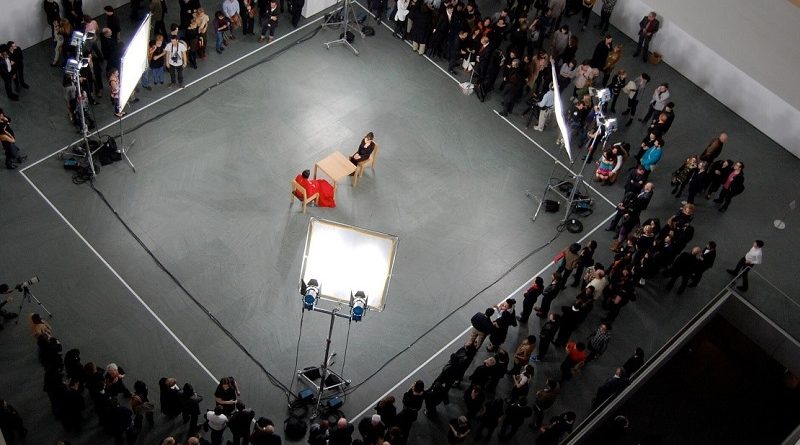
The Artist is Present[5] is perhaps the most well-known performance work celebrating a mode of communication grounded in a process of shared intersubjectivity between a single performer and a single participant. Famously, the piece is an experiment by Marina Abramović, who, over the course of three months at MoMA, engaged in a sustained visual encounter with any spectator who chose to sit across from her. Abramović understands this one-to-one dialogue as a distinctly exclusive form of communication with her spectators. Furthermore, although the performance employed archival strategies and the integration of mediated presence, Abramović conceptualises the work through an over-discursivisation of presence and of the performative present itself. In Abramovic’s words:“There is no beginning, development, and end. It’s just presence, pure presence” (qtd in Biesenbach).
The artist correlates performance art with theatricality and inauthenticity, particularly at the moment when performance resorts to strategies of archiving the performative act. By contrast, in this work (as in The House with the Ocean View), the documentation of the present assumes a function as significant as the performance itself. Within the history of one-to-one performance, no other artist has attributed such weight to photographic and video documentation, contrary to Abramovic’s claims that the essence of performance art is ephemerality and liveness of the performance.[6]
The artist conceives of co-presence as founded upon a personal and subjective relationality, individually constructed for each participant who sat before her. Abramović remarked that, unlike other performative practices in which the audience was conceived as a collective, within this encounter: “The important thing about the audience at this performance was that I had been interacting with them as individuals, not as a group” (qtd in INTERWEAVE for MAI).
How, then, is that performative pact of intersubjectivity, which Abramović so carefully constructs, deconstructed when her in corpore presence and her digitised presence are integrated within the same performance? Do these one-to-one encounters still function in the name of a particularised relationship, a co-presence addressed from one to another, capable of offering an intense affective dialogue?
The Artist is Present must also be remembered for the fact that the interaction was archived through two complementary documentary practices: the photographing of participants’ emotional reactions and the video recording of the performance. As in Adrian Howells’ performance, in this work too, exposure before the other is simultaneously an exposure before multiple spectators. Abramović, in this case, constructed an anticipated presence, representing her own appearance. At the same time, the participant-spectator was surrounded by multiple recording devices. It is therefore possible that they too may have theatricalised their own posture and presence or aware of being observed not only by those awaiting their turn to participate, but also by future viewers of the photographs and documentary film.
Regarding the photographic documentation of facial expressions, this form of archiving carries a certain physicality and performativity: through close-ups, portraits of the participants were produced. Abramović thus structured her performance around mediated presences, particularly around the effects of physical (and emotional) proximity generated by such close-ups.

Consequently, the co-participant of the one-to-one performance–initially conceived as active, present, and co-present solely by virtue of this exclusive relationship–becomes both spectator and performer the moment they are rendered vulnerable before multiple audiences. The spectatorial dialogue in The Artist is Present entails the participant’s hyper-exposure: before the artist, before the spectators from the performative now, and before the future audiences of the documentation. In this situation, within the one-to-one relationship, the artist assumes the role of performer as spectator of the emotions exhibited by the participant, while the participant becomes a spectator as performer.
The one-to-one spectator–traditionally theorised as the paradigmatic co-participant released from passivity–here comes to act within a “collective one-to-one performance.” They enter into a triadic dynamic of relation: performer–participant–collective of future audiences who will access the documentation.

Abramović herself is equally caught within a triad of relations, oscillating between them. Her presence remains suspended between the “performative now,” the communication with potential future audiences of the documentation, and the immediate encounter with those awaiting to sit with her. This triadic interplay produces a deconstruction of the particularised co-presence grounded in the subjectivities of individual participants, which Abramović otherwise claims to uphold.
With regard to the video documentation, this process has resulted in the creation of a documentary that has reached the cinemas and, consequently, a wide audience. In this sense, Abramović effectively constructed a genuine community of spectators around the one-to-one performance. Moreover, since she employs multiple practices of documentation, the dynamics of reception place the performance within a broader collective of spectators.
Conclusion
The aim of the present research was to examine how the model of exclusive participation in one-to-one performances is transformed once video or photographic recording devices are introduced into performative frameworks. We observed that by situating the spectator within an intermedial space–at the threshold between in corpore presence and mediated presence–the spectator becomes a co-author in a collective model of participation. These elements of intermediality are less frequently discussed by theorists of one-to-one performance.
Through the analysis of documentation practices in one-to-one performance, we have observed that the two modalities of participation–namely, dialogical intersubjective co-presence and collective co-presence−can in fact coexist within the same performance. To the theoretical debates on one-to-one performance, I have therefore contributed a new typology of this performative practice: that of the collective one-to-one. This typology also involves participants who were not physically (“live”) present at the performance, but who, by engaging with its documentation, may form micro-communities of feedback, analysis, and subsequent reflection on the one-to-one interaction.
One of the implications of extending the relational dynamics of the one-to-one encounter towards a collective (rather than merely dialogical) dimension is that the participant may adopt an emotionally distanced position in their dialogue with the performer, being aware that they are recorded and will subsequently be observed by a future other. At the moment in which the participant becomes a spectator-performer, they may censor their emotional involvement, interrogating their own performativity both in relation to the artists with whom they interact and to the audience of the documentation.
Thus, both within the dialogical dynamics of performer–participant and within the broader dynamic of performer–participant–collective of recipients, an objective distancing may emerge that deepens the interpretation of one-to-one practices. The one-to-one performance, when embedded in such a collective community, can transcend the acute subjectivism of affective intensity shared in a strictly dyadic relation. This artistic practice may then open itself towards a more objective and critical hermeneutic gaze, capable of “evaluating,” from an ethical standpoint, the extent to which the potential for presence and authenticity of the performer has been fulfilled. At the same time, the gaze of spectators who were not co-authors of the “affective sphere” of a one-to-one encounter may evaluate these experiments on aesthetic and dramaturgical levels as well.
Endnotes
[1] If we read synopses of one-to-one performance, we can see that sometimes the desired authentic encounter is anticipated even before the actual moment of the hic et nunc meeting between performer and participant.
[2] See an important mapping of the theories of presence in theatre and performance in the study of Power, Presence in Play.
[3] This fundamental theories of theatrical and performative presence have also been discussed in the article of Ana Tecar (129-45).
[4] Both T. Hsieh and L. Montano maintained meetings with friends and, correspondingly, each constructed distinct social contexts within which they could pursue their work.
[5] The perspective on the representation and theatricalization of presence in The Artist is Present has also been discussed in Tecar (129–45). In this paper, I further examine the implications of the digitalization of Abramović’s presence for opening the performance toward a collective reception.
[6] Marina Abramović claims “Theatre is fake […] the knife is not real, the blood is not real, and the emotions are not real. Performance is just the opposite: the knife is real, the blood is real, and the emotions are real.” Interview by Sean O’Hagan. Accessed 8 September 2025.
Bibliography
Abramović, Marina. “The Fundamentals of Endurance: Marina Abramović on How She Learned to Refuse the Body’s Limits and Make Immortal Art.” Interview by Klaus Biesenbach, Artspace Magazine. Accessed 8 Sept. 2025.
———. “Interview by Sean O’Hagan.” The Guardian, 3 Oct. 2010. Accessed 8 Sept. 2025.
———. “A Lecture on Performance Art.” INTERWEAVE for MAI. Accessed 8 Sept. 2025.
Ahluwalia, Kyle. Projecting Presence: Establishing an Effet du Presence for Virtual Characters. MA thesis, University of Ottawa, 2014.
Auslander, Philip. “The Performativity of Performance Documentation.” Semantic Scholar. Accessed 7 Sept. 2025.
———. Liveness: Performance in a Mediatized Culture. 2nd ed., Routledge, 2008.
Bishop, Claire. Artificial Hells: Participatory Art and the Politics of Spectatorship. Verso, 2012.
Chatzichristodoulou, Maria, and Rachel Zerihan, editors. Intimacy Across Visceral and Digital Performance. Palgrave Macmillan, 2012.
Gomme, Rachel. “Not So Close Encounters: Searching for Intimacy in One-to-One Performance.” Participations, vol. 12, no. 1, 2015, p. 28.
Heddon, Deirdre, and Adrian Howells. “From Talking to Silence: A Confessional Journey.” PAJ: A Journal of Performance and Art, vol. 33, no. 1, 2011, p. 4.
Johnston, Dominic. The Art of Living: An Oral History of Performance Art. Palgrave Macmillan, 2015.
Montano, Linda M. Letters from Linda M. Montano. Routledge, 2012.
Phelan, Peggy. Unmarked: The Politics of Performance. Routledge, 1996.
Reason, Matthew. Documentation, Disappearance, and the Representation of Live Performance. Palgrave Macmillan, 2006.
Tecar, Ana. “Presence, Co-presence, Authenticity: Principles of Questioning the Intimate in One-to-One Performance.” DramArt, no. 9, 2020, pp. 129–45.
Wake, Caroline. “The Ambivalent Politics of One-to-One Performance.” Performance Paradigm, no. 13, 2017, p. 166.

*Ana Tecar is an associate lecturer in the Department of Theatre, Faculty of Theatre and Film, Babes Bolyai University, in Cluj-Napoca and a researcher specializing in performance art. She obtained her PhD from the same faculty with a thesis on representations of intimacy in performance art (The Representation of the “Intimate” in Performance Art: Spaces of Interiority, Limits of the Encounter with Alterity). Her teaching and research focus on theatricality and performativity in the 20th and 21st centuries. More specifically, her work explores temporal regimes in theatre and performance, dramaturgies of intimacy, and digital environments in performance art.
Copyright © 2026 Ana Tecar
Critical Stages/Scènes critiques, #33, June 2026
e-ISSN: 2409-7411

This work is licensed under the
Creative Commons Attribution International License CC BY-NC-ND 4.0.
