
Digital Dramaturgy as Composite-Body Making: The Hunger Games: On Stage and Paddington: The Musical
Bernadette Cochrane*
Abstract
This article reframes digital dramaturgy in contemporary commercial adaptation as composite-body making: the infrastructural practice of binding bodies, media, and systems into coherent performance entities. Drawing on The Hunger Games: On Stage and Paddington: The Musical, it argues that digital dramaturgy functions as an ethics of bonding, calibrating how recognisability, affect, and moral pressure are produced at scale. Through analysis of reception and paratexts, the article demonstrates how differing compositional priorities—arena legibility versus creature intimacy—shape spectatorship and ethical address. It proposes a portable analytic focused on bonding, cueing, and seams, positioning digital dramaturgy as infrastructural authorship rather than technological display.
Keywords: digital dramaturgy; bonding; ethics; commercial adaptation; franchise adaptation; infrastructural authorship
Introduction
Franchise adaptation has become a defining production logic of the contemporary commercial stage. Audiences arrive with memories and expectations shaped by screen culture (Cochrane); producers invest in recognisable intellectual property; and creative teams are tasked with making theatrical eventfulness compete with cinematic scale without simply imitating it. Within this ecology, “digital dramaturgy” often functions as shorthand for screens, projections, automation, and immersive environments, rather than an account of redistributed dramaturgical work (Harries 8–9). Yet, the interpretive payoff of the term does not lie in enumerating technological elements. It lies in understanding how dramaturgical work is redistributed when recognisability, spectacle, and spectator-positioning must be produced through complex technical coordination.
This article reframes digital dramaturgy as composite-body making: the infrastructural practice of binding heterogeneous components into coherent performance entities. Those entities may be characters (Paddington as suit-body, facial mechanism, and voice), worlds (Panem as arena architecture, broadcast logic, and scenic system), or spectatorial positions (the audience installed as “the Games’ viewers”). The central claim is that digital dramaturgy in contemporary commercial adaptation is best understood as an ethics of bonding: the calibration of composite infrastructures so that recognisability, affect, and moral pressure can be carried at theatrical scale. Adaptations succeed or fail less by technological quantity than by how precisely infrastructure is bonded to affective and moral demand. When bonds misalign, critics reach for idioms of “heart,” dread, warmth, or sentimentality, or else describe the production as mechanical, naming—often indirectly—how technical and embodied elements have (or have not) been made to carry ethical pressure and affective consequence (Akbar “The Hunger Games: On Stage review”; Hemming).
This approach also sharpens what adaptation means. Historically, adaptation scholarship was organised around narrative transfer, medium specificity, or fidelity debates. Those remain relevant, but they are insufficient for productions whose defining work occurs at the level of coordination—where the adaptation is materially accomplished through architectures, interfaces, timing systems, distributed performance labour, and managed attentional pathways. In digitally sustained commercial performance, the question is not only what story is told, or how closely it resembles its source, but how presence is manufactured so that spectators recognise, attach, recoil, and judge. Digital dramaturgy becomes a name for that manufacturing: an account of how the stage produces recognisability and affect through composite ecologies rather than through a single performer-body, a single scenic image, or a single medium.
The Hunger Games: On Stage (hereafter HG) and Paddington: The Musical (hereafter Paddington) make this argument unusually legible because each production is organised around a clear infrastructural problem. HG, adapted by Conor McPherson and directed by Matthew Dunster, is staged in a purpose-built theatre-in-the-round in Canary Wharf, repeatedly framed in coverage as inseparable from construction logistics and engineered performance architecture (Bosanquet; Millward). Paddington, directed by Luke Sheppard with book by Jessica Swale and songs by Tom Fletcher, must render a beloved screen-bear convincingly in a large auditorium while sustaining warmth and moral address without collapsing into either visible trick or cloying sentimentality (Akbar “Paddington”; Wyver). In both cases, adaptation is not only narrative transfer but the orchestration of an ecology in which bodies, media, and systems produce ethically consequential presence.
The comparative stakes are therefore specific. HG stages a story about spectatorship as apparatus: violence becomes entertainment through a broadcast regime that renders watching itself a form of participation. The production’s challenge is to stage action at scale without allowing the apparatus of event-management to soften dread into spectacle. Paddington stages a story organised around welcome and kindness, where the ethical demand is not recoil but care. Its challenge is to make a nonhuman protagonist legible as a subject whose vulnerability can be felt at distance and across spectacle. Read together, these works clarify that digital dramaturgy is not a neutral technical substrate. It is a set of compositional commitments through which commercial adaptation makes spectatorship by shaping how audiences are positioned to watch, what they are trained to feel, and when they are invited to recognise their own watching as part of the performance’s ethical economy.
Theatre as a Technologised Ecology: Theoretical Frame and Methodology
Accounts of digital theatre have often been organised around the live/mediated divide: whether media threaten liveness, extend it, or reconfigure it. A composite-body approach begins elsewhere, with the premise that theatre is already technological and that “media” are not an external intrusion into an otherwise pure live form. W.B. Worthen articulates this bluntly: “An axiom: theatre is a technology that uses technology to represent human experience and existence” (3). This is not a flattening claim that “everything is technology,” but a methodological shift. If theatre is a technologised ecology, then dramaturgical analysis must attend to the binding of technologies to purposes: which systems are joined to which dramaturgical tasks, and how the seams of that joining are managed, concealed, or made legible. Worthen’s axiom clears the ground for a compositional account of mediation: the question is not whether technology enters theatre, but how particular technologies are bonded into dramaturgical work and made to matter.
Martin Harries offers a complementary orientation, noting that “The proliferation of intermedial performance is one of the hallmarks of contemporary theater” (8). He treats intermediality not as a self-evident virtue but as an analytic problem: how media mark theatre and what experiences they produce when theatre is reshaped by the media landscape in which it circulates (9). Yet new media is frequently used, at times casually, as a label for visible devices—screens, projections, interfaces—when what matters dramaturgically is the infrastructural labour that binds systems into legible performance. I therefore approach digital dramaturgy infrastructurally: not simply screens onstage, but distributed systems of image, sound, movement, automation, and cueing that reorganise attention, legibility, and relational force.
Dramaturgical scholarship further supports this reframing by insisting that dramaturgical work is not reducible to textual organisation. In practice-based accounts, dramaturgy is approached as thinking-through-making: the work of shaping relations among actions, materials, and conditions of perception (Bleeker). This is a useful anchor for digital dramaturgy precisely because it directs attention away from device-description and toward coordination: what is being held together, by whom, and to what end. Kristina Georgelou et al. sharpen this point by explicitly extending dramaturgy “beyond the solely artistic domain into the infrastructural one,” emphasising its entanglement with institutional structures and conditions of production (3). In commercially scaled adaptation, that entanglement is not incidental. Large productions are built from (and constrained by) venue architecture, technical capacities, automation systems, specialist labour, rehearsal logistics, and safety regimes. To analyse digital dramaturgy in this terrain is therefore to analyse how dramaturgical work is distributed across those infrastructures, and how those infrastructures do not merely support meaning but actively author it.
Posthumanist performance scholarship adds a vocabulary for describing what such coordination produces: bonded entities in which agency and expressivity are distributed across human and nonhuman components. Laura Karreman et al describe composite bodies as configurations defined not by “substance or outward appearance” but by “particular bonding and the movement that it generates,” insisting that such bonding entails more than the functional use of an object or technology (9). This insistence matters for the present argument because it prevents ‘digital dramaturgy’ from becoming a synonym for technical display. Instead, it frames digital dramaturgy as a dramaturgical problem: how to craft bonds that read as character, world, or spectatorial position, and how those bonds are calibrated to carry ethical and affective demand.
This article reads reviews and selected paratexts, supplemented by personal viewing of the productions,[1] as dramaturgical traces that register composite coherence, perceptible seams, and reported ethical and affective pressure. Reviews are not approached as transparent reports or as verdicts to endorse; they are read as diagnostic language, repeatedly returning to evaluative terms such as “heart,” dread, warmth, and sentimentality in ways that name compositing outcomes. Paratexts are used where they make infrastructural operations and spectator-positioning directly observable, clarifying how the event engineers attention, legibility, and forms of audience address within a wider media ecology. The method is designed for commercially scaled productions whose technical organisation and labour distribution are integral to spectatorship yet only partially legible from the auditorium alone.
Analytically, the article tracks composite-body making through three operations. Bonding and legibility ask what is joined (bodies, objects, interfaces, architectures) and how recognisability is stabilised at scale. Cueing and control examine how attention is timed and steered through spatial design, screen logics, narrational devices, and other systems of pacing and information. Visibility of labour and agency considers where distributed work becomes perceptible as seam and whether that perceptibility cools affect or, alternatively, becomes part of the production’s aesthetic and ethical address. These operations are not a checklist. They provide a procedure for describing how composite bonds are formed and sustained, and how their perceptibility—experienced as seamless integration or as seam—shapes spectatorship and feeling.
The Hunger Games: On Stage
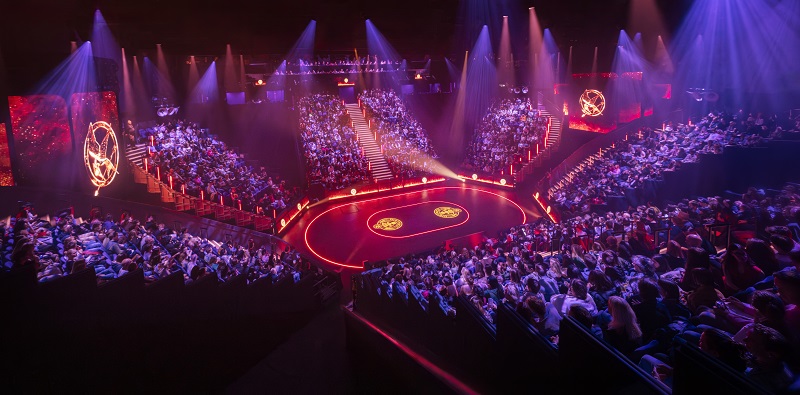
HG is best understood as an exercise in arena compositing: it builds Panem not primarily as a narrative world but as a viewing apparatus whose efficacy depends on scale, speed, and managed legibility. The production’s dramaturgical wager is therefore infrastructural. Rather than asking whether spectacle ‘belongs’ in theatre, it asks what must be bound—architecture, screens, choreography, voice, effects, and audience placement—so that an action-heavy property becomes readable as live event. Critical reception repeatedly recognises the success of that binding while also diagnosing a recurring shortfall: the apparatus does not consistently produce dread, intimacy, or moral pressure in proportion to its technical and architectural achievement (Akbar “Hunger Games”; Hemming). What the reviews register is not an objection to technology as such, but a calibration problem: bonds tuned for event-coherence can compress the slower accumulation of ethical unease that the story requires.
The production’s first and most visible achievement is the stabilisation of readability under conditions theatre conventionally finds difficult: rapid re-siting, multi-directional action, and sustained combat involving many bodies in simultaneous motion. Lukowski names the difficulty directly—“a half-hour plus nonstop combat sequence featuring 24 fighters and multiple sub-locations is… tricky”—and then credits Dunster and his team with “finding a way forward” through an explicitly composite solution. His description is instructive because it catalogues bonding rather than plot: aerial work, pyrotechnics, video screens, drilled choreography, and a “highly mobile, rapidly changing set” are integrated into a sequence that remains “coherent and gripping”. In dramaturgical terms, this is a legibility machine: heterogeneous systems are bonded so that the audience can track who is where, what is happening, and what counts as action at arena scale.
Akbar’s review locates the same calibration in a different register: the production establishes an event-optic from the outset, framed as “The Super Bowl optics,” with a “wardrobe of great gaudy glory” that draws on “the 1960s,” “twists of commedia dell’arte,” “the Palace of Versailles,” and “alien-chic” (HG). She also specifies an “array of screens,” the “thundering sounds of the cannon whenever a Tribute dies,” and a gantry that materialises a key narrative location. These details show Panem rendered as a mediated gameshow world through an ecology oriented toward spectacle, speed, and audience capture; recognisability is produced not by psychological depth alone but by the consistent operation of the event-apparatus.
There is, however, an identifiable dramaturgical cost. When coherence and throughput are dominant priorities, relational density is structurally pressured: the composite has fewer opportunities to dwell on hesitation, coercion, or the slow sedimentation of dread without compromising the velocity that sustains the arena event. This pressure is precisely what Akbar and Hemming name when they argue that the production does not reliably land emotionally. Akbar observes that the first half “lacks tension” and that “you don’t feel the dread,” describing the adaptation as “clipped by the pace of events,” “all spectacle above emotion.” Hemming’s “beating heart” idiom functions as a parallel diagnosis, suggesting that the event’s technical energy does not automatically yield the affective and ethical consequences that the premise should impose. The objection is not to spectacle per se, but to a compositing outcome in which spectacle and legibility are secured more successfully than dread.
Character construction becomes one mechanism through which this misalignment is made visible. Akbar argues that, because of the pace, “there is not enough time for characters to come to life,” and that “the actors do capable impressions of their screen counterparts instead,” even citing film-specific traces (HG). Dramaturgically, such “impressions” can be understood as a bonding strategy: cinematic memory operates as a prosthesis for rapid recognition, allowing the event to maintain momentum without investing time in building relationships from scratch. Yet the same strategy risks converting relational intensity into citation. The composite secures recognisability through reference rather than through the gradual production of attachment, ambivalence, and dread that would thicken the moral pressure of the Games.
The production’s second major achievement is spectator-making: it engineers a watching position aligned with Panem’s broadcast regime. Akbar explicitly identifies this as the stage version’s advantage over film and novel: the auditorium “really does seem like a gameshow space, with us as its bloodthirsty audience,” and the production uses “moving blocks of seats” to intensify immersion (HG). The point is not merely that the staging is “immersive,” but that spectatorship itself is an authored component of the composite. The audience is not placed outside Panem’s viewing logic; it is installed inside it.
Lukowski’s account reinforces this reading by describing the venue as a stadium/studio hybrid: the steep rake resembles “a sports stadium or the audience seating in a TV studio,” so that “we are implicitly cast as spectators to the games.” This is cueing and control operating at the level of architecture. Before the story’s ethical questions arrive, the production has already assigned the audience a position within an optic regime: viewers are oriented as consumers of a lethal entertainment format. The auditorium thus functions as an attention interface, allocating vantage, identity, and complicity as a baseline condition of perception. My own viewing from District 11 reinforced this point, as that vantage made audience reactions to the deaths of their assigned tributes especially visible; yet this visibility did not necessarily intensify felt complicity, suggesting a gap between the production’s spectator-positioning and its ethical force. Tom Millward’s opening-night highlights make this spectator apparatus materially explicit. The footage shows live camera images of audience members routed onto in-arena screens at key moments, and it shows seating zones illuminating red in correspondence with deaths, converting audience placement into a visible index of loss. As evidence, this paratext matters because it demonstrates spectatorship being actively composed: the audience is not only positioned to watch the Games, but rendered legible within the Games’ visual economy, folded back into the event as readable content. The production thereby literalises a central premise of the HG storyworld: watching is never neutral; it is part of the apparatus.
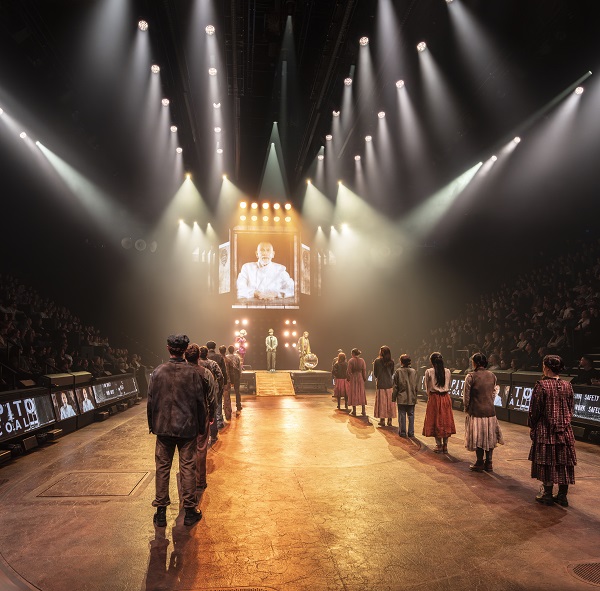
That literalisation also clarifies the production’s central calibration risk. Once spectatorship is engineered so effectively as event-content—architecturally installed, visually confirmed, and fed back through screens—the dramaturgy must work with equal precision to generate discomfort. If the apparatus of viewing remains primarily thrilling, legible, and pleasurable, then complicity can be experienced as entertainment rather than as moral abrasion. This is why critical language about insufficient dread is analytically consequential: it suggests that the production’s spectator-making may be more successful as immersive event than as ethically pressurised complicity.
Within this apparatus, Caesar Flickerman functions as a local mechanism of cueing and control. Lukowski notes that the action sequences are “lifted (and clarified)” by the “slickly amoral host.” Clarification here is dramaturgical labour distributed across performance, architecture, and media: the production repeatedly chooses legibility and steerage so that the event remains intelligible at speed and at scale. The question is what this clarity is in service of. In a story designed to indict spectatorship, the host’s clarifying role can either sharpen the apparatus’s cynicism or smooth its edges. Reception that emphasises coherence without corresponding dread suggests a potential imbalance: the system clarifies so well that it may also soften the abrasions that should make clarity feel complicit.
The production’s third recurring issue, as named in reception, concerns seams—moments where distributed agency becomes perceptible in ways that cool immediacy. Narration is one such seam. Lukowski argues that McPherson’s adaptation makes Katniss both protagonist and narrator, and that having her “constantly offering background on what’s going on really undermines the sense of her living in a dangerous moment.” Akbar similarly notes that internal monologue is “burdened with exposition and background” and is “not quite enough” to carry feeling under the show’s pace (HG). Dramaturgically, narration can function as infrastructural repair: it compensates for what an arena optic regime threatens to eclipse—interiority, reflection, relational pressure. But when narration becomes audible as system-maintenance rather than lived thought, agency shifts from embodied risk to explanatory delivery, and the affective temperature drops.
A second seam concerns screen-mediated authority, particularly the use of a pre-recorded John Malkovich as President Snow. Lukowski finds it “disorientating” to have a famous American appear “at massive scale on the screens,” and describes the “talking” exchanges with live actors as “an odd thing to be watching.” Akbar sharpens the critique: Malkovich is “as flat as his 2D image, more a cameo than a character” (HG). These are not generic objections to mediation; HG is already a screen-rich ecology, and its storyworld is premised on broadcast. The issue is bonding. The mediated component does not consistently join forces with the live ecology as dramaturgical pressure; it shows as insertion, drawing attention to celebrity and format rather than thickening the machinery of power the narrative requires.
Taken together, these diagnostics demonstrate the claim about HG as arena compositing. The production binds architecture, screens, host address, choreography, effects, and mobile scenography into a coherent viewing machine that solves a central problem of stage adaptation: how to make sprawling action readable at scale (Akbar Hunger Games; Lukowski). The persistent critique is that this same calibration does not always generate an equivalent density of dread and moral pressure (Akbar Hunger Games; Hemming). Where seams show—through narrational overburdening or screen authority that reads as cameo rather than coercion—critics describe the event as impressive but affectively thinned (Akbar Hunger Games; Lukowski). In bonding terms, the arena composite installs spectatorship as complicity with remarkable clarity, but reception suggests that this complicity is not always calibrated to curdle into dread rather than remain as legible, exhilarating event.
Paddington: The Musical
Paddington is calibrated toward creature intimacy: its digital dramaturgy is organised to make kindness and welcome legible as a felt relation rather than as a merely stated theme. Where Hunger Games engineers an arena optic that risks converting violence into managed event, Paddington must sustain gentleness at scale without collapsing into sentimentality or allowing mechanism to dominate perception. The critical record matters here not because it supplies “approval,” but because it consistently describes affect (warmth, delight, tenderness) as an outcome of technical and organisational coordination—an infrastructural achievement rather than an ineffable by-product (Akbar “Paddington”; Crompton).
Reception also indicates that this calibration holds even when critics register the show’s risks. Akbar praises the production’s coherence while noting the tonal dangers it courts, including “schmaltz,” “cliched Englishness,” and a kindness ethos that can seem “laid on with a trowel” (“Paddington”). That friction is analytically useful: it clarifies that the production’s ethical address cannot rely on message alone. Warmth has to be carried by the composite’s perceptual credibility—by the bear’s capacity to read as a vulnerable subject—so that the show’s moral register is experienced primarily as relational rather than collapsing into didacticism.
The production’s central compositing unit is the bear, and the dramaturgical stakes of the show are concentrated in the bear’s legibility. Reviews repeatedly foreground distributed agency as the condition of presence: a suit performer supplies embodied weight and spatial contact, while voice and facial responsiveness are produced through remote operation (Akbar “Paddington”; Crompton; Wyver). This distribution solves a theatre-specific problem. In a large auditorium, the production cannot depend on the cinematic close-up to deliver micro-affect; it must manufacture micro-expressivity inside the composite so that spectators can read hesitation, embarrassment, pleasure, and worry at distance.
Crompton’s review is particularly valuable because it names minute facial actions—small changes of eyebrows, jaw, and nose—as the perceptual cues through which the bear reads as “utterly real” (Paddington). My own viewing from the rear of the stalls supports this emphasis, as these micro-facial cues remained legible at that distance. Wood’s critics’ roundup reaches for the same register when Cavendish emphasises that the show is openly theatrical while still investing the bear’s posture and “blinking” with emotional credibility; Marlowe likewise describes scepticism dissolving once micro-expressivity and bodily responsiveness begin to read as interiority (qtd. in Wood). Read as dramaturgical diagnosis, these remarks identify the precise locus of successful bonding: the composite does not persuade by hiding its labour, but by producing an affective output stable enough that the bond reads as subject rather than as mechanism.
Production listings and publicity further clarify the labour required to sustain this bond. These materials make distributed authorship institutionally visible, even as the performance works to minimise the perceptibility of operation. Rather than foregrounding manipulation, as in forms of puppetry where operators remain visibly present, Paddington binds onstage suit performance to offstage voice and remote facial control, while sound localisation, acoustic matching, and servo-noise suppression help the bear read as a single coherent subject rather than as an assembled mechanism. These credits therefore matter not simply because they name specialist labour, but because they reveal how the production engineers the bear’s presence as an ongoing practice of alignment among body, voice, facial control, and timing. The show’s wider technical density functions as an enabling envelope rather than as a rival spectacle. Akbar describes a visually rich ecology—set, “sweeping immersive effects,” “next-level projections,” and audience-facing effects such as confetti, leaflet drops, and water jets—yet frames the result as coherence rather than overload (“Paddington”). Crompton similarly emphasises “thought and care” distributed across world-building, pacing, and musical structure (Crompton). The dramaturgical point is that cueing and control are calibrated to keep attention returning to the bear’s micro-actions while the environment shifts rapidly around him.
In composite terms, this is not merely good stagecraft. It is a specific attentional engineering. The production repeatedly changes location, tone, and scale, but it does so without requiring spectators to re-learn how to read the protagonist; the environment is timed and structured to protect the bear’s legibility through transition. This is why the production can afford broad theatricality—even parody and cliché—without losing the moral line: the composite’s micro-affective stability anchors attachment, allowing the show’s kindness ethos to be enacted in relation rather than asserted as instruction (Akbar “Paddington”; Crompton).

Paddington also clarifies that the labour behind the composite is not uniformly invisible, but selectively disclosed. Unlike HG, where narration and certain screen-mediated elements are described as seams that cool immediacy, Paddington occasionally allows aspects of its distributed operation to become perceptible without sacrificing intimacy (Akbar “Paddington”; Cavendish qtd. in Wood). Cavendish’s phrasing, “cannily upfront” about theatrical means, matters because it identifies a mode of belief grounded not in total concealment but in calibrated bonding: spectators accept the composite because its affective output remains coherent and ethically aligned. Akbar’s observation that Hameed appears alongside Paddington in selected solo numbers is especially suggestive here. As the Young Man, a figure whose story parallels Paddington’s and whose voice is effectively transferred to the bear, Hameed becomes a visible counterpart to Paddington rather than simply an exposed operator. In these moments, the production makes the bear’s distributed authorship more legible without dissolving the sense of subjecthood; as Akbar notes, the effect can be “strangely moving” (“Paddington”).Taken together, the evidence supports a specific claim about Paddington as composite-body making. The production’s digital dramaturgy is organised to sustain creature intimacy: distributed agency produces micro-expressivity at scale, and scenographic cueing protects that legibility through spectacle and transition. In bonding terms, the production’s achievement in engineered intimacy is its defining strength: the composite is calibrated so successfully as care-work that theatrical abundance supports—rather than dilutes—the felt ethics of kindness and welcome.
Composite-body Calibrations
Read together, HG and Paddington clarify digital dramaturgy as an ethics of bonding: the calibration of composite infrastructures that make presence, spectatorship, and ethical address legible. In both productions, bodies, objects, media interfaces, architectural conditions, and timing systems bond into perceptually stable units that spectators recognise as character, world, and spectatorial position. Here, digital does not name a device-layer added to theatre; it names the infrastructural labour through which performance coheres. The decisive difference, then, is calibration—what each composite is tuned to carry, and what kinds of spectatorship that tuning enables.
In HG, composite-body making is calibrated toward arena legibility. The production’s headline achievement lies in the conversion of action-heavy source material into a readable live event. Review discourse repeatedly admires the coherence of extended combat and the integration of multiple systems—pyrotechnics, screens, choreography, mobile scenography—into an action-machine that remains intelligible under conditions of speed and simultaneity (Lukowski). That achievement is inseparable from cueing and control: spectatorship is engineered through a purpose-built auditorium that resembles stadium and studio, positioning the audience as Games-viewers from the outset (Akbar “Hunger Games”; Lukowski). The ethical risk appears precisely where this calibration is most successful. If spectatorship is installed so effectively as entertainment—clarified, paced, spectacularised—then dread and moral recoil must be engineered with equal precision, or the narrative’s pressure thins. This is the force of the recurrent diagnosis that the piece is “all spectacle above emotion,” that “you don’t feel the dread,” or that it lacks a “beating heart” (Akbar “Hunger Games”; Hemming). In composite terms, the unit holds together, but it holds together around coherence and velocity in ways that can compress relational density and soften the discomfort of complicity.
In Paddington, by contrast, the composite is calibrated toward creature intimacy. Composite-body making is explicit and central: the bear’s presence depends on distributed agency—suit performance bonded to remote facial operation and voice—and reviewers repeatedly treat this distribution as the condition of emotional credibility rather than as a distancing mechanism (Akbar, “Paddington”; Crompton). Where HG depends on event-legibility, Paddington depends on micro-expressive legibility: minute facial and postural cues that can carry vulnerability across a large auditorium. Reception also registers the surrounding scenographic and projection systems not as a rival spectacle but as an enabling envelope that protects the bear’s legibility through tonal shifts and rapid transitions (Akbar “Paddington”; Crompton). Even where Akbar notes the risks of “schmaltz” or a kindness ethos “laid on with a trowel,” the composite tends to hold because the ethical address is carried by a stable perception of subjecthood: the bear reads as vulnerable being rather than as mechanism (Akbar “Paddington”). The dramaturgical point is not that the production is “technically impressive,” but that infrastructure is organised to safeguard tenderness and moral address at scale.
A further contrast concerns how media surfaces function within each ecology. In HG, screens serve the show’s broadcast logic: they clarify action, enlarge authority, and construct the auditorium as an optic regime aligned with Panem’s televised violence (Akbar “Hunger Games”; Lukowski). The Millward’s opening-night highlights are evidence because they show spectatorship being made legible: live audience images are routed onto arena screens, and seating zones illuminate red with each death, turning placement into a visible index of loss. This feedback loop can sharpen the premise—watching as complicity—yet it can also tip into thrilling immersion if dread is not equally produced. In Paddington, by contrast, reviews frame projection and scenic transition as environmental: they sustain world-coherence while keeping attention on blink, posture, and responsive facial change rather than on the apparatus as a second stage (Crompton; Cavendish qtd. in Wood). The difference, therefore, is not the presence or absence of screens, but whether mediation is calibrated as spectacle in its own right or as an enabling condition for relational work.
The productions diverge most sharply around seams, and this divergence clarifies why “bonding” is analytically useful. A seam is not simply evidence that labour exists; it is the perceptual moment when the bond becomes audible or visible, and therefore when agency is experienced as integration or as insertion. In HG, reception repeatedly identifies seams that cool immediacy—explanatory narration that reads as system-maintenance, and a screen-mediated authority figure experienced as disjunctive cameo rather than as coercive power (Akbar, “Hunger Games”; Lukowski). In Paddington, by contrast, reviewers are upfront about theatrical means without reporting a collapse of intimacy, suggesting that disclosure does not necessarily break belief when the composite’s affective output remains coherent (Cavendish qtd. in Wood; Akbar “Paddington”). Put differently: what matters is not whether seams exist, but how bonds are calibrated so that seams either redirect attention away from ethical relation or become compatible with it.
The comparison therefore yields a disciplinary contribution that is both conceptual and practical. Conceptually, it positions digital dramaturgy as infrastructural authorship—the compositional labour through which theatre, already technological (Worthen), is tuned to the demands of contemporary media ecologies (Harries). Practically, it makes reception language analytically usable without treating reviews as transparent reportage. When critics reach for idioms such as “heart,” dread, warmth, tenderness, or “spectacle above emotion,” they are often naming compositing outcomes: whether infrastructural bonds allow relational pressure to accumulate and ethical address to take hold, or whether event-management and legibility dominate the spectator’s experience. Digital dramaturgy, on this account, is not best analysed as a catalogue of devices. It is a question of calibration: which bonds are prioritised, where seams become perceptible, and what kinds of spectatorship—broadcast pleasure, ethical unease, creaturely care—those bonded ecologies enable.
Conclusion
Digital dramaturgy in contemporary commercial adaptation is an ethics of bonding: the calibration of composite infrastructures that enables recognisability, affect, and moral pressure to be carried at theatrical scale. The paired case studies make the claim concrete. Hunger Games shows how arena compositing can deliver extraordinary legibility—action becomes trackable, space readable, spectatorship engineered as event—while exposing a recurring risk: when systems designed to clarify and pace the action become perceptible as seams, ethical pressure can thin rather than intensify. Paddington shows a different calibration, in which distributed agency is received not as a cooling mechanism but as the condition of creature intimacy: micro-expressive legibility is manufactured at scale, and scenographic systems operate as an enabling envelope that protects tenderness through transition. Together, the productions underscore a central point: what matters is not the quantity of technology but what infrastructure is bonded to do dramaturgically, and how precisely that bond aligns with moral and affective demand.
This argument offers a portable analytic for digitally sustained adaptation grounded in dramaturgical work rather than device-description. To analyse digital dramaturgy is to ask four linked questions: what is being bound; how the bond is maintained; where the bond becomes perceptible; and what kinds of feeling and judgement the bond enables. These questions make reception language usable without granting criticism the status of transparent report: idioms such as “heart,” dread, warmth, sentimentality, or “spectacle above emotion” often name compositing outcomes. In doing so, the argument avoids two familiar shortcuts—celebrating technology as novelty or treating infrastructure as a problem—and specifies how theatre reorganises labour across bodies and systems to make audiences watch, feel, and judge.
Digital dramaturgy, finally, is not an add-on to adaptation. It is one of the primary means by which adaptation becomes legible as contemporary world-making and spectator-making, and by which ethical address is intensified or thinned in the very act of engineered presence.
Endnote
[1] I attended performances of The Hunger Games: On Stage from District 2 on 28 December 2025 and from District 11 on 30 December 2025, and Paddington: The Musical from the rear of the stalls on 10 January 2026. These viewings inform the analysis, but reviews and selected paratexts remain the primary sources for tracing recurrent critical language, infrastructural legibility, and reported affective response.
Bibliography
Akbar, Arifa. “Paddington: The Musical Review – They’ve Looked after This Bear Quite Splendiferously.” The Guardian, 1 Dec. 2025. Accessed 12 Dec. 2025.
———. “The Hunger Games: On Stage Review – Thundering Fight to the Death in a Dazzling Dystopia.” The Guardian, 13 Nov. 2025. Accessed 3 Dec. 2025.
Bleeker, Maaike. Doing Dramaturgy: Thinking Through Practice. Springer, 2023.
Bosanquet, Theo. “The Hunger Games Stage Adaptation: From Panem to London.” The Stage, 10 Nov. 2025. Accessed 3 Dec. 2025.
Cochrane, Bernadette. “Reprogramming the Live Body: Digital Adaptation and Telepresent Spectatorship.” Body, Space & Technology, vol. 25, no. 1, 2026, doi:10.16995/bst.26229.
Crompton, Sarah. “Paddington: The Musical West End Review – A Paw-fect Stage Adaptation.” WhatsOnStage, 30 Nov. 2025. Accessed 12 Dec. 2025.
“Gasp-Worthy, Clunky, a Moral Problem? Critics React to The Hunger Games: On Stage.” The Guardian, 13 Nov. 2025. Accessed 3 Dec. 2025.
Georgelou, Konstantina, Efrosini Protopapa, and Danae Theodoridou, editors. The Practice of Dramaturgy: Working on Actions in Performance. Valiz, 2017.
Harries, Martin. “Theater and Media before ‘New’ Media: Beckett’s Film and Play.” Theater, vol. 42, no. 2, 2012, pp. 7–25. Duke UP, doi:10.1215/01610775-1507766.
Hemming, Sarah. “The Hunger Games: On Stage Pulsates with Energy but Lacks a Beating Heart — Review.” Financial Times, 13 Nov. 2025. Accessed 3 Dec. 2025.
Karreman, Laura, Christel Stalpaert, and Kristof van Baarle, editors. Performance and Posthumanism: Staging Prototypes of Composite Bodies. Springer, 2021.
Lukowski, Andrzej. “Review: The Hunger Games: On Stage.” Time Out, 13 Nov. 2025. Accessed 3 Dec. 2025.
Millward, Tom. “The Hunger Games: On Stage – Watch the Full Opening Night Highlights.” WhatsOnStage, 13 Nov. 2025. Accessed 3 Dec. 2025.
Saville, Alice. “Paddington the Musical Review, Savoy Theatre: Gloriously Eccentric Adaptation Transports This Furry Legend to the Stage.” The Independent, 1 Dec. 2025. Accessed 12 Dec. 2025.
“Reviews of Paddington: The Musical at the West End’s Savoy Theatre in London.” WestEndTheatre.com, 1 Dec. 2025. Accessed 12 Dec. 2025.
Wood, Alex. “Did the Critics Have a Fur-vent Reaction to Paddington: The Musical?” WhatsOnStage, 1 Dec. 2025. Accessed 12 Dec. 2025.
Worthen, W. B. Theatre as Technology: Apparatus, Nostalgia, Obsolescence. Cambridge UP, 2025.
Wyver, Kate. “Big Belly, Wavy Fur and a Nose for Trouble: We Exclusively Reveal the New-Look Paddington.” The Guardian, 2 Nov. 2025. Accessed 12 Dec. 2025.

*Bernadette Cochrane is a Senior Lecturer in Theatre and Performance at the University of Queensland, specialising in dramaturgy and the intersection of theatre and digital media. Her publications include “Adjacent to the Live: Paratextual Augmentation of Performance During the Pandemic” in Body, Space and Technology (2022, with Frances Bonner); “Upside Down: Adaptation and Digital Affordances” in The Afterlives of British Drama and Performance (2025); and “Reprogramming the Live Body: Digital Adaptation and Telepresent Spectatorship” in Body, Space and Technology 25(1) (2026): 1–22. She is co-editor of the forthcoming Drama Handbook of Theatre and Adaptation (Methuen).
Copyright © 2026 Bernadette Cochrane
Critical Stages/Scènes critiques, #33, June 2026
e-ISSN: 2409-7411

This work is licensed under the
Creative Commons Attribution International License CC BY-NC-ND 4.0.
