Latvian Theatre Starts to Leave a Mark in Europe
Lauma Mellēna-Bartkeviča*
Latvian Theatre Showcase SKATE 2025 plus European Theatre Convention conference in Riga and Spēlmaņu nakts (Latvian National Theatre Awards Ceremony), November 23, 2025, in Riga, Latvia.
Long days in theatres and long nights in debate: this was the rhythm of November 2025 in Riga. Over the course of five days, more than 300 theatre professionals from abroad—critics, scholars, programmers and artists—watched performances, exchanged impressions and took part in conference panels and informal discussions that extended well past midnight in the festival club located in the tiny gallery Istaba. Latvian Theatre Showcase SKATE was held alongside the European Theatre Convention’s (ETC) annual conference Theatre of Truth. Which Truth? hosted by Dailes Theatre, the largest theatre venue in Latvia. The ETC is a network of publicly funded theatres across Europe; its presence ensured that discussions did not remain local but were constantly measured against broader European practices.
These encounters—intense, collegial, sometimes sharply critical—shaped not only how individual productions were perceived, but also how Latvian theatre as a whole was discussed in an international context. What emerged repeatedly in the conversations with colleagues—critics Bryce Lease (UK), Raluca Radulescu (RO), Savas Patsalidis (GR), Vaidas Jauniškis (LT), Anneli Saro (EE) and stage director Dan Henriksson (FI)—was a sense of strong craftsmanship and institutional stability paired with a cautious approach to artistic risks. And this is the current state of affairs: a young generation of artists is knocking on the door, facing a relative stability in the field, but no particular surprises shake the surface of the pond, and this is how the show has already gone on for the last few years.

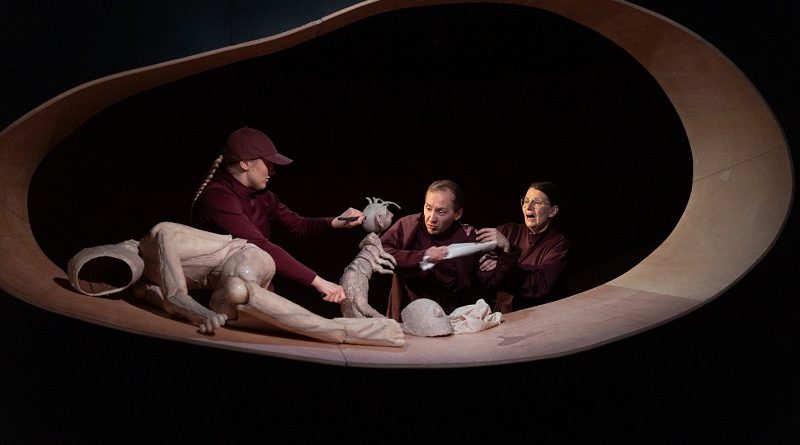
With its emotional precision, technical sophistication and ability to address ecological themes without moralizing, Salmon Stasis (Latvian Puppet Theatre, directed by Edgars Kaufelds), a puppet production for children, impressed the international critics and domestic audiences alike. During discussions, some praised it as a rare example of environmentally engaged theatre that remained playful and visually rich. Others questioned whether its use of recycled materials—gathered during an earlier eco-awareness campaign organized by the theatre—fully resolved the contradictions inherent in eco-theatre. Still, few disputed its affective power. The differences between national contexts were also highlighted: what feels familiar or even exhausted in the UK may remain innovative and necessary in Central and Eastern Europe, where public conversations in art around, for instance, sustainability, eco-footprints and climate change are still emerging.
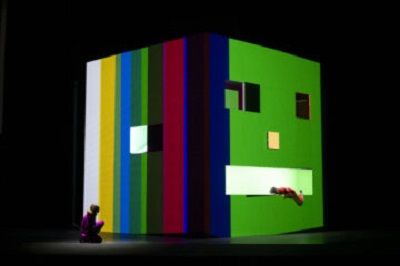
Visual dramaturgy became a focal point of debate on the production National Network (Latvian National Theatre, directed by Matīss Kaža). Its second act—driven by pulsating lights, numerical patterns and framing structures—was repeatedly described as a compelling metaphor for mediated reality and the impossibility of disengaging from circulating “truths.” In conversations with foreign critics, it was the design concept of visual artist Reinis Dzudzilo that was most often foregrounded, with several arguing that the scenography effectively carried the dramaturgical argument of the production. In the Spēlmaņu nakts award ceremony Dzudzilo received the special acknowledgment of the international critics group “for insightful and evocative visual dramaturgy concept.”
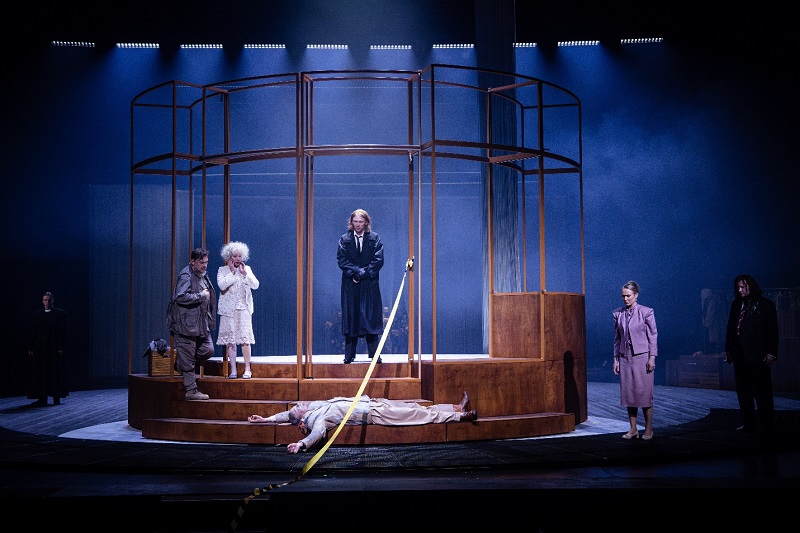
The Latvian jury in the category Scenographer of the year voted for Germans Ermičs, internationally acclaimed Latvian multi-disciplinary designer debuting on a theatre stage in the large-scale production Drive your Plow over the Bones of the Dead (Dailes Theatre, directed by Iranian stage director Ola Malafani) with Russian actress Chulpan Khamatova in the leading role performing in the Latvian language along with her Latvian colleagues. This production, based on the novel by the Nobel Prize laureate Olga Tokarczuk, was in addition declared the large-scale production of the year, even though the content was extensively dominated by rather ambitious form and visual language, which—to some extent—is symptomatic of current theatre practice in Latvia.
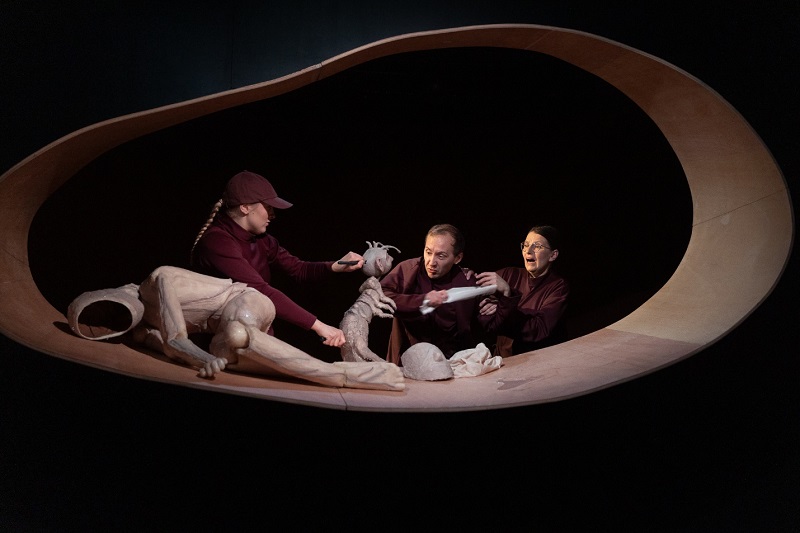
Across the showcase, the diversity of forms was striking. From the minimalist interplay between a live actor and a puppet in the emotionally refined Metamorphosis (Liepāja Puppet Theatre, directed by Rihards Zeļezņevs), to the documentary musical Alphas (Dirty Deal Teatro, directed by Valters Sīlis), and the contemporary use of commedia dell’arte in The Dreamers (Latvian Academy of Culture, directed by Kārlis Krūmiņš), Latvian theatre revealed an ecosystem capable of sustaining widely different artistic approaches. Several visiting programmers remarked that this breadth—rather than individual standout works—was what made the scene legible and attractive internationally, while loud and expensive large-scale productions such as Oracle (Dailes Theatre, directed by Lukasz Twarkowski) or King Ubu and Other Monsters (Latvian National Theatre, directed by Vlad Troicky) show that the Latvian theatre ecosystem provides a fruitful soil for creative cooperation. For the increase of international visibility, it is sometimes even more important than pure artistic excellence, especially when encapsulated in local contexts.
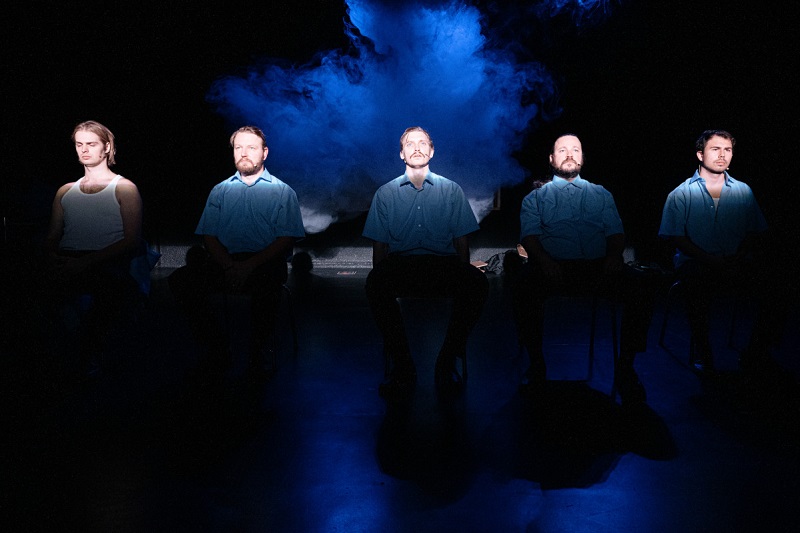
Alphas, based on a real criminal case from 2011 involving police officers planning and committing a robbery, generated some of the most animated debates. Many critics acknowledged the relevance of its themes: masculinity, corruption and institutional failure. Others felt that its musical and scenic strategies remained too uniform. A more contentious point concerned the ethical stance of the production, questioning whether extending compassion toward characters who knowingly commit crimes while acting within the law was a productive or problematic gesture. These disagreements, openly voiced, exemplified how Latvian productions functioned as catalysts for broader ethical discussion. The Latvian National jury named Valters Sīlis Stage Director of the Year, who in addition divided the joy of the team for the double recognition of Alphas (Edgars Raginskis was named Composer of the Year, and Alphas won the category of small-scale production) in Spēlmaņu nakts. This example illustrates the broader observation: productions that resonate strongly within Latvia do not always align with the expectations of international professional audiences.
Nevertheless, Latvian drama keeps breaking through: a recent English-language volume, Five Plays from Latvian Theatre (2025), presents contemporary texts that have proven performatively viable both at home and abroad. The collection contains About Us, Sex, Rock and USSR by Ance Muižniece, The Boy Who Saw in the Dark by Rasa Bugavičute-Pēce, Richard. Nothing Personal by Artūrs Dīcis, The Frankenstein Complex by Kārlis Krūmiņš and How to Lose a State by Matīss Gricmanis.
Political theatre, the central theme in the ECT conference panels and discussions, is currently not really a topic on Latvian scenes. This genre carries a specific historical resonance in Latvia and in the wider Baltic region. Decades of metaphorical, Aesopian communication under Soviet rule continue to shape how political content is encoded and decoded on stage. Several international critics noted that while Latvian theatre increasingly addresses contemporary issues—media ecosystems, gender-based violence, ecological anxiety, post-imperial trauma—it often stops short of directly confronting political conflict.
Others countered that what may appear cautious from a Western European perspective can still function as necessary intervention in a context where theatre remains a mainstream art form, regularly reaching sold-out audiences, which is the strength of Latvian theatre. Directors such as Milo Rau, Data Tavadze, Łukasz Twarkowski and Viesturs Kairišs contributed to debates of the conference on truth-telling, responsibility and representation. Tavadze and Twarkowski have both worked in Latvia in recent years. Despite the notorious old joke of Lithuanian theatre being Polish theatre on tour, Twarkovski’s work, developed with international teams and co-produced across countries, has contributed a lot to make Latvian, Lithuanian and Polish theatre makers more visible internationally, starting from Respublica co-produced by the Lithuanian Drama Theatre and München Kammerspiele, and Rotkho produced by Dailes Theatre in Riga that have been performed throughout Europe since 2022. In 2024, Rotkho received the Premio Ubu as the best foreign performance shown in Italy. A Critical Stages review of Rotkho here.
November encounters in Riga showed that Latvian theatre can easily become a crucial hub for Baltic and European collaborations. Bringing an international crowd to Riga created a dynamic environment, in which visiting professionals can immerse themselves in local theatre while artists receive immediate feedback from peers with diverse perspectives, making the world smaller and opening shortcuts to wider waters.

*Lauma Mellēna-Bartkeviča (PhD) is an academic researcher at Jāzeps Vītols Latvian Academy of Music, active music and theatre critic and Head of the Latvian Section of AICT/IATC. Research interests cover opera, music theatre and culture both from historical and contemporary perspectives. Since 2020, she is editor-in-chief of the only Latvian musicology journal Mūzikas akadēmijas raksti (scriptamusica.lv). Editor of Contemporary Latvian Theatre 2010-2020. A Decade Bookazine in English (2020). Coordinator the project Five Plays from Latvian Theatre for Gothenburg Book fair (2025).
Copyright © 2026 Lauma Mellēna-Bartkeviča
Critical Stages/Scènes critiques, #33, June 2026
e-ISSN: 2409-7411

This work is licensed under the
Creative Commons Attribution International License CC BY-NC-ND 4.0.
