A Manifesto for an Age of Violence
Ieva Rodiņa*
Hamlet by William Shakespeare. Directed by Ivo van Hove for Comédie-Française. Opened January 21, 2026. Seen January 31st, 2026 at Odéon Theatre, Paris. Adaptation by Ivo van Hove and Bart Van den Eynde. Set and lighting design by Jan Versweyveld. Costumes by An D’Huys. Video by Claudio Cavallari. Choreographic work by Rachid Ouramdane.
Shakespeare—Our Contemporary
While the film Hamnet,[1] dedicated to William Shakespeare’s family tragedy—the premature loss of his son—continued its wave of acclaim, Odéon–Théâtre de l’Europe in Paris hosted,[2] from January 21 to March 14, 2026, a production of Hamlet created by the Dutch director Ivo van Hove in collaboration with the Comédie-Française ensemble.

Hamlet, as Shakespeare’s most canonical play, has always enticed directors to seek new interpretations across times and contexts. Yet in today’s anxious global climate, the play seems to have acquired a different—more emotionally charged and tense—resonance, foregrounding the fragility of human life against the backdrop of personal existential crisis and a world steeped in chaos and destruction. Accordingly, van Hove constructs a stripped-down stage universe infused with contemporary cultural signs—from the fragmented rhythms of social media content flows to pop music references through which Hamlet and Ophelia articulate their feelings and thoughts.
Hamlet—the Centre of the Universe
Parisian audiences are well acquainted with van Hove’s work in both theatre and opera, including his internationally acclaimed productions of Tennessee Williams’ The Glass Menagerie (2022) and Sophocles’ Antigone (2015). His ongoing collaboration with the Comédie-Française has yielded several productions, making Hamlet feel like a return to familiar terrain, with a trusted ensemble and long-standing creative team.
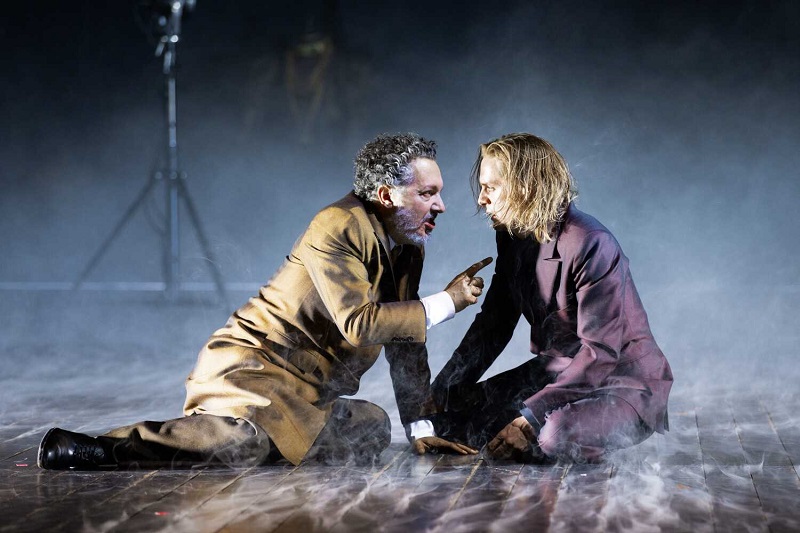
A particularly striking choice is his casting of the young actor Christophe Montenez as Hamlet. His performance—ranging from lyrical sensitivity to explosive anger, expressed through a fragile physicality—recalls figures like Kurt Cobain or the intense screen presence of Caleb Landry Jones, the leading actor in recent movies by Luc Besson. Slender, long-haired and inwardly driven, Montenez’s Hamlet appears alone on an empty stage in the prologue. Almost immediately, video projections (by Claudio Cavallari) draw the audience into an extreme close-up of his eye, pulling us into his mind as if traversing a neural labyrinth. The sequence culminates with loud rock music, which becomes the external manifestation of Hamlet’s inner monologue throughout the production.
Van Hove anchors the entire performance in Hamlet’s subjective perspective, refraining from moral judgment and instead inviting the audience into an empathetic, almost visceral experience of the character’s psychological descent. The pathological hatred that grows within him after his father’s death escalates rapidly, boiling over within weeks. As van Hove explains in his video interview: “We have chosen to stage a Hamlet, not the Hamlet—an extremely reduced version that focuses on this young man and tries to understand why he does not act at first, and then moves towards extremely violent, cruel actions.”

The conciseness of the production is reflected not only in its visual design (created by Jan Versweyveld), which consists of a wooden platform as a “stage within a stage”, flanked by mobile curtain systems and a limited number of essential scenographic elements (a video screen, movable lights, costume mannequins, etc.). The same principle defines Ivo van Hove’s adaptation of the play (in collaboration with Bart Van den Eynde), in which only approximately one third of Shakespeare’s original text is used. The production thus assumes an intense and deliberately fragmented theatrical form, in which the action is structured not in line with classical dramaturgical principles, but through the psychological and emotional fluctuations of Hamlet’s inner world. Extended philosophical monologues are replaced by physical action—even when it leads to inevitable destruction.
Not only the text but also the dramatis personae has been reduced, narrowed down to those essential for the personal storytelling of Hamlet: Ophelia, Gertrude, Claudius, Horatio, Laertes and Polonius. Reinforcing the idea that everything on stage takes place within Hamlet’s disturbed mind, several actors perform double roles. Guillaume Gallienne appears both as Claudius and as the Ghost of Hamlet’s father, embodying two coexisting and conflicting paternal archetypes within Hamlet’s psyche—the dead, idealised father, appearing crawling on the floorboards in theatrical smoke and gnawing at Hamlet’s subconscious like a worm, and the “false” father who has replaced the original and gained social legitimacy as an attractive politician-showman. Meanwhile, Jean Chevalier’s Laertes and Fortinbras function both as rivals and, in van Hove’s conceptual framework, as embodiments of a broader world view of the young generation.
Belief in Theatre
One might say that van Hove’s approach to Hamlet is almost mathematical, even surgical in its precision. He outlines three phases of Hamlet’s development: “The first phase: Hamlet believes that theatre is the perfect tool to investigate reality and, if necessary, to question it. I believe theatre can improve, can change the world.”
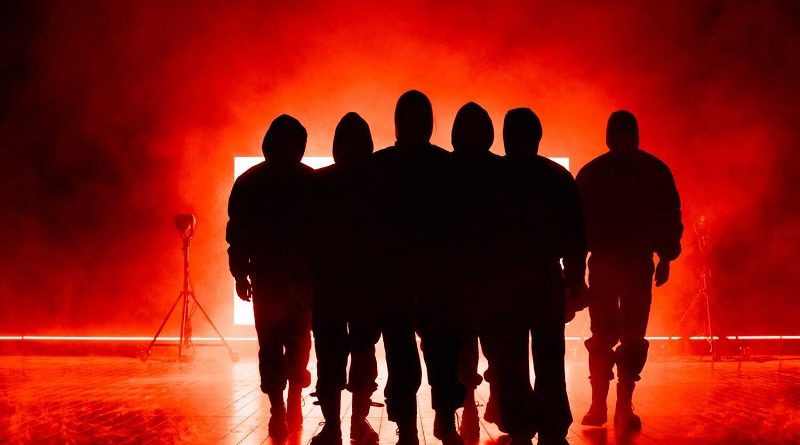
At the outset, Hamlet remains detached from those around him, unable or unwilling to integrate into society after the shock of his father’s death and his mother’s hasty remarriage. He turns to theatre as a means of inquiry. Constantly present beside him is a group of similarly dressed young men—a hybrid of chorus, actors and companions—who function as witnesses, collaborators and embodiments of a restless younger generation. During the “Mouse-trap” scene, these companions take on the role of actors, putting on elaborate Elizabethan costumes in a ritual-like sequence. When this indirect method fails, Hamlet resorts to a more direct and brutal approach. To the full blast of Queen’s Bohemian Rhapsody, the ensemble performs a choreographically intricate sequence (Rachid Ouramdane’s choreography is outstanding, unafraid of blending different genres and styles, interweaving high culture with influences from pop culture). The effect of this play within the play is fascinating, as it draws the entire mise-en-scène into a spiralling dynamic, dissolving the boundaries between “performers” and “spectators”. As the intensity of the music builds, the actors, invited by Hamlet, immerse themselves in one-to-one interactions with Claudius, Gertrude, Polonius and Ophelia. While the first three watch in confusion, Ophelia surrenders to a frenzied dance, driven by the thundering rhythm of the music.
However, once again, Hamlet’s (a.k.a. Treplev, the author of this contemporary performance) idealistic vision of theatre’s capacity to transform and influence the world proves ineffective. Hamlet stages Claudius’s confession under harsh lighting, but it remains merely a monologue—striking, yet devoid of genuine remorse.
The Collapse of Reality
The second phase: he discovers that theatre does not have the power to change the world. He increasingly mixes theatre with reality and fully identifies with a character that leads him to his first murder—that of Polonius. Theatre becomes reality for him.
In this production, curtains play a crucial symbolic role, marking thresholds between truth and illusion. The encounter between Hamlet and Gertrude unfolds on a vast white fabric resembling a bridal veil, behind which Polonius is killed—an image that subtly associates the mother with responsibility for the unfolding events.
Ophelia (Élissa Alloula) emerges as a particularly vivid presence. Unlike Hamlet, she appears socially open and grounded, yet her emotional fragility becomes increasingly evident. Her descent into madness is given significant stage time, addressing contemporary concerns about the mental health of young people. Through songs like L’Enfer (Hell) by Stromae, she confesses: “I have sometimes had suicidal thoughts, and I am not proud of it. Sometimes one thinks it is the only way to silence them.”[3]
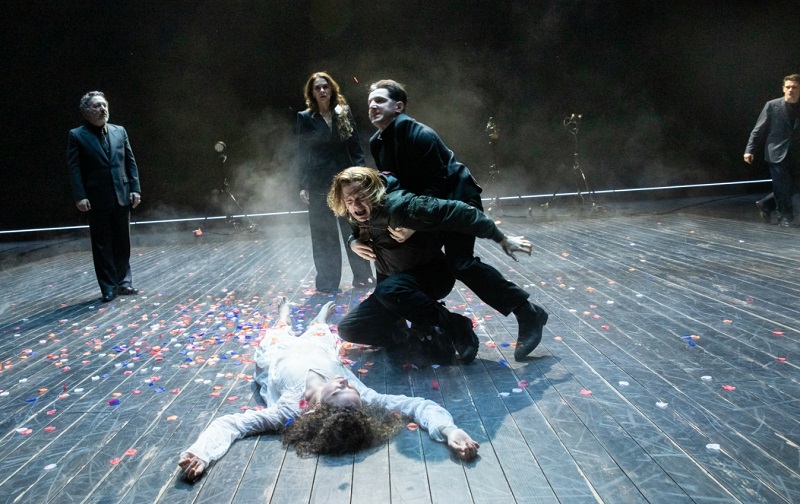
Similarly to the “Mouse-trap” scene, the deaths of Polonius and Ophelia are given a separate, large-scale choreographed sequence that recalls the signature style of Pina Bausch. Set to Bob Dylan’s ballad Death Is Not the End, the stage figures move together in a slow and ceremonial snake-like procession across the stage, enacting a funeral rite and, as a gospel-like chorus, singing meditatively. The lifeless bodies of Polonius and Ophelia are lifted above the outstretched arms of the living characters as in a rock concert, culminating in Ophelia being laid down at the front of the stage with sentimental confetti falling from the sky, while Laertes mourns his dead sister. Meanwhile, Hamlet has already entered his third developmental phase and is ready for the final duel.
Triumph of Violence
The third phase: inspired by the fighting spirit of other young people like Laertes and Fortinbras, Hamlet becomes more and more violent, ready to go very far for his beliefs. Once an idealist, he becomes an activist—and then a murderer without remorse.
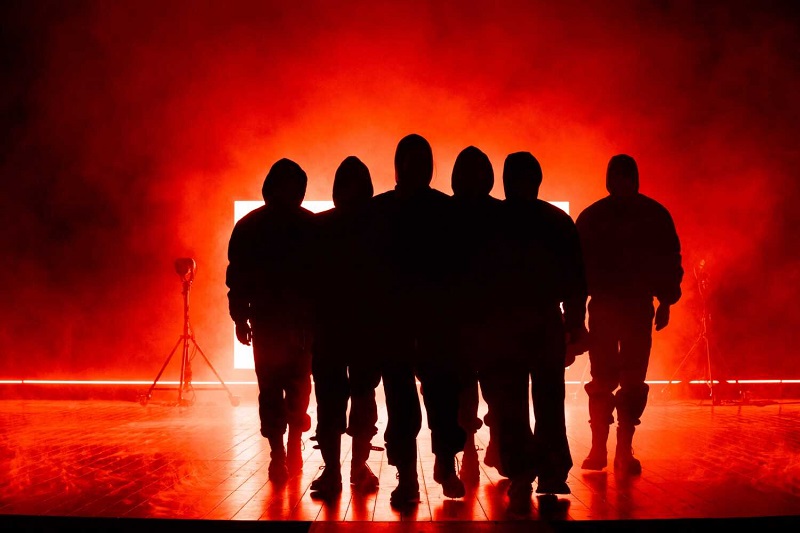
The radicalization of youth stands at the core of van Hove’s interpretation. The minimalist stage design gradually transforms into a machine of theatrical spectacle—lighting intensifies, projections flicker, and the stage becomes a confined arena, a ring for combat. Costumes (designed by An D’Huys) evolve from elegant suits into paramilitary attire, reinforcing a sense of collective militancy.
Even in the final bloodbath, van Hove embraces theatrical stylization, marking the characters’ deaths with neon “poison” makeup. Violence leads inexorably to destruction—an idea central to both Shakespeare’s tragedy and van Hove’s interpretation. And, while some critics accuse the director for straying too far from the literary source and catering to younger audiences through pop culture references, this bold engagement with classical material—focused, contemporary and unafraid—feels not only justified but necessary. It is precisely this kind of reinterpretation that keeps Shakespeare alive as our contemporary.
Endnotes
[1] Chloé Zhao’s ambitious film Hamnet (2025) foregrounds an emotionally charged portrait of Shakespeare’s family, largely shaped by the viewpoint of his wife, Anne Hathaway (Agnes). van Hove, by contrast, turns inward, focusing on the psychological landscape of Hamlet as the central driving force of the play, while giving less attention to its other dramaturgical layers. Both directors adopt an uncompromising approach, unafraid of emotional intensity, which in today’s increasingly alienated world resonates as a reminder of the weight of human tragedy.
[2] Due to the reconstruction of the Comédie-Française’s Salle Richelieu, the production was performed at Odéon–Théâtre de l’Europe.
[3] Ophelia also comments on her father’s death through the lyrics of Zaho de Sagazan’s Tristesse (“Sadness”), singing: “I have finally found wisdom, / And from now on I have absolute power. / What audacity to make me believe / That I am merely a poor puppet, / Manipulated by your / Disgusting hands of despair. / I am the puppeteer, / And certainly not the other way around.”
Bibliography
Van Hove, Ivo. “Hamlet par Ivo van Hove”, Odéon Théâtre de l’Europe, YouTube, 19 November, 2025. Accessed 16 Apr, 2026.

*Ieva Rodiņa (PhD) is a theatre critic and researcher. In 2020, Ieva Rodiņa finished her PhD thesis dedicated to Latvian modernist theatre director Eduards Smiļģis. She is the Editor-in-chief of the Latvian theatre website www.kroders.lv, the Manager of Ogre Theatre, a regional theatre in Ogre city, Latvia, and an independent researcher focusing on Latvian theatre history and contemporary theatre processes.
Copyright © 2026 Ieva Rodiņa
Critical Stages/Scènes critiques, #33, June 2026
e-ISSN: 2409-7411

This work is licensed under the
Creative Commons Attribution International License CC BY-NC-ND 4.0.
