Global Revolutions, Uneven Coverage
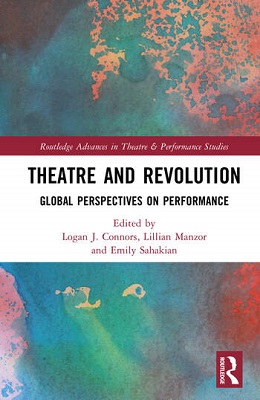
Theatre and Revolution: Global Perspectives on Performance
By Logan J. Connors, Lillian Manzor, and Emily Sahakian (eds.)
Routledge, 296 pp.
Reviewed by Lenka Pichlíková-Burke*
Theatre and Revolution is a collection of essays on performance-related works associated with political revolutions, slave revolts, large-scale riots and other civic disturbances, anti-authoritarian dissident activities, and social manifestations—generally of a progressive social nature—throughout the world. These range from the French Revolution in 1790 to Tahrir Square in revolutionary Cairo in 2011, and from Communist East Berlin through Iran, China, Japan, Chile, and Mexico to the Antilles.
Connors, Manzor, and Sahakian set the stage for the 15 essay-chapters with a historical, meta-historical, and theoretical “Introduction.” Among their historical concerns is what constitutes a “revolution”—a question they admit can be “subtle and vague,” but one that is most often socially progressive and certainly involves people’s participation. They embrace Augusto Boal’s ideas (Theatre of the Oppressed) on the proper relationship of the dramatic arts to revolution and Richard Schechner’s concept of “Performance Art,” an umbrella term that applies both to many of the staged performances and to all of the public or social spectacles studied in the chapters. Among the theoretical and meta-historical concerns is something they call “Archive,” in which dramatic works serve to preserve stories of the social revolutions and revolts of the past.
The chapters are organized into three groups: “Performance Archives, Repertoires, and Memories of Revolution”; “Ruptures and Repetitions of Revolutionary Time” (modern works recreating or inspired by historical revolutionary events); and “Places and Spaces of Revolutionary Performance” (documenting modern and contemporary revolutionary performance, along with a public festival from the French Revolution). The grouping seems arbitrary: either the first or the last category could have included a majority of the studies.
An important group of chapters documents theatre related to revolutionary themes in Latin America and Latiné culture in the United States. Two of the most compelling narratives in the volume are Melissa González-Contreras’s discussion of dissident theatre in Chile after Augusto Pinochet’s right-wing coup d’état in August 1973, and Neta Kanny’s analysis of two contradictory performances in post-Chávez Venezuela. Two chapters focus on Latiné theatre in the United States: Lilianne Lugo Herrera’s study of three Cuban American plays from the 1980s and Briana Beeman’s analysis of the “Garbage Offensive(s)” of the Puerto Rican Young Lords Organization (YLO), which may be considered “performance art” in Schechner’s sense. (González-Contreras discusses several Chilean performances as taking back popular control of cultural spaces—essentially the same idea as Beeman’s “spatial intervention” by the Young Lords.) At the same time, it is odd that two centers of revolutionary theatre in Latin America—Cuba and Puerto Rico—would be represented in the volume by performances and manifestations in the United States. In particular, Puerto Rican playwrights such as René Marqués (anti-colonial themes) and Francisco Arriví (issues of racial identity) are absent, not to mention New York-based Puerto Rican authors such as Tere Martínez (diaspora and identity). One also misses a discussion of the role of drama in contemporary Honduras, such as work by Melissa Cardoza.
Four chapters in the book analyze the dramatic and “archiving” aspects of revolutionary events in the non-Hispanic Caribbean: Stephen Cedars’ narrative of the 1881 Carnival riots in Trinidad; Andy Stafford’s analysis of Auguste Macouba’s play about the December 1959 riot in Fort-de-France, Martinique; Soraya Limare’s explanation of “revolutionary time” in plays by Édouard Glissant (Martinique) and Maryse Condé (Guadeloupe) about the Haitian Revolution, 1791–1804; and Liam Johnston-McCondach’s study of “revolutionary time” in Heiner Müller’s The Mission (1979), about French revolutionary agitators in 1790s Jamaica. Glissant was an important literary critic and philosopher, and Condé a significant political activist in France and the Antilles—their absence from the other chapters is truly surprising. (There are still relatively few English translations of many Francophone Caribbean authors, as well as many Latiné writers.)
Modern dramas in other areas of the Caribbean are omitted, including Haiti, home to a vibrant national dramatic tradition, and Jamaica, with modern playwrights such as Stafford Ashani (diaspora, cultural identity, Rastafari, Carnival), Pat Cumper (Afro-Caribbean identity), Basil Dawkins, Honor Ford-Smith (postcolonialism, police violence), Ginger Knight (partisan social violence), and David Tulloch examining “postcolonial” themes.
Half a world away and a century earlier, plays about the French Revolution heroine Madame Roland inspired revolutionaries in late Qing dynasty China, as analyzed by Cecilia Feilla. (Only Feilla, among the authors, picks up on the editors’ interest in Boal’s ideas on theatre and revolution.) Even more fascinating is Siyuan Liu’s chapter on Japanese proletarian theatre puppeteers who produced translations of German Marxist plays in 1920s Japan and, after 1927, in China. Liu points out that string-controlled marionettes attracted less censorship than plays spoken by human actors and removed the productions from the traditions of hand-controlled Bunraku puppets.
Of more contemporary interest, particularly in light of recent events in Palestine and Iran, are Yassaman Khajehi’s chapter on the “Three Stages of Iranian Theatre in Revolution” (1979–2022) and Dalia Basiouny’s narrative of the role of theatre in the context of the 2011–2012 Egyptian Revolution (“R for Rehearsal, R for Revolution: Stories from and About Tahrir Square”), including her memories of creating the pieces and their subsequent performance in the United States in 2014. The two essays are the opposite of each other: Basiouny describes theatre involved in the revolutionary process, while Khajehi analyzes reforms in theatre taking place in the wake of a pre-existing revolution and its evolving development.
The chapter on Heiner Müller raises another significant gap in the topics covered in the volume: the East Central European anti-Communist dissident movement of the 1960s through the 1980s. While Müller had a difficult relationship with the East German Communist government, including repeated censorship and productions withheld, he was not exactly a dissident. His inclusion follows the editors’ theoretical interests and the fact that Müller was able to publish and present plays in non-Communist countries. Perhaps Volker Braun (born 7 May 1939 in Dresden) might have been a better example of a revolution-minded author. Similarly, Janusz Głowacki (1938–2017), who wrote Cinders and Journey to Gdansk in 1980 amid the “Polish Summer” semi-liberalization and the subsequent founding of the Solidarity union, would have been a good example of a dissident playwright who outlived the Communist regimes. Above all, there is Václav Havel (1936–2011), a Czech playwright and essayist who initially used the “Theatre of the Absurd” to criticize the ruling Communist regime in the 1960s, culminating during the “Prague Spring” of 1968. Some of Havel’s important plays include The Vaněk Plays and The Garden Party. Havel, an anti-Communist dissident thereafter, was the only playwright to have been a successful revolutionary political leader—during the Czechoslovak “Velvet Revolution” of 1989—and later the first non-Communist president of postwar Czechoslovakia, and then of the Czech Republic (1993).
One very useful aspect of the volume is its international perspective, since studies of this topic are, in general, almost exclusively focused on one country. The reader will find in this work a broad spectrum of international studies that will, in many cases, inspire contemporary drama in our challenging era.

*Lenka Pichlíková-Burke (PhD), professor, actress and mime, has long researched the theatrical pedagogy of Michael Chekhov. The editor of a two-volume study of his work published by Routledge, she holds an MFA and PhD from the Faculty of Dramatic Arts (DAMU) in Prague and a Certificate of Completion from the Michael Chekhov Association (MICHA).
Copyright © 2026 Lenka Pichlíková-Burke
Critical Stages/Scènes critiques, #33, June 2026
e-ISSN: 2409-7411

This work is licensed under the
Creative Commons Attribution International License CC BY-NC-ND 4.0.
