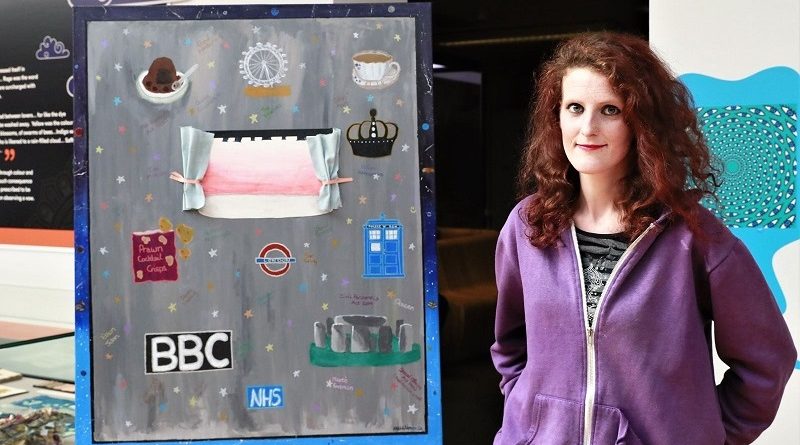
Different Pasts/Shared Futures : Performing Pictures (Poter Gaan) in the UK for a Better Future
A.M.M. Noor-Us-Saiyem Khan* and Farjana Kabir**
Abstract
This article examines Different Pasts/Shared Futures (DPSF), an arts-based research project developed in Bolton, UK, in Autumn 2021. The project brought together migrant participants, local artists, and community practitioners through engagement with Poter Gaan, an Indigenous Bengali form combining scroll painting (Patachitra) and sung narration. DPSF is framed as practice-based research, where artistic process produces knowledge rather than illustrating pre-existing theory. Using collective autoethnography, the article situates the project within debates on participatory art, dialogical aesthetics, authorship, and translation. It introduces ‘digital sanctuary’ to describe pandemic conditions shaping participation. Analysis of workshops, performances, and documentation shows polyvocality emerging through negotiation.
Keywords: collaborative autoethnography, Poter Gaan, performance of the displaced, embodied storytelling, polyvocal performance
Introduction
In Autumn 2021, Different Pasts/Shared Futures (DPSF) was developed as an arts-based project in Bolton, Greater Manchester, in collaboration with Bolton Library and Museum Services and City of Sanctuary. The project was locally funded by Bolton One (Formerly Bolton at Home), National Lottery Community Fund, and Bolton Station Community Partnership and brought together twelve migrant participants representing twelve nationalities, along with local artists and community practitioners, through structured engagement in storytelling, visual art, and performance. At the centre of the project was Poter Gaan, an Indigenous Bengali form that integrates scroll painting (Patachitra) with sung narration, traditionally performed by itinerant artist-singers known as Patuas (Banik and Kundu). It is important to note that the form does not separate image from voice or narrative from performance; rather, meaning is produced through their interaction. In this respect, DPSF was not conceived simply as a series of workshops but as a relational space in which knowledge emerged through shared making.
This article argues that DPSF constitutes not only an artistic intervention but also a form of practice-based project that produces situated knowledge concerning authorship, representation, and the ethics of visibility. Rather than relying on generalised claims of contribution, it seeks to specify what is altered by this work and how that change is made legible through practice. As Grant Kester argues in community arts practice, “meaning is generated through dialogue and exchange rather than the production of autonomous objects” (8). Building on this proposition, it can be suggested that DPSF reconfigures the conditions of such exchange by redistributing narrative authority and foregrounding relational ethics. In particular, the project shifts the performative burden away from the expectation that displaced participants must narrate trauma in legible or recognisable forms, instead allowing them to determine what is shared, how it is expressed, and when silence remains part of the work.
Three interrelated claims structure the discussion that follows:
First, it is argued that the adaptation of Poter Gaan provides a dialogical framework through which participants negotiate past, present, and future within a shared aesthetic structure.
Secondly, the article introduces the concept of digital sanctuary to understand how participation was enabled under pandemic conditions, in which access to technology and domestic space became central to artistic engagement.
Thirdly, it is suggested that the project’s documentation, including images, performances, and QR-coded materials, transforms ephemeral practice into a durable archive, thereby extending the life of the work and reshaping the ethics of visibility.
Taken together, these claims indicate that knowledge is not external to practice but is produced through the interaction of form, context, and participation.
Ways of Making, Ways of Knowing
This performative integration of image, voice, and ritual situates Poter Gaan within a global lineage of enacted visual storytelling, resonating with African rock art, wayang kulit, thangka displays, and Navajo sand paintings. Across cultures, such practices dissolve boundaries between artist and audience, mobilising art as a conduit for memory, healing, and social transformation.
Participatory art has frequently been positioned as a form of social engagement; however, it can be suggested that its evaluative criteria remain contested and, at times, insufficiently grounded in practice. On the one hand, Claire Bishop argues that participatory practices risk privileging ethical intention over aesthetic rigour. On the other hand, Kester emphasises the significance of dialogical exchange, proposing that the value of such work lies in the quality of interaction it produces. In light of this tension, it is important to establish that DPSF does not seek to resolve this debate in the abstract; rather, it offers a situated instance through which these positions can be examined in relation to practice. More specifically, the project demonstrates that aesthetic and ethical dimensions are not mutually exclusive but are relationally co-constituted through process.
In this respect, it can be argued that the significance of DPSF lies in its capacity to redistribute authorship. Participants were not positioned as subjects to be represented but as co-authors of the work, actively shaping both form and content. This is evident, for example, in one participant’s reflection during the workshop process:
The picture also has another meaning in that it represents what I want to do in the future. I like working with people to help them see their potential, growth, and development, which turns into the joy of life, and to have a fulfilling life. (Razia, Diaspora poet and participant)
This statement is significant because it resists the expectation that migrant narratives must be framed through trauma, instead asserting a more complex relationship to memory and futurity. It may therefore be suggested that authorship in DPSF is not simply shared but negotiated, emerging through moments of hesitation, refusal, and re-articulation.
“Poter Gaan” in a Migratory Aesthetic
Poter Gaan operates as a multisensory narrative practice that intertwines oral song with visual storytelling through painted scrolls, commonly in Choukopata (square) and Jarhanopata (rolling) forms. Performances begin with the Bhumika (invocation), followed by the gradual visual unfolding of the scroll, in which images are animated through chanting, gestures, and audience engagement, and conclude with a moral reflection aligned with Mahatmya. In the DPSF project, these structures transform lived experience and trauma into future-oriented wisdom. As participant Razia reflects, the images embody “potential, growth, and development,” culminating in a shared “joy of life” (Feedback notes).
This performative integration of image, voice, and ritual situates Poter Gaan within a global lineage of enacted visual storytelling, resonating with African rock art, wayang kulit, thangka displays, and Navajo sand paintings. Across cultures, such practices dissolve boundaries between artist and audience, mobilising art as a conduit for memory, healing, and social transformation. Furthermore, the project DPSF engages with cosmopolitics, understood as a mode of intercultural performance that operates across difference without collapsing it (Gilbert and Lo). In DPSF, this becomes visible in the adaptation of Poter Gaan within a UK-based migrant context. The form is not reproduced as a fixed cultural artefact; rather, it is reconfigured as an “architectural frame” within which diverse subjectivities can be articulated. During the early sessions, a facilitator underscored that the scroll does not prescribe narrative content but operates as a mediating structure through which participants organise and articulate pre-existing meanings. This distinction is analytically significant, as it positions the form as enabling and generative rather than directive or prescriptive.
This arts-based intervention was framed as a “collective autoethnography,” weaving individual lived experiences into a shared, resilient community narrative, even as it was highly demanding given ongoing COVID-19 restrictions (Karalis Noel et al. 2). Moreover, we utilised collective autoethnographies and arts-based research to investigate the practice of Poter Gaan as a site of psychosocial transformation and “inclusive identities: individual or relational, institutional, and cultural” (Dutta 478). The authors did not remain external observers but participated as facilitators, co-creators, and interlocutors. This dual positioning is reflected in the way workshop conversations informed both the creative process and the subsequent analysis. For instance, during one session, a participant who recently arrived in the UK remarked: “When I draw, I feel I can say things without finding the exact English word” (a Nicaraguan female participant). This observation is analytically significant because it highlights how visual practice functions as an alternative mode of articulation within multilingual contexts.
DPSF Workshop as Dialogical Space
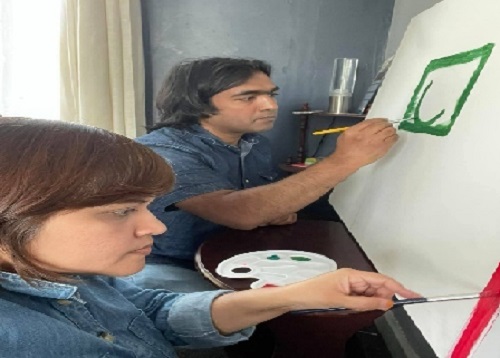
The project evolved through three distinct stages: Phase I, Digital Workshop, and Adaptation & Partnership, beginning with the strategic adaptation of the DPSF framework to a digital format in partnership with other organisations. We conducted the first phase of the workshop and reported to the funders, supported by participant evidence and reviews, to obtain a “green signal” following rigorous negotiations to proceed with the workshop-based project. This transitioned into the Phase II Online Workshop Series for Performance, in which the instructors and participants successfully devised and rehearsed the performance entirely via online meetings from their respective homes in late 2021. The initiative concluded with Phase III, Polyvocal Performance and Documentation of Displacement, which focused on delivering the work and preserving the artistic achievements through recorded media and photography.
The composition of the participant group further shapes the methodological approach. The twelve consenting individuals represent a cosmopolitan cultural landscape; eleven participants identify as female and one as male. This demographic configuration is not incidental; rather, it situates the project within a gendered and transnational field of experience. It can therefore be argued that the knowledge produced through DPSF is shaped by these intersecting positionalities, rather than emerging as a neutral or universal account.
The authors’ own positionality requires explicit articulation in this context. As British-Bangladeshi practitioners, they approached the project with both a cultural connection to Poter Gaan and an awareness of its translation within a UK arts context. This dual positioning informed the facilitation process, particularly in relation to how the form was introduced and adapted. Rather than presenting Poter Gaan as a fixed tradition, it was framed as a flexible structure open to reinterpretation. As reflected in an online workshop discussion during the COVID-19 pandemic, facilitators emphasised that the scroll should remain responsive to participants’ needs rather than conforming to an established aesthetic or model. Such statements indicate a deliberate effort to decentre authority while maintaining structural coherence.
The methodological framework is further shaped by the conditions of the COVID-19 pandemic, which necessitated a shift to digital engagement.
Phase I: Digital Workshop, Adaptation and Partnership
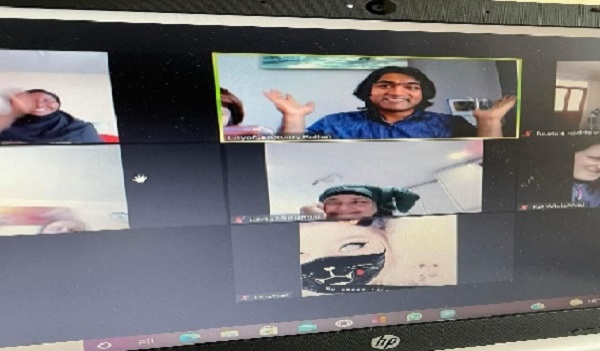
The concept of digital sanctuary becomes analytically central when examining how DPSF was realised under pandemic conditions. It can be suggested that participation in the project was not simply enabled by digital tools but fundamentally shaped by them. Funders have ensured access to devices, similar tablets for everyone, which ensures stable internet connections with SIM cards, and private domestic space, determining not only whether participants could attend sessions but also how they could engage even while exercising alone. In this sense, digital access functioned as a condition of possibility rather than a neutral medium. Our observation of participants joining online from the kitchen, back garden, living rooms and bedrooms highlights how domestic environments intersect with artistic practice, often constraining visibility even within a project concerned with representation.

Workshops were therefore designed to accommodate these conditions through a multimodal structure that combined drawing, writing, and spoken reflection. It is important to note that this approach did not assume a linear progression from one form to another; rather, participants moved between modes depending on confidence, language proficiency, and personal preference. Often, they wrote everything down to describe it to other participants. This sequence of images preceding speech proved significant because it disrupted the expectation that narrative must be articulated verbally to be recognised.

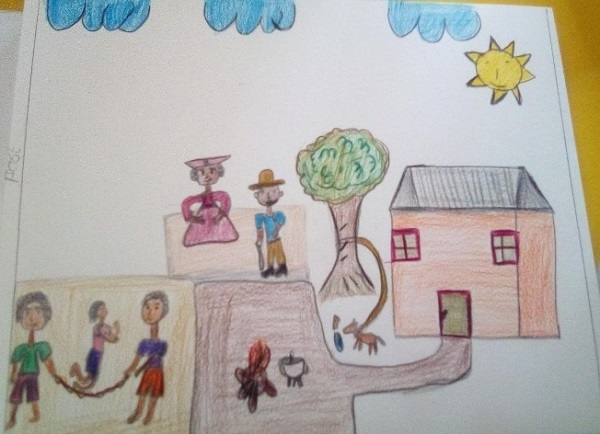
The early stages of the workshop process focused on introducing the structural principles of Patachitra, particularly the use of segmented panels or “storeys” to organise narrative progression. Participants were encouraged to break down their experiences into discrete yet connected moments, as it was hard for them to express the story of their pictures online. Such uncertainty is analytically important because it demonstrates that narrative coherence cannot be assumed; it must be constructed through iterative engagement with form. Facilitators responded by reframing the task, suggesting that the scroll need not represent a chronological life story but could instead hold fragments, memories, and imagined futures.

Phase II: Online Workshop and Performance Series
As the workshops progressed, participants began to translate these fragmented sketches into scroll-based compositions. The scroll format introduced a new temporal dimension to the work, requiring participants to consider how images would be revealed sequentially during performance. This shift from static image to unfolding narrative marked a critical moment in the process.
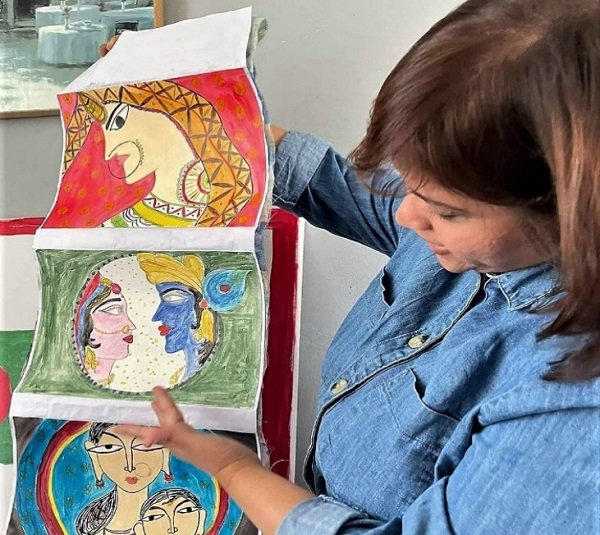
At this stage, facilitators introduced the integration of text and song, drawing on the conventions of Poter Gaan. Participants experimented with short lyrical phrases, spoken narration, and, in some cases, silence or music of their own choice. It is important to note that not all participants felt comfortable singing; instead, many recited lyrics from their preferred songs, drawing on a range of genres including classical, pop, metal, and folk within their respective cultural contexts. This flexibility was crucial in maintaining inclusivity while preserving the structural integrity of the form. Rather than enforcing a uniform performance style, the project allowed for variation, thereby enabling participants to adapt the form to their own expressive capacities.
In DPSF, we adapted the Poter Gaan form to allow diverse migrant voices to reframe their journeys. Once they seemed more confined in describing their own painting through their own interpretation, using their poems, lyrics, and narration, we moved on to the scroll, which became both an artefact and a prompt, a portal to story and song. It has three segments of six vertical pictures, typically the first two frames representing the past, the next two the present, and the final two the future.
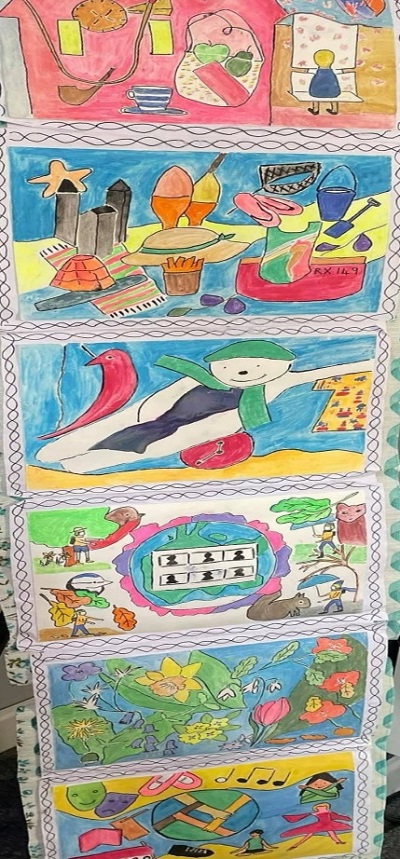
Past the first frame, it can be read or sung.
Red terraced houses
Cups of tea
Trains pass
To and fro
To and fro
A swing hangs
Suspended in time and space
I rock
To and fro (2)
The bough creaks
A rooster crows
Soon he will escape
To be chased down
The cobbledy back street
To and fro (2)
Mum’s apple pie
Cools on the kitchen table
Dad’s pipe smoke
Old Virginia
Wafts through the window
The rope turns
My sisters skip
To and fro (2).
Fig. 8: A drawing by Pamela Spurling, former Chair of the City of Sanctuary, Bolton, demonstrating one form
(vertical) of performing a picture with song and narration (top down), 2021, Photo: Courtesy of the authors
This is a section performed online during the pandemic by Pamela Spurling (Fig. 8), a native performer and Ex-chair of the City of Sanctuary of Bolton, who supports and guides newly arrived refugees in Bolton. Pictures are bordered with a design and affixed to a family-owned cloth, and she chose to describe her past in three frames, her present in one, and her future frames in two (Fig. 8).
The workshops also foregrounded the relationship between memory and imagination. Participants were not limited to recounting past experiences but were encouraged to project future possibilities. In this way, the workshop process can be understood as a series of translations: from memory to image, from image to sequence, and from sequence to performance. Each stage introduced new possibilities and constraints, shaping the final outcomes in ways that cannot be reduced to individual intention. It is therefore important to emphasise that the knowledge produced through DPSF resides not only in the final performances but in the processes through which they were developed. These processes reveal the complexities of participation, including hesitation, adaptation, and negotiation, thereby providing a more nuanced account of collaborative artistic practice.
Phase III: Polyvocal Performance and Documentation of Displacement
The DPSF project provides a clear example of how Poter Gaan can be reinterpreted within a migratory aesthetic and reimagined in the UK, aiming toward a possible decolonial space. Its redeployment by participants from diasporic communities reclaims the form as a polyvocal platform for articulating transnational identities, thereby reterritorialising the notion of ‘cultural hybridity’, in which migration becomes a site of aesthetic innovation and epistemic plurality (Papastergiadis 20).
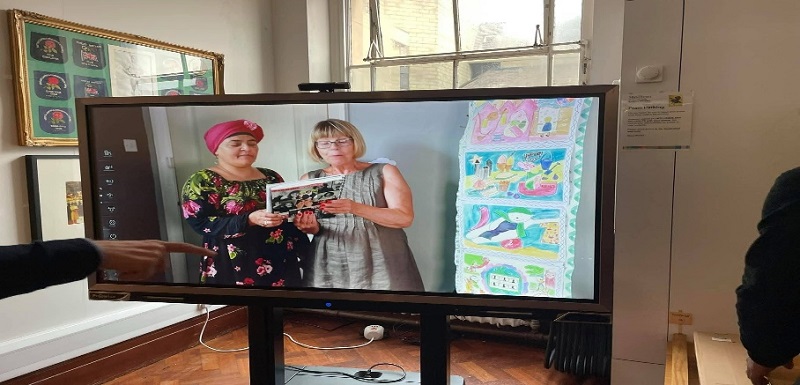
The rehearsal phase revealed further complexities in the relationship between preparation and performance. Several participants relied on written scripts during their presentations, a practice that might initially appear to contradict the spontaneity often associated with participatory art. Moreover, the use of written prompts introduced a visible tension between fixed text and embodied delivery. Participants frequently moved between reading, recalling, and improvising, creating a layered performance dynamic. This oscillation is significant because it demonstrates that polyvocality is not only a matter of multiple voices but also of multiple modes of expression coexisting within a single performance.
The performance phase of DPSF provides a critical site through which the project’s claim to polyvocality may be examined in detail. Polyvocality does not emerge simply from the presence of multiple participants but is produced through the juxtaposition of distinct narrative positions within a shared formal structure. In this respect, Poter Gaan functions as a mediating tool that allows different cultural voices to hybridise without requiring resolution or synthesis. The sequential unfolding of the scroll, combined with the alternation between speech and song, creates a temporal framework in which each participant’s narrative is both autonomous and relational.
This dynamic is particularly evident in the opening performance text developed by Pamela Spurling, whose role as a representative of the host community introduces a distinct positional perspective within the collective. Her refrain states:
Opening Song
Painting a picture
Painting a picture
Potergaan pictures together
Our pasts may be different
We come to the present
And now shape our futures together
We all share our memories
The light and the darkness
Our hopes for a world that is better
Painting a picture
We’re painting a picture
Poter Gaan pictures together
(Pamela Spurling, Ex-Chairperson, City of Sanctuary, Bolton)
At one level, this text establishes a thematic cohesion for the performance, emphasising shared temporality and collective aspiration. However, it is important to examine how this framing operates in relation to the other narratives presented. The phrase “our pasts may be different” acknowledges divergence without specifying its terms, thereby opening a space in which difference is recognised but not fully articulated, but the text performs a careful balancing act between inclusivity and abstraction.
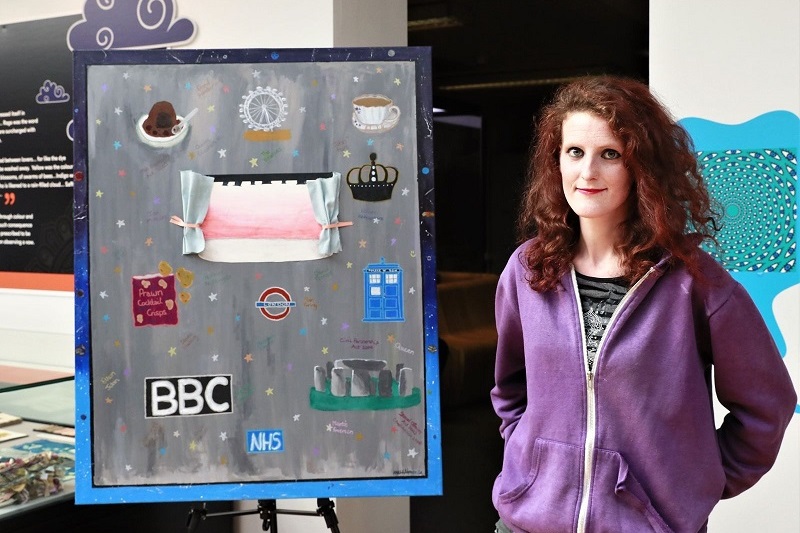
It is also important to consider how performance delivery contributes to the construction of polyvocality. Participants employed a range of vocal strategies, including singing, spoken narration, and hybrid forms that moved between the two. In several instances, performers paused to consult written scripts, performing moments of hesitation into the performance. Rather than detracting from the work, these pauses made visible the labour of articulation, particularly in a second language. Moreover, the act of unrolling these painted memories (Fig.8 and 9) and singing them aloud transformed private grief into public expression.
Our exploration of Poter Gaan prompts broader questions about performance: what does performing mean, and how do performances influence our understanding of the world? Helen Gilbert and Jacqueline Lo suggest that performance is more than entertainment; it is a tool for navigating social and political landscapes. Within their conceptualisation of cosmopolitics as an ethics and politics of being-in-the-world, they emphasised relationality, difference, and ethical responsibility (Ibid). Performing pictures in DPSF can play a vital role in cultivating cosmopolitical awareness by bringing diverse perspectives into dialogue and challenging dominant narratives.

The use of Bengali stylistic elements, aesthetic minimalism, linear narration, and rhythmic cadence was not imposed; rather, it emerged as a shared visual language through workshops facilitated by British Bangladeshi artists. The form became capacious enough to accommodate diverse cultural expressions while remaining rooted in a distinctly South Asian aesthetic sensibility. Moreover, the British audience’s role in the live performance at the Bolton Museums and Art Galleries should not be overlooked. The scroll’s sequential nature requires viewers to follow the unfolding narrative, thereby positioning them as active witnesses rather than passive observers. During the event, moments of recognition, silence, and applause punctuated the performances, indicating an ongoing negotiation between performer and audience. It can therefore be suggested that polyvocality extends beyond the performers themselves to include the responses and interpretations of those present.
The question of language remains central within this context. As noted earlier, English functioned as a shared but uneven medium, shaping both the content and delivery of narratives. Some participants chose to incorporate words from their first languages, while others relied on simplified English phrases. This linguistic variation contributes to the performance’s texture, reinforcing the sense that polyvocality is not only thematic but also linguistic. At the same time, it is necessary to acknowledge that not all aspects of the performance were equally successful. In some instances, the pacing of the scroll did not align with the spoken or sung text, resulting in moments of disjunction. However, these inconsistencies should not be understood as failures. Rather, they reveal the challenges inherent in adapting a traditional form within a new context. It may therefore be argued that such moments contribute to the overall analysis by demonstrating both the limits and the possibilities of the practice.
In light of these observations, it becomes clear that the claim to polyvocality must be grounded in specific instances of practice rather than asserted in the abstract. DPSF does not produce a harmonious synthesis of voices; instead, it creates a structured space in which difference can be articulated, juxtaposed, and negotiated. The significance of this lies not in the resolution of difference but in its sustained presence within the performance. Consequently, the project offers a nuanced account of participatory practice that foregrounds complexity over coherence.
Intercultural Ethics
The question of ethics emerges as a central concern when examining how DPSF extends beyond the workshop and performance context into public dissemination. It can be suggested that the use of QR codes, digital recordings, and exhibition materials introduces both opportunities and risks regarding visibility. On the one hand, such technologies enable broader access to the work, allowing audiences to engage with performances beyond the temporal limits of the live event. On the other hand, they raise important questions regarding consent, ownership, and the circulation of personal narratives. In response to these concerns, the project adopted a process-based approach to ethical decision-making, in which participants were actively involved in determining how their work would be shared. As one participant stated during a discussion on documentation, “I am happy for people to see it,” which represents an anonymous voice that Razia raises in her feedback “…it represents what I want to do in the future.”
It is therefore important to emphasise that consent within DPSF was not treated as a one-time procedural requirement but as an ongoing negotiation. Participants were given the option to withdraw materials, anonymise content, or limit the use of their images and recordings. This flexibility reflects an understanding that visibility is not inherently empowering but must be carefully managed in relation to individual circumstances. It may thus be argued that the project contributes to existing debates by demonstrating how ethical frameworks can be embedded within practice rather than imposed externally.
Closely related to this issue is the question of intercultural form, particularly the use of Poter Gaan among participants who do not share a Bengali cultural background. At first glance, this might raise concerns regarding appropriation or misrepresentation. However, it can be suggested that the project avoids such pitfalls by framing the form as a structural resource rather than a fixed cultural identity. Participants were not required to replicate traditional stylistic conventions; instead, they adapted the form to reflect their own experiences and aesthetic preferences. This approach underscores the distinction between form and content, allowing the former to function as a flexible framework for the latter.
The presence of non-Bengali participants within the project further complicates the notion of cultural ownership. Rather than presenting Poter Gaan as an exclusive tradition, DPSF positions it as a living practice capable of transformation. This perspective aligns with broader discussions in intercultural performance, where the emphasis shifts from preservation to adaptation. Nevertheless, it remains necessary to acknowledge the asymmetries that underpin such exchanges. In this respect, the project does not resolve the tensions associated with intercultural practice but makes them visible as part of the process.
The transformation of performance into archive constitutes another key dimension of the project’s significance. Through the integration of images, recordings, and digital platforms, DPSF extends the work’s temporal and spatial reach. It can be argued that this archival function does more than preserve the project’s outcomes; it actively reshapes how the work is encountered. Viewers engaging with the archive do so outside the immediacy of the live event, encountering the material in fragmented and asynchronous ways. This shift alters the relationship between performer and audience, introducing new forms of interpretation and engagement.
QR codes Phase III: Documentation
The reader can also watch the trailer by scanning the QR code below from their smartphone.

The QR code below was widely distributed for performance at Bolton Museum and Art Gallery:

At the same time, the archive raises further ethical considerations, particularly regarding the longevity of digital materials. In response, DPSF incorporated mechanisms to review and, where necessary, remove archived content. This reinforces the principle that participation includes not only creation but also control over dissemination.
Bringing these strands together, DPSF offers a methodological contribution to the study of participatory art and intercultural performance. The project demonstrates that practice-based arts projects can generate knowledge through processes of making, sharing, and reflecting, rather than through detached analysis. In particular, it highlights the importance of attending to the conditions under which participation occurs, including access, language, and cultural translation. By foregrounding these factors, the project moves beyond generalised claims of inclusion to provide a more nuanced account of how participation is enacted.
Conclusion: Towards a Shared Future
The DPSF demonstrates that traditional art forms, specifically Poter Gaan, serve as effective instruments for social integration when situated within digital and intercultural frameworks. This art-based project confirms that such practices embody the intercultural aesthetic as “relational,” where the emphasis shifts from static objects to the process of collaborative creation and mutual transformation (Dutta 478; Bishop).
The application of collective autoethnography has shown that stories are not merely recounted but are performed to establish agency within modern society. Theoretically, the project utilises Gilbert and Lo’s concept of cosmopolitics to navigate the ethical dimensions of performance in a globalised world where displaced people are deliberately marginalised. During the pandemic, marginalisation felt by the displaced participants was shared by and through native ‘others’ who were suffering from psychological trauma due to mandatory social distancing. Such positioning of performance and theatre as a vital tool for peacebuilding and the resolution of conflict through empathy and shared experience (Premaratna).
Ultimately, Poter Gaan represents a portable archive of shared human experience. In an era marked by increasing social and physical barriers, these performances offer a practical model for cultural affirmation and reconciliation. By bridging the gap between tradition and innovation, the project provides a structured path toward a more cohesive social future.
In conclusion, DPSF demonstrates that artistic practice can serve as a site of critical inquiry, yielding insights into authorship, representation, and the ethics of visibility. The adaptation of Poter Gaan creates a dialogical framework through which participants negotiate identity and belonging, while the concept of digital sanctuary foregrounds the material conditions of participation. The integration of documentation and archive extends the life of the work, transforming ephemeral performance into a resource for ongoing engagement. It may therefore be concluded that DPSF does not simply illustrate theoretical concepts but actively reshapes them through practice. In doing so, it offers a model for future research that seeks to integrate artistic production and critical analysis within a shared methodological framework.
Bibliography
Banik, Subhajit, and Utpal Kundu. “Patachitra—A Micro Scale Industry: Overview and Challenges.” IOSR Journal of Business and Management (IOSR-JBM), pp. 24–9.
Bishop, Claire. Artificial Hells: Participatory Art and the Politics of Spectatorship. Verso, 2012.
Chang, Heewon, Faith Ngunjiri, and Kathy-Ann C. Hernandez. Collaborative Autoethnography. Routledge, 2016.
Dutta, Urmitapa. “Creating Inclusive Identity Narratives through Participatory Action Research.” Journal of Community & Applied Social Psychology, vol. 27, no. 6, 2017, pp. 476–88.
Gilbert, Helen, and Joanne Tompkins Lo. Performance and Cosmopolitics: Cross-Cultural Transactions in Australasia. Springer, 2007.
Karalis Noel, Theodoros, Atsushi Minematsu, and Núria Bosca. “Collective Autoethnography as a Transformative Narrative Methodology.” International Journal of Qualitative Methods, vol. 22, 2023, article 16094069231203944.
Kester, Grant. The One and the Many: Contemporary Collaborative Art in a Global Context. Duke UP, 2011.
Papastergiadis, Nikos. The Turbulence of Migration: Globalization, Deterritorialization and Hybridity. Polity Press, 2000.
Premaratna, Nilusha. “Theatre for Peacebuilding: Transforming Narratives of Structural Violence.” Peacebuilding, vol. 8, no. 1, 2020, pp. 16–31.
*A.M.M. Noor-Us-Saiyem Khan is a Leverhulme Trust Doctoral Scholar at the University of Warwick and a Manchester-based artist. His interdisciplinary research operates at the intersection of applied performance, postcolonial studies, and sustainable development theory. Drawing on theatre practices and community research, he explores social and cultural dynamics, focusing on the performances of displaced individuals and broader international contexts. Email: u2283116@live.warwick.ac.uk.
**Farjana Kabir (she/her) has a PhD in Theatre and Performance Studies and is an IAS Early Career Fellow at the University of Warwick. Her thesis, Theatre of Transformation, utilises Practice as Research (PaR) to challenge charitable models of applied theatre. Her recent works include the installation Kitchen Window Diaries (2025) and the film Dandelion: A Weed is Still a Flower (2024). Email: farjana.theatre@yahoo.com.
Copyright © 2026 A.M.M. Noor-Us-Saiyem Khan and Farjana Kabir
Critical Stages/Scènes critiques, #33, June 2026
e-ISSN: 2409-7411

This work is licensed under the
Creative Commons Attribution International License CC BY-NC-ND 4.0.
