Anxious Times/Anxious Timings: Nonorganic Rhythms in the Choreography of Lucy Guerin
Andrew Fuhrmann*
Abstract
Lucy Guerin’s Aether(2005) offers an example for how choreographic rhythm can register and contest the pressures of acceleration under late-capitalist regimes of communication. It identifies four rhythmic motifs, accelerated, machine, polar and fugitive, that together articulate an ambivalent aesthetic response to the conditions of digitally networked life. Devised in the first decade of the 21st century, Aether reflects a moment of intensifying broadcast saturation and ubiquitous wireless connectivity. Guerin’s choreography, in this context, can be read as a kinaesthetic response to what Paul Virilio diagnosed as the “fugitive anxiety” of the digital era: the simultaneous urge to connect and to escape, to be present and to disappear.
Keywords: contemporary dance; choreography; rhythm; acceleration; logistics; anxiety; intersubjective communication; technics
Introduction
The Australian choreographer Lucy Guerin (*1961) has an ongoing fascination with the nonorganic. Her work is often described as angular, distorted, mechanical, hinged, stilted, doll-like and disturbing. On the one hand, Guerin’s wilful subversion of beautiful cohesive shapes clearly generates grotesque and unnatural effects; and yet, on the other, it is precisely the disruptions figured in her choreography that connect her to the conditions of everyday life. The warping of organic forms is interesting for its own sake and as an embodied critique of established dance cultures; but it also restores continuity between the aesthetic regime and contemporary life, in which various nonorganic rhythms now predominate.
In a series of works created in the first decade of the twenty-first century, including Plasticine Park (2003), Aether (2005), Corridor (2008) and Human Interest Story (2010), Guerin sought to capture something of the rhythmic texture particular to the age of ubiquitous digital communication. Across these pieces she experimented with patterns of acceleration, pause, filtration and cutting, producing movement vocabularies that appear both over-stimulated and strangely dislocated. At times her dancers seem to operate with attenuated agency, as if subject to remote prompts or externalised systems of control: ghostly, puppet-like bodies whose gestures are initiated elsewhere. Yet these same works often demand extreme clarity and precision, a mix of speed and control that suggests an embodied negotiation with increasingly coded and regulated temporalities. Taken together, such strategies belong to the broader kinaesthetic imaginary that I describe as nonorganic: a mode of subjectivity shaped by, and responsive to, the pressures, protocols and values of the digital communications revolution.
The point of this engagement with nonorganic rhythms is not straightforward mimicry but the evocation of a particular social mood. Guerin mobilises these kinaesthetic devices to produce choreographies suffused with a low-grade disquiet. The resulting mood—anxious, restless, marked by a barely suppressed desire to elude the very systems that organise contemporary life—argues for a pervasive unease regarding the rise of digital technologies in the late twentieth and early twenty-first centuries. And yet alongside these expressions of technological pressure, a second, more affirmative sense of the nonorganic emerges, one that can be compared to the use of the term by Gilles Deleuze and Felix Guattari, one that evokes joy rather than anxiety (Thousand Plateaus 411).
Guerin brings forth not only the dystopian figure of the automaton but a restless, unpredictable expenditure of energy that refuses symmetry, regularity or closure. This more affirmative vision suggests possibilities for thinking and feeling beyond the contemporary moment, and it opens Guerin’s work to forms of mobility that gesture beyond the constraints of dominant technological and social rhythms. In her developing her different nonorganic rhythmic modes, Guerin therefore brings together two diverse concepts of the nonorganic. The first responds to the speed and immediacy of digital media technologies and their increasing assimilation with the experience of everyday life. The second expresses a tendency to escape from given modes of social and corporeal organisation.
In this essay I take up these ideas through a close description of Aether, identifying four specific rhythmic motifs at work in the choreography: accelerated, machine, polar and fugitive.[1] These are necessarily provisional categories rather than terms established by Guerin or her collaborators. They emerge from my analysis of the recurring choreographic operations in Aether—patterns of phrasing, repetition and interruption, the handling of transitions, and the way bodies couple and uncouple in time—and are offered here as heuristics that, though developed from this case study, may prove suggestive for analysing other works that stage an encounter with the temporal regimes of networked and mediated life.
Aether premiered in March 2005, having developed from a 2004 project initially titled Information. Guerin first conceived it as an exploration of different modes of communication and the problem of how to connect with others (Gill 73). The eventual title refers to the early modern notion of the luminiferous aether, once thought to fill all space as the medium through which light and electromagnetic waves travelled (Lucy Guerin Inc). The concept emerged during a conversation with collaborator Michaela French while observing Melbourne’s skyline and imagining how the city might appear if the pulsed signals enabling wireless communication were suddenly made visible (Gill 73).
Aether unfolds in two contrasting parts. The first presents a deluge of choreographic data that reflects Guerin’s concern with the sheer volume of input that structures contemporary experience. The movement vocabulary remains recognisably dance but appears chaotic: five performers execute divergent material simultaneously while shifting through unstable groupings. This section can be understood as Guerin’s attempt to render visible the density of the wireless environment—the invisible traffic of signals that surrounds us and that we tap into continually. What emerges is not simply a representation of that space but, more specifically, a rendering of its rhythms: the constant filtering, blocking and editing that shape digital communication and condition how connection is both made and maintained (Lucy Guerin Inc).
The second part of Aether shifts to a more contained mode of interaction, unfolding through a series of exploratory duets. In contrast to the visually dense projections that dominate the first section, this half is relatively spare, and the movement feels more spontaneous and individually inflected. Guerin also incorporates non-traditional elements—brief monologues, vocalisations and mimetic actions—marking the first time she integrates spoken communication into her choreography, a practice she continued in later works. Aether is likewise the first major piece in which she grants dancers significant creative agency, inviting them to generate material in response to structured tasks rather than relying solely on set phrases. Yet the resulting movement still bears the speed and precision characteristic of her earlier style.
The first nonorganic rhythmic mode I analyse is the accelerated rhythm, evident in the opening scenes where rapid sequencing, overlapping phrases and dense audiovisual layering produce a field of perceptual excess that mirrors the tempo of contemporary information exchange. The second, machine rhythm, appears across both halves of the work: dancers move with stylised constraint and near-mechanical precision, evoking the anxious flexibility demanded by digitally networked life. The third, the polar rhythm, draws on Paul Virilio’s idea of partial stasis, reducing movement to isolated limbs or digits and highlighting the paradox of intensive connectivity amid physical immobility. Finally, a fugitive rhythm emerges toward the conclusion, as movement slips free of constraint and traces an erratic, ambiguous line—an expression of nonorganic vitality that resists assimilation to systems of control.
Accelerated Rhythms
In an interview provided to the Australian Ballet’s website ahead of the premiere of her short duet How to Be Us (2022), Lucy Guerin was asked to describe her choreographic style:
It’s a hard question to answer, because each of my works is really different to the rest, but I like to work with more unfamiliar coordinations, more disjointed movements, that are not necessarily familiar to dancers and that interrupt the natural flow of the movement. I really try not to use generic contemporary dance steps. I use a lot of arm and hand and finger work; it’s often quite gestural. And fast! (Mulready)
In Guerin’s choreography, speed is generated through the temporal concentration of detail. The arms and hands do not only shape the space but seem to pull time inward, drawing it around the dancers, compressing it with the speed by which fine details are traced as movements of the hands and fingers.

Even before the audience enters,Aether appears to have begun. Four performers sit on the stage in attitudes of introverted detachment, fiddling with the fragments of scrunched newspaper that are spread across the stage in curving drifts. A fifth dancer, Kirstie McCracken, is lying on her back centre stage. Once the audience is seated, there is a burst of noise and McCracken is abruptly activated. She splays her fingers and wiggles them vigorously as if typing at a phantom console. She stands and then rapidly leans forward and back, forward and back, bending sharply at the waist. At the same time, her typing fingers travel over her body, as if she is now the console. Soon, the other four dancers are activated. Their gestures are expansive: arms and legs moving in large rotations like rigid batons. These gestures get progressively “faster and more jagged” (Sykes). Projections and sound elements are layered into the performance, so that the total stage effect is, as reviewer Stephanie Glickman describes it, a “chaotic and relentless feast of movement and white noise” (np).
According to Guerin, her intention in the first half of Aether is to make it “impossible for people in the audience to take it all in” (Usher 4). It is intended to appear, in other words, as if everything is happening all at once. This effect, to the extent that it is achieved, is one of speed as well as quantity. Not only is there a lot of choreographic material but it is also performed at high speed. Guerin is representing the vast quantity of signals broadcast through the air above a city at any given moment, but also the speed of the electromatic waves that encode those signals and make modern communications all but instantaneous.
Guerin’s career is co-extensive with the historical period in which technologies of digital compression abolished time intervals and dilated space. In the late twentieth century, as the philosopher Paul Virilio writes, communications technology made it possible “to speed up, that is to say, to concertina, our relation to reality” at the cost of an increasing impoverishment of sensory engagement (Information Bomb 114). The first half of Guerin’s Aether conforms to this description. There is the temporal compression of the movement, such that every detail of the choreography is performed at once. Spatially, the focus of the performance is expanded to encompass the entire stage so that all the performers are equally present. What is depicted in the first part of Aether is the revolution in which the rhythms of acceleration approach but do not reach their physical limit; the performance approaches the speed of what Virilio calls a “transhorizon optics” that puts what was previously out of sight on display (The Information Bomb 13). Guerin’s desire to make “the lines of communication […] visible” amounts to a desire to choreograph the whole world at once because through those lines there is nowhere in the world that is dark to us and nowhere that is hidden beyond the horizon (Gill).
Michaela French’s projections spill off the screen at the back of the stage and “colonise” the bodies of the dancers (Christofis). This blurring makes it difficult to focus on individual bodies: they become part of a flattened visual pattern that moves constantly. The effect is the revelation of signal interference, the presentation of background noise, a recreation of the incessant hubbub out of which our broadcasts, our messages, our speeches are formed. Media theorist Michel Serres has compared the immersion of contemporary subjects in a tumult of noise with the immersion of the human organism in air. It is a phenomenon that we hardly register unless our attention is directed to it, and yet it is the “ground of our perception” (7). This noise is the material from which our messages are formed. In a short speech before an early showing of Aether, Guerin suggested that her intention was to force spectators to make a choice about what to focus on in the dense mass of data, to select what is most meaningful or interesting and to edit out the rest. In other words, her intention is for the audience to shape messages from the “dance of integers” (Serres 7).
Such a goal proves difficult, however, because the performance—to use Virilio’s expression—is so much like an “information bomb”: an assault on the senses in which everything is brought to light simultaneously (Information Bomb 12).
Machine Rhythms
At the end of part one, the mise-en-scène becomes gradually less chaotic and the soundscape less dense. The lights go down and a long, narrow line of light is projected along the back wall of the stage. This band of light illuminates and isolates the heads and limbs of the dancers who lie underneath it: “their legs or their arms rise from a sea of darkness and dip back in, or a man sits up and is startlingly headless” (Croggon). Dancer Lee Serle stands up, framed by a small square of light, and approaches the audience. The others begin sweeping the shredded newspaper off stage. While this is happening, Serle addresses the audience and, in a robotic deadpan tone, reflects on the work so far: “In the first half of this show I performed the role of a particle, and in the second half I’ll be attempting to communicate with my fellow dancers using a dazzling array of unconventional methods.”
He also names his fellow dancers and anticipates some of the techniques that will be used in the second half of the performance. In this moment of comic hypermediacy, the talking dancer directly announces the new intentions of Aether. The automaton-like delivery of his address also draws attention to a mechanistic quality that was present in the first half of the performance, although partly obscured by the chaos. In the latter half, it is this mechanistic quality—which is above all a mechanistic rhythm—that predominates.
In part two of Aether, the dancers perform a series of intricate duets, many of which develop around small points of contact, where fingertips, shoulders or feet become sites of connection. The work has a much slower tempo but the choreography remains complex. Pointed limbs flash through extended phrases that suggest convoluted manual tasks, as if each dancer were standing at a workstation. There is a comic duet in which dancers engage in a sort of competitive gurning. There is a quiet but focused moment in which one dancer traces the profile of another with a single finger. And there are small vignettes that depict grotesque or tender attempts at human interaction. Always, however, there is mechanical striving to disentangle and straighten the relationships between the dancers, semantically and corporeally.

Early in part two, Byron Perry and Kyle Kremerskothen perform a comic duet in which Perry appears to reassemble Kremerskothen, as if the latter were a folded-up android. Perry himself uses robot-like movements. He uses his hands as if they were vacuum attachments and accompanies his movements with vacuum-like noises. Kremerskothen reacts accordingly, as if his head and limbs were manipulated by a suction device. Eventually, Perry drops Kremerskothen and wanders to the side of the stage where he joins the other dancers, who are crouching like monkeys, poking at fragments of newspapers. Kirstie McCracken, still performing as a monkey, contemplates the prone figure of Kremerskothen. She begins to manipulate his unresponsive limbs. She brings his arms and feet together behind his back, creating an image of restraint. She fusses with his ears and toes, the angles of his joints and even the skin of his elbow where it is exposed under his tee-shirt. She crawls through an aperture created by his arms and then rests a moment in his manufactured embrace.
Kremerskothen is eventually roused. Suddenly, he and McCracken swivel their heads at the same time, like robots, staring out blankly in the direction of the audience, and perform a passage of unison choreography. Once again, their movement references the cool precision of the machine. They rotate smoothly and follow straight lines. They rapidly sequence movements for isolated limbs. And always they stare blankly into the distance. And yet they are not robots. Even if the sequence with Perry and Kremerskothen begins in “imitation-schtick”—to use Bojana Cvejić’s term for the robot references in Xavier Le Roi’s Self Unfinished (76)—it is ultimately extended toward a sterility of movement that goes beyond mimesis. To the extent, therefore, that the dancers perform a synthesis of representation, it is as victims of an“unutterable technological contamination” (Virilio Information Bomb 39). These are sequences, in other words, regardless of the encounter that is depicted, which are measured at the rhythm of the machine.
Each of the duets shows some attempt at direct connection between the two dancers. McCracken and Kremerskothen, for example, join their feet together by interlocking toes, just as if they were fingers. It is a delicate operation, which they perform with affectless meticulousness. Guerin has described these duets as an examination of the “problems that still remain with expressing ourselves in simple human interactions”, despite the sophistication of contemporary telecommunications technology (McDonald). According to the critic Alison Croggon, the mood evoked by these duets is “rather bleak” (np). And yet the zones of proximity created between the dancers during these duets, the experimental combinations of unexpected body parts and the interpenetration of bodies that already are multiplicities, are also disarming, even comic, because they are so surprising.
What is depicted in this second half of Aether are connections that produce contact but not communion in the sense of a mutual sensuality or living relationship. This experiential isolation is consistent with what the cultural theorists Stefano Harney and Fred Moten call the social reality of logistical capitalism. “We are everywhere degraded in common loneliness,” they write, “and flattered every day in being made to make new theories of connection” (103). Logistics is their term for the form of capitalist production that predominates in the period during which mechanical automatism reduced the worker’s activity to supervision: inputting, operationalising, executing, reporting and endlessly evaluating. And it is a mode of economic life that informs the rhythmic shaping of Aether’s movement; it is, in other words, a disciplining of the tendency toward accelerated movement as repeatable and task oriented.
Why should this be associated with a sense of anxiety? It is because anxiety constitutes the affective dimension of the political project of logistics. Logistics demands both submission to the flow and the assertion of individuality. It demands, in other words, anxious subjects, what Harney and Moten call “subject reactions,” who are caught between shame and exaltation, self-improvement and self-abasement, under constant pressure to be unique, just like everyone else (92). The “subject reaction” is constantly turning, recoiling, doubting and acquiescing. This rhythm of doubt, this anxiety, is what predominates in part two of Aether: a translation of the rhythms of contemporary intersubjective communication, with its straight lines and smooth flow, the isolation of individual dancers and the exploration of new forms of connectivity.
Polar Rhythms
The third rhythmic tendency that can be identified in Aether is the tendency toward partial stasis. This rhythm is not inconsistent with the rhythm of speed but is in fact the most extreme consequence of speed. The stillness in Aether is a stillness that is overcharged with movement. It does not reflect a tendency toward closure, completion or hiatus, but is, rather, an extension of the frenzied hyperactivity in which the body achieves a kind of paralysis that is the consequence of energy and the consequence of speed.
The stillness is partial because it is located only on parts of the bodies of individual dancers. Guerin’s method in developing this tendency rhythmically is one of subtraction. For example, in both part one and part two of Aether, there is a repeated motif in which movement is isolated in one arm of each of the dancers. In part one, there is a moment when all five dancers go limp. Their five bodies appear suspended, like puppets resting on a hook, except for one arm each, which continues to jounce around crazily. Movement in the body is captured in a single limb.
The isolation of movement in the extremities can be understood as a symbolic representation of the filtering and editing processes that Guerin claims are features of everyday life. Isolation can also be understood as a variation of the machine rhythm in which the body is divided into so many independent component parts. And, indeed, there is something in the isolation of specific limbs and parts of the body that connects it to the mime-based mechanical movements of the body discussed above. The technique of isolation as Guerin uses it, however, can also be linked to the inertia that Paul Virilio calls the “integral” accident of automatism and the digital communications revolution. According to Virilio, the body is now the thing that does not need to move. In the twenty-first century, riding on the electromagnetic waves that fill the sky, human beings can travel on the spot, moving at the speed of light while also not moving. For Virilio, digital communications devices are in this sense a special class of vehicle. In fact, he says that they are the last vehicle:
If the end of the nineteenth century and the beginning of the twentieth saw the arrival of the dynamic automotive vehicle—on railway and road and then in the air—it seems that the end of this century heralds a final shift with the advent of the static audiovisual vehicle, a substitute for bodily movement and an extension of domestic inertia which will mark the definitive triumph of sedentariness. (Virilio Polar Inertia 18)
This corporeal substitution is why he will say that “telecommunications lead to a sort of paralysis” (Armitage 154). This offers a compelling way of understanding the suspension of movement in Aether, a work that explores human communication in the digital age and the impact of digital devices on the embodied experience of the everyday. Paralysis is the accidental consequence of our collective desire for acceleration and yet is also its defining feature.
In Aether, the rhythm of the digital ultimately becomes a rhythm of digits because movement is progressively isolated in the extremities until finally becoming lodged in the fingers. In fact, the capture of movement in the fingers is a feature of Guerin’s choreography. In an interview in 2002, she noted that she was working “with a lot of very intricate movements and finger details […] I have always looked at that in my choreography […] I’m interested in how joints and bones intersect, and fingers are very good for that kind of exploration” (Marshall).
As long ago as 1996, Guerin registered her interest in the gradual concentration of movement in the extremities, moving outward from the spine (Harris). And in works such as the short pieces collected in Plasticine Park (2003), Guerin had already—before her work on Aether—explicitly connected this formal use of intricate hand movements and finger details with digital technology.
As already noted, the emphasis on detailed movement in the fingers—combined with subtraction of the torso—is established in the opening moments of Aether, where the dancers appear like “slaves to relentless typing and wriggle their fingers” (Rao 67). This establishes the “angular, jerky intricacies of finger movement” as a recurring motif thematically linked to typing and interfacing with machines (McNeilly). Reviewer Chris Boyd, for example, highlighted the semiological connection between the partial stasis of the body and digital communications: “Watching Aether, I felt I knew what it was like—I felt what it was like—to be […] consigned to communicate through a medium that reduce the truth of the body to a tiny movement of a metacarpal. Into a keystroke [original emphasis]” (np). In the duets of the second half, points of contact are limited—focusing on fingertips, elbows, toes, shoulders—in a precise play of joints and the placement of weight. These contacts are ingeniously crafted but performed rapidly and always fleeting.
Virilio uses the term polar inertia to describe the confinement of life in the “last vehicle”, which is the machine of telecommunication. The absence of velocity is, he writes, “an era of staying on the spot, of housebound inertia [original emphasis]” (Polar Inertia 21). We remain at home while simultaneously travelling to everyplace, as if fixed at the unmoving pole of a world that is rotating beneath us. In this kinaesthetic space, all the energies of the body are passed through fingers and eyes. The mood created by the recognition of this absolute kinaesthetic zero when performed on stage by dancers for an audience—which, as Virilio has pointed out, is already seated in the “very first stationary vehicle”—is summed up in Donna Haraway’s famous remark: “Our machines are disturbingly lively, while we ourselves are frighteningly inert” (152).
Fugitive Rhythms
In the final extended scene of Aether, dancer Antony Hamilton performs for the other dancers who are sitting on the stage, watching him as an audience of four, encoding a second performance space on the stage of the theatre. Hamilton moans like a faulty scientific instrument. The audience is unimpressed. He performs a wild jig. The audience is still unimpressed. He performs a comic pantomime in which he pretends to pluck off his own head. He also plays on the nearby body of Kyle Kremerskothen as if it were an instrument. The audience remains unresponsive. The stage is very quiet now. Hamilton makes gestures of openness and yearning. He smiles. And then he takes up a fighting stance. All these figurations are interrupted and distorted by the performance of glitches in his body. Hamilton sinks to the floor. Apparently, he has lost the fight. He gradually goes limp, relaxing his hands fingers. And it is this, his exhaustion, his collapse, the release of all tension, that finally wins the applause of those gathered about him.

While the applause continues, Kirsty McCracken rises from the floor. She stands over Hamilton. Then he also rises. The applause has turned to rapid unison handclaps; the electronic soundscape rapidly builds to a crescendo of noise and strings. McCracken and Hamilton stand with their feet apart, facing one another, reaching and waggling their right index fingers as if hoping for a connection. It could be a humanist image, reminiscent of Michelangelo’s The Creation of Adam, but does not feel very human: the fingers jigger about like two loose wires. Both dancers stare intently at the moving fingers. Once the connection is made, they look up. The two machines have achieved a connection. Now they are synchronised. They perform a sort of “bootup” sequence of unison movements, as if to confirm that they are in fact connected. This culminates in a stiff embrace, like the pre-programmed embrace of two automata. After which there is much bowing and nodding, all in unison, while Hamilton and McKracken remain connected at the finger.

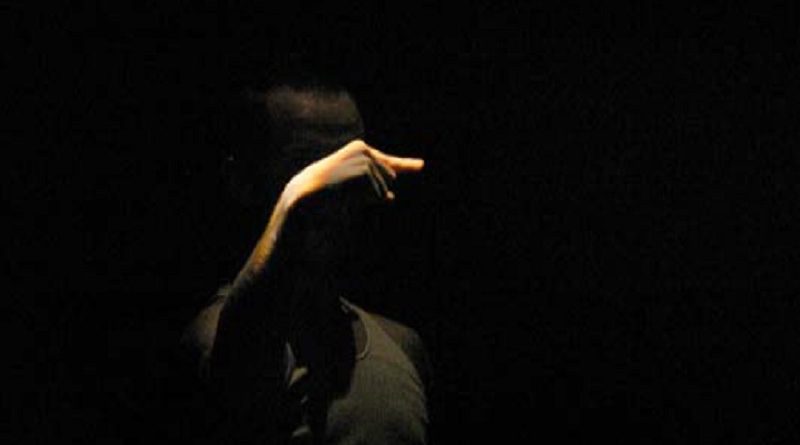
There is much quivering as the two fingers abruptly separate. Hamilton holds his right index finger aloft. The light dwindles until only that finger is illuminated. It is as if the finger has been detached not only from the other dancer but from the organism of which it was a component part. Now it is launchedinto the blackness of space—for the final image of Aether. The finger, undulating, swimming in the void, now suggests not only isolation but a kinetic line of flight. This image seems to attempt an escape from conventional patterns of energy use; it suggests a desire to make a connection that is beyond the orbit of ordinary relations, one that is radically different to the efficient connections demanded by logistical capitalism, a connection that is rather based on affinity, solidarity or mutual support. It suggests a voyage into the unknown. At last, however, unappeased, flowing “senselessly back upon itself” (Worringer 42), the flight breaks off as the light fades. The show is over.
All the nonorganic rhythmic modes discussed in this chapter are present in this final scene: there is speed, machine-like movement and the isolations of the polar rhythm; but in the final moments it is a fourth mode, the deterritorialising fugitive rhythm, that predominates and shifts the aesthetic mood. It is the rhythm of restless, unbounded flight, expressed in the use of an abstract, geometrical form, the sinusoidal wave that animates the finger, which unspools, flowing out into the void. Illuminated in its own spotlight, the line disconnects from any subordinated process or agency. It no longer refers to the duet process from which it emerged, the enforced machinic connection with another finger. The voyager follows again that questing, restless path that Wilhelm Worringer—an art historian frequently referenced by Deleuze and Guattari—calls the Gothic or “northern” line (40). The finger has a will of its own and its movements trace the impulses of a super-organic rhythm and give it life.

Whereas the first three rhythmic modes described in this paper are essentially representational, in as much as they translate the rhythmic impulses propagated on a sociocultural frequency, fugitive rhythms seek to disrupt representational impulses. Not only do they disrupt the representation of the everyday patterns of energy use—the conventions of acceleration, mechanisation and immobilisation—but they also disrupt the moods associated with those patterns. At the beginning of the final duet a machinic rhythm is asserted, one that degrades the duet form and resonates with a “rather bleak” mood. And yet, at the end of the performance, the duet form is dissolved, not restored but abandoned, and the prevailing aesthetic mood is nearer to an unbounded restlessness. It might be felt as an image of bleakness, or it might be felt as an image of a dark vitality, open to infinite possible variations.
Conclusion
The sense of anxiety that predominates in Aether is not uniform; it is part of an affective assemblage with multiple valencies. Nor should this mood be understood as evidence of a desire for a return to communal origins or to a time before the communications revolution. It is, rather, evidence of a desire for new modes of resistance and understanding. Aether does not advocate for a retreat from mediation, or a limit on the use of digital communications technologies. It suggests that a life dominated by the rhythms of acceleration and mechanisation, which can only end in corporeal inertia, is a life of desolation. Such a life requires the absolute alienation of the human organism, or its absolute assimilation with a capitalist logic of access and connectivity.
The anxiety associated with the rhythmic modes identified in this chapter is the anxiety of a fall into a concept of progress that is also a kind of death or sleep. It is the anxiety associated with the thought of capitulating to our devices. Capitulation means living life vicariously, through the nonorganic processes of editing, filtering, tagging, blocking and supervising. The exposed feeling subject is easily overwhelmed. One must either submit to the rhythms of the information deluge or recreate oneself defensively as an inconversable machine: eyes closed tight, as Deleuze and Guattari put it, ears stopped up (Anti-Oedipus 37-8). This cannot, of course, be a complete account of life in the age of accelerated information commodification; but it does register something of the general re-orientation that has taken place in the first decades of the twenty-first century.
The third possibility Guerin depicts is the radical nonorganic extension of the human, a new pattern of energy expenditure that strives for connection and meaning, but also for the expansion of the human toward the more-than-human. In this article, I have tried to show how the deployment of nonorganic rhythms can have a positive affective quality as well as a negative affective quality. Only a concept of the nonorganic that encompasses the attractions of flight will be adequate to Guerin’s particular kinaesthetic imagination and shaping of rhythmic forces. It is through this concept that the combination of fascination and repulsion in the presentation of the nonorganic in Guerin’s work becomes understandable.
Endnote
[1] A recording of the premiere season of Aether is available through the University of Melbourne’s Theatre and Dance Platform. See here. A full performance history of Aether can be viewed through the AusStage database.
Bibliography
Armitage, John, ed. Virilio Live: Selected Interviews. Sage Publications, 2001.
Boyd, Chris. “Lucy Guerin Aether.” The Morning After: Performing Arts in Australia, 29 Nov. 2007. Accessed 28 Nov 2025.
Christofis, Lee. “Present Tense.” Weekend Australian, 8 April 2006, p.16. Accessed 28 Nov. 2025.
Croggon, Alison. “Review: Aether/Brindabella.” Theatre Notes, 7 Dec. 2007. Accessed 28 Nov. 2025.
Cvejić, Bojana. Choreographing Problems. Palgrave Macmillan, 2015.
Deleuze, Gilles and Felix Guattari. Anti-Oedipus: Capitalism and Schizophrenia. Translated by Robert Hurley, Mark Seem. and Helen R. Lane. U Minnesota P, 1983.
———. A Thousand Plateaus: Capitalism and Schizophrenia. Translated by Brian Massumi. U of Minnesota P, 1987.
Gill, Harbant. “Ideas Out of the Aether.” Herald Sun, 14 Mar. 2005, p.73. Accessed 28 Nov. 2025.
Glickman, Stephanie. “Aether.” Herald Sun, 30 Nov. 2007. Accessed 28 Nov. 2025.
Guerin, Lucy (choreographer). Aether: Rehearsal Recording 2 [Rehearsal recording]. 2004. Accessed 28 Nov. 2025.
Guerin, Lucy (choreographer). Aether [Performance recording], 2005.
Haraway, Donna. Simians, Cyborgs and Women: The Reinvention of Nature. Free Association Books, 1991.
Harney, Stefano, and Fred Moten. All Incomplete. Minor Compositions, 2021.
Harris. William. “Female Landscapes.” Village Voice, 20 Feb. 1996. Accessed 28 Nov. 2025.
Lucy Guerin Inc. Aether [Program.] Malthouse Theatre, Southbank, 2007. Accessed 28 Nov. 2025.
Marshall, Jonathan. “Cool Moves.” Inpress Magazine, September 2002. Accessed 28 Nov. 2025.
McDonald, Alex. “Lost in the Aether.” State of the Arts, 7 Mar. 2005. Accessed 28 Nov. 2025.
McNeilly, Jodie. “A Spontaneous Sounding.” RealTime, vol 83, Feb 2008. Accessed 28 Nov. 2025.
Mulready, Rose. “How Lucy Guerin made How to Be Us.” Australian Ballet Blog, 2022. Accessed 18 August 2023.
Rao, Shoba. “It’s a Very Nice Touch.” Daily Telegraph, 28 Jan. 2008, p.67.
Serres, Michel. Genesis. Translated by Genevieve James and James Nielson. U Michigan P, 1995.
Sykes, Jill. “Gravity Bending Performance Gets the Mind Working, too.” Sydney Morning Herald, 25 Jan. 2008. Accessed 28 Nov. 2025.
Usher, Robin. “Projecting messages with meaning.” The Age, 15 Mar. 2005, p.4.
Virilio, Paul. Polar Inertia. Translated by Patrick Camiller. Sage Publications, 2000.
———. The Information Bomb. Translated by Chris Turner. Verso, 2005.
Worringer, Wilhelm. Form in Gothic. Translated by Herbert Read. Schocken. 1964.

*Andrew Fuhrmann is a guest lecturer in the dance department at the University of Melbourne’s Faculty of Fine Arts and Music. He was closely involved in the creation of the Theatre and Dance Platform, a repository of significant Australasian performing arts collections hosted by the University of Melbourne that includes material from the Lucy Guerin Inc archive. He maintains an interest in questions about the creation, expansion and maintenance of performing arts archives in the digital realm. He is currently the dance critic for The Age newspaper in Melbourne.
Copyright © 2026 Andrew Fuhrmann
Critical Stages/Scènes critiques, #33, June 2026
e-ISSN: 2409-7411

This work is licensed under the
Creative Commons Attribution International License CC BY-NC-ND 4.0.
