
Accelerated Rhythms: Performance, Tradition, and Transformation in 21st Century Assamese Theatre
Bhaskar Jyoti Borah*
Abstract
From the gradual rhythms of traditional forms to the dynamic pace of contemporary productions, theatre has continually evolved alongside social and cultural transformations. This paper examines the impact of acceleration—defined as an intensified rhythm in both form and content—on theatrical expression, with a particular focus on twenty-first-century Assamese drama. Drawing on performance theory and cultural studies, it traces the evolution of Assamese theatre from its traditional folk roots to its engagement with new aesthetics, performance modes, and narrative complexities. The study highlights the growing significance of intertextuality and intermediality, as well as fragmented storytelling, rapid scene transitions, and thematic experimentation, as manifestations of cultural acceleration. Through an analysis of selected plays ranging from folk-inspired works to postdramatic experiments, the paper argues that Assamese drama has not only adapted to shifting artistic paradigms but has also emerged as a distinctive theatrical form—rooted in indigenous identity while dialoguing with global performance trends. The research further addresses the often-underexplored domain of theatre management in Assam, positioning it as a critical factor in shaping contemporary productions. Ultimately, this study offers a nuanced understanding of how Assamese theatre exemplifies acceleration in live performance and reflects the cultural dynamics of a rapidly evolving society.
Keywords: Assamese theatre, cultural acceleration, Performance Studies, theatre management
When we speak of drama or theatre, we generally understand them as artistic practices intimately connected with the patterns of everyday social life. Although the terms differ etymologically, drama and theatre have, since their origins, functioned as living art forms shaped by the social and cultural rhythms of the communities in which they emerge. However, the relationship between theatre and social rhythm has not remained historically uniform. Under the conditions of modernity, these rhythms undergo significant transformation, influenced by technological developments, evolving modes of communication, and shifting cultural practices. In this context, Hartmut Rosa’s theory of social acceleration becomes particularly relevant, as it conceptualizes modernity through the intensification and compression of social time. Such acceleration reshapes human behavior, perception, and patterns of interaction—and artistic practices inevitably respond to these changing temporal conditions. Theatre, too, reflects these transformations, revealing novel patterns of change in performance, aesthetics, and meaning.
As one of the most complex of all art forms, theatre is experienced through its applied and audio-visual dimensions, yet it remains profoundly embedded in society. Questions of social consciousness and lived experience therefore continue to shape the essence of theatrical expression. As the theatre theorist Nicoll observes: “Drama is the art of expressing life in such a way that this expression can be interpreted by actors and can engage an audience who gathers to hear the words and witness the actions” (35).
In the context of globalization, performative art forms worldwide have evolved through experimentation and critical engagement. Moving through modernity into postmodernism, Hans-Thies Lehmann’s concept of postdramatic theatre has significantly reshaped the vocabulary of global theatre. Transcending conventional norms, fragmented narrative structures, non-linearity, visual dramaturgy, and performance-oriented approaches have increasingly occupied a central position, surpassing the earlier dominance of character and story. At the same time, the incorporation of modern technological media, multi-layered narrative arrangements, dynamic dramaturgical processes, and intercultural intersections has contributed to a new conceptual framework for contemporary theatre. This framework prioritizes performance over the previously text-centric orientation, foregrounding experiential and visual dimensions. Within this expanded field, the intensification of visuality and technology has pushed theatre into new and broader territories of expression. Lehmann, in his influential book Postdramatic Theatre, emphasizes the significance of this transformation:
Theatre is catching up on an aesthetic development that other art forms went through earlier. It is no coincidence that concepts which originated in visual arts, music or literature can be used to characterize postdramatic theatre… self-referentiality, non-figural, abstract or concrete art, autonomization of the signifiers, seriality, or aleatoric art. (94)
Lehmann’s articulation points towards the emergence of an entirely new vocabulary of theatre. Assamese theatre, too, resonates with this transformation. Through its continuous evolution, Assamese drama has laid the foundations of its modern expression. Within this foundation, we witness a significant shift—from drama to theatre—marking a new phase of transformation in Assamese performance culture.
Assamese drama has evolved through a long historical process that gradually transformed dramatic writing into a broader and more complex understanding of theatre as performance. This evolution may be interpreted not merely as literary development but as a reconfiguration of theatrical practice in response to changing socio-cultural rhythms. Dramatic creation is always shaped by lived experience, collective belief systems, and modes of social interaction. Rituals, customs, and religious performances sustain what may be termed a performative consciousness within society, allowing theatre to emerge from everyday cultural practices. The history of Assamese drama therefore reflects shifting relationships between performance and social temporality rather than a simple chronological succession of plays.
The origins of Assamese theatrical tradition are traced to Srimanta Sankardeva’s Chihna Yatra,[1] which established a foundational connection between religion, community participation, and performance. As Satyendranath Sarma observes:
From the end of the fifteenth century onwards, we find a continuous history of full-length Assamese plays. Since no earlier dramatic texts are available to us, nor do any manuscripts refer to such works, we must consider Chihna Yatra as the first Assamese drama and Srimanta Sankardeva as the first playwright. (1)
The theatrical practices initiated by Sankardeva through Ankiya Naat[2] and Ankiya Bhaona operated within a devotional and community-based temporal structure. Performance unfolded according to ritual cycles rather than theatrical efficiency, emphasizing continuity, repetition, and collective participation. Influences from Sanskrit dramaturgy as well as indigenous traditions such as Ojapali,[4] Dhulia Bhaoria, and Putola Naas reveal that early Assamese theatre emerged from shared cultural rhythms rather than individualized artistic production. Banikanta Kakati’s observation remains significant in this regard: “But the ultimate source of the Assamese drama, divested of outward form, is in all probability the choral performance of the Assamese Oja-Pali. Sankardeva appears to have improved this kind of performance and to have given birth to the Assamese drama” (190).
Such performances may be understood as operating within relatively stable social time, where theatrical experience reinforced communal identity instead of responding to rapid transformation. The continuation of these traditions through Madhavdeva and later Vaishnavite playwrights sustained a performance culture embedded in institutional and religious spaces such as the Sattras,[3] indicating a theatrical system grounded in continuity rather than innovation-driven change.
A major shift becomes evident with the emergence of modern Assamese drama in the nineteenth century. The introduction of colonial education, print culture, and reformist discourse transformed the conditions of theatrical production and reception. Gunabhiram Barua’s Ram-Navami marked a decisive move from ritual affirmation toward socially responsive drama. Theatre increasingly engaged with contemporary concerns such as social reform and public morality, signaling a transition from sacred performance time to socially accelerated cultural participation. Dramatic writing began to respond more directly to ongoing societal transformations, compressing both narrative structure and thematic focus.
The subsequent proliferation of mythological and historical drama during the late nineteenth and early twentieth centuries reflects not merely a return to tradition but an effort to reinterpret the past within an emerging modern consciousness. Playwrights such as Jyotiprasad Agarwala expanded the theatrical imagination by integrating dramaturgical experimentation with socio-historical reflection, gradually shifting Assamese drama from literary narration toward performative visualization. Theatre thus began adapting to changing modes of spectatorship and public engagement, aligning performance with evolving cultural rhythms.
After independence, Assamese drama entered a phase of intensified transformation. As Shailen Bharali notes: “After independence, the themes and techniques of Assamese drama changed rapidly. The political and social transformations, deeper understandings of life and society, and the influence of Western intellectual currents reshaped the nature of Assamese drama in every decade” (7).
This period demonstrates an increasing acceleration of aesthetic change, as playwrights such as Satya Prasad Barua, Phani Sharma, and Arun Sharma experimented with realism and modern dramaturgical techniques while negotiating indigenous performance traditions. Bharali’s clarification regarding the limits of absurdist classification further indicates that Assamese drama retained structural coherence even while engaging with modern experimentation:
Some critics, observing the eccentric behaviour of Nibaran or the scene where he delivers a speech before empty chairs, classify the play as absurdist. But such elements alone cannot place a play within the absurd tradition. In contrast to absurd drama, this play maintains coherence, harmony, and meaningfulness, with a well-structured narrative developed through logical dialogue. (7)
The emergence of the “back to the roots” movement represents another crucial moment in this historical process. Rather than functioning solely as cultural revivalism, this movement may be interpreted as an adaptive response to rapidly modernizing artistic environments. Folk traditions such as Ojapali, music, movement practices, and regional performance vocabularies were recontextualized within modern staging practices. Emphasis gradually shifted from literary text toward rhythm, sound, and bodily expression, indicating a transformation in theatrical perception itself.
In the twenty-first century, Assamese theatre increasingly operates within accelerated cultural conditions shaped by globalization, technological mediation, and transnational exchange. Contemporary productions integrate adaptation, intermediality, visual imagery, and hybrid dramaturgical strategies, reflecting changing modes of audience perception. The incorporation of multimedia elements, pastiche, and interdisciplinary performance practices demonstrates how theatrical space and time are compressed to respond to contemporary experiences structured by speed and immediacy.
Recent productions employing visual projection, adaptation, and experimental staging reveal the growing presence of post dramatic tendencies within Assamese theatre. These developments do not signify a rupture from tradition; rather, they illustrate how inherited performative forms are reconfigured within accelerated modern contexts. Assamese theatre today negotiates continuity and transformation simultaneously, where ritual memory coexists with technologically mediated performance languages.
Viewed through this perspective, the evolution of Assamese theatre reveals a movement from ritual duration toward accelerated performance culture. Changes in dramaturgy, staging logic, narrative structure, and audience engagement collectively demonstrate how Assamese theatre has undergone acceleration in both aesthetic form and experiential rhythm, positioning contemporary practice within wider global transformations of theatrical modernity.
Building upon these transformations, the accelerated rhythm of twenty-first-century Assamese theatre becomes most visible in contemporary performance practices. The shifts in dramaturgy, staging techniques, and modes of perception discussed above find concrete expression in several recent productions that negotiate tradition, modernity, and mediated performance languages. Among the plays that have significantly contributed to redefining the performative tempo of contemporary Assamese theatre, several productions may be identified. However, for analytical clarity, the present discussion focuses on three representative works: The Old Man (2019), directed by Sahidul Haque; Erendira’s Metamorphosis (2022) by Mrinal Jyoti Goswami; and Mask: The Image (2019) by Ashim Kumar Sharma.
These plays exemplify how Assamese theatre responds to accelerated cultural conditions through experimentation in form, narrative structure, and visual dramaturgy. In particular, Sahidul Haque’s The Old Man provides a crucial entry point for examining the evolving rhythm of twenty-first-century Assamese performance. Through its adaptive strategies, staging language, and reconfiguration of narrative time, the production reflects the changing dynamics of theatrical experience shaped by contemporary modes of perception and performance.
Director Sahidul Haque compellingly stages the adaptation of Ernest Hemingway’s renowned novella The Old Man and the Sea, as adapted by Diksamani Bora. In adaptation theory, Linda Hutcheon emphasizes that adaptation involves a transformation from one medium to another, observing that “adaptation is repetition, but repetition without replication” (7). This principle highlights how adapted works generate new cultural meanings.
This transformation can occur across literature, art, or other expressive media. The adaptation by Diksamani Bora, brought to life on stage by Haque, exemplifies this principle. Based on Hemingway’s novella, the Assamese version transforms the title to The Old Man. Opposite Santiago, the elderly protagonist of the original, the director portrays Bhodiya—a rural, vulnerable figure from Assamese life—as the central character. Through this staging, the director enacts a process akin to localisation, rooting the narrative in a distinct Assamese cultural context.
The director establishes a relationship between the helpless Santiago of 84 days at sea and Bhodiya in the context of the river. The bond between humans and rivers is eternal. To establish this connection, the director employs the Brahmaputra River[5] —deeply rooted in Assamese social life—as a metaphor.
Brahmaputra is the lifeline of Assamese society. Along with this river lie countless stories and struggles passed down through generations. Its swelling waves often bring both joy and sorrow into people’s lives. Amid this rhythm of joy and sorrow, the director sketches Bhodiya.
Bhodiya is a character born of this river. This character is real; it contains no trace of fantasy or imagination. For 84 days, Bhodiya has been fishing in this river but has been unsuccessful. Exhausted in body and spirit, yet Bhodiya does not give up. He once again dedicates himself to the river, determined to catch fish. On the 84th day, he succeeds in catching a large fish. But while returning home, he is attacked by an unknown enemy. Struggling against loneliness and emptiness, Bhodiya is inspired to fish by Rongmon, though Rongmon retreats midway after seeing Bhodiya’s helpless state. Yet, after the unfortunate incident on the 84th day while returning with the fish, Rongmon once again motivates Bhodiya to go back to the river and fish.

As a character, Bhodiya is helpless and lonely. Age weighs heavily on his body, yet in thought and endurance he is a symbol of courage. The director does not restrict him to a single character; rather, Bhodiya assumes a symbolic meaning, representing the struggles of marginalised people on stage. He is a living narrative through which the director foregrounds the plight of the oppressed and exploited in contemporary society. In this system lie countless characters like Bhodiya, isolated, yet their spirit of resistance remains unconquered by time. This steadfast patience is seen in many resisting individuals throughout their lives. Those who rise above these hostile circumstances emerge victorious. Bhodiya is one such example.
The director has staged the play entirely on a regional foundation. Although adapted from a renowned English novella, the director has not incorporated any Western style or form in the staging. From English to Assamese, the play has undergone such a deep adaptation that it seamlessly blends into Assamese folk life and acquires a renewed transformative identity. This transformation is successful because it creates a kind of intertextuality without fragmenting the original story. That is, the text of the play is entirely intertextual, connecting both sources. Through its adapted text, the performance offers a visual narrative. This visual narrative creates a meaningful image that embraces the concept of pastiche. As Julie Sanders notes, “Adaptation and appropriation involve a transposition of a source text and a creative and interpretive act of re-vision, which may produce new perspectives” (2).
The driving force behind any theatrical performance lies in the dramatic form shaped and articulated through the director’s vision. In The Old Man, Sahidul Haque constructs this vision through a scenographic canvas that functions almost like a montage. Even before the formal beginning of the play, the supporting actors enter the stage and begin narrating the adapted story directly to the audience. Initially, they appear as spectators within the performative space; gradually, they assume specific roles, dissolving the boundary between observer and character. This fluid transformation establishes a rhythm of performance that resists static realism.
At the centre of the stage stands a simple wooden box. From within this box emerges Bhodiya, the protagonist. The box operates as a mutable symbol: at one moment it becomes Bhodiya’s fragile thatched hut, and at another it transforms into the boat that carries him into the depths of the Brahmaputra. Through this single prop, the director generates multiple spatial layers without altering the physical set. The scenographic economy thus produces a rapid oscillation between hut, river, and boat, compressing spatial transitions into a continuous theatrical flow.

This montage-like construction, combined with swift scene shifts and symbolic condensation, shortens narrative duration while intensifying experiential density. The audience is not granted temporal pauses between locations; instead, they are drawn into an accelerated rhythm where space transforms before their eyes. In this sense, the staging embodies what Hartmut Rosa describes as the “densification of experience,” where multiple layers of action, space, and meaning are compressed into a heightened present. Acceleration here is not merely thematic but becomes a structural principle of performance, manifested through scenographic minimalism, role-switching, and rhythmic transitions. The result is a theatrical language in which the changing tempos of contemporary life find expression through the visual and spatial dynamics of the stage.
Similarly, to represent the foamy ripples and waves of the Brahmaputra, the director uses simple pieces of white paper arranged in the form of a collage. Through this modest yet imaginative device, the river is not realistically recreated but symbolically suggested. This choice reflects the director’s confidence in theatrical language, where minimal elements are capable of producing powerful visual meaning. The stage thus becomes a space where ordinary material transforms into a poetic image.
Such minimal scenography strengthens the aesthetic foundation of the play. Instead of depending on elaborate sets, the production relies on symbolic suggestion, allowing scenes to shift fluidly from one emotional state to another. This fluidity generates a sense of immediacy in performance. The spectator is not distracted by excessive realism; rather, attention is directed toward the rhythm of action and image. In this way, the aesthetic experience becomes transformative, resonating with Fischer-Lichte’s idea that performance creates a liminal space in which transformation may occur without being rigidly defined (2). At the same time, the condensation of visual elements intensifies the pace of perception. The simplicity of stage properties enables quicker transitions and sharper emotional impact, thereby deepening the spectator’s engagement with the unfolding action.
The Old Man is deeply rooted in Assamese folk life, and in order to bring this lived reality to the stage, the director constructs a series of constantly shifting scenes. As the narrative unfolds, the audience witnesses frequent spatial and emotional transitions. Yet beneath these changes, the core story remains unified- only a character like Bhodiya possesses the endurance to carry this lifelong struggle across the flowing currents of the river. To embody this continuity within movement, the director firmly situates Bhodiya at the centre of the dramatic structure.
Alongside him stands Rongmon, who functions as an inner narrator of the story. Rongmon is not presented as a conventional realistic character; rather, he comes alive through performance. The director’s decision to represent Rongmon through a puppet is particularly significant. This choice distances the character from strict realism and opens a layered mode of narration. Rongmon does not signify merely one individual; he becomes a broader presence – an emotional and symbolic companion in Bhodiya’s isolation. In moments of despair, Rongmon’s presence offers strength and continuity. He represents those invisible yet enduring connections within society that survive even in fragmentation. Like Bhodiya, Rongmon becomes a metaphor for resilience.
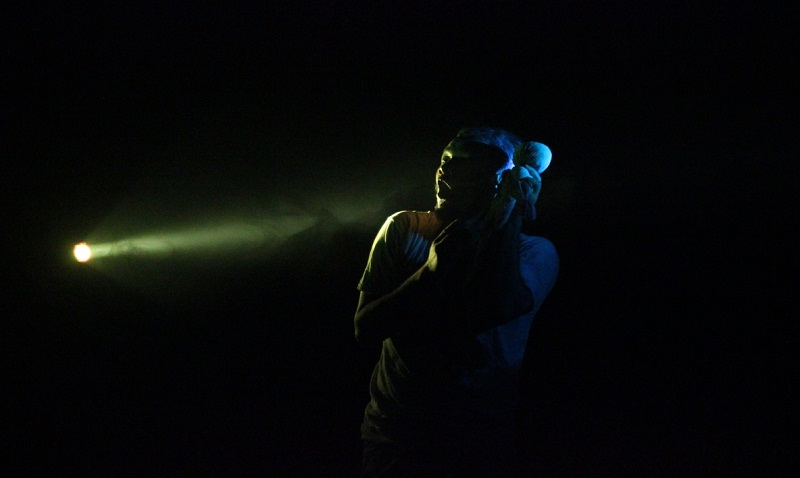
At the same time, the use of a puppet as narrator subtly alters the temporal structure of the play. The interaction between Bhodiya and Rongmon creates overlapping narrative planes—memory, reflection, and present action coexist within the same performative space. This layering disrupts linear continuity and produces a sense of simultaneity. The story no longer moves in a straightforward progression; instead, it unfolds across multiple temporal registers. Such structuring contributes to an accelerated narrative rhythm, where time is condensed and reconfigured within performance itself. Through this device, the director not only deepens symbolic meaning but also shapes a theatrical language that reflects the dynamic and layered sensibility of contemporary storytelling.

The other actors in the play do not represent only fixed characters. Instead, the director creates a multi-dimensional system of representation through them. In each scene, the actors appear in different roles, sometimes as Bhodiya’s friends, sometimes as the waves of the river. These characters act as mediums through which, using a devised form, they paint the picture of Bhodiya’s struggle to fish in the Brahmaputra. Through this river resonates the songs of folk life, which the director presents with great subtlety. On the other hand, through the appropriate use of lighting, the director paints on stage a vivid image of the Brahmaputra as we encounter it in real life. The director breaks through the river’s vastness to create for the spectator an image that transforms the enduring relationship between Bhodiya and the river into a powerful metaphor. This staging element reshapes the aesthetic fabric of the play into a distinct form. Through this visual language, Bhodiya—though a character from a remote corner of Assam—achieves a universal resonance. In conclusion, it can be said that Sahidul Haque’s The Old Man not only advances the performance style of Assamese theatre but also establishes its own unique theatrical language within its landscape.
In recent times, a new conceptual and stylistic approach—Postdramatic Theatre—has begun to emerge in Assamese theatre. This approach has gained considerable prominence largely through Mrinal Jyoti Goswami’s play Erendira’s Metamorphosis. Within the domain of experimental Assamese theatre, Goswami also stands out as a significant director. A closer examination reveals that although Assamese drama has long been influenced by Western traditions, theoretical frameworks entered its discourse relatively late. As Assamese theatre moved along the trajectory of modernism, it gradually engaged with new ideas tested through the methodologies of a theatrical laboratory, eventually encountering postmodernism. In this context, Goswami’s work reflects a sustained engagement with such evolving ideas. Through intertextuality, diverse narrative structures, and the incorporation of folk narratives, he undertakes a range of formal experiments. His plays do not merely guide the reader toward performance but also invite the construction of a visual world through the text itself.
In this regard, Mrinal Jyoti Goswami’s Erendira’s Metamorphosis (2023) assumes particular importance. Postdramatic Theatre, as a concept, does not seek to abolish dramatic theatre; rather, it emerges as a subsequent stylistic formation that reconsiders and reorganizes its principles. The tendencies later identified as postdramatic began to surface internationally during the 1970s and 1980s, notably in experimental collectives such as the Wooster Group, which challenged conventional structures of narrative and representation. Hans-Thies Lehmann subsequently provided a theoretical articulation of these evolving practices in his influential study Postdramatic Theatre. By employing the term “postdramatic,” Lehmann designates a mode of performance that shifts attention away from mimetic representation and questions the dominance of the written dramatic text as the governing centre of theatrical production. As he observes, postdramatic theatre “no longer organizes the performance according to a single textual hierarchy” (46).
Although Lehmann’s formulation predates the present phase of intense digital and technological transformation, his emphasis on fragmentation, simultaneity, and the decentralization of meaning anticipates many features of today’s accelerated performance cultures. In the contemporary Assamese context, such strategies operate within a wider condition shaped by media expansion, rapid circulation of images, and heightened cultural exchange. Fragmented structures and multi-layered narration are no longer merely aesthetic experiments; they resonate with a broader tempo of social and cultural life. Thus, in Erendira’s Metamorphosis, postdramatic devices do not function in isolation but participate in an accelerated dramaturgical rhythm that reflects the changing conditions of twenty-first-century performance practice.
Instead of a monolithic system, this style presents a multi-textual landscape. In Dramatic Theatre, we generally see various elements arranged systematically within the perimeter of the story. This often creates certain limitations in performance, distancing the audience from a holistic dramatic understanding. In contrast, postdramatic theatre maintains a balance between different theatrical elements such as dialogue, image, and action, thereby creating a performance process that becomes more engaging and meaningful for the audience. This approach transforms drama into a form of visual treatment. The impact of postdramatic theatre is clearly visible in Mrinal Jyoti Goswami’s Erendira’s Metamorphosis. This experimental play significantly accelerates the trajectory of 21st-century Assamese theatre.
Based on Gabriel García Márquez’s 1972 novella La increíble y triste historia de la cándida Eréndira y de su abuela desalmada (translated into English as The Incredible and Sad Tale of Innocent Eréndira and Her Heartless Grandmother), Mrinal Jyoti Goswami constructed the performance text of Erendira’s Metamorphosis. The novella tells the story of 12-year-old Eréndira, who, while living with her grandmother, accidentally causes a fire that destroys their house. The grandmother holds Eréndira responsible and decides to recover the loss by selling her into prostitution. In this way, Eréndira becomes a victim of sexual exploitation, while the grandmother remains indifferent to this repeated abuse. Thus, young Eréndira becomes a living testament to a power-game. This is the fundamental storyline of the novella. Goswami transforms this narrative of exploitation into the dramatic structure of Erendira’s Metamorphosis.
To bring the story to the stage, the director employs the device of narration. The performer assumes the role of a meta-narrator, unfolding Eréndira’s story directly before the audience through performance. This strategy reinforces the play’s postdramatic quality. In postdramatic theatre, emphasis shifts from strict fidelity to the written text toward the material presence of the actor and the conditions of staging. Meaning thus emerges not solely from dialogue but from the performative act itself. In this framework, the narrator becomes central, functioning as the living medium through which the dramatic world is both shaped and conveyed.
Another important feature of postdramatic practice is the use of fragmented and non-linear textual structures, a tendency clearly reflected in Erendira’s Metamorphosis. Although a single performer carries the narrative, the story does not unfold in a conventional linear progression. Instead, episodes are arranged to layer memory, commentary, and action within the same performative frame. The narrator does not merely recount events but actively reorganizes them in performance, rendering temporal continuity fluid. Past and present intersect, and episodic incidents are condensed into concentrated theatrical moments. This condensation does not rely solely on speed; rather, it intensifies experience by increasing narrative density. Through this structuring, the performance generates a heightened rhythm in which multiple strands of the story are revealed within a compressed theatrical time, thereby producing a distinct sense of acceleration within the dramaturgy.
When discussing the performance style of a play, stage management inevitably becomes a central concern. In this respect, Erendira’s Metamorphosis reflects Mrinal Jyoti Goswami’s distinct theatrical vision. One of its most striking features is the deliberate conception of stage architecture. In many directorial practices, the architectural dimension of space is often treated as secondary to acting, lighting, or textual interpretation. Productions may be meticulously developed in terms of performance elements, yet spatial organization is not always integrated as a foundational principle of staging. Such an approach reveals a limited understanding of the total theatrical composition. In reality, space is not merely a backdrop; it actively shapes and conditions the dynamics of performance.
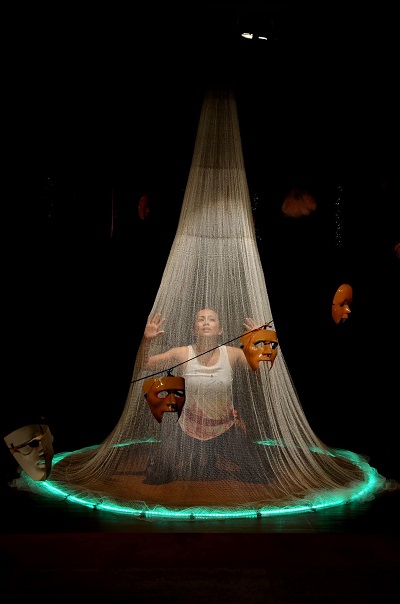
In this production, the controlled and carefully measured use of space becomes integral to the dramaturgy. The restricted spatial arrangement intensifies the performer’s physical presence and sharpens the focus of the audience. Movement within a confined area acquires greater significance, and each gesture carries heightened expressive weight. As a result, the spatial design regulates the tempo of the performance. Rather than allowing action to disperse across an expansive stage, the compression of space generates a concentrated rhythm of interaction between performer and spectator. This spatial concentration produces a heightened immediacy, accelerating the exchange of energy within the performance environment and deepening the experiential impact of the play.

The conceptual design of a play may not always suit every stage. Yet Mrinal Jyoti Goswami makes no compromises. He constructs the stage’s architecture exactly as envisioned in the design, presenting Erendira’s Metamorphosis on a carefully chosen specific stage. This thought process enriches Assamese theatre with a fresh understanding of stage and space. While this creates a limited canvas, it also restricts the possibility of a larger one. Even so, this spatial idea harmonizes with the overall theatrical structure. Secondly, the properties used in the play add a distinct dimension. The director uses props that are integral to the storyline from beginning to end. Most importantly, these properties maintain coordination with the actor. Many directors forget that props and lighting are themselves characters within a play. Without balance, the entire theatrical structure may suffer.
Performance and acting constitute another essential element in Erendira’s Metamorphosis. Lehmann makes a crucial observation regarding acting in postdramatic theatre: “The action of the artists is designed not so much to transform a reality to them and communicate by virtue of the aesthetic treatment, but rather to strive for a self-transformation” (137). Here, “self-transformation” carries a profound meaning. The actor’s goal is not merely to perform; the performance must emerge from a process of transformation. Without such inner transformation, the artistic truth cannot be reached by breaking through superficial layers. The main actor of Erendira’s Metamorphosis, Namrata Sharma, under Goswami’s direction, successfully overcomes this complexity and renders her performance with remarkable ease and depth. Many plays use elaborate lighting merely to create spectacle, rendering it detached from the central narrative. In contrast, Goswami employs minimal, everyday lighting in a way that elevates the entire performance into a successful example of postdramatic theatre. This play not only brings the concept of postdramatic theatre into Assamese theatrical practice but also opens a new avenue for discourse in Assamese theatre studies.
On the other hand, a distinct concept of intermediality has increasingly emerged in twenty-first-century Assamese theatre. In one of his significant essays, Chiel Kattenbelt defines intermediality as “the co-relation of media in the sense of mutual influences between media” (21). Contemporary Assamese theatre is no longer centred on a single form; rather, the incorporation of technology and digital media has become increasingly visible. Although this practice is not yet widespread, its impact has introduced a new dimension to theatrical expression. Technology has gradually evolved into a medium of storytelling in its own right, initiating a discourse of intermediality within Assamese theatre in which different media interact and reshape the structure of performance. Through the deployment of specific media forms, the director presents the narrative to the audience, at times allowing the medium itself to function as a narrator. In certain instances, media even assumes the role of a character within the theatrical framework. This development has significantly expanded the aesthetic possibilities of Assamese theatre and contributed to a transformation in its performative rhythm.
An important play influenced by this intermedial tendency is Ashim Sharma’s Mask: The Image (2019). The subject of the play revolves around nature and the planet. Through the incorporation of projected media, the director portrays how humankind has exploited the earth for its own benefit, how plastic and waste has polluted the environment, and how climate change has become a global concern. The title Mask: The Image itself is layered in meaning. On one hand, the play carries symbolic resonance aligned with its ecological theme; on the other, its visual world is literally constructed through mediated imagery projected onto a white cyclorama. From beginning to end, video projections accompany each scene. Parallel to this, actors perform on stage through a collective devised process. Their performance is multidimensional, yet it unfolds in constant interaction with the media projected behind them. In this sense, the media does not remain a passive backdrop; it becomes an integral component of theatrical organisation, functioning almost as a parallel presence within the dramatic structure.

In a broader cultural context marked by increasing speed of communication and visual transmission, media technologies operate at a tempo that often exceeds embodied human interaction. When digital projection enters Assamese theatre, it introduces this technological rhythm into live performance. The coexistence of the actor’s organic bodily presence and the immediacy of digital imagery create a palpable tension on stage. This tension generates a heightened theatrical tempo, where live action and mediated image intersect and overlap. Such interplay reflects the conditions of an accelerated society, in which artistic expression is shaped by rapid circulation of images and intensified modes of perception. Thus, intermediality in contemporary Assamese theatre not only broadens aesthetic expression but also embodies the shifting temporal dynamics of the present cultural moment.

This concept of intermediality links the play simultaneously to technology and art, positioning media as a central component. Sections driven by animated videos advance the narrative while generating new visual imagery, making complex issues more accessible to the spectator.
Beyond Ashim Sharma’s Mask: The Image (2019), similar use of media can be observed in plays such as Rabijita Gogoi’s Technicolor Dream 2 (2009), Deepjyoti Kakoti’s Xobdor pora Nixobdoloi (2014), Pankaj Chetia’s Dilemma (2017), and Mrinal Jyoti Goswami’s A River’s Tale (2024). These performance styles have markedly accelerated and enriched the rhythm of twenty-first-century Assamese theatre.
Endnotes
[1] Chihna Yatra, created by the fifteenth–sixteenth century Vaishnavite saint-reformer Srimanta Sankardeva (c. 1468), is regarded as the earliest known theatrical performance in Assam and a precursor to Ankiya Naat. Conceived as a devotional performance depicting the Sapta Vaikuntha (seven celestial realms), it integrated painted scenic backdrops, music, dance, narration, and stylized enactment. The production combined multiple performative elements under a single directorial vision, establishing an early multimedia form within the Assamese Bhakti movement, although the original script has not survived.
[2] Ankiya Naat refers to the devotional one-act plays introduced by the fifteenth–sixteenth century Vaishnavite reformer Srimanta Sankardeva and later developed by Madhavdeva, who described similar performances as Jhumura. Composed primarily in the Brajavali language and centred on Krishnaite narratives, these plays combine music, dance, narration, and stylized acting within a ritual framework. Their staged performance is known as Bhaona, traditionally presented in community prayer spaces (Namghar) and guided by the Sutradhar, who functions simultaneously as narrator and director, emphasizing collective religious experience rather than commercial theatrical production.
[3] Sattras are Neo-Vaishnavite monastic and socio-cultural institutions established in Assam during the fifteenth–sixteenth centuries by Srimanta Sankardeva and his disciples for the propagation of Ekasarana Vaishnavism. Functioning as centres of religious practice, education, and community life, they have played a vital role in preserving Assamese performing traditions such as Ankiya Bhaona, devotional music, and Sattriya dance through collective and continuous modes of performance transmission.
[4] Ojapali is a traditional Assamese narrative performance form that combines storytelling, music, rhythmic movement, and stylized enactment. Led by a principal performer known as the Oja and supported by accompanying performers (Palis), it presents episodes drawn mainly from Hindu epics and Puranic narratives. Often regarded as a quasi-dramatic folk form, Ojapali is considered an important performative precursor that influenced the development of early Assamese theatrical traditions.
[5] The Brahmaputra one of Asia’s major transboundary rivers flowing through Tibet, India, and Bangladesh, holds profound ecological and cultural significance in Assam, where it is also known as Luit. Beyond its geographical presence, the river deeply shapes Assamese social life, imagination, and artistic expression, frequently functioning in literature and performance as a symbol of continuity, struggle, displacement, and collective memory.
Bibliography
Barua, Satyaprasad. Natak Aru Abhinay Prasanga. Lawyers Book Stall, 1967.
Bharali, Shailen. Natak Aru Axomia Natak. Chandra Prakash, 2020.
Bhattacharyya, Harishchandra. Asomiya Natya Sahityar Jiligoni. Lawyers Book Stall, 2011.
Brecht, Bertolt. Brecht on Theatre: The Development of an Aesthetic. Edited and translated by John Willett, Eyre Methuen, 1974.
Chapple, Freda, and Chiel Kattenbelt, editors. Intermediality in Theatre and Performance. Rodopi, 2006.
Fischer-Lichte, Erika. The Transformative Power of Performance: A New Aesthetics. Translated by Saskya Iris Jain, Routledge, 2008.
Hazarika, Atul Chandra. Manchalekha. Lawyers Book Stall, 1995.
Hutcheon, Linda. A Theory of Adaptation. 2nd ed., Routledge, 2013.
Kattenbelt, Chiel. “Intermediality in Theatre and Performance: Definitions, Perceptions and Medial Relationships.” Cultura, Lenguaje y Representación / Culture, Language and Representation, vol. 6, 2008, pp. 19–29.
Lehmann, Hans-Thies. Postdramatic Theatre. Translated by Karen Jürs-Munby, Routledge, 2006.
Lyotard, Jean-François. The Postmodern Condition: A Report on Knowledge. Translated by Geoff Bennington and Brian Massumi, University of Minnesota Press, 1984.
Mahanta, Pona. Natakar Rang-Rup. Assam Publication Board, 2008.
Oddey, Alison. Devising Theatre: A Practical and Theoretical Handbook. Routledge, 1994.
Pathak, Dayananda. Asomiya Natak Aru Pachatya Prasanga. Lawyers Book Stall, 1996.
Pathak, Ramesh. Natak Aru Natak. Bookland, 1991.
Pavis, Patrice. Dictionary of the Theatre: Terms, Concepts, and Analysis. Translated by Christine Shantz, University of Toronto Press, 1998.
Rajbanshi, Parmananda, and Nasifa Islam Rajbanshi, editors. Asomiya Natya Sahitya: Parampara Aru Parivartan. Assam Publication Board, 2007.
Rosa, Hartmut. Social Acceleration: A New Theory of Modernity. Columbia University Press, 2013.
Sanders, Julie. Adaptation and Appropriation. 2nd ed., Routledge, 2016.
Schechner, Richard. Performance Theory. Revised and expanded ed., Routledge, 1988.
Sharma, Mukunda Madhav, editor. Bharatar Natyashastra. Asom Natya Sanmilan, 1991.
Sharma, Satyendranath. Axomia Natya Sahitya. Jonaki Prakash, 1962.

*Bhaskar Jyoti Borah is a theatre practitioner and a dedicated research scholar at Tezpur University. He is the Founder-Director of Naatghar Majuli, one of Assam’s leading theatre groups and socio-cultural organizations, and serves as the Director of the Naatghar Majuli Theatre Festival, which brings together theatre practitioners from across India and abroad. Borah has directed numerous notable plays and has contributed significantly to Assamese theatre, earning recognition on national platforms such as the National School of Drama, Sangeet Natak Akademi, All India Radio, and various State Departments of Art and Culture under the Government of India. In 2023, he was awarded the Anirban Youth Achievement Award for his contributions to the performing arts. His work spans performance, research, and publication, with presentations at both national and international seminars. Known for his dedication, professionalism, and passion for theatre, he continues to promote Assamese culture and mentor emerging theatre artists.
Copyright © 2026 Bhaskar Jyoti Borah
Critical Stages/Scènes critiques, #33, June 2026
e-ISSN: 2409-7411

This work is licensed under the
Creative Commons Attribution International License CC BY-NC-ND 4.0.
