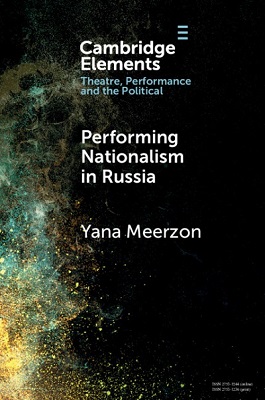
Performing Nationalism in Russia
By Yana Meerzon
Cambridge University Press, 2024, 88 pp.
Reviewed by Alisa Ballard Lin*
Performing Nationalism in Russia is both an odd and a fully apt title for Yana Meerzon’s book on Russian theatre after Russia’s February 2022 full-scale invasion of Ukraine that has led to a destructive, ongoing war. The title is odd because many of the performances Meerzon discusses resist the Russian state’s dangerously nationalist drive: in these works, state nationalism is not performed but is confronted through performance. Meanwhile, Meerzon does give attention to Russian President Vladimir Putin’s oppression of theatre and to the resulting performances (often propaganda events) that indeed perform Putin’s version of nationalism. Meerzon’s title becomes especially smart and relevant, however, given her analysis of how so many protest performances not only denounce state nationalism but also envision new, kinder, more inclusive nationalisms that would uplift and strengthen the diverse communities within Russia’s borders. In other words, this is a book of hope and inspiration, as much as it is a book of crushing darkness.
The book joins the Elements in Theatre, Performance and the Political series edited by Trish Reid and Liz Tomlin for Cambridge University Press. Its placement in this series and adherence to the requisite compact length are fully effective. Performing Nationalism in Russia productively examines the nation’s various points of contact between performance and the political over the past few years, proving that in Russia today, performance cannot escape state politics, while the state seems ever anxious about performance. The brevity of the book, with the leftover space it implies for events not yet transpired, speaks to the continually unfolding nature of this timely topic, day by day.
Meerzon’s introduction contextualizes the book’s goal, which she states as the follows: “This Element reflects this moment of catastrophe [Russia’s 2022 invasion of Ukraine] and documents the performative practices of nationalism and resistances to it that have been building in Putin’s Russia . . . Contemporary Russia is hostage to propaganda, partisan interpretations of its own history, and general political passivity” (2). Meerzon acknowledges that Ukrainians have been the direst victims of Putin’s aggression (and oppression), but her focus is different, and equally crucial for scholars: the destructive effects of Putin’s authoritarianism on the home front.
The introduction also offers the first installment in one of the most widely useful components of this book: Meerzon’s careful synthesis of the chaotic developments in Russian censorship of speech and of the arts, particularly since February 2022. Meerzon also provides a succinct and readable examination of Putin’s nationalist ideology as it has developed since he was first elected president in 2000. Her assessment of the state of political theatre in Russia today is clear: almost all forms of critique, questioning, and resistance are impossible on Russian stages. If previously theatre constantly negotiated with the authorities over what might be possible, now the Russian theatre is tightly straitjacketed. This peculiar, harrowing phenomenon in itself makes Meerzon’s astute analysis instructive for scholars of political theatre worldwide.
Chapter 1, “Performing Institutional Nationalism,” examines the state-endorsed performances that further the Russian nationalist agenda. These include public commemoration practices, often centered on the Russian victory in World War II; Putin’s own speeches; major, televised concerts; and the Eurovision and Olympic self-presentations of Russia to the world. Meerzon exposes the pervasiveness of Putin’s propagandistic mobilization of performance, as well as the long-developed ideological nuances that shape those performances and which regularly borrow from the practices of Joseph Stalin.
This is followed by chapter 2, “An Enfant Terrible of Russian Nationalism,” which begins Meerzon’s case studies of theatre projects that challenge the nationalist narratives. Meerzon’s focus here is the world-famous director Kirill Serebrennikov, who has endured numerous obstacles in attempting to stage politically subversive works in Russia. Namely, Serebrennikov underwent house arrest beginning in 2017, followed by a public trial in 2020, all on spurious charges. In spring 2022 he joined the many anti-war artists who left the country. Meerzon argues that “the director fell victim to his own artistic project of resistance to nationalism.
Provocation—artistic, political, personal—is Serebrennikov’s signature style” (23–24). In that vein, Meerzon traces lines of provocation through Serebrennikov’s work, analyzing details of performances including Stalin’s Funeral (2016) and The Nose (2021), directed over Zoom. She concludes that under Putin, “an artist like Serebrennikov can be only in prison, in exile, or in the wings” (34).
Chapter 3, “Myth-Making and Myth-Breaking of Nationalism,” examines documentary theatre’s resistance to the ethnonationalist myths propagated by the Russian state, manifested in the state’s long co-option of historical narratives, sites, and memorials. Documentary theatre, through its fresh engagement with historical documents, “turns historical memory into a political statement and problematizes the tropes of ethnonationalism” (35). While numerous documentary theatre practices emerged in Russia from the late 1990s, Meerzon looks at the works of Anastasia Patlay and Nana Grinstein, which spotlight marginalized communities in juxtaposition to ethnonationalist narratives. Meerzon closely analyzes the directing pair’s final production in Moscow before they left Russia in response to the war. This production, Memoria (2022), investigates the closure of the major Russian human-rights organization Memorial. Meerzon shows that Patlay and Grinstein break apart state mythology by using Brechtian techniques to dig deeply into the history of Memorial, revealing unreported facts alongside the gaps in documentation that show the limitations of historical narrative.
In chapter 4, “Staging the Other: Contesting Nationalism,” Meerzon turns to performances that challenge the state’s long history of racism, misogynism, and religious intolerance through methodologies resonant with Madina Tlostanova’s concept of “decolonial aestheSis.” Meerzon analyzes Nuria Fatykhova’s Avazlar (2020), produced in the Russian city of Kazan, the capital of the semi-autonomous Republic of Tatarstan, where around half the population are ethnic Tatars and/or Muslims. The production critiques Soviet myths of interethnic equality and harmony within the vast nation by engaging in Tlostanova’s idea of a decolonial reinstatement of oppressed, non-European former Soviet communities through resistance art. Meerzon explains the history and context for the state’s increasing oppression of minorities, revealing the urgent significance of Avazlar, which foregrounds the Tartar language, systematically suppressed by the state among today’s younger generations. Meerzon concludes the chapter with theatre that reflects on traumas of internal migration, including work by Olzhas Zhanaidarov, which draws on Zhanaidarov’s own experiences to reveal the common racism and cruelty toward internal migrants, including enslavement.
Meerzon concludes the book with further details of the frightening censorship that Putin initiated in 2022. In the first criminal case against artistic expression under Putin, director Zhenya Berkovich and playwright Svetlana Petriichuk were charged with terrorism for their Finist the Brave Falcon (2020), a feminist work about young Russian women groomed by Islamic terrorists only to be imprisoned in Russia when they finally leave their ISIS husbands. The production’s call to empathy, writes Meerzon, traverses the productions in this book: “[Empathy] has been used variously as a strategy to undermine, problematize, challenge, and complicate the worst simplifications and excesses of Putin’s nationalist project” (69). In other words, these rebellious theatre artists champion positive, equitable, inclusive, empathy-based concepts of community that serve as radically new versions of Russian nationalism. Meerzon’s final lines are equally quotable, in as much as they shrewdly assess theatre’s dire persecution in Russia today: “As history teaches us, . . . in Russia, life tends to imitate art, and it may not be too long before Putin’s performance of power transforms fully into wholesale aggression and oppression of the people” (70).
In Performing Nationalism in Russia, Meerzon has produced an immensely valuable, thoughtful, thoroughly researched view of Russian theatre under Putin’s oppression. This eminently readable, tightly focused book will reward readers interested in topics of politics, censorship, authoritarianism, and protest in theatre, as well as scholars of contemporary Russian and post-Soviet culture more broadly.

*Alisa Ballard Lin is an associate professor in the Department of Slavic and East European Languages and Cultures at the Ohio State University, with a courtesy appointment in the Department of Theatre, Film, and Media Arts. Her book Theatrical Consciousness: The Actor’s Mind in Russian Modernism was published by Northwestern University Press in 2025. She is a co-editor of the forthcoming volume Precarious Identities: Theatre and Performance of Refuge and Risk in East Central Europe with University of Iowa Press.
Copyright © 2026 Alisa Ballard Lin
Critical Stages/Scènes critiques, #33, June 2026
e-ISSN: 2409-7411

This work is licensed under the
Creative Commons Attribution International License CC BY-NC-ND 4.0.
