
Creating Open Ended Gatherings: Reflections on the Meetings of TEB Oyun Magazine On and Off the Page
Eylem Ejder*
Abstract
This article examines how the editorial practice of TEB Oyun (Play) theatre magazine transformed into a space for open ended gatherings and collective reflection amid an increasingly fragmented public sphere. Shaped by the emotional and political atmosphere in post-earthquake Turkey, thematic issues and associated open-air meetings turned the editorial process from a text centered publishing activity into a site where participants could come together, share time and engage in dialogue. By focusing on these on and off page encounters, the essay highlights how editorial and performative practices of theatre can make visible relational and public forms of togetherness and collective imagination.
Keywords: editorial practice, theatre magazine, collective experience, public sphere, gatherings, TEB Oyun
Introduction
When I visited the group exhibition titled “Forgetting the Past, A Gilded Lie”[1] in Istanbul in January 2023, I encountered a photograph that covered an entire wall of the exhibition space. In the photograph, people gathered on a high, rocky hill overlooking the city center were embracing one another. I asked myself why they were embracing; was it to reunite, to say goodbye or to find solace? Perhaps it was simply because they wanted to come together and touch one another. Noticing that the photograph had moved me, someone told me that the work belonged to artist Ferhat Özgür’s Embrace series, and then showed me the first photograph in the series from an online source. This earlier photograph depicted people gathered on the foundation of an unfinished and abandoned construction site, embracing as if in mourning.
This image led me to consider what accumulated social longings and desires for reconciliation, compromise, reunion and togetherness are visible in these images, and how an alternative vision for the future might unfold in a sociopolitical climate shaped by hostility, division, and continual loss.
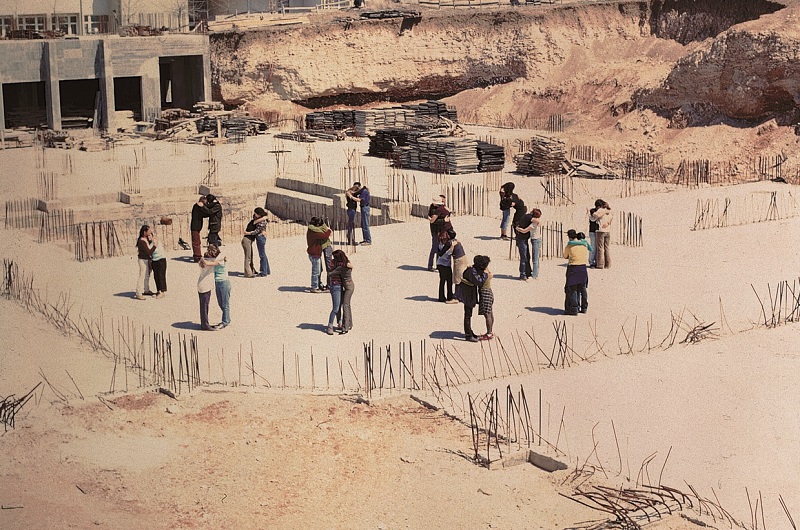
A month later, following the earthquakes that struck eleven provinces in Turkey on February 6, 2023, claiming tens of thousands of lives, I recalled this photograph and the questions it raised. The anxiety and fear that followed the earthquakes, alongside the swiftly organized practices of solidarity and mutual aid, made me feel that we were like the people embracing one another on that unfinished construction site. It also made me reflect on the power of coming together, in moments of crisis, by touching and embracing.
Living in Turkey has long meant living under intense sociopolitical tension created by rising polarization, impoverishment caused by neoliberal economic policies, increasingly authoritarian forms of governance and successive ecological and urban destruction. Over the past decade, the country has experienced a series of social and political upheavals that have reshaped public life. These include the Gezi Park protests in 2013, the June 2015 elections and subsequent political deadlock, bombings and security crises including the 2015 Ankara train station attack, the 2016 attempted coup and state of emergency, mass arrests and restrictions on freedom of expression, the 2018 shift to an expanded presidential system, the pandemic, urban redevelopment projects, mining disasters, forest fires; and finally, in 2023, the devastating earthquakes.[2] As a result of the earthquakes, these long-accumulated fractures suddenly became visible. At the same time, they raised questions about how to live together and build a shared future. We all wondered how we would continue and recover, and how we would create a life rooted in caring, love and attentiveness in which no one was left behind.
These problems prompted me to revisit the very nature of theatre, which I approach, following Erika Fischer-Lichte, as a practice grounded in the bodily co-presence of performers and spectators who gather in a shared space and time (38). Theatre, in this sense, emerges from this encounter as an event produced through co-presence and interaction. It can thus be understood as what Malzacher describes as an “art of gathering” and of encountering others, providing a space in which members of a community meet and communicate without the necessity of a narrative, allowing the experience of being together to come to the fore in the context of contemporary Turkey, we are led to ask how theatre and the discussions it engenders can open new spaces for gathering within a public life that is increasingly fragmented and shaped by ongoing crises, how these gatherings might foreground the inclusive, solidarity based, and ecological possibilities of living together, and how artistic production and processes of discussion can expand social imagination and practices in times of crisis.
Addressing these questions, I began to reconsider the editorial practices of TEB Oyun, the periodical of the Turkish Theater Critics’ Association. In particular, I focused on how a theatre magazine could explore and develop processes that contribute to building such a public life, on and off the page. In this essay, I trace how the journal’s editorial practice gradually evolved into a space for gathering and collective reflection amid an increasingly fragmented public sphere, and how these gatherings relate to public life. I examine the conditions under which the thematic issues prepared between 2023 and 2025 emerged in response to current social and political developments, exploring these experiences through the open-air gatherings around them. I also convey how, during this process, the journal moved beyond a mere platform for publishing texts on theatre and evolved into an open-ended gathering practice, showing how even amid crises, coming together and listening can create a shared, if temporary, ground.
Editorial Practice as Way of Gathering on Page
TEB Oyun is the quarterly online and free publication of the Turkish Theater Critics’ Association (TEB), the Turkish branch of the IATC. Launched as OYUN (Play), it became TEB’s official journal in 2008 and is one of Turkey’s longest running theatre publications. With the pandemic, it moved fully online (see Tiyatroyla İlgili Her Şey), offering articles both as downloadable PDFs and individual web pages. The magazine covers national and international theatre practices through criticism, essays, interviews and book reviews, while also featuring independent and experimental productions alongside institutional ones. Its editorial board, composed of scholars, artists, and critics from different generations, has maintained a collective structure open to new members.
Since 2016, I have been on the editorial board. I have edited dossiers and special issues, designing new pages, columns and sections that approach theatre criticism not only as evaluation but as an artistic and collective thinking practice. These were shaped by aesthetic or experimental curiosity in response to sociopolitical polarization and explore the transformative potential of collective critical thinking (Ejder). The most significant shift in the magazine’s editorial practice, however, occurred after the earthquakes.
After the earthquake, the first proposal for the next issue was an earthquake dossier. Focusing on how the earthquake is represented in theatre during a moment when eleven provinces were devastated and life was almost suspended could have been both premature and reductive. Instead, I suggested reframing the discussion around the question How?. In Turkey, this interrogative expression had become one of the most frequently used words in daily conversations, expressing not only anxiety but also a desire to think together, as members of the community asked each other: How will we continue? How will we live? How will we show solidarity? Will we, the multi-fronted opposition to the authoritarian win elections? How will we struggle to regain a more democratic society? (Ejder and Gülseven 15)
In the face of consecutive political, economic and ecological crises and social tensions, these questions revealed our fears, shared intentions and desires. Therefore, rather than publish an issue solely on the earthquake, I proposed a thematic issue exploring the question of How? through theatre. Through this approach, the issue would not only address the relationship of theatre to disasters, but also express our intensified intellectual and emotional states, social anxieties, and the longings, desires and hopes that emerged from our collective imagination. The approach was designed to explore the theatrical and performative power of a concept and through it, to reconsider both theatre and life. As a result, for the first time in the magazine’s history, a thematic special issue spanning the entire volume was published.[3]
The issue differed from previous editions in both content and production. This transformation unfolded on several levels, driven by a desire to experiment with non-hierarchical, egalitarian and inclusive ways of coming together on the page. For the first time in the history of TEB Oyun, an open call invited contributions from participants across disciplines, focusing on the question: “How?” Together with the accepted authors, we, as two editors, established a collective process in which texts were developed through staged feedback. Through online meetings and reciprocal comments, the texts took shape in continuous editorial dialogue, unlike the magazine’s previous practices. This approach was inspired by Sedgwick’s “reparative reading” (123), aiming not only to evaluate but to collaboratively expand the text’s possibilities, embracing openness to potential and alternative ways of thinking, particularly in a time of crisis. The editorial orientation went beyond the usual review-criticism formats of Turkish theatre magazines, introducing more diverse and experimental writing forms into local publishing practice. These pages allowed artistic production to appear in various textual modes, creating a porous space where poetic, conceptual and performative forms could coexist. The approach aligned with my own writing and pedagogical practice, embracing the idea of ecological entanglement with hybrid text production that avoids rigid boundaries between genres. At this point, Karen Barad’s notion of “diffractive reading” offered an inspiring framework to understand these gatherings on the page as an entangled and plural practice of thinking (Barad 50).
Another key step was opening space for newly formed independent theatre groups, artists and writers who had not previously contributed to the magazine to support emerging creative practices. As a result, the issue published twenty-seven texts from contributors across generations and disciplines, reaching a larger scale than anticipated and significantly expanding the magazine’s audience. The other innovation was design related. Since 2008, TEB Oyun covers had featured a wooden theatre mask on a white background. With the “How?” issue, however, we decided to depart from this visual tradition. In the editorial introduction, we ironically noted that we were “throwing away our mask” (Savaşkan 7). The new cover featured Özgür’s Embrace photograph, creating a powerful metaphor reflecting both the post-earthquake context of the issue and the feeling of compassion from being together.

How Else Can We Make these Evenings Be Beatiful?
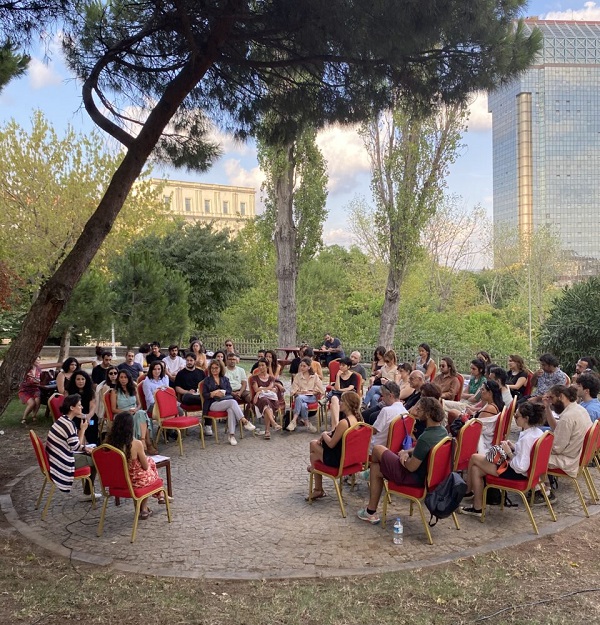
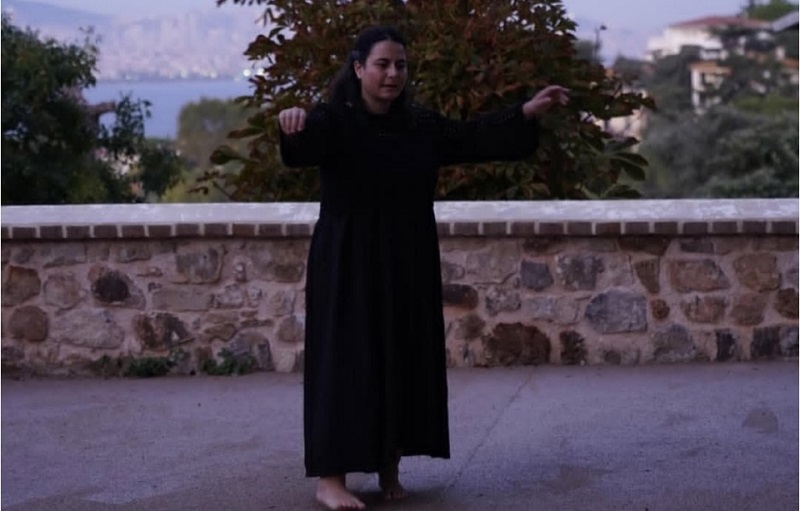
The collective thinking which engendered the “How?” issue and the cross disciplinary dialogue it fostered also prompted us to extend the discussion beyond the magazine’s pages. Could this encounter around the journal be transformed into a physical, performative gathering? To test the temporarily public digital space in a physical setting, I proposed an open-air event. During World Peace Week, on 2 September 2023, we held TEB Oyun’s first outdoor gathering for writers and readers in Istanbul. Entitled “How Else Can These Evenings Be Beautiful?”, the event later became a model for regular open-air gatherings held after each new issue, gradually taking the form of open-ended meetings with a distinct flow. The events, called “open ended gatherings,” inspired by Anna Lowenhaupt Tsing’s ecological concept (23), have begun to function as an assemblage in which diverse ways of life, rhythms and experiences converged to produce a collective experience.
Each gathering typically began with a performative and poetic introduction by the issue editors, followed by short contributions from a guest poet and an academic engaging with the issue. At the center was an open-mic session where participants read their own texts or excerpts from selected writings; these sessions often expanded into performative presentations, staged readings and artistic interventions. As participants shared poems, texts and reflections, they experienced both the courage and vulnerability of being visible in public during a period of increasing restrictions on freedom of expression. The events ended with everyday sharing, including food, around a communal table and closing conversations, while experimental elements, such as sound collages made from the texts, amplified the polyphonic character of the encounter.
The first gathering took place in the garden of Atatürk Library. Its proximity to Taksim Square allowed it to be part of the city’s daily flow while offering a sense of temporary retreat. Another significant aspect was its adjacency to Gezi Park, where the 2013 protests began against plans to convert the park into a shopping mall and soon grew into a nationwide mass movement. This location became a meeting ground carrying both historical and contemporary political and urban memory.
As an example, the first event opened with manifesto-like poetic text readings by the issue’s co-editor Yaşam Özlem Gülseven and me, Eylem Ejder, followed by contributions from poet Sevinç Çalhanoğlu and academic Esra Dicle. In the open-mic session, participants read their own texts as well as selected writings, later published in subsequent issues as the documentation of the gathering, creating one of the most impressive performative and collective moments of the event. Often read by young theatre makers and students, these texts reflected precarity, ecological anxiety, queer possibilities and shifting imaginaries of the future. The session was followed by Dilşad Aladağ’s performance Taklak, which traced the artist’s migration from her hometown Adana to İstanbul and finally to Berlin, and the challenges encountered in these cities, its title evoking both inversion and the blooming of the Judas tree that accompanied her journey. A sound collage of excerpts from contributing authors was also developed, circulating throughout the day in the space, allowing texts to be experienced collectively, even by those who could not attend in person, and merging with the city’s ambient sounds to create a unique soundscape.
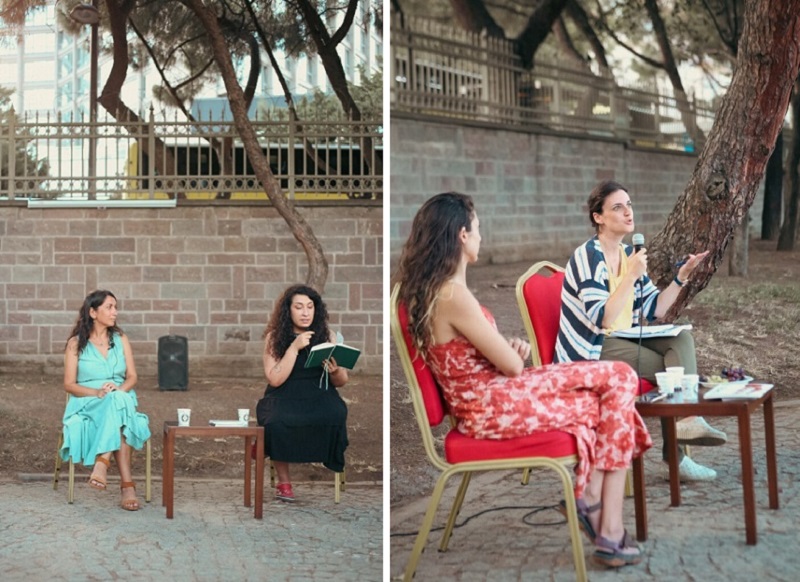
Another important aspect was that the gathering took place without institutional funding or sponsorship. Participants shared food they had brought from home at a communal table, while another table displayed old issues of TEB Oyun, enabling participants to access and take the archive for free.

The title of the event, “How Else Can These Evenings Be Beautiful?”, comes from Turkish poet Turgut Uyar’s poem “Kırlardan Geliyorlar” {They come from the meadows}.
They come from the meadows, hyacinths in their hands / of course they will come from the meadows / how else can these evenings be beautiful / tell me how to endure the shops and warehouses / how else can this tar smell pass.”)[4] (translated by the author from Uyar (138).
The phrase both captured the spirit of the issue and shaped the name and direction of the gathering. It suggested possibilities implied by a not yet realized future that could transform a bleak present. It also resonated with Turkey’s recent political memory: during the nationwide Gezi Park protests of May 2013, one graffiti read, “We are Turgut Uyar’s lines.”[5] The title’s reference to this verse and the location of the first event near Gezi Park serendipitously invoked the possibilities of being together in public and creating shared time without becoming an open target under the hyper sensitive atmosphere of growing authoritarianism.
A decade after young protesters wrote “we are the verses of Turgut Uyar” on the walls of Gezi, gathering under a line from his poem in the same location, evoking the urban memory, felt like a reenactment of that claim. In this sense, the gathering and the reference of the title also echoed what Deniz Başar describes as “monuments of absence” in the post-Gezi public sphere: embodied traces of past resistance that persist even when suppressed, carrying the potential for future forms of collective action. (Başar 169) The title became more than a name: it became a proposition. Perhaps enhancing our shared time requires experimenting with new forms of gathering; the gathering itself was a small rehearsal of that possibility.

Warmly received by participants, the title was retained in subsequent events, and became the permanent heading of the series. These gatherings, where people came together to talk, listen, read, and spend time collectively, offered small but powerful experiences of alternative ways to create shared time. As TEB Oyun contributor Yüsra Yüce reflects in her account of the gathering, recalling a moment when Ceren Kaçar from Reka Collective said,
Even if we don’t speak, just being next to each other and holding hands is enough for me. Throughout the event, we draw strength from the people we sit beside. We find consolation in each other’s presence. We realize we are not alone in feeling, suffering, and thinking. For four hours, we become hope for one another. (Yüce 173)
How to Sustain the Process
The “How?” issue was shaped not only by the emotional and social atmosphere following the earthquake but also by an intense political year. The year 2023 marked the tenth anniversary of the Gezi Park protests and the centenary of the Republic, and it also coincided with a critical presidential election. Across broad sectors of society, there was a strong expectation that political change could come through voting, along with a strong sense of mobilization, reflected, among other things, in record levels of voter turnout and widespread voluntary participation in election monitoring. This climate inevitably prompted reflection on solidarity, collective action and visions for the future.
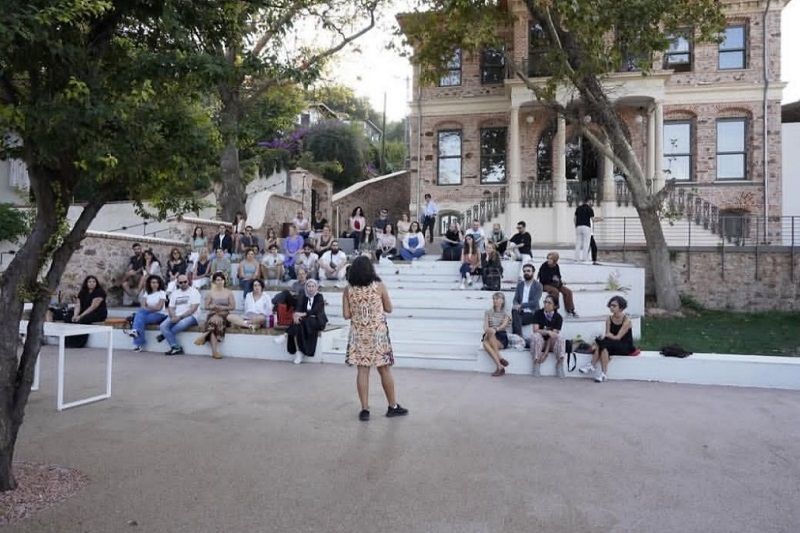
The second thematic issue, prepared a year later, continued these questions and focused on the theme of gathering. While the “How?” issue asked how we could make life beautiful in alternative ways, this issue explored the forms of coming together that made it possible, also shaped by the relatively hopeful atmosphere following the 2024 local elections which generated a temporary sense of collective possibility.
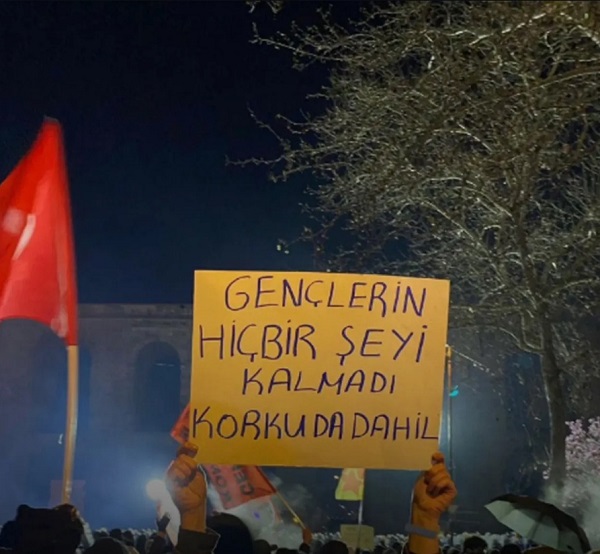
The third thematic issue, prepared in 2025, was shaped under the shadow of political developments that deeply unsettled young generations’ visions of the future in Turkey. On 19 March 2025, the revocation of Istanbul Mayor Ekrem İmamoğlu’s university degree and his subsequent arrest triggered strong feelings of insecurity and anger, particularly among university students. The protests that followed quickly revived public gatherings and forum practices in different cities. The fact that young people mobilized not only around political demands but also around shared concerns for the future led us to reconsider our thematic focus around the concept of future, producing the Spring/Summer 2025 issue under this heading.
Maintaining the editorial collaboration model was especially important for me. In each thematic issue, I worked with different, often younger, editors to create spaces for collective learning and to transform the journal’s editorial knowledge over time. This approach not only shaped the publication process but also triggered new forms of solidarity and organization. For instance, dramaturgs and researchers who came together during this period established an independent platform called Dramatist, developing professional support networks. Inspired by the open-air gatherings, I organized “Performative Gatherings, in Together,” circle meetings where participants came together through the texts they wanted to read. All these initiatives demonstrated that the thematic issues were not merely publishing projects but also practical spaces enabling new forms of community formation.
In Lieu of a Conclusion
In her study Public_ing: Practicing Democracy Through Performance, Danae Theodoridou emphasizes that public debates often take place through space, whereas public time is just as decisive. Unless it is reconfigured outside existing dominant neoliberal approaches, opportunities for collective thinking and democratic action remain limited (Theodoridou 62). Her approach intersects with Falk Hübner’s concept of “artistic connectivity”, defined as a different form of connection and attachment guided by processes based on spending time together, mutual learning, care and respect, positive change, and endless curiosity (Hübner and Theodoridou). The collective editorial processes and open-air gatherings we developed around the thematic issues became spaces where these conceptual frameworks could be experienced concretely. Our goal was not only to bring people together in the same space, but also to create an environment where they could spend time together, slow down to listen to one another, and participate in collective thinking. The collaborations emerging in each issue and outdoor gathering enabled not just content production, but also a creative practice that could make social imaginaries visible and transformable.
The emotion embodied in Ferhat Özgür’s Embrace photograph gained further significance as this process unfolded. Encounters during the open gatherings and reading performances made visible for participants a closeness that went beyond physical contact, the intimacy created by being present together and attentive to one another. This process of community building around the thematic issues reminds us of the essential capacity of theatre: to exist together, care for one another and collectively imagine future possibilities that we have yet to name.
Such open-ended gatherings, echoing the ideas of theatre as “art of gathering” or “publicing,” exemplify how encounters in shared space can extend the relational and deliberative potential of theatre and performance in public space. I hope these practices, which contribute to a growing literature on participatory and civic oriented theatre, remain open to further theoretical and practical exploration.
Endnotes
[1] Original title of the exhibition is “Geçmişi Unutmak, Yaldızlı Bir Yalan” (Karşı Sanat 2023).
[2] For a detailed overview of these transformations, see Başar; Ejder.
[3] For the full issue, see Ejder and Gülseven.
[4] Original Turkish text of the poem’s first quatrain: “kırlardan geliyorlar ellerinde sümbülteber/elbette kırlardan gelecekler/başka türlü nasıl güzelleşir bu akşamüstleri/söyleyin nasıl dayanılır dükkanlara depolara/bu katran kokusu başka türlü nasıl geçer” (Uyar 137-38).
[5] At this time, the poem also became the focus of other artistic projects: Metin and Kemal Kahraman composed it as a song “Kırlardan Geliyorlar” (2022). See (Metin-Kemal Kahraman); and the edited book Kırlardan Gelecekler by Özge Güneş and İlkay Özge explored its imagery in contemporary rural, ecological, and anti-capitalist contexts.
Bibliography
Barad, Karen, Rosi Dolphijn, and Iris van der Tuin. “Matter Feels, Converses, Suffers, Desires, Yearns, and Remembers.” Interview with Karen Barad. New Materialism: Interviews & Cartographies, Open Humanities Press, 2012, pp. 48–70.
Başar, Deniz. “From Repertoires of Resistance to Monuments of Absence.” European Journal of Theatre and Performance, vol. 4, 2022, pp. 160–97.
Ejder, Eylem, and Yaşam Özlem Gülseven. “Giriş: Nasıl?” TEB Oyun, Special Issue: “How?”, Spring/Summer 2023, pp. 15–19. Accessed 21 Mar. 2026.
Ejder, Eylem. “Critical Endeavors: Experimental Searches in Contemporary Performance Criticism in Turkey.” Platform: Journal of Performing Arts, vol. 13, no. 1, “On Criticism,” Autumn 2019, pp. 103–15.
Fischer-Lichte, Erika. The Transformative Power of Performance: A New Aesthetics. Translated by Saskya Iris Jain, Routledge, 2008.
Hübner, Falk and Danae Theodoridou, editors. “Call for Papers: On Social Imaginaries.” Performance Research, June 2023, Circulated via email.
Güneş, Özge, and İlkay Özge, editors. Kırlardan Gelecekler: 21. Yüzyılda Tarım ve Antikapitalist Perspektif [They Will Come from the Meadows: Agriculture and Anti-Capitalist Perspective in the 21st Century]. Sol Kültür Yayınları, 2024.
Kahraman, Metin-Kemal. “Kırlardan Geliyorlar.” YouTube, 4 Nov. 2022. Accessed 21 Mar. 2026.
Karşı Sanat. “Geçmişi Unutmak, Yaldızlı Bir Yalan.” Accessed 21 Mar. 2026.
Malzacher, Florian. The Art of Assembly: Political Theatre Today. Alexander Verlag Berlin, 2023.
Savaşkan, Tijen. “Merhaba.” TEB Oyun, Spring/Summer 2023, pp. 6–10.
Sedgwick, Eve Kosofsky. Touching Feeling: Affect, Pedagogy, Performativity. Duke UP, 2003.
Tiyatroyla İlgili Her Şey. TEB Oyun, 2020. Accessed 21 Mar. 2026.
Theodoridou, Danae. Public_ing: Practicing Democracy Through Performance/An Analogue Company. Nissos Academic Publishing, 2022.
Tsing, Anna Lowenhaupt. The Mushroom at the End of the World. Princeton University Press, 2015.
Uyar, Turgut. “Kırlardan Geliyorlar.” In Ne Güzeldi Senin Çılgınlığın, edited by Turgay Fişekçi, Adam Yayınları, 2003.
*Eylem Ejder holds a BA in Physics from Istanbul University and studied Theatre at Ankara University. She completed her PhD in Theatre with a dissertation titled “Recycling Dramaturgies.” During her doctoral research, she was a guest researcher at the Centre for Ibsen Studies, University of Oslo, and a selected participant in the Mellon School of Theatre and Performance Research at Harvard University. Since 2020, she has been developing autobiographical performances, public learning programs, workshops and collaborative projects. Her artistic research engages interdisciplinary and hybrid forms, incorporating writing as well as urban and nature walks. Her writings on theatre have been published nationally and internationally in journals including European Stages, Critical Stages and Arab Stages. She is currently a faculty member in the Department of Performing Arts at the Istanbul Nişantaşı University Conservatory.
Copyright © 2026 Eylem Ejder
Critical Stages/Scènes critiques, #33, June 2026
e-ISSN: 2409-7411

This work is licensed under the
Creative Commons Attribution International License CC BY-NC-ND 4.0.
