Framing Illness Stories in Theatre – An Identitarian and Storytelling Approach
Daniela Șilindean*
Abstract
This paper examines how first-person theatrical narratives—also shaped through digital storytelling, emphasise illness as both an identity marker and an artistic collaborator. Focusing on live and online plays, as well as personal storytelling performances, the analysis explores how illness, whether physical disability, mental disorder, or syndrome, does not dominate the stage but instead subtly reshapes theatrical perception and dramaturgy. The methodology combines close readings of plays, critical observation of performances, and insights from narrative medicine and medical communication theories. Case studies demonstrate how pathology functions as a lens, transforming the experiences of both performers and audiences.
Keywords: digital storytelling; first-person narrative; illness as identity; narrative medicine; theatrical performance
What are We Looking at? What are We Seeing?
The aim of this study is to examine three theatre performances in which personal realities are brought to both page and stage. It investigates first-person narratives developed by artists who adopt a twofold approach. First, illness becomes an accepted and integrated component of their identity. Second, they succeed in positioning illness as an artistic partner on stage, in subtle ways, without foregrounding it to provoke immediate emotional response.
Confronting illness constitutes a challenging process. Moreover, the spectator is required to undergo a reconfiguration of perception, at times even unlearning established ways of seeing, when staged reality presents a visibly different identity—whether physical or mental—one that is not typically encountered in everyday life, let alone brought to artistic expression. Unaccustomed to confronting illness, either our own or that of others, the encounter with it on stage can be deeply unsettling.
This study does not address performances that treat illness as a theme or as fiction; rather, it focuses on works created by artists who embody the identity shift brought about by their own illness and choose to incorporate it into their practice as an artistic partner. This is achieved neither through minimization nor through exhibition, but through a form of exposure that creates a passage—both personal and artistic—through this experience.
Faced with such realities, we are reminded, as Andrew Solomon observes in his book Far From the Tree: Parents, Children and the Search for Identity, that:
Defective is an adjective that has long been deemed too freighted for liberal discourse, but the medical terms that have supplanted it—illness, syndrome, condition—can be almost equally pejorative in their discreet way. We often use illness to disparage a way of being, and identity to validate that same way of being. This is a false dichotomy. (4-5)
Solomon further emphasises that “[s]elf-acceptance is part of the ideal, but without familial and societal acceptance, it cannot ameliorate the relentless injustices to which many horizontal identity groups are subject and will not bring about adequate reform” (6). Andrew Solomon distinguishes between vertical and horizontal identities. Vertical identities comprise traits transmitted from parent to child across generations, not only through genetic inheritance but also through shared cultural frameworks, such as ethnicity, skin colour (both as biological pigmentation and as a socially constructed self-image), language, religion, considered moderately vertical, as individuals may reject or convert, and nationality (with certain exceptions, such as in the case of immigration).
By contrast, horizontal identities encompass characteristics that are not shared with one’s parents, including sexual orientation, recessive genes, random mutations, prenatal influences, as well as values and preferences that diverge from one’s progenitors. As Solomon explains, “Then there are horizontal identities, those that occur when someone has an inherent or acquired trait that is foreign to his or her parents and must therefore acquire identity from a peer group.” (See also the relevant chapter available online here).
Narrative medicine (concept coined and developed by Rita Charon) appeals to listening to stories, to honouring the stories of illness, holding the space for the experiences, operating also with such subtle instruments that we almost exclusively associate with the field of humanities. According to Columbia University, “[n]arrative medicine is an international discipline at the intersection of humanities, the arts, clinical practice, and health care justice with conceptual foundations in narratology, phenomenology, and liberatory social theory.” Some of the concepts emphasized in narrative medicine include listening, self-awareness, creative capacity, profound understanding, and empathy. As described: “Narrative medicine began as a rigorous intellectual and clinical discipline to fortify health care with the capacity to skillfully receive the accounts persons give of themselves, to recognize, absorb, interpret, and be moved to action by the stories of others.” When applied to the theatre, these same dimensions, recognizing, absorbing, interpreting, and being moved by the stories of others, emerge as both possible and desirable aspects of spectatorship.
The Intimacy of Stories: Jo Bannon and the Invisible exposure
On Jo Bannon’ website, the artist describes her work, Exposure:
Exposure is the beginning of an investigation into how we look, how we are looked at and if we can ever really be seen. This intimate one-to-one performance is a tender and tentative look into autobiography, asking how fully we can reveal ourselves – to ourselves, to another, with another.
Exposure is a ten-minute, one-on-one performance, involving a single performer and a single spectator. The experience begins in complete darkness, signaling that the eye, and, by extension, vision, must recalibrate. Almost immediately, the question arises: who is exposed, and in what way? The one-on-one format suggests a form of confrontation, prompting consideration of who is revealing themselves, to what, and for what purpose.
Entering the blackened space evokes a sense of developmental process, reminiscent of a camera obscura. The spectator’s orientation is guided by a faint light and by the performer’s voice, mediated through a recording despite her physical presence. A sense of estrangement emerges immediately, as the spectator is addressed directly and hears the artist’s voice through headphones, creating an uncanny dissociation.
The recorded performance proceeds with precision, gestures accompanying the pre-set discourse. A subtle captatio benevolentiae establishes an emotional bridge, as the performer conveys courage through her presence. The narrative unfolds gradually, allowing the audience to assemble the clues and understand the story’s progression.

The experience is highly intimate, relying on the impact of a narrative that is rigorously and ingeniously constructed, delivered with the necessary tension. Although the artist stands face-to-face with the spectator, the guidance of the light reveals only fragments rather than a complete whole image. The latter only materializes at the conclusion, when the spectator reconstructs the totality from the dispersed information received. Playing with the perception and with the idea of seeing and being seen, the artist controls how her work around identity is perceived beyond how she is viewed, beyond her condition (albinism). Eyes, eyelashes, the whole face are in the spotlight of flashlight, in fact, distracting the attention from the journey within.
The image electronically zooms in, evoking the experience of reviewing medical records, as if part of taking a clinical history: high dioptres of +7 and +8 produce heightened light sensitivity. Family photographs and personal stories are then presented. In an immediate “odd-one-out” exercise, the audience recognizes why the artist emphasizes: “I do not look like my family.” This is the moment when illness enters the stage, but it does not dominate. As the artist explains, “This work is informed by my relationship to albinism, a genetic condition which affects my pigmentation and my sight, complicating both how I physically see and experience the world and how I am seen and perceived within it.” This exemplifies one of the most subtle ways an artistic partnership with illness can be woven into both the conceptual core and the enactment of a performance.
The Visible Hideout
As demonstrated in Exposure, the artist investigates the interplay between intimacy and self-exposure. Another example is her film Kitchen Alba, a reimagining of a theatre work, described as follows:
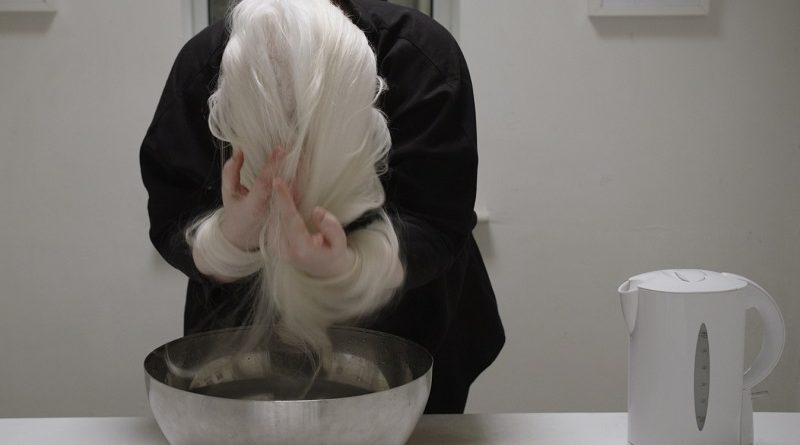
This new film version, Kitchen Alba, made in 2021 amidst a world ‘working from home’ places the miraculous in the most mundane of domestic spaces, blurring the border between the ordinary and the sublime. Riffing on religious iconography, white goods, family and faith, Kitchen Alba prompts us to look anew at our most ordinary and homely of spaces and to find meaning, miracle and mystery wedged between the cookery books and the stack of dirty dishes.
In contrast to Exposure, Kitchen Alba, available online on the artist’s website, plays extensively with the presence of white and also with the colour dissipated across every single element of the setting, but also engaging with questions of human condition and, symbolically, and ironic-irreverential with religion. What starts as domestic setting is built in the thirteen minutes of recording into a philosophical matter of “ways of seeing” (see also Berger), sliding scales of perception and de-mystifying at the same time.
A shrouded figure, hidden beneath a bedsheet, feels its way toward objects in the kitchen. What strikes one from the very beginning is the prevalence of white: bedsheet, walls, kettle, paper mitre, bread, painting/photo frames, towel, plate. It is as if we, viewers, landed in a White Realm. The gestures of the performer are ample, creating both tension and anticipation. Unveiling the head leaves us with a different type of white: white hair, white eyebrows and eyelashes – albinism. Washing the hair in a kitchen ball, allows the camera (and the viewer’s eye) to focus on the white tresses changing form under the effect of water, vanishing and reappearing, being then swiftly lifted and trailing streams into the air. Or on how they are floating (changing perspectives, in a close-up or enlargement) under the hot air of the hairdryer, filling in the air almost as a dynamic soft sculpture does. Visuality indeed prevails. In the background sketchy pre-recorded dialogues are audible. They seem memories from the past evoking two episodes. One, in which an albino person is sighted in a shop, provoking stirring reactions and a second one in which the memory of a visit of the Pope coincided with the return of the child. The contrast with the black blouse and trousers is meant to emphasise the extremes of colour even more distinctly. Once the ritual of washing, drying and brushing the hair is done, supper is prepared (a sandwich is pressed by hand, leaving a clear imprint), the white-cardboard mitre is place on the performer’s head, the liturgic music is on.
A mystical gaze and a self-portrait are established, but the image is immediately subverted through irony and humour. The character eats the sandwich with sober attention, munching, wiping her mouth by hand, and biting, in striking contrast to the convent carols playing in the background. Objects, bodily condition, albinism, and liturgical symbols converge in a performance that keeps both interpretation and spectatorship highly alert.

Teatro Patologico and the Overlapping Times and S(h)elves
Teatro Patologico is an Italian company that works with people with physical and mental disabilities, who have become over time an integral part of its ensemble. It is important to emphasise that the company’s approach is not primarily therapeutic, although this dimension is ultimately present, but is fundamentally artistic.
What is striking from the very first encounter with their work is the envisioning of a comprehensive aesthetic trajectory, supported by engagement with major texts (including Medea, Don Quixote, Titus Andronicus, Romeo and Juliet, and The Overcoat), the organisation of the Cinema Patologico and Teatro Patologico festivals, and a significant educational component, notably the establishment of the first university course on integrated theatre and emotion at Università degli Studi di Roma Tor Vergata. One of the slogans openly adopted by company members is “Io sono un po’ matto e tu?” (“I am a bit crazy, and you?”).
Among their latest productions is a digital work, L’Odissea (directed by Domenico Iannacone). The theatre performance Ulisse e il suo viaggio is directed by Dario D’Ambrosi, with a cast drawn from the Compagnia Stabile del Teatro Patologico. Music is by Francesco “Papaceccio” Crudele, stage design and costumes by Annamaria Porcelli and Sergio Maria Minelli, and lighting design by Danilo Facco. The production was broadcast on television and online.
Digital theatre often entails fragmentation, compression, or extension of temporal experience. Online spectators can negotiate the rhythm of the narrative at their own pace. The reconstruction in film of the rehearsals for L’Odissea presents a divided temporal frame and layered realities. Due to the digital format, time is experienced non-linearly: it lapses, fast-forwards, or rewinds, while the story itself follows a linear progression, depicting both the creation of Ulysses’ story and the company’s strategies for navigating the pandemic. These are two seemingly parallel narratives, unified by the themes of journey, peril, and nostos.
As the camera moves through the rehearsal scenes, actors’ faces emerge. The effects of illness are visible, Down syndrome, for example, is readily recognisable, as are various physical disabilities. In this way, the gallery of faces functions as a gallery of initial masks, highlighting both individuality and the collective performance of identity.
The stories unfold with precision, simultaneously serving as explorations of identity. Wide shots emphasize the stark emptiness of Rome’s major boulevards, deserted during March 2020. The film consistently maintains an outside-inside shift of perspective, creating a dynamic interplay between environment and performance. Particularly powerful is the dual access to both actor and character, especially visible in the construction of the roles. The audience observes behind-the-scenes moments during rehearsals, work sessions on text and movement, reflections on the format of the show, and costume fittings.
At the outset, the pandemic emerges almost as a character, permeating the actors’ experiences. Its presence is manifest both in the desolate streets and in the actors’ poignant reflections. Recurring images, cages, helplessness, and isolation, underscore this reality. Testimonials from actors unable to attend rehearsals convey the sense of captivity, at times so extreme that they report feeling they had even forgotten their “right to exist.”
The second strand of the documentary follows the personal stories of the actors. Individual interviews take place both within theatre spaces and in private settings, including their homes. The performers speak candidly about the illnesses they live with and how these manifest, while also reflecting on their encounters with theatre, an experience that holds both revelatory and defining significance for them. Their testimonies are delivered openly, supported by direct information and observations, while the spectator’s emotional engagement completes a dialogue mediated through the screen.
The documentary provides limited access to a psychotherapist’s session, in which one actress, Christiana, aged 55 at the time of filming, speaks about the profound loneliness and intensity of distress she has experienced, alongside the sense of magic she associates with theatre. Paolo Vaselli discusses moments of complete self-doubt and emotional overwhelm, noting that his role as Ulysses is particularly challenging for someone who struggles with social interaction. Another cast member demonstrates remarkable mastery, knowing the entire text by heart and performing all the parts with precision.
Carlo Di Bartolomeo, aged 31, engages in exercises to train his mind. Born prematurely, he does not know how to socialise; he avoids eye contact and shields his gaze. He relies on his memory. He is an encyclopaedia of data and events, seemingly organised in drawers that are easily accessible. Andrea Scrimieri plays Calypso and has an affinity for feminine objects, which he wears (from accessories to clothing). He appears excessively shy, both in his gestures and speech, walking with a slight limp, his gaze tentative and intimidated. In his apartment, he speaks of the rituals he has with photographs of his family and friends. A multitude of portraits cover the walls and furniture of his house. He carries some with him constantly, keeping them in his bag; others, he sleeps with under his pillow to keep his loved ones near: “they keep me company,” “I feel so lonely,” he explains.
Undeniably, one of the most striking stories is that of Marina Starace, in her sixties, who portrays Penelope. Her gaze is penetrating, and her words convey remarkable self-possession. What is particularly striking is her ease in discussing her life as a patient living with multiple diagnoses, including paranoia, schizophrenia, and bipolar disorder. She recounts her experiences while inviting the viewer to witness them. Having been on medication for three decades and having undergone hospitalisation, she demonstrates a clear awareness that illness is an integral part of her life. Her relationship to time is marked by long pauses, waiting, and a sense of suspended living: “When you are hospitalised, time ceases to exist,” she reflects. Among the intense emotions she recalls are the humiliation of having her arms restrained and the profound lack of trust: “Do you know what it means not to trust anyone?” She also reflects on marginalisation, while emphasising the vital necessity of self-acceptance. Starace speaks openly about her mental illness and describes moments of freedom—both in swimming and within her mental turmoil—revealing a consciousness unbound by external constraints, yet fully attuned to the reality of her condition. What moves her deeply about Penelope is the character’s fidelity: the capacity to wait and to love Ulysses unwaveringly.
The journey concludes on the beach at Ostia. “Our disability is a strength; we have something that others do not,” Dario D’Ambrosi tells the actors. The film then presents key scenes from the performance: Circe transforming Ulysses and his companions into pigs, the sirens with their netted skirts, the bucket-megaphones, and the emotionally charged closing scene in which Penelope and Ulysses are reunited. Together with the company, the audience reflects on the experience of wandering in order to find one’s way home, a journey that resonates both metaphorically and experientially.
Conclusion
It is also important to remember that witnessing another person’s illness is a profound act, and when undertaken as an “altruistic” listener, viewer, or reader, as Charon describes in The Ecstatic Witness, it carries unique ethical and emotional significance:
When one cares for a seriously ill person – either as a doctor or nurse, a chaplain or ethicist, or a relative or friend-he or she similarly is launched onto perilous travel outside the self, not simply into the awareness of the fragility of health but more fundamentally and transformingly and irrevocably into an identity with that ill person and hence into a subject position from which one must own up to not only the certainty of the self but also the certainty of its end. (165)
Moreover, witnessing and accompanying another person’s experience of illness can produce profound shifts in perception, broadening and deepening both our theatrical experience and our role as spectators. Such encounters also refine empathy and enhance understanding. Artists who bring their lived experiences of illness to the stage contribute to a broader appreciation of how theatre can engage with medical experience through storytelling, enriching performance studies, perceptual awareness, and the field of practice-based medical humanities.
Bibliography
Berger, John. Ways of Seeing. Penguin Books, 1977.
Bannon, Jo. “Exposure.” Jo Bannon. Accessed 24 Aug. 2025.
———. “Kitchen Alba.” Jo Bannon. Accessed 24 Aug. 2025.
Charon, Rita. “Narrative Medicine: A Model for Empathy, Reflection, Profession, and Trust.” JAMA, vol. 286, no. 15, Oct. 2001, pp. 1897–1902.
———. “Narrative Medicine: Attention, Representation, Affiliation.” Narrative, vol. 13, no. 3, Oct. 2005, pp. 261–70.
———. “The Ecstatic Witness.” Clinical Ethics and the Necessity of Stories: Essays in Honor of Richard M. Zaner, Springer, 2011.
Columbia University, Division of Narrative Medicine. Columbia University Irving Medical Center. Accessed 20 Aug. 2025.
Guy, Charlie. The Art of Medical Communication: Bringing the Humanities into Clinical Practice. CRC Press, 2024.
Kelliher, Rebecca. “The Art of ‘Radical Listening’.” Columbia Magazine, Winter 2019–20.
Patterson, Debbie. “This Is How We Crippled It.” HowlRound Theatre Commons. Accessed 12 Aug. 2025.
Robertson, C., G. Clegg, and J. Huntley, editors. Storytelling in Medicine: How Narrative Can Improve Practice. 2nd ed., CRC Press, 2023.
Solomon, Andrew. Departe de trunchi: douăsprezece feluri de dragoste: părinți, copii și căutarea identității. Humanitas, 2015.
———. “Far from the Tree.” Andrew Solomon.
———. Far from the Tree: Parents, Children and the Search for Identity. Scribner, 2013.
Șilindean, Daniela. Narațiuni ale corpului. Boală și discurs. Editura Universității de Vest, 2025.
Teatro Patologico. “Spettacoli.” Accessed 5 Aug. 2025.

*Daniela Șilindean, member of the International Association of Theatre Critics (IATC) and the IATC.Ro Group, is an Associate Professor at Victor Babeș University of Medicine and Pharmacy in Timișoara. She has authored and edited books, published in cultural magazines, peer-reviewed journals, and collective volumes. She has contributed foreword studies and translations of plays and theoretical works, and coordinated national and international cultural and educational projects. Her latest volume is Narratives of the Body: Illness and Discourse. Her research focuses on theatre, literature, and medical humanities.
Copyright © 2026 Daniela Șilindean
Critical Stages/Scènes critiques, #33, June 2026
e-ISSN: 2409-7411

This work is licensed under the
Creative Commons Attribution International License CC BY-NC-ND 4.0.
