
Scenographic Tempo and Digital Collaboration
Patrick Rizzotti*
Abstract
This article examines how digital scenographic workflows reconfigure the pace and rhythm of theatrical collaboration. Drawing from Practice-based Research on two recent productions—Ring of Fire and Behind the Moon—it explores how tools like Miro, Loom, and real-time 3d modelling introduce new tempos into the design process, reshaping not only how scenography is made, but how it is felt by its collaborators.In Ring of Fire, asynchronous tools enabled rapid iteration and sustained visual dialogue. Loom recordings replaced long-form emails, allowing the scenic designer to narrate and explain design evolutions through video, which the director could watch and respond to on their own schedule. Shared 3D models and collaborative Miro boards offered persistent access to spatial thinking and visual references. The result was a rich, emotionally resonant design shaped by intentional, distributed acceleration. Behind the Moon used many of the same digital tools but in a more synchronous, real-time mode. Working remotely but concurrently, the team used Miro as a shared digital materials table—placing, adjusting, and discussing texture, colour, and spatial detail together. This process fostered a tactile, image-driven dialogue that mirrored traditional in-person collaboration, but compressed into shorter, faster-paced virtual sessions. The tempo introduced a different kind of acceleration—one shaped not by flexibility over time, but by intensity within time. These case studies reflect broader shifts in the technologization of creative labour and the evolving structures of theatrical authorship. The article introduces scenographic tempo as a critical lens for understanding acceleration not merely as a matter of speed, but as a dramaturgical and operational condition. It calls for more intentional reflection on how digital workflows shape—and are shaped by—the collaborative rhythms of contemporary theatre-making.
Keywords: scenographic tempo, Ddigital scenography, collaborative authorship, synchronous and asynchronous collaboration
Introduction
In recent scenic design practice, digital tools do more than enable iteration or rapid exchange. They reshape the conditions under which collaboration unfolds, influencing when ideas surface, how long they remain active and when decisions take hold. They alter the tempo of collaboration.
Digital tools are now integral to contemporary theatre-making (Boiko et al. 2), and their value for communication, iteration and visualization is well documented (Baugh 215; Boiko et al. 5–8). Less examined is how these tools reorganize the temporal structure of early-stage collaboration. This article examines how specific digital tools reconfigure the timing of early-stage collaboration between scenic designer and director.
Historically, early design collaboration revolved around shared physical artifacts, scripts, sketches and scale models handled in the same room. Material constraints structured the exchange: only one person could hold the model; only one version could occupy the table. Even when distance required mailing drawings or models, material constraints still structured who could engage and when. With the rise of digital drafting, shared image folders, 3D modelling and browser-based whiteboards, collaboration became increasingly screen-mediated. These tools expanded access and flexibility while altering how ideas are encountered and revised. As the medium shifted, so did the pacing of the exchange.
Scenographic tempo remains underexamined within digital design workflows. Hann’s concept of scenography “in time” (77) helps frame tempo as more than scheduling; it shapes how scenographic meaning emerges through encounter. Rather than treating timing as background logistics, this article foregrounds tempo as a generative condition of collaborative authorship.
I approach this question through Practice-as-Research, drawing on Nelson’s account of practice as an epistemic mode of inquiry (4–5, 19). My analysis centres on two recent productions in which digital tools structured collaboration through contrasting temporal conditions: Behind the Moon and Ring of Fire.
Behind the Moon unfolded through compressed, synchronous Zoom exchanges, with Miro—a browser-based digital whiteboard platform that allows collaborators to upload, rearrange and annotate images in real time—serving as a shared workspace.
Ring of Fire developed asynchronously through Loom recordings—a screen-recording platform used to create narrated video walkthroughs of evolving design proposals—and through shared navigable 3D digital models that allowed the director to move virtually through the proposed set. These contrasting temporal structures provide a comparative frame for examining how specific digital tools reorganize feedback cycles, redistribute authorship through tempo.
Acceleration is often equated with technological speed or efficiency. Here, it is reframed as the compression or extension of collaborative intervals. Digital tools do not simply make design faster; they reorganize when reflection occurs and who controls its duration.
The following section defines scenographic tempo in greater detail and outlines the theoretical foundations of the analysis.
Defining Scenographic Tempo
Scenographic tempo names the patterned pacing through which collaborative decisions emerge. It concerns the spacing between offer and response, reflection and commitment, and the duration ideas remain viable within a shared process. Tempo is not speed but the organization of intervals and sequences through which a design unfolds. Because collaboration unfolds through time, tempo functions as a condition of authorship: it determines whose ideas arrive in time to shape direction and which recede. When intervals compress, tempo accelerates; when they stretch, tempo elongates.
Scenography as Temporal Encounter
Hann’s theorization of scenography “in time” offers a critical foundation for understanding tempo (77). She argues that “to speak of scenography is to speak of the time of scenography” (65). Her emphasis on orientation positions scenographic meaning as something that emerges through paced engagement rather than as a static visual form (19). For Hann, presence names a relational condition rather than simple visibility: scenographic elements position bodies, spectators and space in time. Meaning coheres gradually through paced encounter. Extending Hann’s emphasis on temporal encounter, I consider digital collaborative environments as spatial-temporal frameworks that similarly structure how collaborators encounter, interpret and revise emerging worlds.
Tempo and Iterative Practice
Design practice unfolds through iterative cycles of proposal, testing and revision. Tempo governs the spacing and density of these cycles—how quickly responses follow proposals and how long ideas remain active before commitment. When intervals compress, collaborative momentum intensifies; when they stretch, reflection expands. Tempo thus provides a comparative framework for examining synchronous and asynchronous collaboration.
Reflection-in-Action as Temporal Practice
Donald Schön’s theory of reflection-in-action provides a way to situate tempo within the lived experience of design. He describes design as a “reflective conversation with the situation,” in which each adjustment in the work prompts new insights and challenges (93–4). This exchange unfolds at variable speeds: it quickens in moments of clarity and slows in moments of ambiguity (62). Designers experience tempo internally as a shifting interplay of thought, action and revision structured by the affordances of specific tools. These shifts in tempo shape how designers think in action, what might be understood as a form of scenographic intelligence.
Digital Tools as Temporal Structures
If tempo structures authorship, then digital platforms—by structuring access, visibility and response—directly reshape that authorship. Boiko et al. note that digital technologies influence how creative ideas move and transform within contemporary theatre practice (5–8). Baugh observes that virtual modelling integrates spatial and temporal dimensions within a single environment (215), while Brejzek and Wallen describe models as epistemic tools through which designers negotiate spatial logic (19–20). Together, these accounts suggest that digital tools are not neutral carriers of content but environments that structure encounter.
Digital whiteboards, recorded walkthroughs and interactive 3D models determine when and how ideas are encountered.
When a Miro board preserves multiple concurrent options beyond their practical viability, the field of attention expands and narrowing is delayed. Digital abundance does not necessarily clarify the work; it can prolong it. Tempo operates here as an epistemic condition, determining which contributions persist long enough to shape direction.
Why Tempo Matters?
Tempo matters because it makes visible how digital tools compress, stretch, or sequence collaborative attention. Analyzing scenographic tempo reveals digital media as structuring agents within collaborative design. Attending deliberately to tempo allows collaborative pace to be shaped as intentionally as spatial form itself.
This conceptual foundation raises the methodological question at the centre of this study: how can tempo be analyzed as an embodied, lived phenomenon? The following section outlines the approach used to conduct this analysis.
Methodology: Practice-as-Research and Embedded Temporal Inquiry
This study uses a Practice-as-Research (PaR) methodology to examine how digital tools shape the temporal and collaborative conditions of the early conceptual phase of scenic design, where designer and director work together to establish a shared creative direction. PaR treats creative practice as a site of inquiry, where knowledge is produced through making, reflecting and interacting (Nelson 19–31). Because tempo is experienced within practice, PaR provides access to the temporal dynamics under investigation.
Nelson notes that practitioners already generate documentation—sketches, models, notes, digital files—and that these materials become research evidence when approached with reflexive intent (42). In this study, the evidence includes Miro board archives and comment histories, Loom recordings, iterations of 3D Vectorworks models, email and messaging logs and field notes from design sessions. Together, these artifacts form a temporal record of how conversations accelerated, stalled and shifted across the two projects.
Reflection-in-Action as Method
Schön’s concept of reflection-in-action—the designer’s capacity to think, adjust and reframe problems within the act of making (50)—serves as both a theoretical anchor and an analytic tool. Tracking model adjustments, Miro revisions and feedback exchanges makes it possible to identify where tempo changed—moments when reframing slowed progress, when synchronous dialogue intensified it, or when asynchronous feedback extended incubation. The aim is not exhaustive chronology but the identification of recurring temporal patterns.
Positionality and Embedded Knowledge
My dual role as designer and researcher is central to this work. PaR treats insider experience not as bias but as epistemic strength (Nelson 37–44). Rigour lies in making the process transparent: showing how insights emerge from embedded practice and how artifacts support them. The insider position enables attention to microtemporal shifts—acceleration, drift, hesitation and clarity—that may be imperceptible from outside the collaboration.
Case Selection
Behind the Moon and Ring of Fire were selected because they relied on similar digital tools yet unfolded with contrasting tempos: one synchronous and concentrated, the other asynchronous and dispersed. These differing tempos offer a productive comparative frame for examining how digital tools shape temporal experience, authorship and collaborative dynamics.
Case Study 1: Behind the Moon—Compressed Synchronous Tempo
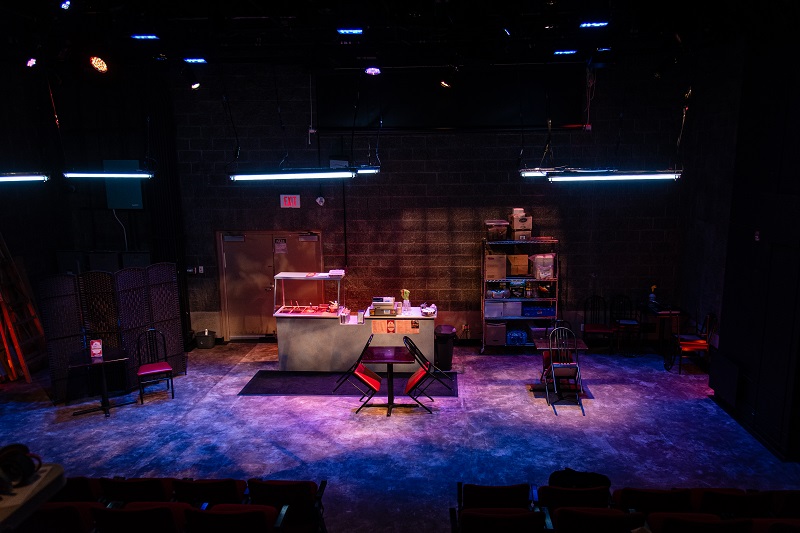
Behind the Moon, written by Anosh Irani and produced by Touchstone Theatre Company, ran at The Cultch’s Vancity Culture Lab (Vancouver, Canada) from March 27–April 6, 2025. I designed the scenery in collaboration with director Lois Anderson. The play unfolds entirely within a late-night take-out restaurant and centres on questions of visibility, identity and belief. Working within a modest budget and an intimate venue, the design relied on a small number of concentrated gestures rather than expansive naturalism. This restraint made collaborative timing especially consequential: decisions had to be precise, and alternatives could not remain in play for long.
A Compressed Synchronous Tempo: A Timeline
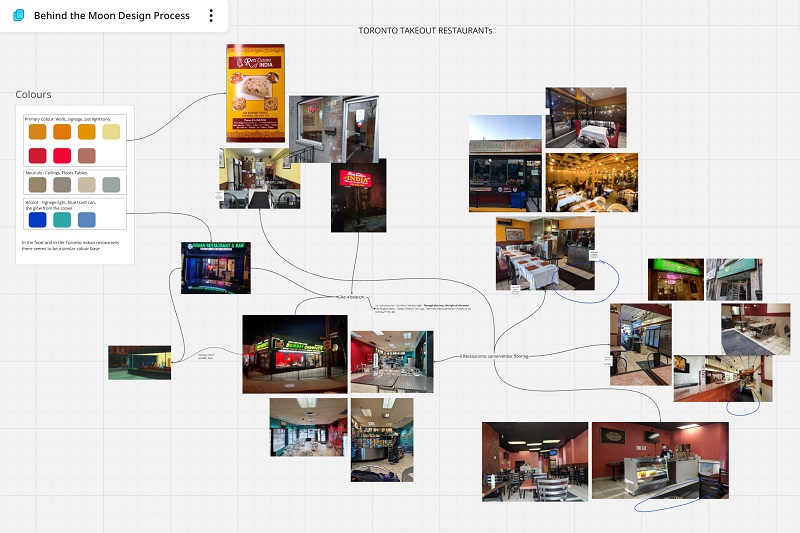
The collaboration unfolded through a compressed, synchronous tempo shaped by frequent Zoom meetings and shared work sessions on Miro. Exchanges occurred in short, focused bursts. Proposals were adjusted, annotated and resolved while everyone watched the design shift in real time. The interval between offer and response narrowed considerably; revisions often unfolded within the same session. Reflective windows shortened. There was little room for incubation or drift.
Although theatre production cycles naturally intensify near deadlines, the specific pattern of compression here was structured by digital tools. Zoom synchronized perception; Miro collapsed proposal, comparison and revision into a single shared exchange. As deadlines approached, collaborative intervals tightened further. What might once have unfolded across days of reflection was resolved within minutes of collective scrutiny.
What Compressed Tempo Produced
Synchronous tempo intensified focus. Because reflection occurred publicly and in real time, authorship concentrated in those present and active within the session. Ideas were tested and resolved quickly, often before extended private exploration could occur. The reflective interval—the time between encountering an idea and responding to it—was structurally narrowed.
Miro simulated gathering around a shared table, but the temporal structure differed from a physical studio. Thinking unfolded visibly and immediately. The process produced clarity and coherence under constraint, but it limited slower exploratory gestures that require temporal slack. Tempo did not simply accelerate decisions, it narrowed the duration for which alternatives could meaningfully remain active.
The Floor as Counter-Tempo
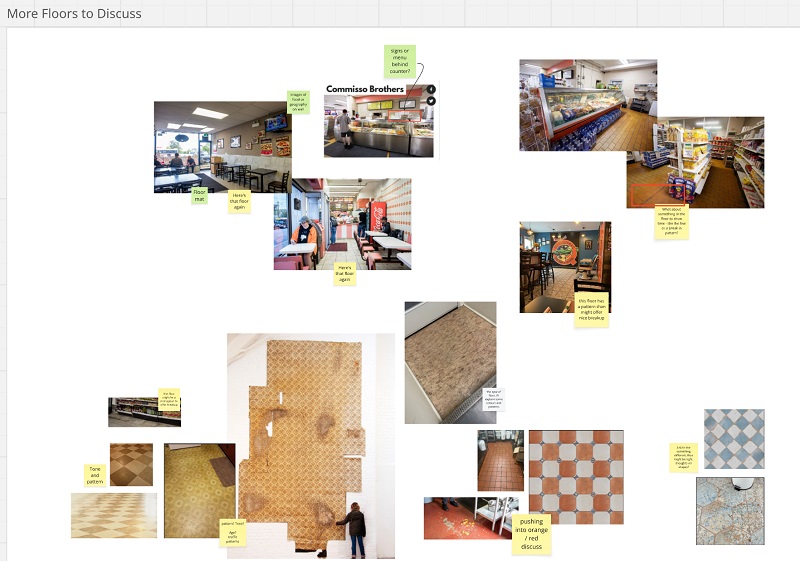
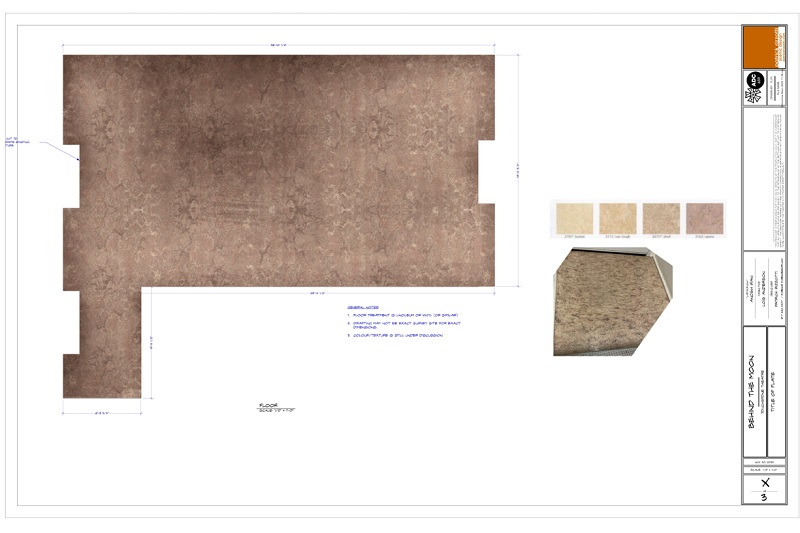
The linoleum floor functioned as the scenographic anchor of the production. Laid wall-to-wall, it shaped audience orientation and defined the spatial logic of the room. Because the design relied on a few scenic elements, the floor carried disproportionate conceptual weight and required repeated collective attention—colour, reflectivity, surface wear.
Unlike other elements that moved quickly from proposal to decision, the floor resisted compression. It demanded revisiting. The interval between offer and resolution widened here, creating a localized counter-tempo within an otherwise accelerated process.
Hann’s concept of withness clarifies this (75–82). Scenographic elements act as orienting conditions that co-position bodies in space and time. The floor functioned as such a condition. Because it structured how performers and spectators were oriented within the world, it required duration. Even within compressed synchronous tempo, certain elements imposed their own temporal demands.
Tools and Interface Control
Miro operated as a real-time collaborative surface. Images were rearranged instantly; floor tests were compared side by side; annotations appeared as we spoke. Because all participants viewed changes simultaneously, the interval between suggestion and evaluation narrowed dramatically.
Zoom functioned as an attention frame. It synchronized perception: everyone saw the same shift at the same moment. This simultaneity intensified tempo and collapsed reflection into the session itself.
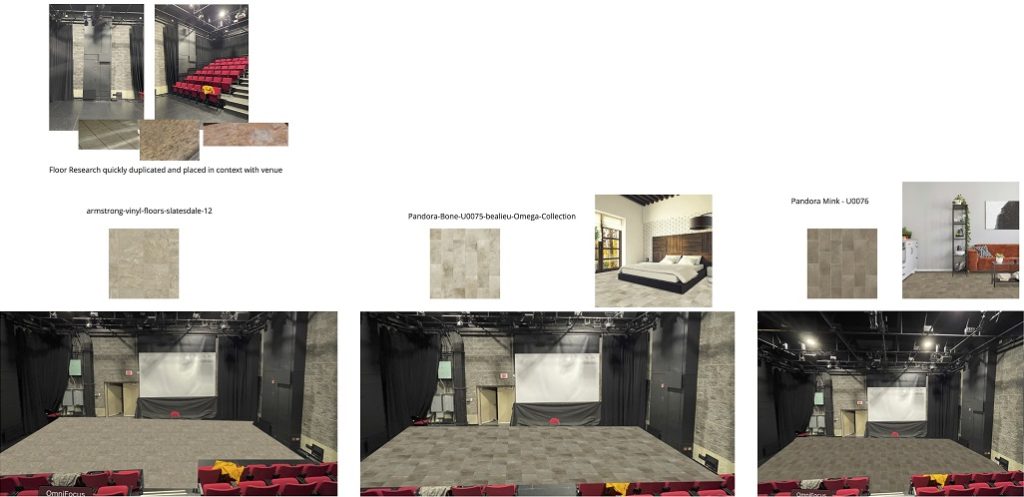
Compression also redistributed authorship. I controlled the interface—selecting images, resizing options, sequencing comparisons—while others responded within the frame I established. Presence was synchronized, but agency was uneven. Alternative paths requiring solitary testing or slower reflection had limited space to emerge. Private incubation was structurally minimized.
Interpretation: What Synchronous Tempo Reveals
Behind the Moon demonstrates how synchronous digital exchange compresses collaborative intervals and concentrates authorship in real time. By collapsing proposal, testing and revision into shared sessions, digital tools intensified convergence while narrowing reflective duration. The coherence produced under compression came at the cost of slower exploratory gestures.
These dynamics become clearer when contrasted with Ring of Fire, where asynchronous exchange redistributed intervals across time. The comparison does not position one tempo as superior. Instead, it reveals how temporal structure reorganizes authorship, attention and the conditions under which collaborative meaning takes form.
Case Study 2: Ring of Fire—Asynchronous Tempo and Digital Distance
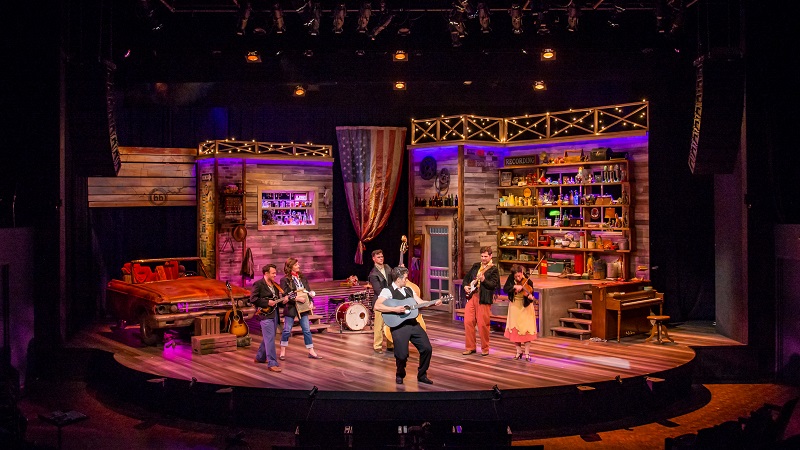
Ring of Fire (Arts Club Theatre Company, Granville Island Stage, Vancouver, Canada, June 26–August 7, 2024) was developed through an almost entirely remote director–designer collaboration. While the production’s scenographic world was built around memory—accumulation, activation, and the logic of replay—the collaboration itself was shaped by a parallel condition: ideas accumulated and returned over time rather than resolving during creative meetings.
Unlike Behind the Moon’s compressed synchronous exchanges, Ring of Fire unfolded through asynchronous cycles of offer, pause, and revision, structured primarily by Miro, Loom, and navigable 3D models. This case study examines how those tools patterned delay, extending the temporal life of options, sequencing attention before dialogue, and producing uneven access to decision-making through differences in digital fluency.
The Asynchronous Tempo
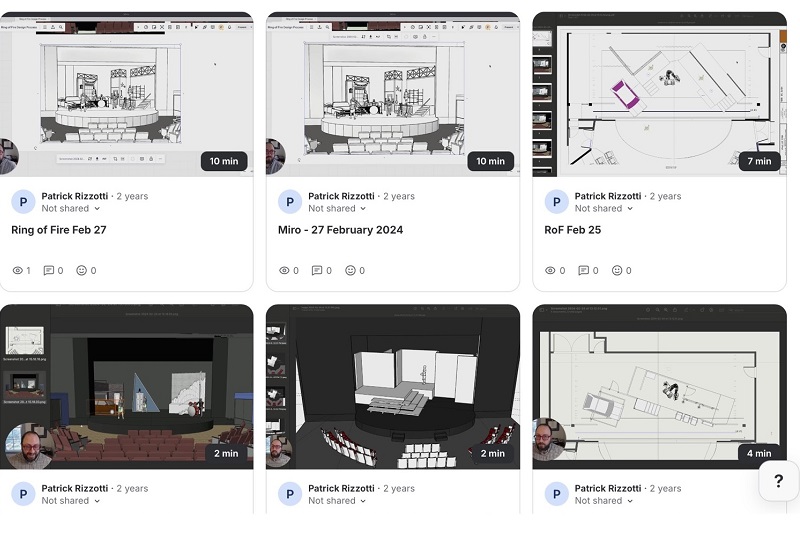
Miro, Loom and navigable 3D models structured most exchanges, with Zoom used intermittently to regroup. Loom recordings allowed me to narrate evolving iterations of drafting or model updates without meeting synchronously. Rachel often responded hours or days later, and revisions followed when time permitted. Ideas incubated independently before re-entering our director-designer conversation.
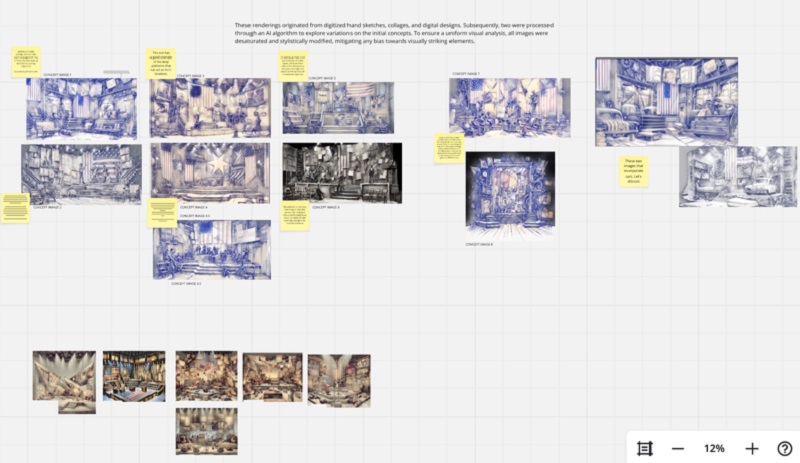
This asynchronous structure became visible early in the process. Early in the process, I built a Miro board that functioned more as a curated archive than as a co-manipulated surface. Posting five or six design iterations at once required little effort. Digital space created an illusion of endless capacity: multiple alternatives remained visible concurrently, extending their temporal life. Live meetings became moments of compression—opportunities to sift through accumulated proposals rather than generate ideas in real time.
Over time, the collaboration settled into a recurring pattern: upload, narrated walkthrough, delayed response, revision. The interval between proposal and reply lengthened, sometimes spanning days. Rather than converging within a shared session, decisions accumulated across dispersed exchanges. What emerged was not a simple delay but a temporal redistribution. Loom sequenced interpretation before dialogue began; Miro preserved concurrent options beyond their practical lifespan; the 3D walkthrough required differing levels of digital fluency, introducing uneven temporal access to the same material.
Tools as Temporal Architectures: Miro: Retention Without Subtraction
The Miro board began as a digital studio wall. Because it could be modified endlessly, it reflected my thinking more readily than it invited co-creation. Rachel viewed it but rarely manipulated it. The platform preserved ideas with little friction. Options lingered visibly beyond their practical viability, extending their temporal life and widening the field of attention.
As Hann reminds us, spatial arrangements are never neutral (85). The board’s layout staged attention and structured which ideas remained active. Without deliberate subtraction, retention slowed convergence and dispersed authorship. Digital abundance intensified this effect. Posting new variations required minimal effort, so multiple concurrent paths forward accumulated. Unlike a physical studio wall—which imposes material limits and demands replacement—the digital board imposed no constraints. Elongation did not produce depth but diffusion. What began as generosity became excess.
Loom: Sequencing and Framed Attention
Loom created clarity. I recorded narrated walkthroughs of evolving designs; Rachel could watch and rewatch as needed. But Loom imposed its own temporal logic. Watching required uninterrupted, linear attention. Because I controlled the sequencing and narration, I structured the order in which ideas were encountered. Although Rachel could pause or revisit sections, exposure unfolded within the temporal frame I established. Authorship consolidated around whoever controlled sequencing. Reflection expanded, but control over the timeline of interpretation narrowed.
3D Walkthroughs: Fluency as Temporal Access
I was able to navigate the digital model easily. Rachel was not. Digital fluency became a temporal variable: the same walkthrough unfolded at different speeds for each of us. Although she could explore independently, access was uneven. She worked within a pared-down interface and with fewer navigational tools. We shared a world but not a tempo. Differences in fluency shaped how quickly spatial insights surfaced and entered the decision cycle.
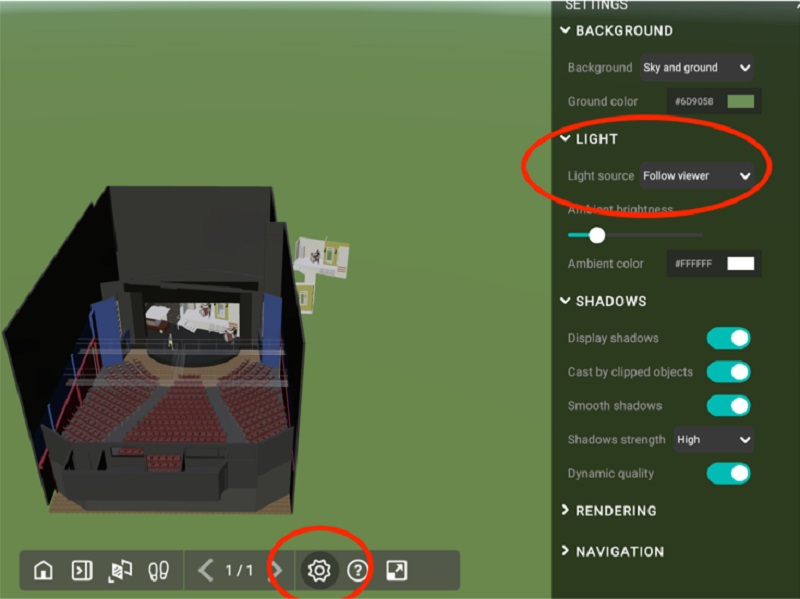
Together, these tools formed a layered temporal architecture. Miro archived ideas without naturally inviting hands-on play. Loom stretched attention through narrated sequencing. The 3D walkthrough unfolded at different speeds depending on digital fluency. The tools, rather than geography, became the primary organizers of tempo.
Missing the Physical Model
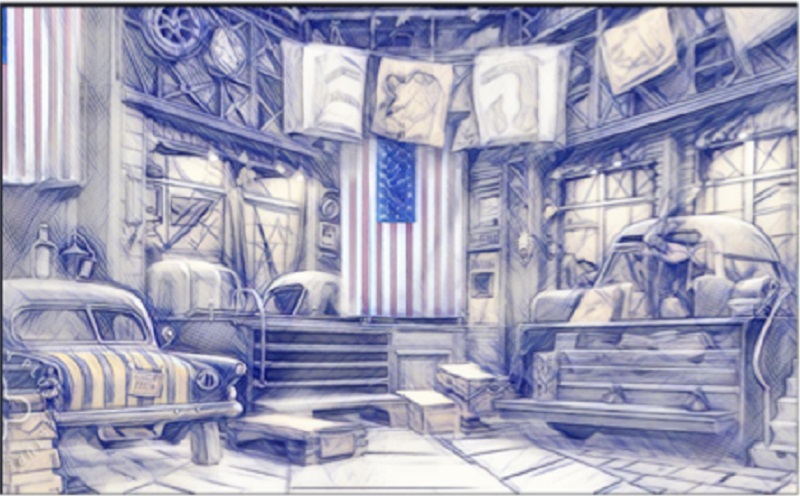
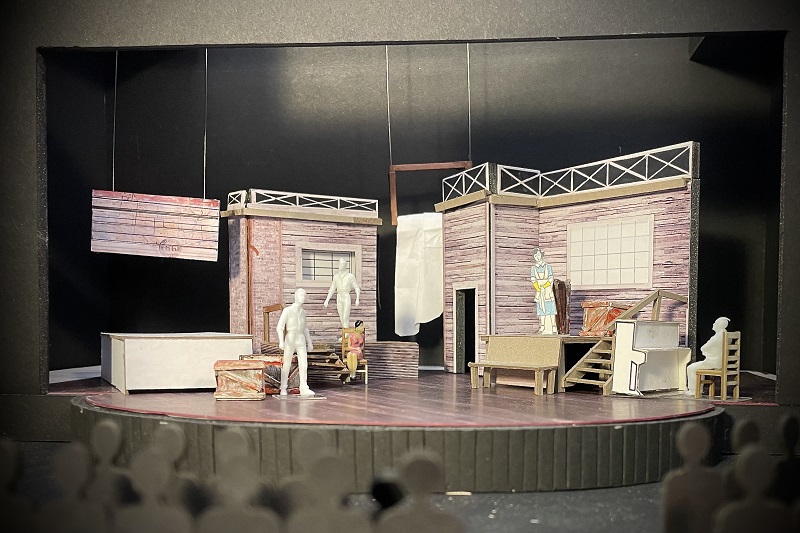
Digital massing studies allowed rapid testing of spatial ideas and car placements within the design. Yet interaction was imbalanced: I manipulated the model directly; Rachel responded verbally. In a shared studio, we would have handled the model simultaneously.
The absence of a shared physical model removed informal temporal intervals—moments of drift, incidental exchange, and embodied co-presence—identified by Lam et al. as structurally significant for collaboration (611, 619). Digital platforms synchronized attention but eliminated transitional time. Zoom compressed encounters into scheduled sessions; Loom sequenced communication without shared aftermath; Miro preserved artifacts without embodied negotiation.
The loss was not only material but temporal. Shared manipulation gave way to staggered response. Simultaneity was replaced by sequencing.
What Asynchronous Tempo Revealed
Asynchronous tempo expanded reflective intervals while unevenly redistributing control. The tools structured which ideas arrived “in time” to shape direction. Loom required sustained linear attention; 3D links demanded digital fluency; Miro staged visibility hierarchically. These conditions shaped whose contributions gained traction and whose receded.
If Behind the Moon compressed tempo into shared bursts of real-time exchange, Ring of Fire dispersed it across extended cycles of offer and return. Asynchronous exchange did not simply slow collaboration—it redistributed authority by managing sequence, visibility, and access.
What Tempo Makes Visible
The contrast between Behind the Moon and Ring of Fire clarifies tempo as a structural condition of scenographic authorship. In the synchronous model, proposal, reflection and decision collapsed into shared moments of scrutiny, intensifying convergence and concentrating agency in real time. In the asynchronous model, intervals were redistributed across time, elongating reflection but shifting authority toward those who controlled sequencing, visibility and interface fluency.
Digital platforms do not merely transmit collaboration; they impose temporal logics. Zoom synchronizes attention and compresses reflection. Loom sequences interpretation before dialogue begins. Miro preserves ideas unless actively reduced. Each platform structures pacing, determining what gains traction and what recedes. Across contexts, the common mechanism is not speed but control over temporal sequencing: who introduces material, who curates visibility and who determines when reflection closes into decision.
Tempo also carries affective weight. Compression generates urgency and clarity but narrows incubation. Elongation expands reflection but risks diffusion and uncertainty. In both cases, tempo operates as an infrastructural condition of scenographic thinking, shaping how meaning and agency take form over time.
Treating tempo as an analytic lens reframes digital tools as temporal architectures rather than neutral carriers of content. It reveals that authorship is not only distributed spatially across collaborators but temporally across intervals of attention. Designing a world onstage, therefore, involves designing, or at least acknowledging, the tempo through which that world comes into being.
Conclusion
This analysis focuses on early-stage designer–director collaboration and does not extend to rehearsal processes or technical production timelines. The patterns traced here, therefore, describe the conceptual phase of scenographic development rather than the full lifecycle of theatrical production.
Scenographic tempo clarifies how digital tools restructure the intervals through which collaboration unfolds. In Behind the Moon, synchronous digital exchange compressed reflection and concentrated agency within shared moments of scrutiny. In Ring of Fire, asynchronous digital exchange elongated intervals, redistributing authority through sequencing, visibility and interface fluency. In both cases, tempo operated as a structural condition of authorship rather than a neutral backdrop to design activity.
Although this study centres on scenic design, the temporal dynamics identified here extend across disciplines wherever digital tools organize early-stage collaboration. The implication is not simply methodological but practical: tempo can be shaped. Designers and directors can calibrate when reflection occurs, how long ideas remain active and under what conditions decisions converge.
The question is therefore not only, “What world are we building?” but also, “At what tempo are we building it—and who does that tempo serve?” Attending to scenographic tempo reframes digital tools as temporal architectures rather than neutral channels, positioning collaboration not merely as efficient exchange but as a deliberately structured distribution of time, access and agency.
AI Transparency Statement: The writing of this article involved limited assistance from OpenAI’s GPT-5.1 model for editorial purposes only, including small clarity improvements, minor rephrasing and suggestions for organizing text I had drafted. All conceptual development, analytic content and interpretive claims are solely the author’s. No AI system generated original ideas or research material. The author verified and revised all AI-assisted text and retains full responsibility for the final manuscript.
Bibliography
Baugh, Christopher. Theatre, Performance and Technology: The Development and Transformation of Scenography. Macmillan Education UK, 2013.
Boiko, Tetiana, et al. “Digital Tools in Contemporary Theatre Practice.” ACM Journal on Computing and Cultural Heritage, vol. 16, no. 2, June 2023, p. 27.
Brejzek, Thea, and Lawrence Wallen. The Model as Performance: Staging Space in Theatre and Architecture. Bloomsbury Methuen Drama, 2018.
Hann, Rachel. Beyond Scenography. 1st ed., Routledge, 2018.
Lam, Busayawan, et al. “Design and Creative Methods as a Practice of Liminality in Community-Academic Research Projects.” The Design Journal, vol. 21, no. 4, July 2018, pp. 605–24.
Nelson, Robin. Practice as Research in the Arts and Beyond: Principles, Processes, Contexts, Achievements. Springer International Publishing, 2022.
Schön, Donald A. The Reflective Practitioner: How Professionals Think in Action. Ashgate, 2013.

*Patrick Rizzotti is a scenic designer and Associate Professor at the University of British Columbia. His research explores digital scenographic workflows, authorship, and collaborative tempo in theatre-making. He has designed internationally for theatre, opera, and exhibitions, including World Stage Design 2022 and the U.S. national exhibitions at the Prague Quadrennial.
Copyright © 2026 Patrick Rizzotti
Critical Stages/Scènes critiques, #33, June 2026
e-ISSN: 2409-7411

This work is licensed under the
Creative Commons Attribution International License CC BY-NC-ND 4.0.
