
Acting and Reenacting: Or How Videogames Transform the Role of the Audience
George Vasilikaris*
Abstract
Technological developments have transformed the role of audiences by opening new avenues for intricate and impactful storytelling. Within this context, videogames, as tools of artistic expression, have expanded the boundaries of narrative media, as audiences can now engage, participate, and perform more autonomously. The interplay between theatre and videogames has long been acknowledged, yet research has predominantly focused on Role-Playing Games (RPGs) and Massively Multiplayer Online Role-Playing Games (MMORPGs). In videogames, however, meaning is not tied to genre but rather emerges through audiences’ actions and interactions within the virtual world, subverting the traditional notions of stage and performer, thereby creating experiences akin to fantastic realism. A conceptual bridge between theatre and videogames can be offered by Vakhtangov’s avant-garde approach, emphasising the transformation of both actor and audience through the erasure of the audience threshold and the negotiation of player identity. This paper explores the intersection of theatre and videogames through the dystopian document thriller Papers, Please (2013), drawing parallels with immersive theatre and experiential learning principles. In particular, it seeks to analyse how narrative and meaningful mechanics transform the role of the audience, cultivating empathy, prompting moral reflection, and, ultimately, blurring the lines between performer and spectator.
Keywords: videogames, immersive theatre, experiential learning, participatory dramaturgy, performer-audience convergence
Introduction
Technological developments have transformed the role of audiences by opening new avenues for impactful storytelling. The abundance of narrative media is greater than ever before, and as videogames are starting to permeate the very fabric of our society, so do stories (Muriel and Crawford 21). Within this context, the study of videogames—as tools of artistic expression—has emerged as an academic discipline, providing a space for the independent analysis of the medium (Hammeleff Jørgensen and Aarseth).
The multitude of voices and approaches towards the study of videogames can provide fruitful ground for true multidisciplinary research; however, this comes to the great detriment of methodological and theoretical formulaicity (Hammeleff Jørgensen and Aarseth). The interplay between theatre and videogames has long been acknowledged—primarily under the prism of Huizinga’s Homo Ludens—while research exploring the technical similarities between theatre and videogames has focused predominantly on genres like Role-Playing Games (RPGs) and Massively Multiplayer Online Role-Playing Games (MMORPGs) (Fernández-Vara; Bloom). In light of their participatory nature, extensive customisation features, and sandbox design, the genres above constitute prime specimens for this form of analysis.
But in videogames, meaning is not confined to genre; instead, it emerges through audiences’ actions and interactions within the virtual world, thereby subverting the traditional notions of stage and performer, invoking feelings of empathy, and questioning the morality of the audience. This unique interplay of mechanics, dynamics, and aesthetics is oftentimes overlooked when attempting to explore the connection between modern videogames and contemporary theatrical performances.
This paper explores the intersection of theatre and videogames through the Dystopian Document Thriller Papers, Please, drawing parallels with immersive theatre and experiential learning principles. In particular, it seeks to analyse how narrative and meaningful mechanics transform the role of the audience, cultivating empathy, prompting moral reflection, and, ultimately, blurring the lines between performer and spectator.
Of Art and Videogames
In April 2010, the late film critic Roger Ebert claimed that “no video gamer now living will survive long enough to experience the medium as an art form,” sparking a debate regarding the legitimacy of videogames as a form of art (Ebert). Although he revisited his claims the same year—hinting at the possibility that videogames could eventually attain the status of art—his initial attitude largely reflects a common sentiment in contemporary media theory. This perceived lack of artistic merit in videogames could be ascribed to their inclusion of “rules, points, objectives, and an outcome” (Ebert). In defense of his claims, he stressed that when a game does not fulfill these criteria, it transforms into something different: an experience, akin to a story, novel, play, or film.
The debate around the differences in habitual forms of perception and, consequently, media separation has persisted for a long time. Higgins (18) suggests that this discourse can be traced back to the Renaissance, while Frank (6) asserts that this attitude is a characteristic of the French fine arts academies of the seventeenth century. Technological developments have introduced new forms of media and storytelling, leading to an increasing acceptance of media flux, where different techniques and methods are starting to blend within artistic spaces.
The concept of intermediality can be traced back to Wagner’s notion of the Gesamtkunstwerk (Total Work of Art), referring to a work of art that synthesises elements from various media and performing arts—including drama, music, décor, and dance—to create a more holistic experience for the audience (Schrötter 2). According to Schrötter (2-6) one can identify multiple forms of intermediality or discursive fields:
- synthetic, which refers to the combination of multiple media to create the “intermedium,” an amalgamation that is greater than the sum of its parts;
- formal (or transmedial), which supports the lack of medium-specific structures;
- transformational, which emphasises the representation of media through one another; and
- ontological intermediality, that rejects the monomedium and supports the ubiquitous occurrence of intermedial relations.
Arguably, modern videogames embody the Gesamtkunstwerk and represent the pinnacle of intermediality. Videogames inherently encompass, emulate, adapt, and build upon other forms of art such as music and theatre, while enhancing them through interactive gameplay. Furthermore, the substantial increase in videogame production costs and the overcoming of hardware limitations have paved the way for the more effective and elaborate incorporation of various artforms, with prominent artists being invited to collaborate on new releases.
In conclusion, Schrötter (6) argues that research would benefit more from focusing on intermediality, rather than specific media or artforms in isolation. This perspective parallels videogame analysis, where interpretation largely depends on the researchers’ background and familiarity with different intersecting fiends (Hammeleff Jørgensen & Aarseth). In this light, intermediality can lead towards a more holistic understanding of how art and media converge to shape narrative experiences.
Avant-garde and the Spectrum of Videogame Experience
Whether videogames can, or should, be regarded as art or contemporary manifestations of the Gesamtkunstwerk remains a point of contention for the scholar and the wider community alike. Nevertheless, through this continuous dialogue, another significant question is raised: Are all games art? If not, which ones truly deserve scholarly attention?
Imagine that you are reviewing proposals for a journal—not dissimilar to the one you are reading—and three videogame-related articles have landed on your desk: 1) an analysis of a football simulation game, 2) a study of a high-fantasy, text-based adventure game, and 3) an exploration of a first-person shooter about a space marine exterminating demonic hordes. At first glance, the second game seems an obvious choice for a scholarly article. This perception largely reflects the public’s view of video games, prompting the question of whether a football simulator holds the same significance as a high-fantasy game with extensive worldbuilding and arguable literary merit. Similarly, is a game about killing demons artistically equivalent to a videogame conveying narrative through visual and emotional cues?
In Avant-garde Videogames Brian Schrank reconceptualises videogame studies by positioning videogames as forms of artistic expression, rather than mere industrial commodities. Schrank (12-27) attempts to situate videogames in a radical-complicit/political-formal avant-garde matrix, suggesting that this can encourage experimentation in design and play, broaden the spectrum of creative engagement with the medium, manifest new forms of play, and attract a wider and more critically engaged audience, thereby allowing for the potential redefinition of the medium (3).
While Schrank places emphasis on experimental videogames, his theory can be expanded to account for increasingly creative forms of play emerging through videogames. For example, machinima—machine and cinema—allows players to transform the digital landscape into a stage for cinematic performance, creating animated films using assets from videogames like Quake or The Sims. Similarly, games like Minecraft exemplify seemingly unlimited player agency, providing them with a digital sandbox to bring their own worlds to life or meticulously recreate iconic fictional settings such as Middle-earth or Westeros. The videogame’s code itself also allows meaningful creative engagement through game modification (or “modding”), as users can create unprecedented genres, paving the way for the emergence of new forms of play, with cultural phenomena like Counter-Strike, Dota 2, and Auto Chess serving as concrete examples of games and genres that derived from modding. In the same vein, the widely popular and critically acclaimed Grand Theft Auto 5, introduced a vast open world, which became the foundation for a new form of digital LARP, leading to the creation of thriving communities within GTA RP. Furthermore, the creative use of videogames extends beyond their code or digital fictional realms. A concrete example can be found in Pokémon GO, which utilised smartphone portability and Augmented Reality to allow users to relive their childhood fantasies through locative media, merging real and digital navigable spaces.
Considering the above, it remains difficult to make definitive claims about which videogames constitute art and which do not merit scholarly attention. Revisiting the dilemma introduced earlier in this section: Could one make definitive claims regarding the value of Sensible World of Soccer or Doom when compared to Zork? Even when assessed through Schrank’s framework, each of these games occupies a unique position on the avant-garde matrix, demonstrating innovative forms of play and engagement. Notably, all three videogames were some of the first to be introduced into the Archive of the Library of Congress and are now preserved as works of cultural significance (Video Game Canon). Therefore, each videogame has its own distinctive merits and can offer ground for scholarly enquiry, whether analysed independently or in relation to another discipline. While videogames share some characteristics with other media, one should acknowledge the differentiating elements of videogames and treat them holistically in terms of analysis, recognising their playful departure from established norms.
Interactions Between Theatre and Play
Although videogames tread a fine line between high and popular culture, they have developed their own dramaturgy, shaped by distinct dialectics, aesthetics, rules, and mechanics, gradually detaching themselves from traditional media norms (Vasilikaris 26-45). Unlike films and theatre, videogames require a certain degree of openness to allow meaningful play, action, and learning (Backe 17-32; Gee 78-87). Consequently, performance is inherently tied to players themselves, as the creation of meaning stems from their actions and interactions within the virtual world (Koubek 192; Gee 165). The established dynamic partially resembles a digitised autopoietic feedback loop in which the players adopt the role of both the performer and the emancipated spectator, as they are prompted to create their own meaning (Fischer-Lichte; Rancière). Although a more exhaustive analysis situating videogames in the wider context of performance theory would hold significant merit, it extends beyond the scope of this article, which will focus on how Papers, Please relates to theatre and transforms the role of the audience, focusing on interactive theatre and immersive theatre.
Much like videogames, interactive and immersive theatrical performances constitute amalgams of other forms of theatrical play. Although the terms are often used interchangeably, they present subtly differentiating qualities. Interactive theatre, for example, aims to bridge the distance between performers and audience, encouraging meaningful interaction that may influence the story’s outcome, as was the case with The Mystery of Edwin Drood. On the other hand, immersive theatre emphasises the setting, relinquishing the traditional stage in favour of greater immersion, similar to Sleep No More.
When discussing what makes immersive and interactive theatrical experiences unique, several key elements come into focus:
- degree of participation, referring to the active/passive participatory role of the audience;
- audience agency, or the control they have over the performance;
- the level of interaction, encompassing the degree they can engage with the performers, the environment or both; and
- subversion of the stage, whereby traditional boundaries are challenged to enhance immersion and the impact of the performance.
It is important to note that these elements are not fixed; rather, they can be viewed as scalable factors that exist along a spectrum of interactivity.
Interactivity, metatheatricality, and the deconstruction of the stage are elements that inherently connect videogames with theatre. This could be exemplified under the prism of Vakhtangov’s principle of “fantastic realism”; the notion that objects “undergo a double transformation” in theatre, initially when reality is transformed into play and subsequently when the play is transformed into a stage production (Mirochnikov 5). In videogame theory, fantastic realism is reflected by the mechanics-dynamics-aesthetics model, as code is initially transformed into a videogame and subsequently a gaming experience.
Vakhtangov’s approach towards the actor-audience relationship also resonates deeply with modern videogame dynamics. Committed to the truth of the theatre, he championed the monism of the actor, a principle emphasising the performers’ creative freedom and subjectivity to create a passionate reflection of life (Mirochnikov 5-10). For Vakhtangov, the audience was an equally crucial part of the theatrical production, an active agent in the co-creation (Boris Shchukin Theatre Institute). In his production of Princess Turandot, he exemplified this by erasing what Malaev-Babel describes as the audience threshold (67-81). By breaking the fourth wall, he created a layered form of spectatorship, where the audience adopted one of three roles: 1) the real-world audience, 2) a member of a Commedia crowd, or 3) an active participant in the Turandot plot.
This layered form of spectatorship also finds a parallel in the concept of the emancipated spectator, which dismantles the binary of active performer and passive viewer (Rancière 15-23). For Rancière, spectators are rendered active by interpreting, connecting, and instilling meaning to a performance, thereby subverting the presumed hierarchy of a performance.
The concept of transformative identity is central not only to the works of Vakhtangov and Rancière, but also to the theories of videogame scholar James Paul Gee, who introduces 36 principles that demonstrate how videogames facilitate learning. While some principles can be linked to specific videogame genres, the Identity Principle is universal. Gee argues that “there is a tripartite play of identities as learners relate, and reflect on, their multiple real-world identities, a virtual identity, and a projective identity”, allowing users to reflect on the interplay between new and old identities (64).
Similar to Vakhtangov’s Turandot, Gee argues that players can perform in three ways: 1) they can maintain the identity of the player (real identity); 2) adopt the identity of a character in the play (virtual identity), or 3) imbue their own aspirations to the character (projective identity). In close resemblance with Vakhtangov’s principles, these identities coexist, and to achieve meaningful results, players will inevitably have to merge and juggle between them, while engaging creatively with their environment (Gee 45-69).
Another parallel between games and theatre lies in how the audience—be it players, learners, or actors—perceives the stage. In interactive, immersive, and Vakhtangovian theatre, the manifestation of the stage is destabilised, with performances taking place within a space reminiscent of Huizinga’s magic circle (10). Videogames offer a similar space, a psychosocial moratorium, “in which the learners can take risks where real-world consequences are lowered” (Gee 59; 222). Through experimentation, learners can experience the Principles of Amplification Input and Self-Knowledge, meaning they can gain significant output for minimal input, while also gaining a deeper understanding of themselves, their current and potential capacities (Gee 222).
Although Gee claims that stories in videogames [did] not hold the same depth as good books and movies due to the limited computational power of their platforms, he suggests that their aim is to provide a story with long-lasting impact (Gee 80). This largely reflects Vakhtangov’s intention to make “the audience not to be able to realize their own sensations, want them to bring the sensations home and live with them long” (Boris Shchukin Theatre Institute).
Technological advancements have transformed videogames into tools of meaningful artistic expression that can surpass conventional narrative techniques and enhance storytelling through mechanics. In order to explore how the mechanics of Papers, Please operate, it is useful to consider the perspectives of Miguel Sicart and Jörg Friedrich on game mechanics. From a theoretical perspective, Sicart views the players as “active moral agents with creative and participatory capacities,” who are conditioned by the videogame mechanics and are called to construct experiential meaning through moral reflection within a “ludic hermeneutic circle” (226, 116-27). Although he emphasises the importance of treating the players as moral beings, Sicart adopts a structuralist approach, focusing on player agency within the confines of the virtual world, an idea that is challenged by Friedrich.
When discussing the thought process behind the creation of Spec Ops: The Line, Friedrich both verifies and challenges the notions introduced by Fischer-Lichte and Rancière (66-71). Like Gee and Sicart, Friedrich agrees that “players have been trained to make [their] decisions strategically within the context of the game,” yet suggests that this provides an additional challenge when trying to introduce impactful moral decisions (68-9). Recognising the players as “acting actors” capable of pausing and thinking before acting, Spec Ops: The Line introduces three rules regarding player choice: 1) there is no right decision in the choice between two evils; 2) the dilemma should create pressure during decision-making, if players hesitate, the game continues and decides for them; and 3) the consequences of judgement are unpredictable (69).
In this sense, the game itself invokes and disrupts Fischer-Lichte’s notion of autopoietic feedback loops and Rancière’s emancipated spectator. Although meaning still emerges through players’ actions, the system restricts their agency, thereby fracturing reciprocity. Similarly, players remain active interpreters, but are constrained to confront and interpret their own complicity, even after they stop playing.
Building on these considerations, the discussion now turns to Papers, Please and its relationship to the concepts introduced regarding the audience’s role in the production of meaning, as well as player morality through meaningful mechanics.

Papers, Please
Created by a single developer, Papers, Please was initially released in 2013 to thunderous acclaim for its excellence in design and narrative by gamers and critics alike, standing as a unique creation in the realm of videogames (Papers, Please). Set in the fictional war-torn country of Arstotzka, the players take the role of a border inspector at the checkpoint dividing East and West Grestin. According to the developer, Lucas Pope, the game’s premise is simple: “people are coming into your little booth, and they give you their documents ‘papers, please’ and you line all those papers up on the desk, and you look at them, and you check, and you see if all the documents they have match all the rules.” (Peabody Awards 0:16-0:30) Despite its superficial simplicity, Papers, Please unfolds into an abstract political commentary, placing morally ambiguous situations before the players and then prompting them to act or reenact. However, before delving deeper, it is important to set the stage.
Congratulations. Your Name was Pulled
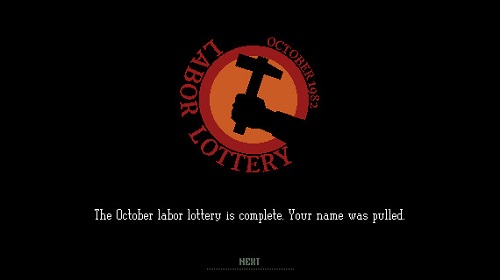
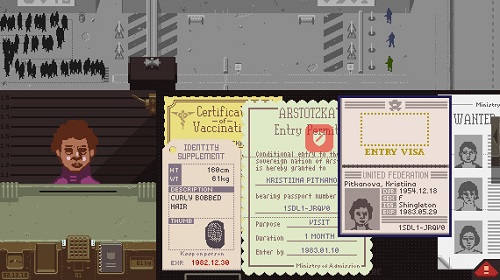
The story begins with a series of introductory screens, informing the players that the inspector’s name was pulled from the October 1982 lottery, resulting in his relocation to East Grestin. The game spans over 31 days, each divided into four distinct segments. Each day starts with the inspector reading “The Truth of Arstotzka,” a newspaper featuring different headlines based on the inspector’s actions and walking to work. The next segment starts when the inspector enters the booth, where he is given time to review new orders from the Ministry of Admission and prepare for his daily tasks. The next segment is the main gameplay of Papers, Please, and consists of a 12-hour shift (3-8 minutes) during which scripted and non-scripted events unfold. At the end of the shift—the final segment of the day—the inspector allocates resources to rent, heat, food, and other expenses such as medicine. Visually, the screen is divided into three parts. At the top, the players can see an overview of the Grestin checkpoint, with the blockade of guards on the right-hand side and the line of people on the left. The bottom half of the screen shows the interior of the inspector’s booth, which is divided into two parts: the desk, where the inspector can shuffle documents and highlight discrepancies, and the front desk, where the entrants wait.
Have your Documents Ready
At first glance, Papers, Please appears to be a generic job simulator. Yet, the beauty of interactive media lies in their ability to immerse the players in a narrative about abstract politics through interaction, allowing a level of involvement that surpasses traditional storytelling media such as books or movies (Peabody Awards 1:16-2:01). When players start the game, they are greeted by a drab palate of muted colours, underscored by a minimalist marching melody with Soviet-era undertones. The design also invokes a strong sense of oppression through confining screen space and limited, intentionally cumbersome, and unresponsive mechanics.
Pope’s great emphasis on design and mechanics is evident, with the gameplay of Papers, Please revolving around 2 axes: document processing and resource management. Players earn 5 Credits per entrant, and penalty citations are issued after the second mistake, with the penalty increasing by 5 Credits for each subsequent error. Therefore, players must meet a processing quota to accumulate seemingly adequate resources or find other ways to make ends meet. In other words, the game’s mechanics condition players to operate within Sicart’s ludic-hermeneutic circle and in Friedrich’s principles of choice, acting fast and decisively, while being confronted with the unpredictable consequences of their judgment.
Cause no Trouble
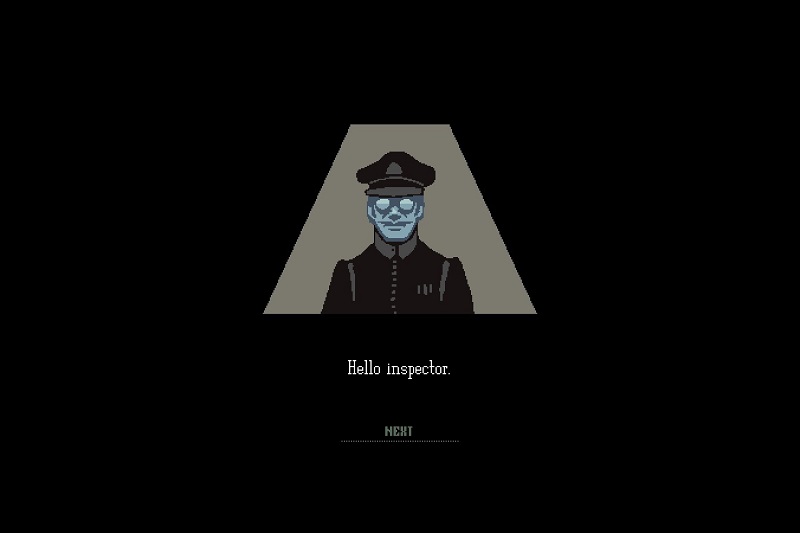
The scripted events highlight the decisions players must make, reminiscent of Friedrich’s idea of choosing between two evils and Rancière’s emancipated spectator. In this light—and under the prism of Gee’s Identity Principle and Vakhtangov’s theory on acting and audience participation—the players are prompted to explore their identities within the psychosocial moratorium of Papers, Please, and act or reenact based on their predominant identity.
For example, on day 17, the inspector befriends Sergiu, a newly-assigned guard from his hometown. A few days later, Sergiu asks for help in getting a girl named Elisa across the border. However, Elisa’s paperwork is incomplete due to the increasingly strict and ever-changing regulations. Player decisions are influenced by their approach toward the game and the degree of conditioning by its mechanics, provided that, in order to ensure the survival of the inspector’s family, they have to blindly follow the rules. In such moments, Papers, Please, presents a blank slate, forcing both player and inspector into a bleak “What if?” scenario. If players act based on their own identities and moral compass, they may allow Elisa to cross the border, endangering the survival of the inspector’s family. Conversely, acting based on player identity, players might be more lenient towards other entrants. On the contrary—if they fully enact the role of the inspector—they will be forced into morally ambiguous decisions such as granting entry to criminals, accepting bribes, and denying entry to Elisa to align with the regime and live another day.
Glory to Arstotzka
Similar to LARP, videogames often require from players to act in character, performing in a way that enhances immersion. Pope’s creative approach serves to amplify this feeling. The game’s intentionally impractical mechanics, unresponsive controls, and repetitive motions reflect the inspector’s mundane routine. Similarly, the brief interactions with entrants both elicit empathy and challenge players’ identities. Moreover, by linking the number of Credits earned to the—as per Arstotzka—accuracy of passport evaluations, the mechanics instill a feeling of angst in players, who must grapple with the morality of their choices amidst escalating international tensions and terrorist attacks that disrupt both the workflow and the autopoietic feedback loop. Though, does this justify sending innocents to labour camps, or an even worse fate, for some extra Credits?
The game openly portrays Arstotzka as an authoritarian state that thrives on poverty and propaganda. The underlying question is to what extent adherence to the rules of an oppressive regime conveys morality. If your evaluation is subpar, you are sent to a labour camp and your family is left to die, while good performance leads to better living conditions. With new regulations implemented daily and failure to comply leading to denial of entry, players are confronted with moral challenges. You can grant entry to an acquaintance of your supervisor to earn his favour, but not to someone facing execution?
Pope emphasises the importance of striking a balance between resisting an oppressive regime, while operating within its constraints (Rev3Games 2:40-2:52). Players are forced to perform within a morally gray area, make conflicting choices based on their feelings, and assess their actions themselves. This is also reflected by the lack of feedback other than the results, thus underscoring that the moral thing to do remains ambiguous. As Pope states, “You find yourself in a situation where you are trying to do the right thing, but the right thing is not at all clear… You can say that everything is right or everything is wrong, like you are really trying to balance your priorities.” (3:27-3:50).
By successfully simulating life in an oppressive society, Papers, Please encourages players to reflect on their potential actions in similar scenarios and reassess their different performing identities. Although empathising with pixelated humans may seem striking, the game provides an additional layer of contemplation through meaningful design. While the entrants’ models are procedurally generated, most of their names were community submissions. In doing so, players are made part of the virtual world in more ways than one, adding gravitas to the inspector’s actions. Relying heavily on player interaction, Papers, Please does not follow a narrative of heroism, but rather explores the interplay of survival, obedience, and morality.
In the game’s best ending, these themes converge, and the notions of stage and identity are subverted to deliver a powerful message. If the inspector and his family flee to Obristan, they experience the same predicament from the perspective of the entrants. Players are informed that the forged passports “look terrible,” yet the seemingly hostile Obristan inspector grants entry to the whole family, leaving the players to wonder if this will lead to a citation.

Final Thoughts
The emergence of videogames as meaningful tools of artistic expression has pushed the boundaries of traditional storytelling. Although meaningful mechanics or ethical explorations are not always a design priority, each videogame can possess artistic value and serve as basis for insightful analysis. Their openness allows for meaningful play, action, and learning, facilitating multidisciplinary approaches and shifting the focus from passive consumption to active co-creation of meaning.
Play intertwines with theatrical performance, especially in how videogames enable varying degrees of participation, interaction, and agency; thereby, enhancing and destabilising feedback loops, and necessitating a redefinition of the performer/audience roles. Vakhtangov’s avant-garde theatre and modern videogames are connected by a shared emphasis on fantastic realism and the transformative roles of actors and audiences highlighted by erasing the audience threshold, prompting thematic reflections, and providing sociopolitical commentary. A parallel can also be drawn between immersive, interactive, and Vakhtangov’s theatre with Gee’s tripartite play between real, virtual, and projective identity, as their interplay mirrors the roles assumed by audience and players respectively. In such contexts, the traditional stage is replaced by a magic/ludic-hermeneutic circle or a psychosocial moratorium that allows players to experiment within a controlled environment, as well as challenge their belief and ethical systems. However, as stressed by Pope and Friedrich, for a game to create lasting emotional and ethical impact, it must exert consistent pressure, convey a sense of consequential decision-making, and limit the players’ abilities to predict the outcome of their judgement.
In this context, Papers, Please exemplifies these ideas by foregrounding the players’ moral agency and challenging their beliefs. Through minimalistic design and meaningful mechanics, it transforms the role of the audience by presenting a dystopian scenario and prompting them to balance survival and ethics, raising questions about human behaviour under totalitarian regimes. Although such concepts have been key themes for stories in every medium, Papers, Please simply sets the stage for the performance and encourages the audience to experiment within its circle. The game acts as a mirror, illustrating how shifts in perspective can alter the roles of oppressor and oppressed, showcasing the consequences of decisions, and emphasising moral subjectivity.
All artists seek to create lasting impressions on their audiences, prompting reflection in light of potential worldview shifts. By leveraging dynamics from theatre, videogames can deepen audience engagement and evolve interactive storytelling. As virtual reality has already found its way into theatrical performances, new avenues between artistic expression and narrative exploration are bound to emerge.
Bibliography
Backe, Hans Joachim. “Between ‘One for All’ and ‘Free for All’—Transmedia Storytelling.” Films and Games: Interactions, 1st ed., Bertz + Fischer Verlag, 2015, pp. 91–95.
Bloom, Gina. Gaming the Stage: Playable Media and the Rise of English Commercial Theater. U of Michigan P, 2018.
Ebert, Roger. “Video Games Can Never Be Art.” Roger Ebert, 15 Dec. 2012.
“Evgeny Vakhtangov.” Boris Shchukin Theatre Institute.
Fernández-Vara, Clara. “Breaking New Ground: Innovation in Games, Play, Practice and Theory.” Play’s the Thing: A Framework to Study Videogames as Performance, DiGRA, 2009.
Fischer-Lichte, Erika. The Transformative Power of Performance: A New Aesthetics. Routledge, 2008.
Frank, Peter. Intermedia: Die Verschmelzung der Künste. 1987.
Gee, James Paul. What Video Games Have to Teach Us About Learning and Literacy. 2nd ed., Macmillan, 2014.
Hammeleff Jørgensen, Ida Katherine, and Espen Aarseth. “Game Analysis Reloaded.” Game Studies, Apr. 2022.
Higgins, Dick. Horizons: The Poetics and Theory of the Intermedia. 1983.
Huizinga, Johan. “Homo Ludens: A Study of the Play-Element in Culture.” American Sociological Review, vol. 16, no. 2, Apr. 1951, p. 274.
Koubek, Jochen, et al. “Zur Medialität des Computerspiels.” Spielkulturen: Funktionen und Bedeutungen des Phänomens Spiel in der Gegenwartskultur und im Alltagsdiskurs, Hülsbusch, 2013, pp. 17–32.
Malaev-Babel, Andrei. The Vakhtangov Sourcebook. Taylor & Francis Group, 2011.
Mirochnikov, Oleg. “The Vakhtangov Technique.” University of the Arts London, 2007.
Muriel, Daniel, and Garry Crawford. Video Games as Culture: Considering the Role and Importance of Video Games in Contemporary Society. Routledge, 2018.
“Lucas Pope Accepts a Peabody for His 2013 Video Game Papers, Please.” YouTube, uploaded by Peabody Awards, 24 Mar. 2022.
Rancière, Jacques. The Emancipated Spectator. Verso, 2009.
Rauscher, Andreas. “Interview with Jörg Friedrich.” Films and Games: Interactions, Bertz + Fischer Verlag, 2015, pp. 67–71.
“Papers, Please: Adam Sessler Chats with the Man Behind the Affecting People Simulator.” YouTube, uploaded by Rev3Games, 17 Sept. 2013.
Schrank, Brian. Avant-Garde Videogames: Playing with Technoculture. 1st ed., MIT Press, 2014.
Schröter, Jens. “Discourses and Models of Intermediality.” CLCWeb: Comparative Literature and Culture, vol. 13, no. 3, Sept. 2011.
Sicart, Miguel. The Ethics of Computer Games. MIT Press, 2011.
Vasilikaris, George. “Storytelling in the Age of Videogames: The Fall of Traditional Storytelling and the Rise of Multidimensionality.” Multidisciplinary Perspectives on Narrative Aesthetics in Video Games, Peter Lang, 2021, pp. 26–45.
Videogame Bibliography
Auto Chess. Drodo Studio, 2019.
Counter Strike. Valve, 2000.
Doom. id Software, 1993.
Dota 2. Valve, 2003.
Grand Theft Auto 5. Rockstar Games, 2013.
Minecraft. Mojang Studios, 2011.
Papers, Please. 3909, 2013.
Quake. GT Interactive, 1996.
Sensible World of Soccer. Renegade, 1994.
Spec Ops: The Line. 2K, 2012.
The Sims. Electronic Arts, 2000.
Zork. Personal Software, 1980.

*George Vasilikaris is a Doctoral Researcher at the School of Languages and Translation Studies of the University of Turku. He holds a BA in English Language and Literature from Aristotle University of Thessaloniki, where he also completed an MA in Translation and Conference Interpreting. He is an active translator and localisation specialist with a primary focus on videogame and software localisation. His research interests and publications center on videogame localisation, intercultural communication, digital humanities, and the multidisciplinary analysis of videogames.
Copyright © 2026 George Vasilikaris
Critical Stages/Scènes critiques, #33, June 2026
e-ISSN: 2409-7411

This work is licensed under the
Creative Commons Attribution International License CC BY-NC-ND 4.0.
