
Mythmaking, Cultural Memory, and Postcolonial Dramaturgy in Kung Paano Nanalo sa Karera si Rosang Taba
S Anril P. Tiatco* and Jonas Gabriel Garcia**
Abstract
This paper examines the connection between theatre, mythmaking, and cultural memory through the Filipino play Kung Paano Nanalo ng Karera si Rosang Taba, an adaptation of Dean Alfar’s children’s book How Rosang Taba Won a Race. The play follows Rosa, a citizen of the fictional Lupang Hinirang (The Beloved Land), and a criada (housemaid) in a mansion owned by the Ispancialo family, whose patriarch is the Governor-General of Lupang Hinirang. Rosa is also a cherished daughter of an elderly Katao couple who used to tell her stories about the divine Lakambini, protector of the lands of Hinirang and its people. In historiography, mythmaking is often seen as excess or exaggeration due to its hyperbolic nature and the potential to spread false information. However, in this production, exaggeration is viewed as necessary. The play’s hyperbolic strategy aims to portray a postcolonial narrative through strategic essentialism, where a marginalized community affirms an essentialized identity and unites for political reasons. Ultimately, staging Kung Paano Nanalo ng Karera si Rosang Taba acts as an allegorical reflection of how the past influences the present and shapes the future—a hope for a better community built on shared ancestry and history.
Keywords: political theatre, decolonized dramaturgy, theatre and history, theatre and mythmaking, contemporary Philippine theatre
| AMA. | How are you going to beat the fastest runner in town? |
| ROSA. | I have an idea! |
| AMA. | To beat him in a race? |
| ROSA. | Yes! And if I win… |
| AMA. | If you win, do you think they will change how they see us? |
| ROSA. | I have no answer. I don’t even think I can get them to change their minds. But I hope we can change ours. |
| AMA. | But what if you lose? |
| ROSA. | Oh, dear father! We’ve already lost everything from them, haven’t we? We no longer recognize our honor and dignity as people. But if I win? Just like the heroes in our stories? |
| AMA. | But this isn’t a story, Rosa! Do you even know what you risked? |
| ROSA. | Yes, Father! Our humanity! |
From Kung Paano Nanalo ng Karera si Rosang Taba (Rosang Taba), a stage adaptation of Dean Alfar’s children’s book How Rosang Taba Won a Race,[1] the main character, Rosa, responds to her father’s skepticism about her winning the race against the town’s fastest man: the Ispancialo (a reference to Spanish) Jaime Alonzo Pietrado ei Villareal (Pietrado). The distrust comes from her physical condition. Rosa is a large woman, which is why she’s called “Rosang Taba” (Fat Rose). Additionally, her father believes that Rosa challenging Pietrado in a race might bring more embarrassment to their family and their homeland.
Three key points from the excerpt above: First, when writing history, the victors often get the chance to tell their stories. We see Rosa’s urgency to share her perspective, even if others believe she is on the losing side of history. Second, it examines the dynamic relationship between remembering and forgetting, and how those in power manipulate both. The short scene demonstrates how authorities can easily create oppositions, such as civilized versus savages, the strong versus the weak, winners versus losers, and the capable versus the helpless, with the aim of defining individuals as the opposite of these oppositions: the savages, the weak, the powerless, etc. As in Rosa’s case, her parents have long believed they are uncivilized and uneducated because colonial powers have repeatedly reinforced these ideas in their minds. Lastly, it encourages us to view mythmaking as a form of postcolonial storytelling through strategic essentialism, a process where marginalized communities essentialize themselves to assert their identity against others and unify for political reasons.
In Rosang Taba, mythmaking becomes a constructive way to affirm personal identity and collective belonging. This affirmation is vital because it shows how marginalized or subaltern groups respond with “enough is enough,” to the ongoing denial of their ontologies and epistemologies by the dominant authority, instead advocating for alternative truths as valid and absolute.
Originally staged during National Women’s Month in the Philippines, José Estrella, along with Issa Lopez and Mark Dalacat, collaborated with playwrights Rodolfo Vera and Maynard Manansala to bring the children’s story to the main stage of Villamor Hall in Quezon City. Initially planned as a recorded performance during the global pandemic, Rosang Taba ran from March 26 to April 2, 2023, and had a rerun at the newly opened KAL-IBG Theatre inside the University of the Philippines Diliman in April 2024.
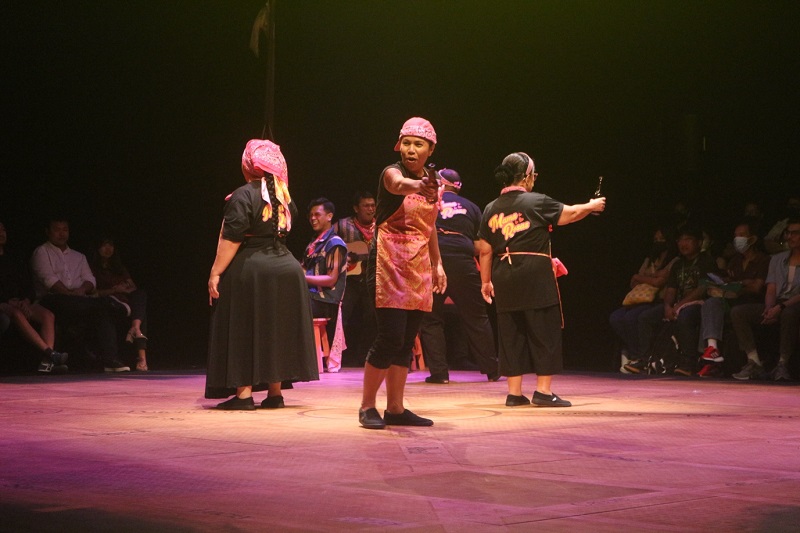
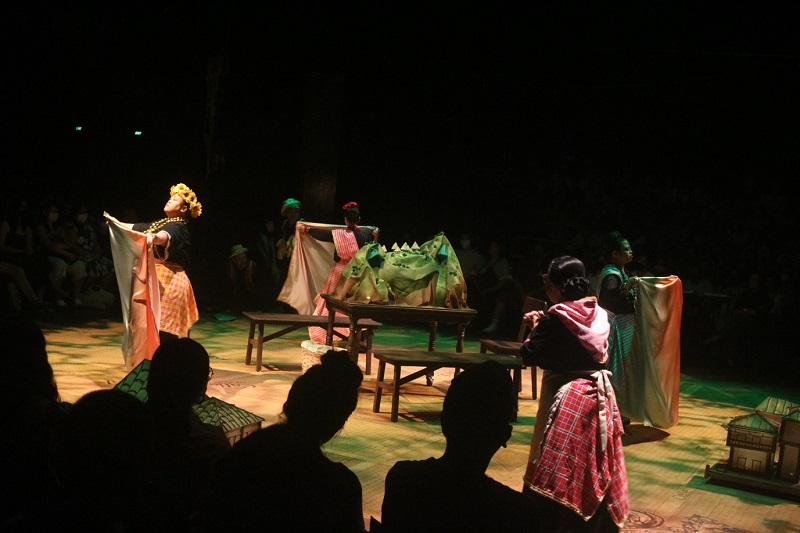
Rosang Taba begins at the present-day restaurant called Mama Rosa’s, run by Rosa’s three great-great-granddaughters (Fig. 1). During the colonial era, Rosa was the Governor General’s cook. Today, the restaurant is famous for its tasty food and the warm hospitality of the owners, who often share the story of their lola (great-great-great-grandmother) Rosa through a musical show. Interestingly, the customers always look forward to hearing the same story. The race is important to the granddaughters because it helped Rosa and her family gain their freedom from the Governor General, and they used some of the prize money to start their food business.
Franz Sorilla IV reports in Tatler that the play was well received by audiences because it celebrates pride and difference. Social media posts also see it as a play addressing feminist concerns, particularly body issues. Others on social media view it as a political piece, such as National Artist for Literature Virgilio Almario, who describes the piece as necessary in this era of post-truth. Almario wrote on his social media account, Rosang Taba is the persona here, telling the real story despite the force of historical revisionism.
The dramaturgical team also notes in the play’s program that the play examines the lingering effects of colonial trauma while celebrating the rich precolonial past. Rosang Taba serves as a testament that, despite what colonial authorities documented about the natives, they cannot simply be seen as uncivilized beings because their repertoire reflects local ontologies and epistemologies. Additionally, the team envisions the spectators as active witnesses or, as Derek Goldman mentions, as performers of a conscious act of witnessing, a transfer of responsibility that recognizes that something important has occurred involving everyone present, and that this experience can never be erased.
This paper examines the links between theatre, mythmaking, and cultural memory to analyze postcolonial dramaturgy. In historiography, mythmaking is often seen as an excess or overflow because of its exaggerated nature and its potential to spread misinformation. In the context of the play, this overflow is considered necessary. Ultimately, Rosang Taba acts as an allegorical symbol of the past that shapes the present and influences the future: a vision for a better community grounded in a cultural imagination of a united people based on shared ancestry and history.
An Invitation to Witness Rosa’s Fate
From the moment the audience enters the lobby of Villamor Hall to go to the main stage, they are greeted warmly by the ushers with “Welcome to Mama Rosa.” At the front of the house is a large Mama Rosa marquee lit in neon, also welcoming everyone, resembling the signage of local restaurants in the city center, especially in the historic districts of Binondo and Intramuros, which were residential areas for Spaniards in Manila during colonial times. A similar neon-light marquee hangs in the middle of the arena stage. With the ushers’ gestures and warm greetings, everyone is invited to participate in the performance as a patron.
The play begins with three women (collectively called the Rosas here onward) who introduce themselves as Rosalinda (played by experienced theatre and TV actress Pewee O’Hara), Rosa Mia (played by Skyzx Labastilla in the 2023 production and Meann Espinosa in the 2024 rerun), and Rosana (played by Kiki Baento). They tell the audience that they are the great-great-great-granddaughters of Rosang Taba, the matriarch and original owner of Mama Rosa. Accompanying them are three servers, who also serve as the restaurant’s entertainers. As a tradition, the entire crew performs a musical show to honor and celebrate Rosa’s heroism (Fig. 2). After assigning roles, the Rosas begin the show by inviting the audience to watch the events that took place.
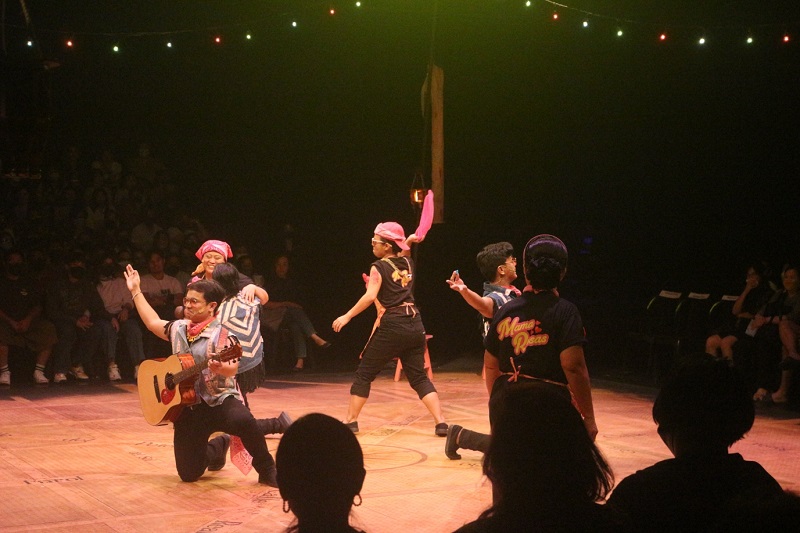
The prologue is a testimonial piece that “comprises of representations either by those who have lived through such events or by those who have been told or shown such lived realities, either directly or indirectly, and have been moved to convey to others what has been impressed upon them” (Simon and Eppert 176). In this regard, the Rosas’ invitation to the audience to be witnesses is also an invitation to remember. In the prologue, the Rosas literally inquire about the audience members’ whereabouts during the race: were they in Binondo or in Plaza Binondo? Figuratively, the Rosas invite the audience to remember that Binondo signifies the Ispancialos (colonizers), while the Plaza Binondo is a reference to the Katao (colonized). In other words, the Rosas point out that Binondo and Plaza Binondo are the production’s heterotopias.
During the colonial era, Binondo was known as the village of the wealthy and elite. Typical colonial houses in these areas were the bahay na bato, which were stone mansions with large balconies. Residents often displayed their wealth from these balconies to passersby. Sometimes, they would gossip about the passersby, especially the indios (commoners), whom they regarded as second-class citizens. In contrast, Plaza Binondo was considered a space for ordinary people. Colloquially, they are called “those who belong under the mansions.” In this way, Binondo and Plaza Binondo are distinguished by their connection to different worlds: one representing the colonial elite and the other the common people, echoing Joanne Tompkins’ idea of theatre’s heterotopia. This raises the question: were you aligning with the colonial rulers, sitting proudly on their balconies, or were you with the common people, fighting alongside Rosang Taba in the streets?
The audience members are then transported to the past, where we see Rosang Taba (also played by Baento), the daughter of the village’s top criada. She and her mother serve Alejandro Beltran Alessio du Verrada y Ramirez, the Governor General of Ispancialo, to the Lupang Hinirang (played by Jojo Cayabyab), and his wife Andreia Carmen Jimenez y Rojillo (also portrayed by Labastilla in 2023 and Espinosa in 2024). As the Rosas guide the audience to become key witnesses to Rosang Taba’s story, they shed the colonial-period costumes of their characters and return to the present as commentators or narrators.
The journey into Rosang Taba’s distant past starts with her first meeting with Commandant Pietrado (played by Victor Sy), who is visiting the Governor General. When he sees Rosa in the mansion, he mocks her simply because she is overweight and is an ordinary Katao: the daughter of a maid and a farmer. Furthermore, he treats her unfairly because she is a woman. When he realizes that the Governor General and his wife protect Rosang Taba and her mother, the commandant reminds them of their social status as Ispancialos. Overconfidently, the commandant declares:
| PIETRADO: | In my extended stay in this archipelago, no one, not even one Katao, has won over me in different challenges from races, combats, and physical competitions, even if I allow them to win over me – these Katao still don’t get a chance. And why? Because they are not humans! They are animals. |
Rosa takes this as Pietrado’s final strike. She steps forward and shouts, “I will defeat you!” shocking everyone, including her mother. Taken aback, Rosa admits that it was only her emotions talking, not her reason. Still, Pietrado keeps insulting her. In a rage, Rosa vows to beat Pietrado, despite his condescending laughter at her. Even though Rosa’s mother begs her to be quiet, Rosa sets the conditions for the race: 15 steps ahead of Pietrado, and the route to be her choice. Pietrado mockingly accepts the conditions.
Rosa is scolded by her parents, who remind her of their social status. However, she fights back by recalling their glorious past, which they have forgotten. She tells her father about the necklace he gave her as a child and vows to wear it during the race. The necklace is a family heirloom from her grandfather, made from the “teeth of a serpent that my grandfather defeated in the forest of Madawag. Each time you wear the necklace, it protects you from harm. May this remind you that you should not let anyone put you down.” Then she talks to her mother about a tapis (a skirt), which she also plans to wear during the race: “Here Rosa, my child – it was woven from the fabric of a mysterious tree and mixed with crystals from a sacred cave when I was a baby” (Fig. 3). Most importantly, Rosa reminds them of Lakambini, their goddess and protector of the earth, whom they no longer worship since the colonizers introduced a new religion.
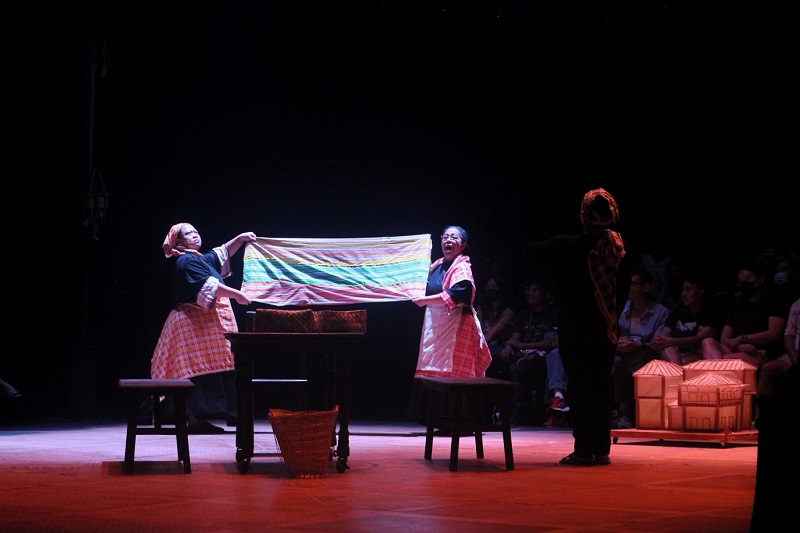
Wearing the tapis and necklace and praying to Lakambini on race day, she confirms the route is heading toward Sawing Palad, the narrowest street in town. Confused about the choice, the proud Pietrado even assures everyone that he will win the race, mocking Rosa for her leg not fitting through the narrow street. Rosa then takes 15 extra steps. Despite her ambivalence, the Katao exclaimed in jest: “Win for us, Rosa.”
Despite attempts to cheat during the race, Pietrado could not overtake Rosa because her entire body filled the narrow street. In the end, Rosa defeated Pietrado (Fig. 4).
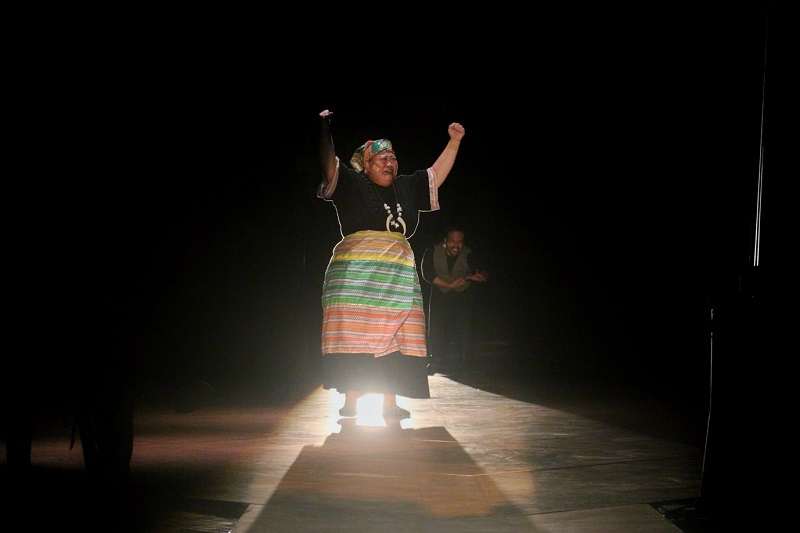
The Governor General reluctantly hands Rosa a gold medal and a pouch of valuable gold coins. Seeing her parents standing proud, she faces the Governor General and remarks, “I wish to buy our freedom,” returning most of the gold coins she has received. At first, the Governor General is hesitant but later relents because his wife reminds him of punto de honor (literally point of honor but figuratively honoring defeat). Then, Andreia hands over a letter that Rosa reads aloud.
| ROSA: | From this day onwards. . . Alejandro Baltran Alessio Du Verada Y Ramirez. . . is giving Rosa and her family the freedom from being enslaved to the Governor General of the Lupang Hinirang. The family may no longer be owned or enslaved by any Ispancialo. |
The Rosas then tell the audience that the small gold coin she took from the pouch was used to open Mama Rosa, and the savings from the local business were spent on buying her fellow Katao’s freedom, especially those from her hometown. Years later, Ispancialo left the Lupang Hinirang and granted the Katao the freedom they wanted. Rosang Taba’s story is now less known by many. However, the Rosas always make sure that their great-great-great-grandmother is honored and remembered, even through small gestures like the extravaganza they perform every day.
As the lights fade, Mama Rosa’s marquee stays lit on stage. The audience is pulled back to the present. Gradually, the marquee dims, but the phrase “Mama Rosa” remains illuminated for a while before the stage is finally plunged into complete darkness, leading to the curtain call and the final bows. This concluding moment of the play reminds the audience of their witness to Rosa’s triumph and joy. It signifies that the past is still present (represented by the word Rosa) – an absent presence (symbolized by the darkness) that influences the future (shown by the joyful bows). Ultimately, the play uses Rosa as a symbol of remembrance and mythmaking to explore a postcolonial Philippine society.
Mythmaking: Allegorizing Cultural Memory
After every performance, a talk-back session took place. In many cases, the directors, their dramaturgs, and the actors would return to the stage to answer questions from the audience. In every discussion, one or two students would always comment that they appreciated the staging of Rosang Taba because it was an effective way to tell the story of the Philippines. One student remarked that everyone must acknowledge and honor Rosa for her bravery and sacrifice to secure independence from the colonial powers, as if Rosa were a real person.
This irony of invoking cultural memory in the story of Rosa is a playful way of blending myth and theatricality, ensuring an authentic cultural memory experience for the audience. Sally Ann Ness notes that authenticity should not be defined as the recognition of something that appears reliable, trustworthy, and accepted, but as a test of identity that is always shifting. Additionally, if we use the standard definition of the term, then it is impossible to consider the play’s historical accuracy as truly authentic. However, the artistic and production team members are not historians, nor do they claim to be one. The creative team behind Rosang Taba crafted a performance, an interpretation of a text that is not even a historical document. Still, Rosang Taba succeeds in conveying essential values to the audience, especially to younger viewers: a sense of pride in place and people, whether historical or mythical.
Katherine Johnson has expressed regret about the hostility between historians and performance-makers, especially when the latter produce historical performances like reenactments. The importance of historical accuracy, as demonstrated in Rosang Taba’s performance, is a key reason for this ambivalence. Despite the tension, Johnson argues that these performances are valuable because they provide alternative educational resources for the public. She stresses that historical documents alone can never fully capture a community’s cultural memory. The act of remembering, enacted through reenactments, is also an essential part of cultural memory. Johnson notes that these performances are a playful way to engage with history and should not be taken literally but as symbolic, since they are “an imaginative evocation rather than a claimed [literal] imitation of the past” (45).
Cultural memory was not the play’s main goal. However, it is a key principle that helps explain its symbolic gestures. With this in mind, historical accuracy was not the primary focus of the play. What matters is creating a historical narrative that resonates with the history many audience members recognize. This narrative creation can be seen as an overflow, excess, or exaggeration, which can be viewed positively in many ways. The issue arises from its connection to revising history to benefit a few, such as political elites. This “overflow” is related to concerns about the spread of misinformation.
In the case of Rosang Taba, the overflow seems necessary because it functions as a form of strategic essentialism, where marginalized communities define themselves to assert their identity against oppressive others and come together for political reasons. This framework helps clarify the mythologizing aspect of the play, which also reflects the colonial experience familiar to the audience. This, in turn, encourages the audience to adopt a collective identity based on shared struggles (Spivak).
Kirsten Hastrup explains the practice of overflow or excess in performance as a form of mythmaking: “Myth and history are equally true renderings of the past; they differ mainly in their being two distinct modes of representation. Myth is an allegorical representation of the past, whereas history is perceived as literal [. . .] We have repressed the knowledge that metaphors induce action and thus are history” (139). Myths are narratives with some factual origins. They are more than just stories because they play a significant role in communities. Seen as events from the past, myths influence the present, and many are projected into the future.
From Mythmaking to Postcolonial Dramaturgy
Kuang-Hsing Chen encourages scholars in cultural studies from postcolonial and/or post-imperial Asian states to pursue de-imperialization by reexamining their histories of empire-building and the global negative effects these histories have had. This approach promotes placing Asian history, politics, and culture at the center of knowledge creation. Chen also urges ending dependence on the West as a benchmark and advocates engaging with multiple perspectives in knowledge production. He stresses a decolonized effort focused on a cultural imaginary that aims to develop counterhegemonic movements against dominant colonial powers. For Chen, disciplines within Asian cultural studies are crucial for challenging the hegemonic foundations of colonialism in knowledge production and for developing new theoretical frameworks.
In relation to Chen’s argument, the postcolonial history of the Philippines is not defined by a single moment of liberation but by a historical parchment where new layers of foreign influence were written over but never fully erased, leaving an indigenous foundation. Unlike many nations in the East Asian region that transitioned from a single colonial ruler to independence, the Philippine Republic came from a unique succession of Spanish theocratic feudalism, American democratic imperialism, and Japanese occupation. This complex colonial order, which eventually transformed into cultural heritage, created a state characterized by institutional hybridity, in which Western democratic systems were grafted onto deeply rooted Hispanic social hierarchies. As a result, the Philippine postcolonial experience is marked by a persistent tension between formal sovereignty and a “neocolonial” reality that maintained Western economic and military dominance well into the late 20th century, as expounded by many Filipinologists such as Stephen Shalom, Floro Quibuyen, E. San Juan, Jr. and Neferti Tadiar.
In this regard, Philippine theatre has functioned as more than a cultural pastime; it has served as a liminal space where the “ghosts” of three colonial powers are often summoned, interrogated, and dismantled. Doreen Fernandez and Sir Anril Tiatco note that theatre in the Philippines addresses the urgent call of the time – the social issues that haunt the baggage of colonialism – repression and oppression. Additionally, Fernandez and Tiatco agree that since the Philippine postcolonial condition is characterized by a complex layer of imperial legacies, its theatre has become a vital tool for reclaiming the indigenous voice and staging a critique of the neocolonial structures that persisted long after the failed Philippine revolution at the turn of the 20th century, leading up to the end of World War II in 1946, when colonizers and imperialist authorities finally left the Philippine islands.
Rosang Taba employs a postcolonial critique creatively to recover the lost grandeur of the past caused by colonial structures. Rosang Taba also uses a strategy to affirm multiple forms of cultural identities, especially those of marginalized and subaltern groups, not just intellectually but also emotionally.
The Rosas are women narrators who annotate and comment on the events surrounding Rosa’s challenge to the so-called “unchallengeable.” These narrators’ perspectives are also refreshing, as if there is a reversal of hierarchical roles in the binary between men and women. Often, annotations and commentaries about women in history are sidelined and footnoted. In the Philippines, for example, women’s roles as caregivers during the revolution are emphasized more than their actual battlefield contributions.
In the play, the woman fights for her life and homeland. Rosa receives severe blows from Pietrado during the race (Fig. 5). She is kicked from behind, bruised, and physically tormented. Despite the physical pain, she insists on continuing with the race, and the audience witnesses her struggles. The narrators want the audience to see them as sacrifices. Additionally, the Rosas want the audience to see that the male body has become fragile. They aim for the audience to realize that men are also weak. Through this, the Rosas seem to reveal a harsh truth: machismo is just a facade hiding the vulnerability of the male body. The story of the women who fought for the motherland in our history is being reclaimed. The archives documented that women fought side by side with men during the Philippine Revolution, yet we only celebrated the heroism of the male Katipuneros (the Revolutionaries). In the end, Rosang Taba joins the effort to recover herstory instead of the dominant narrative of history.
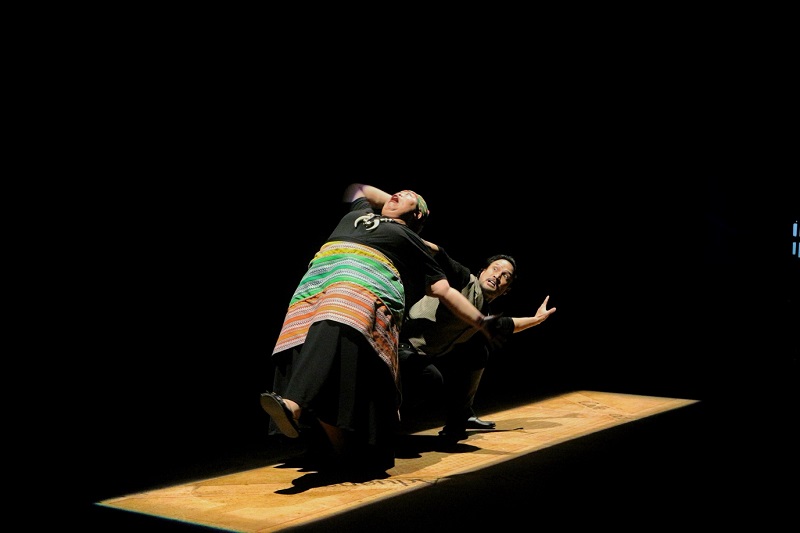
Rosang Taba also highlights stories of ordinary people. Our history typically emphasizes the narratives of the ilustrados (middle class), the intelligentsia (educated class), and the cacique elite members of Philippine society. During the colonial era, knowledge of the world was based on a Western colonial framework. These intellectuals were trained in Europe. With Rosang Taba, Indigenous Knowledge Systems and Practices (IKSP) are brought to the forefront. The play advocates for the validity of these epistemological systems.
Francis Adyanga Akena explains that IKSP is a complex system that “embraces the essence of ancestral knowing as well as the legacies of diverse histories and cultures. It essentially represents speaking back to the production, categorization, and position of cultures, identities, and histories” (601). During colonization, this form of knowledge was branded as inferior, superstitious, and backward, to the point of eradicating the entire system, convincing the natives that these were the devil’s workings, as Filipinologist John Phelan explained. However, IKSP is crucial because it involves understanding the world through its natural or environmental context, including the cycle of time. In other words, Rosang Taba responds to the colonizers: we are not idiots; our knowledge systems and practices are just as valid and legitimate as yours.
Finally, Rosang Taba also highlights the often ostracized and ridiculed fat woman. Fat people, especially obese women, face both hyper-visibility and hyper-invisibility. They are hyper-visible because they attract excessive ridicule and name-calling, often being compared to large objects, as if they are non-human. Simultaneously, they are hyper-invisible because their needs are ignored or dismissed. In this context, these individuals are what Jeanine Gailey describes as the hyper(in)visible persons, who are “sometimes paid exceptional attention and [are] sometimes exceptionally overlooked, and it can happen simultaneously,” fostering fatphobia (7). Rosang Taba examines both the internal struggles related to fatness and the external pressures placed on fat people to conform to the idea that being fat is a personal failing stemming from a lack of self-control. This focus on individual blame fuelshatred, internalized oppression, and justified bullying.
The play does not end in this exposé. Midway through the play, Rosa recalls how she was bullied when she was younger:
| ROSA: | You pig! Rosa, the pig! The whale! The elephant! The carabao! Yes, the ugly buffalo! Yes, the elephant! Yes, the whale! And so what? I don’t care – I am the best cook in town, and I am Rosang Taba; I have a big heart! |
These pains and traumas served as a way for her to find strength and respond to criticism that extends beyond issues of weight and body image. She faces bullying because colonizers ingrained in people’s minds that she belongs to a group considered inferior. As previously mentioned, this is not just because she is fat, but also because she is a woman, a Katao, a member of an indigenous community, and the daughter of a maid and a farmer. In this context, the audience is invited not only to bear witness to these oppressions but also to morally support Rosa in replying: “I am Rosang Taba, a fat woman, a member of the indigenous Katao, a citizen of the Lupang Hinirang, a daughter of a maid and a farmer, and I will beat you in this race.” Rosa, by forcefully embracing her otherness, accepted this strangeness not just in her mind but also in her heart.
Postcolonial Positioning of the Rosang Taba’s Dramaturgy
Rosang Taba aims to bring history to life. In this context, it acts as a form of public history: the depiction of Rosang Taba’s world suggests that historical documents alone can sometimes fall short of capturing a community’s collective memory. The act of remembering, conveyed through the musical extravaganza, is also crucial in building cultural memory. Diana Taylor points out that performance is ‘[history] based on memory, rather than just documents. These alternative histories are always enlightening [because] embodied practices always surpass the limits of written knowledge because it cannot be contained in documents or archives” (92). Somehow, this performance resonates with what Tiatco exclaims, “the body remembers what the archives failed to record” (“Celebration and Remembrance” 290).
This approach to bringing history to life portrays Rosang Taba as a symbol of both survival and loss. She strives for human continuity, justice, and shaping the future. As noted in the souvenir program, the dramaturgical team suggests viewing Rosang Taba as an analogy for Philippine history, particularly during the late 19th-century Hispanic colonial period. The pursuit of human continuity reflects the Katao’s desire to be recognized as human. The play also aims to recover indigenous knowledge systems, especially those erased during colonial times. That’s why Rosa kept the archives alive, strategically reopening them to address her parents’ doubts about her abilities as a Katao.
These were not solely based on children’s storybook material. The rehearsal process reflected the same dramaturgy that seeks to dismantle inequalities by first acknowledging that our understanding of knowledge is heavily biased toward literary and often colonial standards. In the colonial hierarchy, indigenous performance traditions are often marginalized as mere folk art or raw material, rather than being recognized as complex intellectual systems.
In developing the different sections and moments of the play, the artistic team approached it from a perspective that affirms diverse ways of knowing and being. Even the differences in cultural positions, roots, and heritage—such as those of the director and the designers—are like the many islands of an archipelago. These differences interact by being observed, challenged, transformed, and reconciled within this reimagining of an alternative history of the Philippines. Here, postcolonial dramaturgy goes beyond just inclusive casting and multidisciplinary expertise; it has become a rigorous and active inquiry into how a performance is created and understood.
Finally, when Rosa was reminding her father about the necklace, she was referring to the flora, fauna, and other natural resources of the motherland (Lupang Hinirang, symbolizing the Philippines) that were exploited by the colonizers (the Ispancialos, but the Spaniards overall). When Rosa reminded her mother about how the tapis was woven, she referenced the beautiful traditions of the people that the colonizers labeled as paganistic. However, Rosa’s mention of the intricate weaving and the incorporation of natural resources into the cultural product signified the presence of a strong civilization on the Lupang Hinirang before the arrival of the colonizers.
The invocation of Lakambini emphasized the colonizers’ neglect of the IKSP of the Lupang Hinirang (Fig. 6). The United Nations defines IKSP as the understandings, skills, and philosophies developed by societies with long histories of interaction with their natural environment. For Indigenous peoples, IKSP guides decision-making on fundamental aspects of daily life. This knowledge is part of a cultural system that includes language, classification systems, resource-use practices, social interactions, rituals, and spirituality. The retelling of Lakambini reminded the audience that these unique ways of knowing are essential components of the world’s cultural diversity, and these knowledge systems serve as foundations for locally appropriate sustainable development.
This sentiment extends to recognizing the sovereignty of the very land that gave birth to their people, with their own unique ways of understanding sovereignty. While this land may be under the occupation of a single Ispancialo regime, Rosa acknowledges the archipelagic significance of carrying the future. Lupa of Lupang Hinirang means soil or land, and it is in this soil that many have been born. Through cycles of reaping and sowing, many have had their own stake in how the land should be tilled. Rosa reminds audiences that through the retelling of scenes, it is not only the story of Madawag or Lakamibini that defines her, but rather the recognition of both roots. Of not shunning one in favor of the other in the name of overcoming a colonial regime. To truly remember.
Interestingly, Lupang Hinirang is also the official title of the National Anthem of the Republic of the Philippines, which functions as a quintessential postcolonial text—a musical “palimpsest” that captures the nation’s violent shift from Spanish theocracy to American democratic imperialism. Ethnomusicologist Nikki Anne-Castro explores how, while often sung as a routine expression of patriotism, the anthem is also a site of ongoing tension between Western musical modernity and a sovereign indigenous spirit. Philippine National Artist and Ethnomusicologist Ramon Santos comments that the anthem seems to suggest that the Philippines is set to enter modernity, proving it could wield the sophisticated musical tools of the West. Nonetheless, this European shell in the anthem is inhabited by an indigenous psyche that reclaims the melody through its lyrical evolution. While the notes may echo Spain’s Marseillaise or the Marcha Real, “Lupang Hinirang” is found in its transition to the Tagalog vernacular, where the “beloved land,” the literal translation of Lupang Hinirang, is no longer a colonial outpost but a sacred space of ancestral defiance. It is, ultimately, a sonic act of mimicry as resistance, using a foreign cadence to carry a distinctly Filipino vow of self-determination.
This tension is also imagined dramaturgically in the play: how it navigates between Hispanic cultural modernity and a sovereign indigenous soul. In the play, Rosang Taba is a burning fervor in hope that the motherland will never be under any oppressive power – di pasisiil (will not surrender). The Rosas, on the other hand,are working to secure the future of their homeland – the Lupang Hinirang. They are strategically calling on the recovery of their indigenous and glorious pasts to challenge the colonial prejudices imposed on them. This approach is a form of essentialism that affirms a political identity with a clear, direct link to history. In essence, it is a utopian vision of a bright future where the influence of foreign colonizers is reversed. Additionally, Rosang Taba, by inviting the audience to testify as witnesses, is somewhat obligating them to see that justice is not just an abstract idea but a value because “it exists in relation to a person, and it is something done by a person for another. […] Injustice is condemned not because a law is broken but because another person was hurt” (Heschel 2).
Rosa faced injustice from a young age. She was called Rosang Taba because she was overweight, considered ugly, and even disgusting. She was ostracized because she was poor: the daughter of a maid and a farmer. However, Rosa’s situation reflected the inhumane conditions experienced by every Filipino during the colonial period. The colonized—the Filipino people—were called indios, or the uncivilized, or the uneducated. Filipinos were treated inhumanely because they did not speak the language of the colonizers. In the play, Rosa embraces her fatness, being a criada, and being a Katao to her advantage. As she told her parents, winning the race would vindicate her and her family. Winning the race would mean being recognized as “free citizens of Lupang Hinirang.”
Concluding Reflections
In colonial discourse, the native body was often portrayed as either savage or weak to justify foreign rule. Rosang Taba is a double subversion: she is both a colonized subject and a woman whose body (being a fat person) defies Western aesthetic standards. By winning the race, she reclaims the Filipino body from the colonial gaze, proving that indigenous foundations are not inferior, but possess a different kind of strength and resilience.
The race is not won through sheer physical speed, but through wit. The Spanish Ensign represents the imperial past—arrogant, rigid, and reliant on brute force. Rosa’s victory mirrors the postcolonial strategy of mimicry and subversion. She plays the colonizer’s game (the race) but wins by changing the logic of the contest. This reflects how Filipinos have historically navigated “Western systems” to find loopholes for liberation.
As a theatrical piece, the use of an imaginary and bastardized Hispanic language and local humor serves as a postcolonial strategy. By centering the narrative on a protagonist who speaks from the margins (i.e., subaltern), the play critiques the Hispanic institutional legacy, that prioritized the Spanish language and elite status. It centers indigenous culture as the true source and foundation of national pride.
Ultimately, Rosang Taba is a series of exaggerated allegories about the Philippines’ colonial history. These are myth-like stories presented as metaphorical versions of history. They provide creative ways to claim an identity that was denied to a Filipino figure, just as Rosa was denied her embodiment as a Katao. Rosang Taba, therefore, serves as a political symbol that helps unify the Filipino people as a postcolonial community. Rosa represents the past that influences the present and is aimed at a hopeful future. She is the cultural icon that connects Filipinos as a community rooted in shared ancestry and stories.
The race itself can be seen as the Philippines’ struggle for sovereignty. Just as the Philippine Republic did not emerge as a clear break, but as a long, arduous negotiation – a series of revolutions, meetings leading to signing of treatises – Rosa’s race is a grueling symbolic battle for dignity. Her win is not just a personal victory; it is a collective triumph for her community, signaling that the colonized can outlast and outsmart the colonizer. The play exists within a socio-political setup where the Spanish elite holds absolute power. Rosa’s defiance disrupts this hierarchy. It suggests that the centralizing authoritarianism of any ruler—whether a colonial governor or a modern dictator—can be dismantled by a grassroots movement that values local identity over imported modernity.
In essence, Rosang Taba is a postcolonial play because it refuses to be ashamed. As Rosa exclaims in the play, “What should I be ashamed for?” It takes the very traits the colonizer mocked (the native’s appearance and status) and turns them into the tools of liberation.
Acknowledgement: The authors acknowledge the Office of the Chancellor of the University of the Philippines Diliman, through the Office of the Vice Chancellor for Research and Development, for funding support through the Outright Research Grant (262616 ORG).
Endnote
[1] The playscript by Maynard Manansala and Rody Vera was written in Filipino and an invented language called Ispancialo, which is a bastardized version of Spanish. Translations into English are by the authors unless otherwise specified.
Bibliography
Akena, Francis Adyanga. “Critical Analysis of the Production of Western Knowledge and Its Implications for Indigenous Knowledge and Decolonization.” Journal of Black Studies, vol. 43, no. 6, 2012, pp. 599–619.
Almario, Virgilio. “Katatapos Manood ng Kung Paano Nanalo sa Karera si Rosang Taba. Grabe ang Saya!” Facebook, 1 Apr. 2023.
Carey-Webb, Allen. “Transformative Voices.” Teaching and Testimony: Rigoberta Menchú and the North American Classroom, edited by Allen Carey-Webb and Stephen Benz, State University of New York Press, 1996, pp. 3–18.
Castro, Christi-Anne. Musical Renderings of the Philippine Nation. Oxford UP, 2011.
Chen, Kuan-Hsing. Asia as Method: Toward Deimperialization. Duke UP, 2010.
Fernandez, Doreen. Palabas: Essays on Philippine Theatre History. Ateneo de Manila UP, 1996.
Francisco, Gabi. “UNI Review: Dulaang UP’s ‘Kung Paano Nanalo sa Karera si Rosang Taba.’” Theater Fans Manila, 29 May 2023.
Goldman, Derek. “From Spectating to Witnessing: Performance in the Here and Now.” Arts and International Affairs, 17 July 2017.
Hastrup, Kirsten. A Passage to Anthropology: Between Experience and Theory. Routledge, 2013.
Heschel, Abraham J. The Prophets. Jewish Publication Society of America, 1962.
Ness, Sally Ann. Body, Movement, and Culture: Kinesthetic and Visual Symbolism in a Philippine Community. U of Pennsylvania P, 1992.
Phelan, John Leddy. The Hispanization of the Philippines: Spanish Aims and Filipino Responses, 1565–1700. U of Wisconsin P, 1959.
Quibuyen, Floro C. A Nation Aborted: Rizal, American Hegemony, and Nationalism. Ateneo de Manila UP, 1999.
San Juan, E., Jr. Beyond Postcolonial Theory. Palgrave Macmillan, 1998.
Santos, Ramon P. Modernismo sa Sining Musika. U of the Philippines P, 2018.
Scott, William Henry. Barangay: Sixteenth-Century Philippine Culture and Society. Ateneo de Manila UP, 1994.
Shalom, Stephen Rosskamm. The United States and the Philippines: A Study of Neocolonialism. Institute for the Study of Human Issues, 1981.
Simon, Roger, and Claudia Eppert. “Remembering Obligation: Pedagogy and the Witnessing of Testimony of Historical Trauma.” Canadian Journal of Education, vol. 22, no. 2, 1997, pp. 175–91.
Sorilla IV, Franz. “Children’s Book-Turned-Stage Play ‘Rosang Taba’ of Dulaang UP Defies Stereotypes and Historical Amnesia.” Tatler Asia, 26 Apr. 2023.
Spivak, Gayatri Chakravorty. “Can the Subaltern Speak?” Marxism and the Interpretation of Culture, edited by Cary Nelson and Lawrence Grossberg, Macmillan, 1998, pp. 271–313.
Tadiar, Neferti X. M. Things Fall Away: Philippine Historical Experience and the Makings of Globalization. Duke UP, 2009.
Taylor, Diana. “Performance and Intangible Cultural Heritage.” The Cambridge Companion to Performance Studies, edited by Tracy C. Davis, Cambridge UP, 2008, pp. 91–104.
Tiatco, Sir Anril P. Buhol-Buhol/Entanglement: Contemporary Theatre in Metropolitan Manila. Peter Lang, 2017.
———. “Celebration and Remembrance in Kalibo’s Ati-Atihan: Mythmaking, Devotion, and Cultural Memory.” Asian Theatre Journal, vol. 42, no. 2, 2024, pp. 269–95.
Tompkins, Joanne. Theatre’s Heterotopias: Performance and the Cultural Politics of Space. Palgrave Macmillan, 2014.

*S Anril Tiatco is a full professor at the University of the Philippines Diliman Department of Speech Communication and Theatre Arts. A practicing dramaturg, he frequently collaborates with Filipino theatre makers José Estrella and Jem Javier. As a scholar, he has published extensively in various academic journals, including Critical Stages, Asian Theatre Journal, Modern Drama, and Contemporary Theatre Review (CTR). Currently, he serves as the editor of CTR. He was the dramaturg for Kung Paano Nanalo ng Karera si Rosang Taba.

**Jonas Gabriel M. Garcia is a faculty member at the University of the Philippines Diliman in the Department of Speech Communication and Theatre Arts. As a theatre-maker, he practices dramaturgy and has served as a dramaturg for Dulaang UP, the Cultural Center of the Philippines Virgin Labfest, The Sandbox Collective, and others. He is currently completing his graduate studies in Theatre Arts at the University of the Philippines Diliman. Garcia was co-dramaturg for Kung Paano Nanalo sa Karera si Rosang Taba.
Copyright © 2026 S Anril P. Tiatco and Jonas Gabriel Garcia
Critical Stages/Scènes critiques, #33, June 2026
e-ISSN: 2409-7411

This work is licensed under the
Creative Commons Attribution International License CC BY-NC-ND 4.0.
