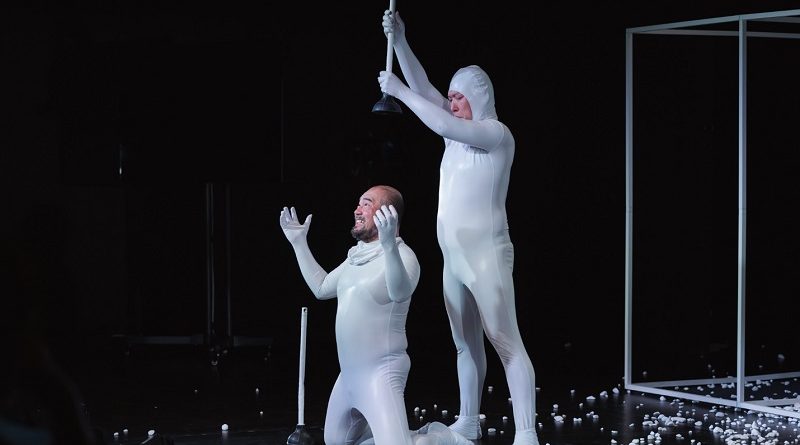
With Hamlet in the Stall—Is Shakespeare down the Drain?
Alexandra Dietz*
HAMLET / TOILET. Written and directed by Yu Murai. Hamlet: Takuro Takasaki. Ophelia, Claudius, Horatio: G.K. Masayuki. Patient, Laertes, Marcellus: Atsuyuki Tanaka. Music: TSUTCHIE (SHAKKAZOMBIE). Choreographer: Shinnosuke Motoyama. Video Designer and Operator: Takashi Kawasaki. Lighting Designer: Tsubasa Kamei. New York Premiere, January 10, 2024. Seen at Craiova International Shakespeare Festival, Romania, May 22, 2026.
To see or not to see the show that bears a title so unique, combining serious and fecal matter in an unforgettable swirl—in a setting where one would rather enjoy the peaceful privacy of his own solitude?
In a water-closeted space, in which the question becomes “To wipe or not to wipe?”, the Japanese show HAMLET / TOILET raises quite a few other questions that remain unanswered and perhaps should have remained unasked.
The second day of the Shakespeare International Festival in Craiova. Stranded in the first row of Yu Murai’s production, I stand, trapped as the soul of Hamlet’s father was in Claudius’s intestines for about an hour and a half of repetitive absurd humor, in which Schroedinger’s cat also gets entangled in the non-potty-trained young prince’s existential crisis.
One could describe the show of the Japanese director and playwright as an intertextual miracle, definitely not suited for the faint-hearted or the more conservative. Yu Murai’s Hamlet places the human soul in an unexpected, unimaginable and inconvenient place: one’s intestines. And as the soul struggled to be freed, causing major toilet troubles for the Danish royal family, part of the audience longed for freedom and rushed to the exit as quickly as they could.
Contemporary and yet timeless, the show explores life and death through the idea of the body’s temporality, highlighting it with a taboo topic for Western theatre, the physicality of the body itself. In Michael Ende’s famous novel The Neverending Story, the protagonist Bastian Balthazar Bux sincerely asks his teacher, if Jesus ever used the bathroom. So, what if Hamlet reflected on current affairs in a rather secluded space?
And while we are indoctrinated to distinguish what we consider sacred and tragic from the physical aspect of life, HAMLET / TOILET slaps sense into us in a very Rabelaisian way.
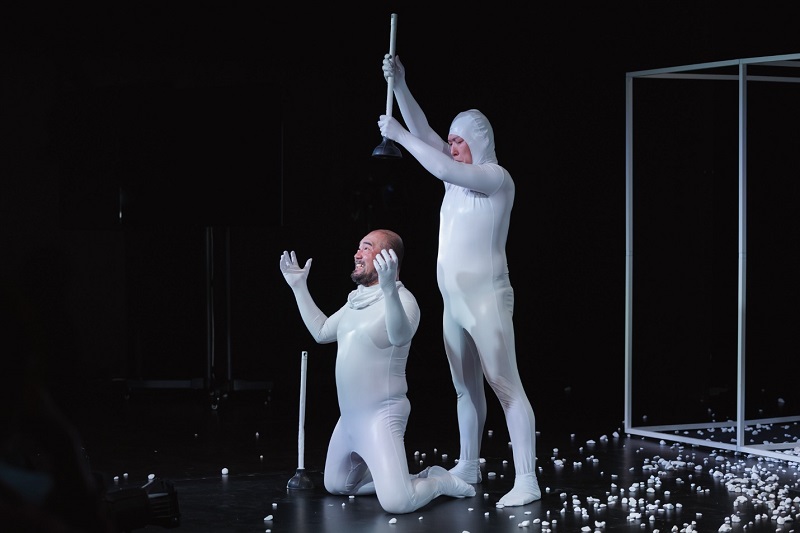
The show offers the audience the paradoxical nature of life retold by three middle-aged Japanese men, wearing extremely tight, almost see-through, rubbery-silky white costumes, fully revealing only their faces, and not-so-subtly revealing what prospects they have to offer.
The actors—Takuro Takasaki, G.K.Masayuki, Atsuyuki Tanaka—manage to deal with the rather unusual topic in an exceptional manner, concentrated and fully present, bringing their bodies into quite uncomfortable positions, playing with the tempo—delivering the repetitive dialogue faster and faster and faster.
In a minimalistic set, designed by Natsuko Takebe, with three cubicles resembling—you guessed it—toilet stalls, with the help of multimedia, the three men put their work into arranging their bodies as a modern work of art, like Marcel Duchamp’s Fountain. As Japanese potty culture rather differs from the European—providing immense comfort, ambient music and discretion during one’s stay, the loudness of a sound far from unpleasant brings to mind Aristophanes’ sense of comedy and humor.
Your chocolate is no longer chocolate, as things in life shift and transform. Here, in the stall, stands an old man, reflecting and pitying himself for never bringing his wife to the sea. Then, two young boys discuss whether flowers would bloom from your behind if you don’t wipe, as one of them frantically calls his mother for hygiene assistance.
All of this merged into the potty-adapted and fragmented plot, in which Ophelia is crowned with a creative hairdo, made of toilet rolls, with the help of the unconventional costume design of Akane Sato.
Masayuki handles the roles of both Claudius and the young maiden using his full capacity and beyond. Alongside Takuro Takasaki and Atsuyuki Tanaka, he makes the repetitive humor bearable and even funny. A never-imagined Mousetrap scene emerges in which Claudius reads Hamlet in the stall, with the other actors resembling a piece of hygienic furniture, plotting his killing with an invisible knife from behind…
There follows a confession scene in which Petrarch and Martin Luther get involved in the murderous conscience-stricken monologue of the fratricidal man. And as the guilty one shall throw the first stone, from a pipe above one’s head emerges a catastrophic hail of pebbles which pour and pour during one’s guilt-driven soliloquy.
And as western civilization holds Hamlet upon a sacred pedestal, and one could doubt and question—to see or not to see a show that bears a title so unique, driven by prejudice where the body and tragicality are separated for good… so Yu Murai’s HAMLET / TOILET stands as a creative, thought-provoking piece, that offers us an adaptation of a Shakespearean classic as never imagined before. It carries a great but also greatly tiresome sense of humor. And while one could argue that such an artistic choice is rather inappropriate, one thing is sure. It is never boring.

*Alexandra Dietz is a theatre critic and author with a particular interest in contemporary theatre, dramaturgy and the performing arts. She graduated in Theatre Studies and Theatre Management from the National Academy for Theatre and Film Arts in Sofia, Bulgaria, in 2026. Her work has been published in various Bulgarian cultural media outlets.
Copyright © 2026 Alexandra Dietz
Critical Stages/Scènes critiques, #33, June 2026
e-ISSN: 2409-7411

This work is licensed under the
Creative Commons Attribution International License CC BY-NC-ND 4.0.
